
The Bottle Calf Show

Bottle Calf1 Bottle Calf2The past Madison County Fair Queen, Sarah Al-Mazroa, was about to instruct me and three other judges on the 2014 Madison County Bottle Calf Show. For those of you that don’t know what a bottle calf show is, it’s really quite simple. The calves are generally 3-4 months old and were raised on a bottle. They are supposed to be halter broke. Most of them are twins whose mothers either abandoned them or couldn’t carry two calves. Some are orphans.

The kids displaying them are too young to show the calves’ fuller sized and year older counterparts. They generally range in age from 5 to 10. Prior to the show they submit answers to a variety of questions meant to demonstrate their knowledge about their calf and how they care for it.

“How did I wind up here anyway?” I asked Sarah.

“We made a list of those who would be best for it, none of them could make it, and eventually we got down to you.” This was as I expected.

“I’ve never really judged anything before,” I told her, “I wasn’t even on a judging team in college.”

“Well, you aren’t judging the calf; you’re judging the kid.”

Judging the kid, I thought. I could think of several ways to do that: spelling, their understanding of advanced mathematical concepts, their comprehension of comedic irony, but eventually I settled on the most obvious one: likeability.

“So we pick the kid we like the most then?” I asked. Sarah looked befuddled.

“No. You place them by how they do answering the questions.”

“What if I don’t like the kid?”

“It doesn’t matter.” I sensed she was getting frustrated.

We were to place the kids off of their aptitude. The concept felt outdated. Our education system had abandoned the idea some time ago.

“So for each class we pick first and last place then?”

“Ok, seriously? No.  We don’t pick the kid that comes in last. Who would do that? You place first, second, and third.”

Personally, I thought picking the last place kid was an excellent idea. Sure, first place is something to strive for, but let’s face it, most of us aren’t going to get there. Sooner or later we find the satisfaction of at least not being at the bottom. I would hate to deny any kid that, even if they are 5.

There were 50 calves to go through that afternoon, and soon the first class had assembled. The 4 of us judges were split into teams of 2. Our initial questioning was to be conducted outside the show ring. There we were to pick a couple questions each kid did particularly well on, parade them into the arena, stick a microphone in their face, and hope for the best. While our class was in the ring, the other team would be interviewing the next.

Just before we paraded ours out, I did a head count. We had 4 5 year olds. I grabbed the class sheet. Nearly all of them were in groups of 4. This wouldn’t do.

While it’s debatable how much of my math classes I remember, I do seem to recall three ribbons for 4 5 year olds equals a crying kid and 2 pissed off parents chewing my ass. I objected. As judges we reconvened. They all agreed avoiding a crying kid and an ass chewing were good ideas and decided we would only be awarding first and second.

The questions concerned the calf’s name and how it got it, its sex, how they got the calf, who helps them take care of it, if they had a funny story, if it has ever been sick, and what they learned during the project. We had the sheets they had submitted and were to make sure the kid had taken part in the answers.

3 of the 50 calves had a slight case of pneumonia at one time or another. I couldn’t spell pneumonia if you spotted me all the vowels and a couple of minutes. Their spelling was remarkable. One kid was moving right out with the handwriting you would expect from a 7 year old, but it suddenly broke off when he got to the pneumonia part. In its place, over the top of several remnants of partially erased letters, was printed neatly ‘pneumonia,’ and then the shaky writing of the 7 year old took up again.  I suspected his mother done it.  Either her or the Spelling Fairy.

One of his contemporaries, intent on doing things his own way, had obviously refused help from anyone.  When we got to question about the calf’s health, he simply remarked that his calf had been afflicted with “runny poop, but he got better.” He will make a fine veterinarian someday.

A 6 year old girl made a particular impression by recalling nearly word for word each answer on my sheet. That was until I looked down and saw her reading each answer word for word off my sheet. I was no longer impressed with her recollection. I did become impressed with her resourcefulness.

What every judge is looking for, however, is that one answer that will produce the viral video on YouTube. I thought I had such an answer from Connor, about his calf, Sam.

“Tell me, Connor, how did you get Sam?”

“He kicked the kid that had him before me in the nuts.”

“I’m sorry. What did you say?”

“The kid that had Sam before me got kicked in the nuts by him. After that he didn’t want Sam anymore.”

Lights flashed, bells rang, and I thought to myself, winner, winner, chicken dinner. Victory was mine. Connor was about to become my golden ticket to the Today Show. I moseyed over to my partner partly to tell her the scenario, partly to gloat, and partly to ask that she have her phone ready.

“Do you think I can have him say that?” I asked. A rather disapproving look crossed her face.

“I think you can say he kicked the kid, but I don’t think I would have him say where he got kicked at.”

She was 17 years younger than me and in college. Someday I will have her maturity. Having not got it yet, however, I was disappointed. I told the kid we could mention the kick, but needn’t be so anatomically specific about where it landed. He was disappointed too. Our 15 minutes of fame ended before it ever got started. I have no doubt his mother was pleased.

I was left to quietly abide in the hope that a calf might still go berserk and drag its pint sized handler around the ring a couple of times. That is always good for a laugh or two, but this failed to materialize as well. The 2014 Madison County Bottle Calf Show turned out to be a mundane affair. Still there is always the hope for more fireworks next year. Fireworks, now there is an idea.

With any luck the kids learned someone could stick a microphone in their face and have them talk about what they do, and they would survive it. Some were shy, and it was hard for them. I was shy once too, but got over it. While none of them learned they could be knocked down, drug through the dirt, and survive, I’m not worried. That’s what the Des Moines Register is for.

As for me, I judged the kids quite enjoyable, and it seems my judging stint is not over. Adam Hill with Warren County Farm Bureau has invited me to their fair to judge their cook-off. I’m hoping for barbecue, but wouldn’t rule out a spiciest chili contest. At any rate, with two events under my belt, I won’t be a man without prospects. I have some hope of judging beets at the State Fair next year and eventually working my way up to pies. And perhaps, someday, I too will be able to spell ‘pneumonia.’

Across the Great Divide (A Comedy)

The following started as a bunch of thoughts revolving around in my mind. Their revolution is simply part of being human, and we all turn them, again and again, hoping to make some sense of them and to whittle away what isn’t important and to turn it down to what is. Sometimes, for each of us, a door opens, and we briefly peer into a room that has been beyond us. Why this happens, I don’t know, but it does. It happens to storytellers, husbands and wives, parents and children, and anyone else with a pulse.

For my own part, I would give twenty years of my life to stay in the place where that door is open forever, but it is not to be. The same flash of white hot lightning which opened it, closes it on the return stroke. Like a dream which explained everything and evaporates as we awake.

Left to abide in the hope that someday it will happen again, and that someday we will be present in it always.

A long time ago now was a family which I often likened to the Brady Bunch. In this family was never a quarrel between husband and wife or their children. It was this family I compared all others to.
One day I, visiting with a woman much brighter than I, I spoke of this family.
“How many families do you know like that?” she asked me.
I thought for a while and said, “Only them.”
“Well then, what does that tell you about the family your gauging normalcy by?”
She smiled. I smiled. A door had opened for me, and I tried with all I could to get my ass through before it closed. Conflict is normal.
I believe it changed my life, and will continue to do so as long as I live. I managed to get my shoulders through, but my ass got stuck, and so I alternate between my old life and the new one.
In her estimation, it was conflict that was normal. The thought that it wasn’t, was a sham. The time I spent thinking otherwise was wasted.
Throughout our history there have been people dedicated to finding peace here. I admire their efforts a great deal and respect their calling. But to find peace here they have had to remove themselves from the world. Some have done this physically in the form of communities and communes. Some have done it in their minds. For to remain here in both mind and ass, leaves us with conflict. Perhaps we should figure out what to do about it; perhaps there is no better use of our time.
I suppose it is around the age of eight or ten, when we first get some idea of the liberties that are available for the taking when we are in a different place than our parents. Raids on the candy in the cupboard or cookies in the freezer soon give way to increasingly wild expeditions beginning with the onset of sleep overs, driver licenses, finding love, and moving out on our own. At some point in our life a regression begins, our outings become less wild, and we again find simple satisfaction in the raids which once kept us content as children. For me they have regressed so much so that at thirty seven I am resigned to the simple liberty of writing a story while my parents are on vacation.
A few weeks ago a wicked little storm moved through the area, dumping a couple inches of rain in half an hour with a hard wind driving it. We lost power for a day, but damage was minimal. The neighboring town of Bevington wasn’t so fortunate. There, damage was what one would have expected from a small tornado, but no one knows if they saw one or not. As far as I know the tornado was never really sure whether Bevington, population of 70, was actually a town.
Within twenty minutes or so of its passing my mother came home from there, and I went over to get a damage report. At the end, she asked what I was about to do now.
“I was going to go over to the south pasture and see if any trees fell on the fences. Want to come along?”
“Well there is no power and nothing to do here,” she said. “Sure.”
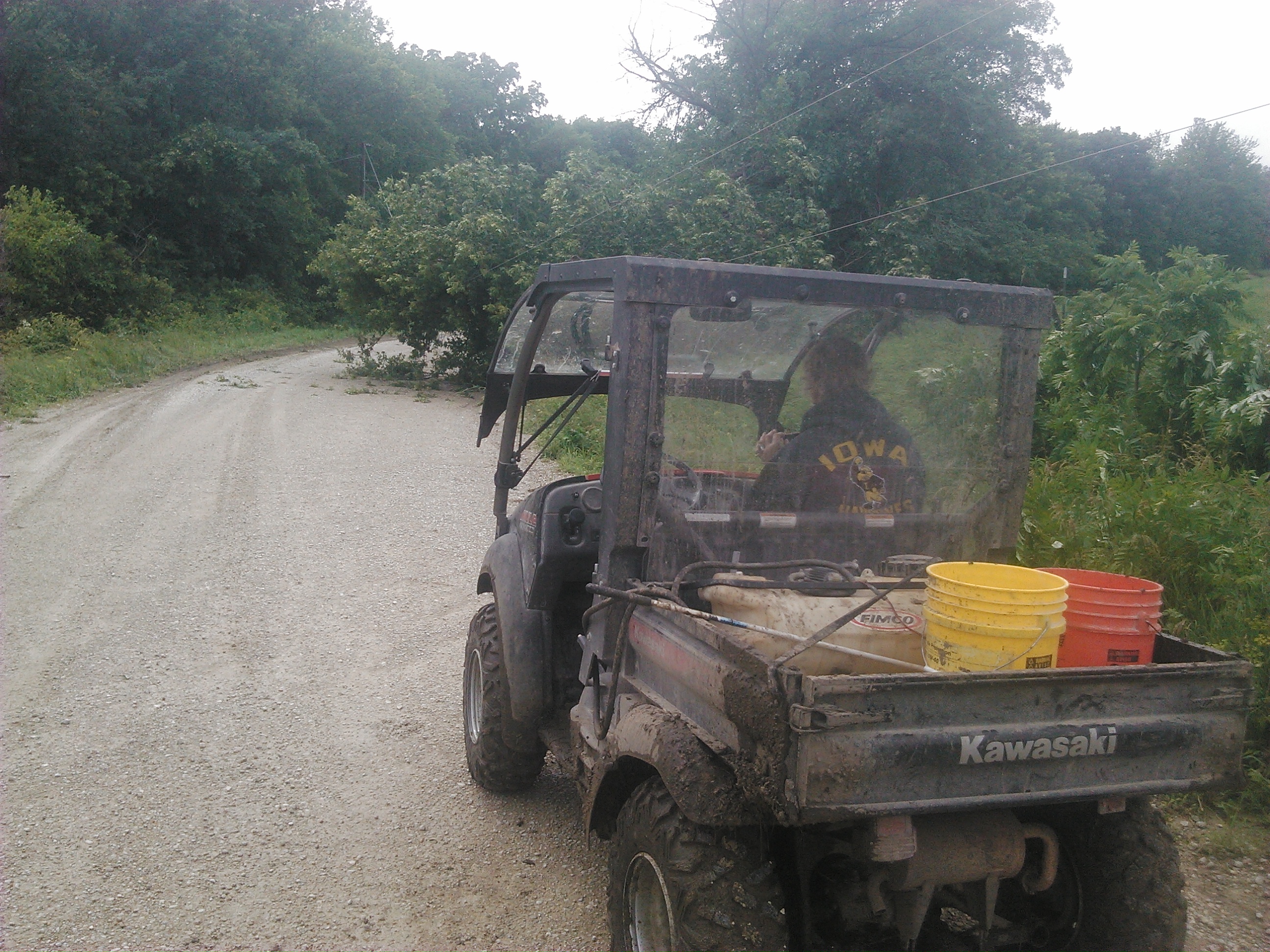
“Fine. I’ll go out and make sure there is gas in the Mule, then bring it around.” I rounded their house to her coming off the back deck in flip flops. Their sole was half an inch thick. The mud was three to four inches deep, but I kept this to myself.
The seat was a little dirty. She asked me if she needed to get a towel. “I think it will be all right,” I said. “Besides, your jeans have holes in them.”
“They are supposed to have holes in them; that’s how they are made.” Thus a conversation I always thought I might have with a child of my own someday, I ended up having with my mother. I kept this to myself too.
To get to the pasture we had to cross North River, and when we got to it, we found it already lying across the road ahead of us. My mother was expecting me to stop.
“You’re going through there?”
“Yes.”
“Do you think that is a good idea?”
“Probably.”
“How can you tell how deep it is?”
“By how far it gets up on the tires when we get there.”
Her hand reached up for the ‘oh shit handle’ welded onto the roll cage just above her. I left mine alone. I knew the Mule wouldn’t float, and had no desire to have a death grip on an oversized boat anchor. Besides, there is nothing more calming than seeing someone else get nervous before you do.
We crossed the river and rounded the corner. There a tree had taken the power line and stretched it as tight as a bow string. It had broken the pole off, but was unable to take it to the ground. Thus the line hung eight feet off the road, with most of the weight of the tree and all of the weight of the pole still on it.
“You are not going under that are you?”
“Yes.”
“Will we make it?”
“Probably.”
“How do you know?”
“We just did.” Emerson said, ‘In skating over thin ice, our safety is in our speed.’ The same is true with downed power lines.
Pulling the long hill out of the valley and stopping at the pasture gate, I got out to open it.
“We aren’t going in there are we?”
“Yes.”
“Well, I think the fence looks fine.”
The pasture is 240 acres, divided into 40 acre lots, and snakes its way back a mile and a half, through ditches, over ridges, and among numerous large oak. By my count there is over five miles of fence on it. From our vantage we could see not quite a third of it. Most of the third we saw at a distance of half a mile or better. I don’t want to doubt my mother, but I was envious of her eye sight. I kept this to myself too.
Most of the cows were in the forty the furthest back, and gingerly in the mud we made our way back to them.
“Are we going to get stuck? I’m not walking. I have flip flops on. We aren’t going to get stuck are we?”
“I haven’t got this stuck yet.”
I left the trail and drove along in the tall, un-grazed grass.
“How can you tell where we are going? I can’t see anything. Can you see what is ahead of us? Watch out for that big rock.”
The rock in question was not as big as a greyhound bus, but possibly larger than a Yugo. Obviously my own eye sight she was not envious of.
“I don’t think much of this excursion. We are not going to get stuck are we? I really don’t think much of this excursion. How much further are they? I don’t think much of this excursion.” The pauses between all of the sentences were removed by me, because it sounds the same all together as it did all spread out.
The final crossing had washed out, leaving a four foot gap where the culvert should have been. I continued along the ditch until I had climbed a steep, bare knob. Below we looked down on the silver and slippery ribbon that was a muddy pond dam, which was our only way back to the cows. On the pond side the storm water laid in a silent stillness, waiting its chance to roar on through the overflow pipe and be off again.
“You’re not going across that are you?”
“Yes,” I said.
“Can you tread water?”
“No. Why?”
“Well I was just wondering what you were going to do when we slid off into the pond.”
“Jump before we get there.” It would have been easier for me to jump. On my side was the long incline of the backside of the dam. My mother’s side was less forgiving. Had I jumped, I would have came back. My own mother had taught me that.
Once Mom and Dad left my sisters and I along the side of the road. When they came back and got us, we were all thankful. Had I jumped and left her, I doubt she would have had the same gratitude we did.
Finally we made it back to the 40 the cows were in.
“Will they come out when you open the gate?”
“No.”
“Are you sure?”
“Yes.”
As I stepped out to get the gate, Mom finally released her death grip of the ‘oh shit handle,’ only to look at her feet and utter, “shit.”
“Mud too,” I reassured her.
As it happened, no trees were down and all the cows were in. Leaving the back 40, after I closed the gate, my mother asked what we were going to do now.
“I’ll get you home,” I said.
“Don’t you have more cows in here?”
“Yes. This year there is twenty head of first calf heifers clear over on the other side.”
“We probably ought to go check them, don’t you think?”
Seems I had made a convert out of her.

Someday, I suppose, when we have completely regressed, we will gladly trade all the liberties we took in their absence for their presence once again. We will realize this as lightning opens its door once more, and we stand on the outside, looking in.

Two Soldiers and a Camp in Patterson

I often wonder how it is that as adults we are content to believe the most preposterous lies that even our children won’t take up. I was reminded of one just this week, having finished a beer, and waiting for the second half of a concert to begin at Des Moines’ Hoyt Sherman Place.

“You know if you are sitting out there in the audience, and you’ve never taken the time to travel across this great country of ours in a way that lets you appreciate the vastness of it, you really ought to. David and I are lucky in that we drive ourselves, and over the years we’ve crisscrossed this country so many times. I still haven’t loss my sense of awe at it all. The climates, the people, and the cultures are so varied, yet here we are, all in the same place,” so uttered Gillian Welch having taken the stage after intermission.

The comment brought lots of applause. Some was from a ghost fluttering around backstage somewhere. Hoyt, onto the side of his stately home this auditorium was built, was surely pleased with Gillian’s call for cross country travel. His famous brother, William Tecumseh Sherman, had the same idea some time ago. He went across Georgia, cutting a swath sixty miles wide.

I have no problem with the wonders of travel, only the subsequent smugness of those whom thought they already had.  What better way to appreciate its vastness than to realize its vastness is beyond our comprehension? Here lies the sense of awe. What more stands in the way of that than to believe one already has?

Every child understands that real places aren’t found on maps. As adults we become convinced of the opposite. The crap that wouldn’t fool a child fools us daily.

At the concert’s start, my father struck up a conversation with the couple ahead of us. He spoke with the wife first, whom had a sense of culture about her. When she mentioned Chicago, Dad naturally asked if that was where they were from.

“Oh goodness, no,” she said. “I’m from Fort Madison, and my husband is from just south of here, Madison County, where the bridges are. He’s from a little town you’ve probably never heard of. We live here in Des Moines.”

They were in their 70s, and if the wife possessed an air of graceful sophistication, her husband, short and thin, bespectacled, and with time having turned his shoulders and back slightly in, was an unassuming man and endearing. He turned and offered a smile as he was brought into the conversation.

“We’d be a little familiar with Madison County,” Dad replied. “We’re from there.”

“You don’t say?” said the man rather excitedly. “Where about?”

“A few miles north of Bevington.”

The smile grew larger, “I was once one of nine in a graduating class from Patterson.”

“Do the two of you come here often?” his wife asked.

“This year we have. It’s our third time. Most recently the two of us saw Lyle Lovett.”

The husband’s smile now gave way to a giddy laugh. “He’s my absolute favorite. I’ve seen him many times. The thing is he always has such good musicians with him, and he’s always such a gentleman on stage, both to the audience and to the band.” He almost seemed embarrassed that he had went on so to strangers, that he had momentarily left the map.

The lights went dim. Gillian and Dave came on, and as they brought their guitars into tune, our man from Patterson laid the backside of his hand on his wife’s knee and she laid her hand in his.

When intermission arrived I went to get a beer, and found the same couple ahead of me.

“So what do you know of where I grew up?” the old man asked.

“Well whenever I think of Patterson, I think of a story my Grandfather was said to have often told. His mother had a poor heart, and in 36’ it was so hot he was afraid the heat would kill her. They say there were 28 days where the high was never below 100. You couldn’t stand to sleep in the house, so they slept in the yard, but the ground would be so hot you’d have to let it cool off.  While they were waiting, he’d get her in their car and they would drive with the windows down, trying to relieve the stress.

There were still salesmen traveling through the area, and some moved from town to town putting on a show. One night there was a fellow in Patterson, so they drove to see him and beat the heat. When he came onto his impromptu stage he related to the crowd the following story:

Folks, I had the most God awful dream last night. I dreamt last night not only that I had died, my friends, but much worse than that. I dreamt I had died and went to Hell. There Lucifer gave me the job of shoveling folks into the fire. God I hated to do it, but he forced me to do it, and so I did.

The first group that came along was a group from right down the road here, in Martensdale. Oh I tell you…they were such nice people. But the Devil bade me to shovel them in, and so I did. And the next group, oh, they were closer still. They were from Bevington, and they were even nicer than the folks from Martensdale. I especially hated to throw them into the fire, but the Devil bade me once more, and I did. But ladies and gentlemen, little did I know that the worst of it was yet to come. Why the third group was a group from right here in Patterson. And they were just as nice as all of you. I cried. I begged, but the Devil spoke, ‘Shovel em in,” and with tears running down my cheeks I did.

But I’ll be damned if those folks from Patterson weren’t too green to burn.”

The husband had found his laugh once again, extended his hand, and told me his name.  “Last nam is ‘Camp,'” he said.  I told him mine.

“It was a real pleasure in meeting you.”

“Very much likewise,” said I.

The most famous story of Patterson, that of Jesse Russell Salsbury and his buddy from Illinois, Joseph Downs, we never got to. The pair met in the Iowa National Guard in 1917. Later that year, preparing to leave for France, they erected a flag pole in the Salsbury yard in Patterson. In the wet concrete they both inscribed their names, below which they wrote “Shot in France.” On May 27th, 1918 the pair was killed there in a gas attack on their trench.

In 1923, the town stood the slab on end and made a monument of it, and you could crisscross this country a thousand times and never see it once. The story is only a local one, and there are no signs directing you to it from nearby Highway 92.

I often thought someday, in an effort to raise funds, they will set another flag pole in the Salsbury front yard and raffle chances to leave an inscription on it. Were I to buy that winning ticket, I’d write, “Dan Hanrahan–Died peacefully in his sleep.” And then, when the crowd had left, but before the concrete dried, I’ll pull from my pocket a list of a few other names with manners of death much more exotic.

I stopped by it this evening, on my home from Creston. Beside the monument is a wreath that has nearly withered away. Above it is an enclosed case, detailing the story. Alongside the story are pinned a few photos, all bleached and faded beyond description. All but one. The lone picture that survives is of J. Russell Salsbury and his friend Downs. Wherever they are standing, it isn’t found on any map, and is as real now as it was then.

Time a Dreamin’

My mother went to an all-girls Catholic school in Des Moines. It was called St. Joseph’s. How St. Joseph made his way into an all-girls Catholic school, I don’t know. I’m sure area boys were jealous of him.   It is unlikely any of them were saints.

She once told me that when she was young a nun had asked them if any of them knew why time went faster as we got older. No one offered any guesses. My bet is that they weren’t old enough to notice yet. It was no matter, their teacher had, and they were going to have to hear about it anyway. This is the process we refer to as education.

“Time goes faster as we get older, because every year a single year becomes less and less significant. When you are five a year represents 20% of your life, but when you are 40 it is but a fraction of it.” The nun was obviously 70 and depressed. She kept a calendar on the wall, not for the dates on it, but rather for the breeze generated as they passed by.

It could have been worse, of course. St. Joseph was well beyond 70 and approaching 2000. Ordinarily he would have been pleased to have had a girls school named after him, but he sneezed and missed it entirely. By the time God said, “I bless you,” it had merged with the boys at Dowling.

My mother related this story to me when I was young, and it sat unchallenged in some recess of my mind for many years. That is until one day when I heard a man describe his 40 year marriage as having only been like five minutes. After a brief pause he simply added, “under water.” It seems he and the nun had a different perspective. Hers had been heavenly, the husband’s something lower. It would appear for him that life was taking forever. Perhaps it was the Devil’s sister he was married to. Either that or he was simply a wise ass, and life was taking forever for her.

It wouldn’t surprise me if he had met her when he was 12, and she was attending an all-girls Catholic school. Perhaps the real lesson of life is to be found there, for it’s the only thing that suggests how we ought to be spending our time, regardless of how fast it moves. We should spend it in pursuit of the dreams we have.

Yes, it’s true: our dreams will never go how we thought they would. They are always going to cost more, pay less, take longer, last shorter than we ever imagined. To pursue a dream is to kill it in a way. But it’s only in pursuing it, it’s only in this killing, that our dreams ever truly live.

Some might think it macabre, this talk of killing a dream, but think of life, think of us, think of those times that we made all the right pursuits only to be left disillusioned when the dream was more expensive, or yielded less, or took longer, or lasted shorter than we thought it should. We took every step except the one that mattered most: letting it be what it is. Instead the dream was traded for the fantasy of what it was supposed to be but wasn’t.

If you are a 12 year old boy, there’s hardly a better dream to have than a cute brunette at an all-girls Catholic school. In fact I would suggest a cute brunette is a damn good dream any old time. It is worth pursuing, and it is worth letting it be what it is.

We tell our kids they should dream, as though that will make them creative, but the fact is it won’t. They could dream the same dream their whole lives, but in order to create something, in order to give it life, they will eventually have to pursue it. Even if in its pursuit life seemingly takes forever, chances are they will love every minute of it. She might too.