The following started as a bunch of thoughts revolving around in my mind. Their revolution is simply part of being human, and we all turn them, again and again, hoping to make some sense of them and to whittle away what isn’t important and to turn it down to what is. Sometimes, for each of us, a door opens, and we briefly peer into a room that has been beyond us. Why this happens, I don’t know, but it does. It happens to storytellers, husbands and wives, parents and children, and anyone else with a pulse.
For my own part, I would give twenty years of my life to stay in the place where that door is open forever, but it is not to be. The same flash of white hot lightning which opened it, closes it on the return stroke. Like a dream which explained everything and evaporates as we awake.
Left to abide in the hope that someday it will happen again, and that someday we will be present in it always.
A long time ago now was a family which I often likened to the Brady Bunch. In this family was never a quarrel between husband and wife or their children. It was this family I compared all others to.
One day I, visiting with a woman much brighter than I, I spoke of this family.
“How many families do you know like that?” she asked me.
I thought for a while and said, “Only them.”
“Well then, what does that tell you about the family your gauging normalcy by?”
She smiled. I smiled. A door had opened for me, and I tried with all I could to get my ass through before it closed. Conflict is normal.
I believe it changed my life, and will continue to do so as long as I live. I managed to get my shoulders through, but my ass got stuck, and so I alternate between my old life and the new one.
In her estimation, it was conflict that was normal. The thought that it wasn’t, was a sham. The time I spent thinking otherwise was wasted.
Throughout our history there have been people dedicated to finding peace here. I admire their efforts a great deal and respect their calling. But to find peace here they have had to remove themselves from the world. Some have done this physically in the form of communities and communes. Some have done it in their minds. For to remain here in both mind and ass, leaves us with conflict. Perhaps we should figure out what to do about it; perhaps there is no better use of our time.
I suppose it is around the age of eight or ten, when we first get some idea of the liberties that are available for the taking when we are in a different place than our parents. Raids on the candy in the cupboard or cookies in the freezer soon give way to increasingly wild expeditions beginning with the onset of sleep overs, driver licenses, finding love, and moving out on our own. At some point in our life a regression begins, our outings become less wild, and we again find simple satisfaction in the raids which once kept us content as children. For me they have regressed so much so that at thirty seven I am resigned to the simple liberty of writing a story while my parents are on vacation.
A few weeks ago a wicked little storm moved through the area, dumping a couple inches of rain in half an hour with a hard wind driving it. We lost power for a day, but damage was minimal. The neighboring town of Bevington wasn’t so fortunate. There, damage was what one would have expected from a small tornado, but no one knows if they saw one or not. As far as I know the tornado was never really sure whether Bevington, population of 70, was actually a town.
Within twenty minutes or so of its passing my mother came home from there, and I went over to get a damage report. At the end, she asked what I was about to do now.
“I was going to go over to the south pasture and see if any trees fell on the fences. Want to come along?”
“Well there is no power and nothing to do here,” she said. “Sure.”
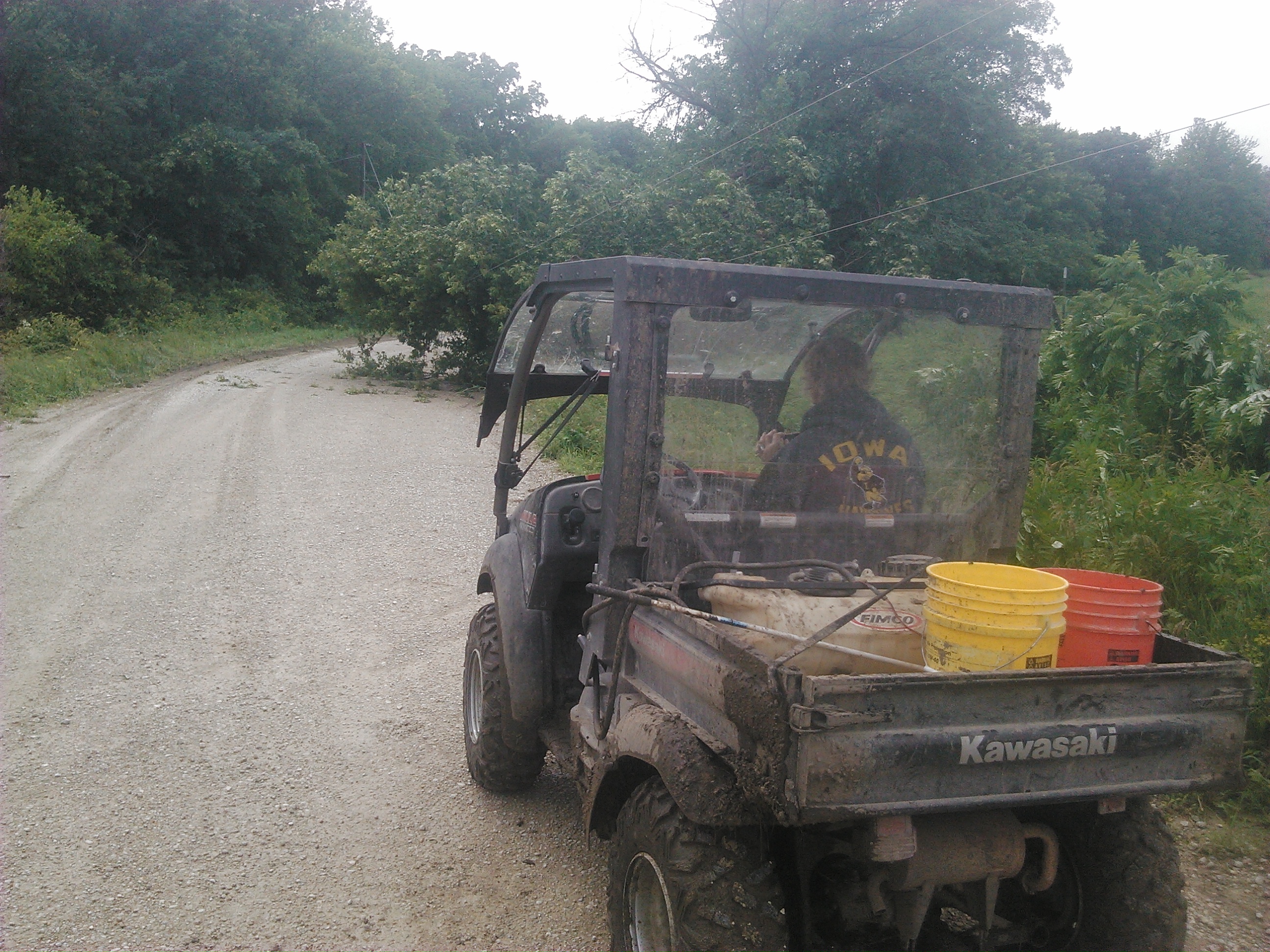
“Fine. I’ll go out and make sure there is gas in the Mule, then bring it around.” I rounded their house to her coming off the back deck in flip flops. Their sole was half an inch thick. The mud was three to four inches deep, but I kept this to myself.
The seat was a little dirty. She asked me if she needed to get a towel. “I think it will be all right,” I said. “Besides, your jeans have holes in them.”
“They are supposed to have holes in them; that’s how they are made.” Thus a conversation I always thought I might have with a child of my own someday, I ended up having with my mother. I kept this to myself too.
To get to the pasture we had to cross North River, and when we got to it, we found it already lying across the road ahead of us. My mother was expecting me to stop.
“You’re going through there?”
“Yes.”
“Do you think that is a good idea?”
“Probably.”
“How can you tell how deep it is?”
“By how far it gets up on the tires when we get there.”
Her hand reached up for the ‘oh shit handle’ welded onto the roll cage just above her. I left mine alone. I knew the Mule wouldn’t float, and had no desire to have a death grip on an oversized boat anchor. Besides, there is nothing more calming than seeing someone else get nervous before you do.
We crossed the river and rounded the corner. There a tree had taken the power line and stretched it as tight as a bow string. It had broken the pole off, but was unable to take it to the ground. Thus the line hung eight feet off the road, with most of the weight of the tree and all of the weight of the pole still on it.
“You are not going under that are you?”
“Yes.”
“Will we make it?”
“Probably.”
“How do you know?”
“We just did.” Emerson said, ‘In skating over thin ice, our safety is in our speed.’ The same is true with downed power lines.
Pulling the long hill out of the valley and stopping at the pasture gate, I got out to open it.
“We aren’t going in there are we?”
“Yes.”
“Well, I think the fence looks fine.”
The pasture is 240 acres, divided into 40 acre lots, and snakes its way back a mile and a half, through ditches, over ridges, and among numerous large oak. By my count there is over five miles of fence on it. From our vantage we could see not quite a third of it. Most of the third we saw at a distance of half a mile or better. I don’t want to doubt my mother, but I was envious of her eye sight. I kept this to myself too.
Most of the cows were in the forty the furthest back, and gingerly in the mud we made our way back to them.
“Are we going to get stuck? I’m not walking. I have flip flops on. We aren’t going to get stuck are we?”
“I haven’t got this stuck yet.”
I left the trail and drove along in the tall, un-grazed grass.
“How can you tell where we are going? I can’t see anything. Can you see what is ahead of us? Watch out for that big rock.”
The rock in question was not as big as a greyhound bus, but possibly larger than a Yugo. Obviously my own eye sight she was not envious of.
“I don’t think much of this excursion. We are not going to get stuck are we? I really don’t think much of this excursion. How much further are they? I don’t think much of this excursion.” The pauses between all of the sentences were removed by me, because it sounds the same all together as it did all spread out.
The final crossing had washed out, leaving a four foot gap where the culvert should have been. I continued along the ditch until I had climbed a steep, bare knob. Below we looked down on the silver and slippery ribbon that was a muddy pond dam, which was our only way back to the cows. On the pond side the storm water laid in a silent stillness, waiting its chance to roar on through the overflow pipe and be off again.
“You’re not going across that are you?”
“Yes,” I said.
“Can you tread water?”
“No. Why?”
“Well I was just wondering what you were going to do when we slid off into the pond.”
“Jump before we get there.” It would have been easier for me to jump. On my side was the long incline of the backside of the dam. My mother’s side was less forgiving. Had I jumped, I would have came back. My own mother had taught me that.
Once Mom and Dad left my sisters and I along the side of the road. When they came back and got us, we were all thankful. Had I jumped and left her, I doubt she would have had the same gratitude we did.
Finally we made it back to the 40 the cows were in.
“Will they come out when you open the gate?”
“No.”
“Are you sure?”
“Yes.”
As I stepped out to get the gate, Mom finally released her death grip of the ‘oh shit handle,’ only to look at her feet and utter, “shit.”
“Mud too,” I reassured her.
As it happened, no trees were down and all the cows were in. Leaving the back 40, after I closed the gate, my mother asked what we were going to do now.
“I’ll get you home,” I said.
“Don’t you have more cows in here?”
“Yes. This year there is twenty head of first calf heifers clear over on the other side.”
“We probably ought to go check them, don’t you think?”
Seems I had made a convert out of her.

Someday, I suppose, when we have completely regressed, we will gladly trade all the liberties we took in their absence for their presence once again. We will realize this as lightning opens its door once more, and we stand on the outside, looking in.
 True Stories and Tall Tales