IPF

Idiopathic pulmonary fibrosis, or IPF, is a progressive hardening of the lung. It is distinguished from other forms of pulmonary fibrosis in a few regards. It alone carries the name “idiopathic.” This means they aren’t sure what causes it, or, in other words, that they are ignorant. I know of no doctor whom spent the front third of their life and hundreds of thousands in tuition to be called ignorant. This is why they use the term “idiopathic.” It is Greek for “ignorant but educated.”

This would be similar to the American term “a genuine asshole.” While it concedes that the individual in question is an asshole, it gives us the assurance that at least they are sincere about it.

IPF also differs from the other forms in that it has very limited treatment options.  Historically there has been supplemental oxygen when needed and a double lung transplant when oxygen alone no longer cuts it. As of today there are two experimental drugs about to be brought before the FDA in an effort to slow the progression.

In a few cases IPF seems to have a genetic component. You use to be able to be part of a research study which would disclose whether or not you carried the gene or genes which were suspected. They don’t do this anymore. Some who carried the gene or genes never developed the illness. Some who didn’t, did. You can still be part of the research study, but you do it blind, and this hardly seems to be objectionable for a test that has trouble seeing anyway.

But what does it tell us anywyay?  Would it be a terrible surprise to learn that all of us, with our self-destructive tendencies, are carrying around self-destructive genes?

My father was diagnosed with IPF well over a year ago. Some patients don’t make it 6 months after a diagnosis, at which time they presumably find the answers to all the questions we spend our lives wondering at. Some make it many years. My father is doing well, has taken it in stride, remains active doing what he wants to do, needs no oxygen, and only battles a persistent cough. Every few months he goes in for a checkup, and I and my sister, Katie, accompanied him today.

Despite all kinds of variations, when you boil it down there really seems to be only two ways to deal with an illness: either you keep it to yourself or you talk about it. If we take the former, the risk seems to be that it will distance us from those we are close to. If we take the latter, the risk seems to be that it will let others up close and personal. Near as I can tell, one risk is as considerable as the other.

For his part, Dad chose the second and talks about things freely. I tend to be caught between the two.  I find humor works in a unique way to let us do both.  After a two hour car ride I was beginning to wonder if my humor hadn’t left.

Just then a doctor came through the door my father had disappeared behind an hour before. He passed my sister and me, and approached a burly fellow, who had been in there so long he had fallen asleep in the corner.

The two were about the same age, but had little in common otherwise. The doctor was slender built and looked younger than he was. The man across from him, just waking up, had the brown ears and red nose of one who labored while the doctor carried in his sandals the tanned feet of a man accustomed to a different lifestyle. The doctor spoke in a business-like, matter of fact way, and the laborer met him in kind.

“Well I wanted to let you know that it was in a really tight spot. It was kind of tucked around behind like we suspected, and there were a lot of blood vessels and other things surrounding it.”

“That’s how they said it looked on the scan.”

“Yes, and the scan was accurate. I couldn’t get very close to it. At one point I kind of jabbed a needle at it with the scope, and I stuck a brush out and tried to rub up against it a time or two. I’m not very optimistic that I got much of anything. I’m afraid with where it’s at surgery won’t be an option for us. She did very well though.”

“Oh, I knew she would. She’s so strong. She greets everything with a smile and never gets discouraged.”

“Yes, she’s a trooper. You can come back in five minutes or so. I’ll culture what I got, and we should know something by tomorrow. I’ll call you. Now when you go back there I want to warn you. We had a water pipe break somewhere up on the sixth floor when we were in the middle of everything. So it is going to look like complete chaos with buckets everywhere.”

The burly man laughed a big laugh and said, “I don’t suppose I’ll even notice. I want to thank you, Doc, for everything you’ve done.”

“Yes, well that’s the trouble. I was hoping to have done more. Still, we are pretty sure we know what we are dealing with. This was just to confirm it. Dot our “i’s” and cross our “t’s”, you know? If we came up empty today, we still have a plan in place as to how to proceed.”

“Do you agree about the difference in the high and low rates?”

“Yes. A high rate is the only rate that offers a hope for a cure.”

“How long will it take her to recover from today?”

“She should be back to her old self in no time.”

“Is a bike ride this weekend out of the question?”

“A bicycle?”

“Do I look like a man that rides a bicycle to you, Doc? The bike I ride is a big old Harley Davidson.”

Now the doctor laughed. “I think a ride on the back of a motorcycle would be just fine. Big plans?”

“Oh, kind of a bucket list thing, you know?”

“Well, I think that’s wonderful. If you don’t have any more questions, you can come back in a few more minutes.”

And so two men whom seemed to have nothing in common, were united by the one thing that unites us all, and found that more than enough to share a mutual respect over. I respected it too.  I had gotten up close at a distance.

How many times that conversation took place today I don’t know. Thousands, perhaps. I suppose in hearing one I received an education. At the same time, I hardly know any more about why it happens than I did before. It’s idiopathic, I would guess, and I’m being genuine.

Sierra Undaunted

I’ve never seen the Sierra Nevada Mountains, except perhaps in drifting over them in my mind on a Sunday with my posterior in a church pew.  A long time ago I used to fight this drifting, but anymore I close my eyes and enjoy the ride without distraction amongst the ancient ritual of the Mass.  Or I should say no distraction most of the time. 

Once, when I lived in Guthrie Center, I had a guy while we were standing lean over and whisper in my ear, “You know, I had a horse that could sleep like you once.”

This past Sunday I had a pew to myself, and when I heard two people come in and sit behind me, I figured it was the nice couple, whose kids have left the nest, which always sit there.  When it came time for us to kneel, though, the time when my mind usually reaches wherever it’s going, I found I was wrong.

It was then that I heard the patter of two little feet on the seat of my pew.  “A mother giving her kid exercise,” I thought.  But the patter came closer.  Undeterred, I kept my eyes closed, and undaunted the feet came closer still.  Finally I felt a little hand on my shoulder.

I turned from snowy summits to look into the face of their 18 month old namesake, Sierra, with big eyes and a face with a perpetual smile.  I smiled too.  She smiled more.  I was bluffing.

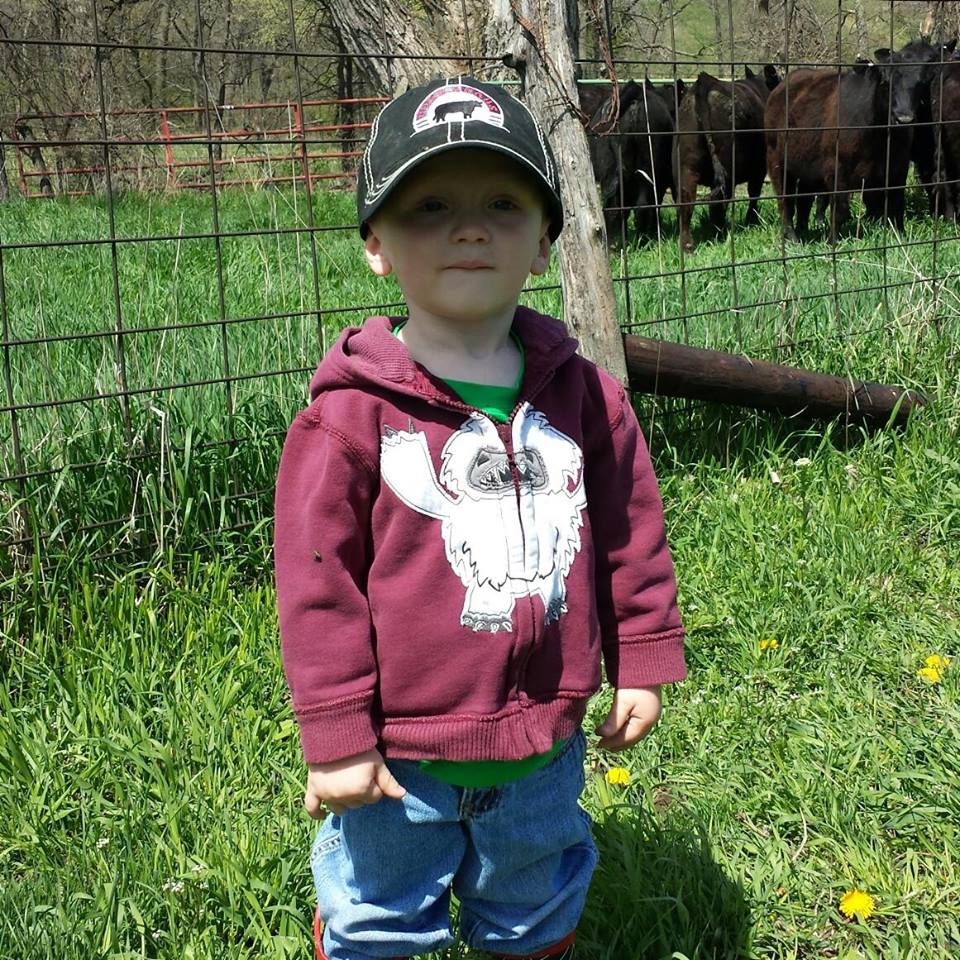
Having no kids of my own, the presence of someone else’s can be intimidating.  Intimidating was a word this gal didn’t know.  Her glance alternated between me and my two year old nephew, Bowen, who was in the pew ahead.  I picked Bowen up, set him down in my pew, and figured the two could captivate each other’s interest eye to eye.  I missed a second time.

Bowen was at least as intimidated as I was, and much poorer in showing it.  I was standing now, and he retreated behind me grabbing my leg.  Sensing weakness, and seeing she had him cornered, our little tiger shark closed in for the kill.  At the last second, I scooped down, plucked Bowen to safety, and returned him to the pew ahead.  I think she scared the hell right out of him, and I don’t suppose he’ll need to go to Mass again.

The tiger shark

The tiger shark

The goldfish

The goldfish

From his fortress Bowen watched his pursuer climb down and stand up on the kneeler to get closer to him.  Bowen feigned a loss of interest.  This I applaud him for, since women usually seize the opportunity to play hard to get first.  Sierra remained undaunted, however, and crept more and more onto the toes of her little black boots with her hand reaching out to seize her man.  I had to hand it to her.  This was a woman whom didn’t take “no” for an answer. 

All of the sudden her feet slipped out, her chinned dodged the back of the pew, and she did a twist worthy of the X Games in order that she might slam face down into the kneeler. 

If I remember my physics lesson correctly, it should have happened in about .4 seconds.  A lot can go through your mind in .4 seconds.  In the first tenth of it, I had removed all blame from myself.  I knew I would be no good at watching a child.  And her mother would have too, had she ever overheard me in the confessional.  I suspected she would have blushed, in fact.  After all, the priest does, and you would figure he had heard it all.  Perhaps he had never heard it all at once before.

(Now, in order not to overwhelm the man, I move around the divider and look at the priest face to face.  Once I begin, I continue until the priest looks embarrassed or looks at his watch.  Or embarrassingly looks at his watch.  Once we had a priest with the countenance of an angel, and the patience of Job.  The man would neither look embarrassed nor look at his watch.  I did find he would sweat profusely, however.  The next time the sacrament was offered, I came around the partition to find he had a sweat band on.  Seems he had been expecting me.  This was mortifying.  It was several years before I went back again.)

Unsure of what to do with a child in the first place, I was now positive I had broken one.  Expecting a wail from my feet at any moment, which would lead to lots of looks and unwanted attention, I quickly reached down to pick her up and get her back in her mother’s hands before Sierra uttered anything audible.  This way everyone would think her mother had done it.

But before I could, Sierra broke the silence with a loud “ugh.”  I suspect it was similar to the noise the skydiver made whose parachute failed to open but lived to tell about it.  She had taken the fall in stride, but I hadn’t got over the shock yet.  I grabbed her quickly to transfer her to her mother, but her mother was laughing so hard I was unable to complete the handoff.  I looked down into the same smiling face and big eyes I had seen before.  This time I offered no smile.  This kid was the Terminator.  Bowen could run, but he would never be able to hide.

To save him until he had developed some better motor skills, I held Sierra up by my shoulder, snuggly so she didn’t fall again. From this vantage she could look down on Bowen, and he timidly moved for protection behind the legs of his mother.

I suppose she’ll too have a horse like me someday.  Hopefully Bowen has a faster one.

Putting Up a Front

Andrew Wheeler and I were making our way down the Grand Concourse at the Iowa State Fairgrounds. It was a little after 8:30 in the morning, on the second Thursday of the fair. There were several people about, but it was hardly a crowd by State Fair standards.

Our walk took us past a whole smorgasbord of culinary adventures.  Some fried, some on a stick, some fried on a stick. The vendors were already open and eagerly anticipating the crowd the late morning would surely bring. I was sure the crowd would bring their appetites, but I was without mine.

We were on our way to the Crystal Studio, which houses 1040 WHO Radio during the fair. At this time it was occupied by their popular morning show hosts, Van and Bonnie, and I was going to have to come up with something to say to them.  I was nervous.

It was a good thing Wheeler was with me. He’s particularly gifted in making smooth, easy conversation, and being able to engage in it made things better. Our talk made its way to the background of my mind, while it’s foreground searched for something else to occupy it other than being nervous.

I caught a sign for Dipping Dots. I decided I would try humor. The tagline for Dipping Dots is “the Ice Cream of the Future.” It’s been this way since I was a boy. I would have thought the future would have got here by now.

I felt nothing, so I tried to build some momentum with another one. The Fair this year featured an incredibly tall sculpture of the American Gothic.   A couple of days before, Sharon Bell had informed me that it was not the farmer’s wife that was sternly standing behind him, but his daughter. Reflecting on it during our walk, I had a series of epiphanies.

First, I realized what her father’s pitchfork was for: guys like me.  By the look of things, he’d been successful.

Second, I gathered that in her suitcase at her feet lay tucked away a little black dress and a cute pair of sandals, a partial can of hair spray, and a tube of lipstick she hoped was holding up well in the heat. She knew he wouldn’t be able to stay up all night, and we he finally tired out, around 8:30, she was going to let her hair down and saunter around a bit.

Her head was wistfully turned towards one of the many establishments that serve beer. The scowl on her face tells me she had seen the $8 price tag, and the sculptor caught her vainly wishing that she would have tucked more away from the old miser.  She’s been isolated to such a degree, the thought never occurred to her that a boy might buy her one.

In the end, this also was to no avail. The closer we got, the more nervous I became.

I mentioned to Andrew, in an understated, conversational way, “I’m a little nervous.” This didn’t help either, but Andrew did his best.

“The way this works is that we will go in at the start of a commercial break. Van and Bonnie will make small talk with you, putting you at ease and giving them a chance to figure out what they are going to ask you. When we go on the air, they’ll pitch you some easy, ‘softball’ type questions, and it will be over before you know it.”

We were at the Depot, and I knew their kegs were still tapped. I thought about seeing if Wheeler wanted a cold one. Unlike the miser’s daughter, I was partially motivated to pay the $8. I also thought better of it. It might make me liable to swear.

Arriving at the studio, we stepped in the side door and were greeted by a man standing behind a counter. Andrew struck up a conversation with him as easily as he had with me. A second man stood silently by and listened. At some point he joined in, and I recognized the voice of Jan Mickelson, waiting his turn to take his show on the air. I thought of asking him if he wanted to go on a littler earlier than normal.

Through a clear door sat Van and Bonnie and their current guest. In no time flat, a commercial came on, the guest rose, the door opened, and someone mentioned for Andrew and myself to go in. I decided not to look nervous. Part of me thought looking nervous would be liable to make them swear.

Van and Bonnie could make conversation as easily as Wheeler, whom might have his own radio show someday. We talked about the weather, the fair, the people of the fair gazing right in the large picture windows across from us, and somehow we wound up talking about grocery shopping at Hy-Vee. By that time only the three of them were involved in the conversation. I was still stuck on the unnerving presence of the faces outside the window.

My internal clock had been ticking during the commercial break, and it told me my moment was quickly approaching. Sure enough, and without warning, Van launched into the weather or traffic or something. I looked over to Bonnie, and I found her looking squarely at me. She had found me out. The expression on her face said, “Shit, this one is nervous after all.”

Just then Van cracked a joke of some sort or other and made a slight raise of his index finger.  On cue Bonnie broke into that famous laugh of hers.  I fancied it was laced with a slight trace of profanity.

Van began, “Joining us in the studio this morning is Dan Hanrahan. How’s it going this morning, Dan?”

Dry, I thought.

Before I could think any further, my mouth opened and out came, “Wonderful, Van. And what a beautiful morning it is to be out here at the Iowa State Fairgrounds talking about agriculture. Thanks so much to the two of you for having me on.” And as my own voice pattered on, without hesitation, laying it on thick and heavy as it went, I wondered, who let this crazy bastard in?

A few more questions, a couple of minutes, and it was over. I had survived it without cursing. I wished I could have said the same for Bonnie. The next commercial had arrived, and Bonnie told us to take our pick from two pans of cinnamon rolls. My stomach, strained from the knot it had recently been in, declined. Perhaps if they were fried and on a stick, they might be liable to make me swear.

As we opened the door to leave the studio, another guy hurried in before I got it closed. There was something about him that made one wonder if he was really supposed to be in there or not. It was as though I had ran into myself. As it was, he didn’t seem the least bit nervous, and I was sure they would find something to talk about.

WHO

The Madison County Water Works

The most famous water works in Iowa is located in Des Moines. It sits on a campus of 50 or 60 acres or so, on an oxbow which juts into the course of the North Raccoon River. It was arguably made most famous by LD “The Flood Stud” McMullen. It has a different director now, whom may not have a nickname, but by now has had several t-shirts dedicated to him.

Why its the most famous I don’t know.  We have much larger ones in the state.  My home county of Madison has one thousands of acres in size, and it rarely gets any press. Perhaps it needs a spokesman with a more fanciful mane. Perhaps it needs its own t-shirt.  Showmanship has always been second nature to it, though.  What it does, it does quietly.

The Des Moines Water Works lies on piece of land resembling a thumb that’s laid on top of the North Raccoon. It makes for great drama.  In Madison County the situation isn’t nearly as dramatic.  We lie over the watershed like a blanket.

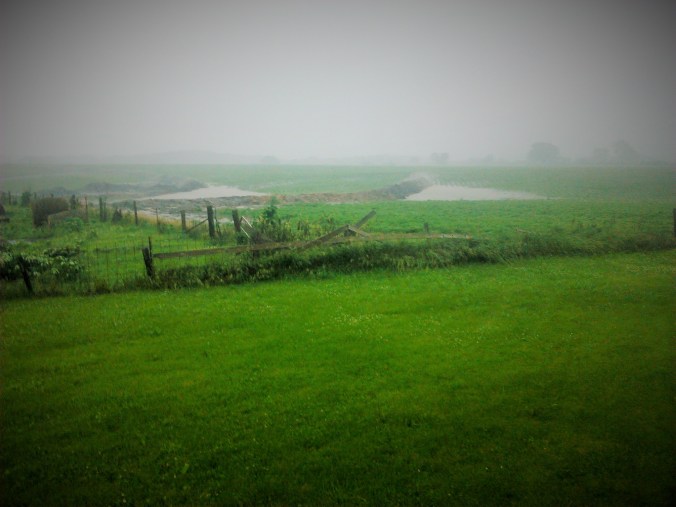
I get to witness this blanket in action.  Late June rains recently left the soil at home saturated, and on June 30th, we received a couple of inches in 30-45 minutes or so. A couple of inches of rain is hardly a big event most times, but on this particular time it came with no place to go. When the rain ended, I set out with my camera, and found a few things to give it some press.

Terrace1

Two new terraces doing their job.


We were in the process of building some terraces over the summer, and had two completed off my back deck.  In agriculture we tend to take for granted that everyone knows what a terrace is, but I’ve found over the last year this isn’t the case.  A terrace simply stops water from running down a hillside, forcing to funnel out through a drainage pipe, letting go of the sediment it would have carried off the farm during its wait.

Outlet1

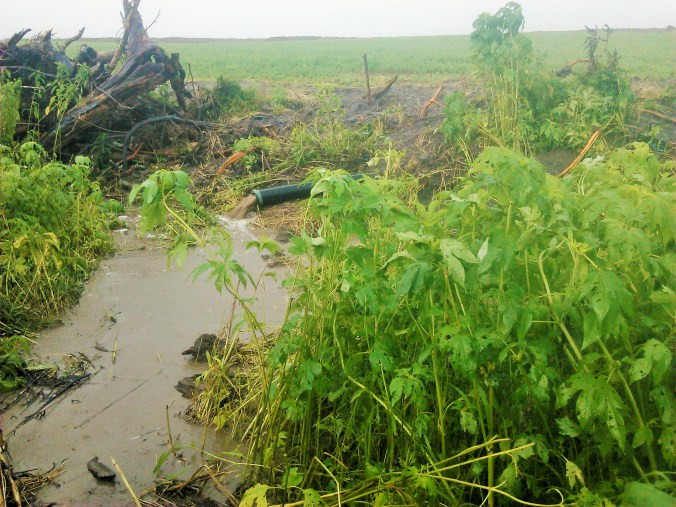
Drainage water being released slowly from an outlet.


Ridge1

Last year’s residue and this year’s crop.


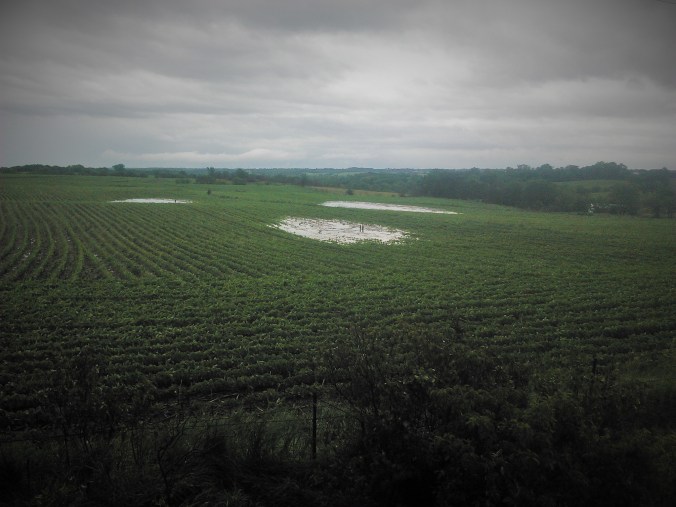
Above the terraces lie other lines of defense for controlling erosion.  This field was no-tilled, leaving last year’s corn residue on top of the soil.  You can see the stalks still standing underneath this year’s bean crop.  Most ground is no-tilled in our area.

The additional residue helps slow down runoff, allowing the water extra time to try and soak in.  Here, on top of the ridge above our new terraces, were a good 2-3 inches of water still laying on top of the ground looking for someplace to go.  One of the basic ideas of any conservation effort is to encourage that water to take its time.

Farmers sometimes tile fields to help with the situation shown above.  In order to have runoff, you need to have excess water in the first place.  Tile works to increase infiltration of water into the soil, reducing the amount sitting on top, as well as reducing runoff and anything that runoff might carry.

While excess nitrogen from the tile can be a concern, how we apply nitrogen, the use of cover crops, ways in which we outlet the tile, and managing when the tile operates can all work to reduce this while maintaining the above benefits.  Eliminating tile due to nitrates, eliminates it’s positive impact on all the other areas mentioned above.

Old Terraces

Long established terraces the new ones compliment.


While the two terraces above are new, the practice goes back much farther.  A bordering field features terraces built in the early 80’s, still doing their job on the landscape.  These older conservation structures mark the conservation efforts of a previous generation, and are the foundation subsequent ones build on.

Terrace2

7 hours later.


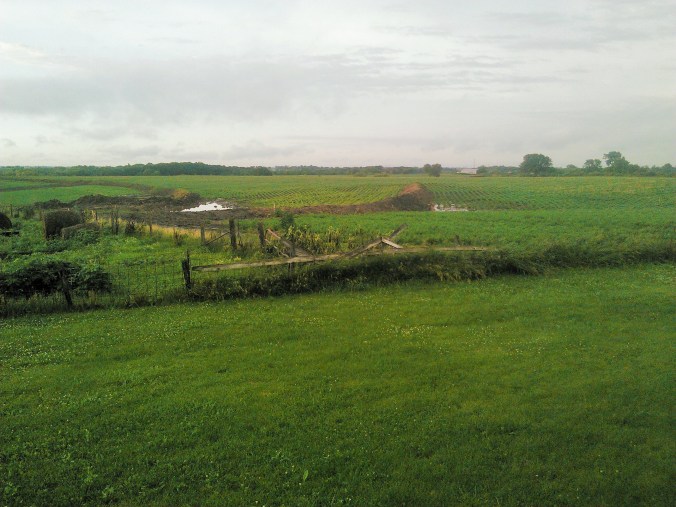
At the end of the day, shortly before sunset, I took one last picture of the new terraces.  They were still 1/2 to 1/3 full.  Water which would have washed its way off the field in minutes was still being released after hours.

Conservation doesn’t make much noise, I guess.  It isn’t designed to.  If only it sported a more flamboyant mane.

Ahquabi

If my grandfather had a way with stories, then it must be mentioned that my grandmother had a way with words.  At her command must have laid a whole army of them, but she never traipsed them about for a good showing, at least not as I recall.  Instead she would make an efficient sort of them and select the one most effective for a particular job.

Once selected, she would wield it effectively.  I don’t recall her being strict, mind you, but when she said a word like “no” it could run a circle around your entire childhood attention span and bring it focused on a single point.  She gave some certainty to it, I suppose, and it fell like a hammer blow.  Once spoken, with its full meaning comprehended, she could convey it in absolute silence with equal effect.  Perhaps this is the acquired skill of all grandmothers.

My aunt tells the story that she was staying with the two near the end of her father’s life, and one day a neighbor stopped to visit.  This wasn’t remarkable, it happened all the time, but what was remarkable that particular day was the story.  The subject of the reminiscing were the two’s younger years and a hell of a good time they’d had when one of their acquaintances had piled up his Model T on the way home from a dance in northern Iowa.  My aunt realized for the first time in her life that her father once drank.

So when my grandfather was poised to celebrate his next birthday, my aunt decided she would get him something special to remember it by.  She went into a liquor shop and inquired from the lady behind the counter on her recommendations for her aging father.  She was directed to a fine, Irish liquor which was then boxed and wrapped.

When the big day came, and the meal had been had, and the rest of the family had said their goodbyes, my aunt asked her father to sit still for one more gift.  She went down the hall and returned with a long, slender box wrapped and tied with a bow.  He was at the table, and had his back to his wife who was dislodging from the plates the final remnants of the party.  My grandmother took an interest, though, and from time to time would look over her shoulder to witness what was about to unfold.  Sliding the bow off one end and cutting the tape with a pocket knife, my grandfather made his way to the day’s final gift.  He pulled the lid off, folded back the packing, and his eyes glistened from the joy of seeing a long lost friend.

My grandmother took one look, raised one eyebrow, and fervently resumed her work.  My aunt was facing her, and her understanding of her disapproval was instant.  My grandfather had neither seen nor heard anything, yet he was perfect in his understanding as well.  He pushed the packing back over the bottle, carefully slid the lid back on the box, and pushed it back across to my aunt with a smile.  “Mary,” he said, “I appreciate the gift, but I cannot take it.  I made a promise to someone a long time ago now, and I intend to keep it.”

My aunt either felt like she’d diminished in size, or that the chair she sat in had grown to Edith Ann proportions.  What she didn’t know was that my grandmother was adamant in her belief that a man that drank wouldn’t amount to anything.  However it was she had that conversation with my grandfather, she had brought his full attention to the topic, his understanding was perfect, and there was no need to repeat it a second time.

But of all the words she rigorously selected, the most famous was in 1935 for a contest to name a new state park south of Indianola.  The Saux and Fox Indian tribes had once wintered in the area, and Grandmother submitted the name “Ahquabi” which was their word for “resting place.”  The committee set up by the local paper loved it, and awarded her first place and $35.

She was quite fond of the stories of the Native Americans, and there are still a box or two in my basement full of her numerous newspaper clippings, letters from the Department of the Interior concerning the old Indian Bureau, and knick knacks from early trips to pow wows in Tama.  Among the clippings is one she saved detailing the night of October 11, 1845.

At midnight that night, the Indian title to the lands in south central Iowa expired.  When it did, settlers could stake claim to 320 acre parcels.  The clipping states that “Precisely at twelve o’clock, the loud report of a gun at the agency announced that the empire of the red man had ended here forever, and that of his master race had begun.”  It goes on to say “civilization had now commenced her reign in Central Iowa.”

The rest of her clippings make it quite clear where my grandmother’s sympathy lied, and I suppose she preserved this in order to note the sentiment.  The early historian goes on to detail how Jacob Frederick and Jeremiah Church were without an ax to properly mark their claims near Fort Des Moines, so they carved their initials into trees to mark their boundaries.  Frederick evidently did it in the dark, but Chruch was aided by the light of an Indian wigwam he had set on fire.

While my grandmother was concerned of the plight of the Native Americans, I take some satisfaction that they never had to see the Food Court at Jordan Creek.  I’m sure they had their own doubts about the “master race” and their “commencement of civilization” on the territory, but I doubt even they could have imagined that.  I wouldn’t have had the heart to have broke it to them.

A year after my grandmother died, in 1986, they put up a small monument in the park to her.  It’s southwest of the trail as you come in the park’s east entrance.  As I recall they put four names of her’s on it, but nowhere appears the one I knew her as.

In her clippings I found the full meaning for Ahquabi.  “Resting place” only accounts for the first half, or the “Ahqua.”  The significance of “bi” seems to have been neglected.  “Bi” was Indian for “sitting around a campfire and telling lies.”  An activity which evidently joins the two empires.  And knowing that, perhaps we can understand its full significance, and not need to be told a second time.

Our Perpetual Lady of 3rd

Seldom do I do requests.  This sounds better than it is.  Seldom do I get them.  I did have a former classmate, Scott Greif, ask me to write a story about baseball.  It was a fine compliment, for Scott would know the considerable talent I lacked in regards to the game.  I figured he thought I could lie well enough to make up for it, and that my vanity would dictate that I would do exactly that.

Our little league team was the Churchville Red Sox, and the first word in our name came from the small, unincorporated community where the field was located.  Its name came from the fact that it did have a church.  In fact it once had two.  The second was moved to Martensdale, bell and all.  How they got it over the hills, I don’t know, save that the move was a joint effort.  The Lutherans were eager to go.  The Catholics were eager to help them.

The world is small when you are in little league, and in that little world we took some pride that we were quite good.  So good, I suppose, we figured God Himself was taking note of it.  Baseball had a long tradition in Churchville.  My Grandfather played for them in the early turn of the century.  If God took note of them, I’m not sure, but His mother was reported to be the third baseman.

In those days there was neither a full-fledged field, nor enough players to field two full teams most of the time.  So Mary, the concrete Virgin which stood watch at the Church of the Assumption, became the designated 3rd baseman.  Having no glove of her own, the rules were simple:  if the ball hit her before the base runner did, they were out.  As to the length of her career, or the chips she took for the team, I cannot say, but she’d had lost her nose with a silent resiliency that was bound to have a profound effect on the rest of the team.

Churchville’s most famous son, Adam Walsh, was born in 1901 and went on to one of the more illustrious sporting careers of any Iowan.  He was the team captain for the 1924 Notre Dame Football squad.  There he played center of the “Seven Mules,” the line that blocked for the famed “Four Horsemen.”  During their undefeated season of 1924, in a game against Army, Walsh is said to have broken both his hands while playing every minute football, never fumbling a snap and defensively making a key interception late in the game.  Their famed coach, Knute Rockne, regarded the effort as the greatest game he’d ever seen a center play.  Walsh is still listed as the center on the All-Time Notre Dame Team, and after his career he coached the Cleveland Browns to the 1945 NFL Championship.

Now if this isn’t remarkable enough, consider the fact that he left Churchville at the age of 6.  Had he a chance to further develop under the Virgin’s tutelage, I suspect there would have been no stopping him.   Those that remained eventually found a field to play on, and a third baseman with a glove.

My grandfather’s favorite story about playing ball in Churchville was that one day an all-black traveling team called the Tennessee Rats came through on the train.  The traveled from town to town, setting up exhibition games against the town teams.  They made a living by charging a gate for their pay.  This was a step up.  In the early days the Rats were a traveling minstrel show.  They added baseball in the early 1900s, with a game in the afternoon and a show at night.  It was all baseball by the ’20s.

The Rats’ full team took the field the first inning.  Only their infield came out in the second.  The rest of the game was finished with their spectacular pitcher and his catcher.  When he finally got a chance to play, my grandfather got the team’s lone hit that day.  He confessed later that it took him a full ten years to realize he had gotten the hit because the pitcher had simply taken sympathy on him, the youngest member of the team.

Family tradition always said the pitcher was the great Satchel Paige, but a little bit of recent research says this is impossible.  Paige never barnstormed across Iowa until my grandfather would have been approaching 40.  If it wasn’t Paige, then who was it?  Had it even happened at all?  Then I came across a semi pro all-black team called W.A. Brown’s Tennessee Rats, and a historian who had become interested in them.

The Rats travelled all across Iowa and Missouri, into the states of Wisconsin, Minnesota, Nebraska, and the Dakotas.  For a time they featured two tremendous black pitchers, who were simply too old by the time the color barrier was broken.  John Wesley Donaldson, “The Greatest Pitcher You’ve Never Heard Of,” played for them in 1911, and in 1914 William “Plunk” Drake threw from the mound.  Perhaps it was the latter, whom my grandfather faced.

When the railroad line had finally been tore up, but before the bike trail had been laid down, we got our chance to be part of Churchville’s baseball lore. The teams we played were from the exotic localities of Milo, Truro, and St. Charles.  Following in my grandfather’s footsteps, I too would see action late in these games, but my age had nothing to do with it.

When I was in fifth grade, we played Milo.  They had a pitcher named Keeney, who should have been in the seventh grade but had been held back a year.  He looked six foot tall, and we suspected that he shaved.  Earlier that year, in a game at St. Mary’s, he hit a kid in the head so hard that it split his helmet right down the seam, with each half symmetrically falling at his ankles.  Kenney should have done it sooner in his career.  The story gave him something few our age were in possession of, a reputation.  It was one he had to have found great value in.

When they came to town, Coach Parker sent our own hard thrower to the mound, Ryan Lull.  Ryan was our shortstop.  As far as I know, he had never pitched.  This was likely due to worry that he could very well kill someone.  We were hoping it was Kenney in the first inning.  During his warm up, as the Milo team watched from the dugout, he sent a fast ball crashing into the backstop a good six feet right of the plate.  This had a level of theatrics W.A. Brown would have been proud of.  Things got pretty quiet.

Tom Lull, Ryan’s dad, pleaded with our coach to reconsider.  He wasn’t sure the family had enough insurance to cover whatever Ryan might do.  I imagine the Milo team could hear the pleas as well as we could.  Someone should have been charging gate.

Coach Parker knew that personal experience trumps a second hand story any old day of the week.  Whatever fear we had of Keeney now paled in comparisson to the fear they had of Lull.

We must have worked up a fair lead in the game, because at some point coach made his way down the bench to tell me I was going in.  He was a kind man, and always wore an expression that he was sorry he’d waited so long to get me in the game.  I always wore one that said it was quite all right, and he really needn’t bother in finding me.  I would have been just as content to sit on the bleachers, but it would have looked odd being the only one there with a uniform on and all.

With my stomach in a knot, I begrudgingly headed to the plate and tried to get as ready as I could for the pitch.  I finally found a spot where I was comfortable when the umpire stopped the game.  It seems I had set up shop a good two feet outside of the batter’s box.  Beyond that I don’t recall anymore particulars of the at bat.  I could offer a solid guess, though.

Having survived it at least, I now needed to take the field, and Coach sent me out to right.  I was hoping for a quick inning, but it was not to be.  The first two runners reached, standing on first and second.  I was fairly deep in right, mainly so I could let any ball drop in front of me.  The third batter nearly hit it to me, and I had to stand around for a while to make up for the fact that I hadn’t been back farther.

When it came down I charged it with great abandon, in case a local sports writer was there.  In case he wasn’t, I was writing the story for him in my mind.  While trying to find the right phrasing for the monumental events about to unfold, I passed the ball as it passed me.  Now I had to change both direction and the story line.  The key play would now be a dramatic throw to the plate, and when I finally caught up to the ball I snagged it and threw it with all my might.  After that I opened my eyes.

At the top of my view was the ball, hurtling straight ahead, and straight ahead was the side profile of the center fielder watching the runners go home.

“Eric, Eric,” I shouted, scared to death I was about to bean him.  He casually glanced my way, and with reflexes much faster than my own, caught the ball just before it nailed him.  This was to be a relay throw unlike any other, but I have lost all heart in writing about it.

Right across the road was the Church of the Assumption, and beside it was Mary still standing watch.  Meanwhile in the outfield, the heavens open and I had an assumption of my own.  I was no ball player.  Mary had suffered enough on my account, and I would make her suffer no more.  Once my 5th grade season had ended, I refrained from going out for the sixth.  Unlike the Virgin, I at least got to keep my nose.