Jonah in the Countryside

For the last two weeks I guess I have had a case of writer’s block. I’ll sit down to write, and partly do so, but soon discover a hour and half has passed by and the only thing I’ve really done is move some sentences around and change the order the paragraphs are in. The accomplishments of the following evening are generally confined to moving everything back. The feeling has a claustrophobic quality to it, but it is a rainy morning, and so I’ll try again.

Somewhere I had seen the sentence, “It’s a blessing and curse to feel things so very deeply.” I had been thinking of my grandfather, John Walker, and for whatever reason linked that quote to him. In such regard I have started and stopped a hundred times, a few on a computer screen but most in my mind.

My grandfather was his family’s only son and would become its only male. His father skipped out never to be seen or heard from again, and in that regard he proved himself to be a true “Walker.” They say my grandmother, Margaret, would tell a story that while they were living in Cherokee a man stopped by the house one day asking for John. He wasn’t home, but she invited him to come back around later. He never did. She’d later remark she had a strong feeling it was his father, and that he bore a striking resemblance to him.

Whether it was or not, who knows? I do know we spend part of our life wondering who some of those closest to us are. I see nothing wrong with devoting a little speculation to who a stranger is.

My earliest memories of my grandfather find him seated at the end of grandmother’s long dining room table, with his elbow resting on it, his fingers straight up, and a lit cigarette between them.   He’d sit there in silence, thinking, while behind him, through the haze of smoke, a police scanner made intermittent noise. Occasionally he’d raise an objection about one thing or another, with grandmother replying, “Oh, hubba,” from the kitchen.

By this time he had worked long enough to retire twice. The first was from the railroad in Cherokee. The second was from Firestone Tire in Des Moines. The cigarettes would have been a companion to him at both places and at the latter one would have dangled from his lips while his hands were busy wrapping and unwrapping asbestos from the pipes he worked on. These pipes were his specialty, though from time to time he was asked to work on others.

There was a story that a toilet clogged in one of the restrooms at Firestone. My grandfather was asked to see what he could do to unplug it. Evidently, one could use air to back pressure the lines, and he did–using a great deal of it. The end result was that he blew two men through their stall doors and re-plastered the ceiling. I was inclined to think the story had some stretching done to it. But when my grandfather passed after my senior year of high school, I heard the story mentioned several times by his former coworkers during the visitation.

I don’t know why he smoked his first cigarette. There are all kinds of reasons to be allured to it. I remember a few myself, but once the habit is acquired I suppose there are only a couple which maintain it. For some it seems to calm their nerves, and for others it is a subtle form of defiance. The latter was the case with my grandfather.

They owned the house right next to Highland Park Funeral Home on Sixth Avenue. He was told by the banker when he borrowed the money that he’d never be able to pay it back. He did, and the same persistence that bought it refused to give in and sell it as the neighborhood lost its shine. While some of his coworkers succumbed to the asbestos they had handled in their job, he kept smoking his way to his mid-eighties, and he kept driving too.

Often they drove out to the farm, and he would take up residence on the porch swing or on a folding chair beneath the large cedar next to it, tucked away in the shade, smoking, and thinking. All these years later, I wonder what it was he was thinking about. All those years ago, I never thought of asking him.

There exists a concept of the “invested child,” which simply states that in any family one child is going to be more sensitive to the happenings within the family than the others. Generally, this child is the oldest or the youngest, the only child of a particular sex, or a child which had a heightened focus from the rest of the family (due to a health issue, for instance).

The claim is that this child feels things deeper and more intensely than the other children and has a harder time bringing the feelings to a state of resolution. They may elect to try and stumble their way through those feelings, or they may get bottled up in themselves. Either way, it can be more difficult for the invested child to “function” in the day to day activities of their contemporaries.

The unspoken assumption, of course, is that the day to day functioning of our contemporaries is what we should be striving for. I don’t believe the contemporaries will mind when I say that any proof of that I find circumstantial at best.

If he was an “invested child,” if from time to time he was locked up in his own thoughts, I also know there was something about him his contemporaries could readily relate to. I remember he would haul us as kids to the mall with my grandmother, and as we grew older our family would meet them in there. Grandma would go about her shopping while he found a place out in the open to sit and smoke. Never did we return to find him unaccompanied, instead he would be there, chatting away with whomever happened by, and as we left he would tell us about all those he had been talking to.

Somehow, more often than not, when we get that sense of loneliness, we wind up spending time with those who have an even better acquaintance with it. Many times we find them without even knowing their story at first.

The final few times he was out, on the porch or under the tree, I remember him with his loafers on, socks pushed down, pant legs pulled up, and his tired and swollen legs running between them. The cigarette now dangled between two fingers of a drooped hand, whose elbow was resting on a knee, as though the weight of the cigarette had finally worn them all out.

“Don’t get old, Danny. Don’t ever get old,” he spoke as he rubbed his legs. I remember him saying that as though it was yesterday, as though his defiance was finally starting to give out. I’m sure it will still seem like yesterday whenever tomorrow shows up. He had a gripe, and even I, who could only stand and watch from the perspective of uneducated youth, could see that there was validity to it.

He wasn’t the first man to sit in the shade with a gripe. The biblical Jonah did. I bet Jonah would have been smoking too, had he any cigarettes, but that is another story for another time. And while the fact that he married a woman from Faith, South Dakota, shouldn’t be a surprise, it too will have to wait.

The Walkers

The Candidate

Young

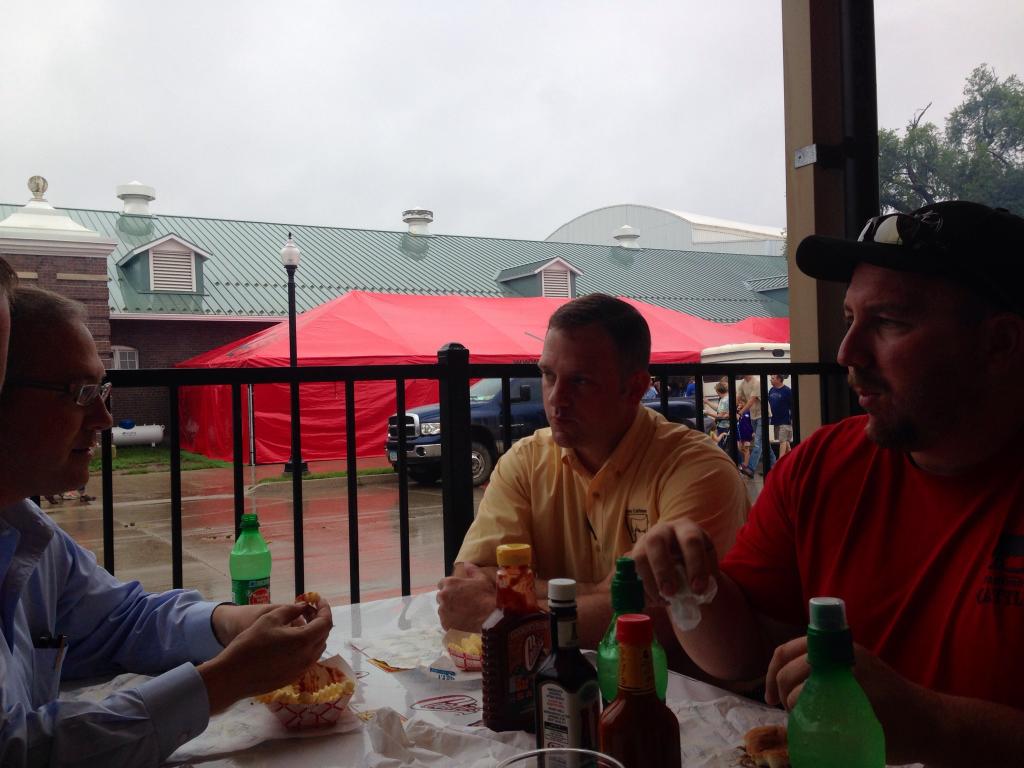
David Young on the left, ICA CEO Matt Deppe in the center, and Isaiah Shnurman on the right.

When David Young and Staci Appel met for a debate last night, in their battle for Iowa’s 3rd Congressional District, I thought that both candidates might alter their appearances.  Up to this point, David Young seems always immaculately well dressed:  sharp glasses, sharp suit, and sharp shoes. One looks at him and thinks “businessman,” or, worse yet, “politician.” The connotation for either is that he is quickly capable in making assessments of both what you want to hear and how to make it sound like he’s saying that. Staci Appel, on the other hand, generally looks like the overly anxious mother you can’t carry on a conversation with because her mind is occupied with all the potentially dire outcomes of the actions her children haven’t even conceived of taking yet.

If I thought they might alter their appearance, I thought wrong. You can find numerous photos online this morning, and for the most part, the two will look exactly as I described them. Appearances can be deceiving, however, and the actual experience of either can move us well past them.  I’ve never spent any time with Appel, and I doubt she is as she appears to me.  I did spend a little time with Young, though, and found he wasn’t either.

I met with David Young the first day of the Iowa State Fair. He had contacted the Iowa Cattlemen’s Association about wanting to meet with cattle producers in his district during the fair’s opening day. Since the Madison County Cattlemen always help staff the Iowa Beef Quarters the fair’s first afternoon, I received a phone call asking if two or three of us particularly interested in legislation could meet with him. Two of us were able to, myself and a young producer named Isaiah Shnurman.

I have about 60 cows, and run them with another 60 my family owns. Isaiah has a few head as well, and has recently started a business providing ultrasound services to other cattle producers. He’s hard working, he’s sharp, and he’s articulate. In short, he’s everything you hope the future of agriculture looks like, and I’m sure when he’s my age he will have much more to show for it.

I mention our backgrounds, because if all you know of the ICA is what you read as articles and comments in the paper, then you would probably suspect Isaiah and I were a couple of the corporate heads of “big agriculture,” or at the very least somehow related to CAFOs.

(As an aside, I always have trouble remembering if “CAFOS” is meant to dehumanize the multi-generational family farm cattle feeders in the state or dog owners. When I think of “confinement,” I think about how it must mean the tight quarters of a kennel more so than the open lot of a feedyard. Then I remember the “f” stands for feeding and that nearly no owner feeds their dog in their kennel.)

Given the above, you might have also expected for us to meet in an oak paneled backroom someplace, smoking cigars and drinking scotch provided by the Koch brothers. Instead we were out in the open, at the Cattlemen Beef Quarters, eating roast beef sandwiches and drinking iced tea. Alas, life appears so much better in a Bruce Braley commercial.

Next to me was David Young, whom I was seeing for the first time. He was wearing what I had described to you above, save that he traded the suit for jeans and a nice button down shirt.  I was wondering what I had gotten myself into while the two of us told him about ourselves. The funny thing was, though, I never did have the feeling he was making a quick and sly assessment during the process.

When it was his turn, he started, “I grew up around Booneville. Do any of you know the Forretts, or the Golightlys, or the Wallers.” I told him I considered them neighbors. “I worked for most of them as a kid.” He briefly continued about who he was and where he had been, and then he did something I wouldn’t have guessed. He listened.

He listened to Isaiah talk about the hurdles facing a young person trying to get established in the cattle business. He listened to our concerns with the Farm Bill, and our concerns about the impact the Conservation Reserve Program appears to have had on some of the economies of southern Iowa. He was generally reserved, and when he did speak he was soft-spoken. I began to wonder how he had got the gumption to run for office in the first place, and in the end I thought in some ways he embodied the public persona of his old boss.

I suppose he could have slipped on the new cowboy boots and white straw hat so many feel obligated to don when they talk to farmers. He could have really leaned into the table and told us about some other sob story he had heard, which is the accepted substitution for empathy and understanding these days. But he did none of that, and the absence of those things made you feel as though you were in the presence of someone genuine.  It crossed my mind that perhaps this was a guy who knew who he was and where he came from, and was thus free of the insecurity of wondering what he looked like.

Before we could break out the cigars and scotch, we were surrounded by a class of first graders. I was about to push ahead anyway, never leaving home without either, but I remembered the cardinal rule of first grade, “Only if you brought enough to share.” I wished I had. It would have been quite a photo op.

As we left, Young said something about having to appear on the Register Soapbox on the main concourse at the fairground in a few days.

“God, I bet that’s fun. Standing up there on the podium while anybody can shout whatever they feel like at you,” I said.

“Oh, it’s part of the process, you know?” And on that matter of fact note, the conversation came to a close without him ever once having practiced his stump speech or setting foot on a soapbox. Neither did he utter so much as a joke towards the other candidate or her party.

A week later, having concluded the interview with Van and Bonnie, I walked through the door only to find Young there, waiting to take be interviewed when Jan Mickelson came on. He knew the fellow I was with from when Andrew had worked for the Romney campaign, and they talked a little while. I didn’t expect him to remember me, when he wheeled, extended his hand, and said, “How are you, Dan? Haven’t seen you in a while.”

“I see you survived the soapbox.”

“Yea. It went great actually. You know, we’re going to do this.”

And even in his final comment to me, I sensed no trace of the over the top bravado that one might expect from an individual in politics. Nor was it the speech of a general, out to rally the troops. Rather it was as though he was confiding in you what he felt to be true. In his absence of swag and once worn cowboy boots, and in the presence of the sharp glasses and shoes, I find myself agreeing with him.

The Ballad of the ’62 Ford

Somewhere south of Emporia Kansas, after Interstate 35 joins up with the Kansas Turnpike, you come upon the Flint Hills. It’s a sudden thing. You round a corner, and there you are–some place different. As far as the eye can see is nothing but the undulating hills of tall grass prairie. I have seen the Sandhills of Nebraska, found them beautiful, and judged these their equal.

When we came upon them, they seemed to stretch all the way west to where the sun was taking its final glance on the day. “We” was my father and I, mid last week, making a long run down to northern Texas to look at 1962 Ford Galaxie Two Door Hardtop.

If you enter these hills like we did, on the Turnpike headed south, then immediately when you enter them you can look to the west and find one hill, a few miles away, standing a little higher than its counterparts and with sharper features. Looking at it I realized hundreds of years ago Indians use to ride their horses to the top simply to say they did. Some years later the white man that replaced them did the same thing, for exactly the same reason. Today the descendants of that white man and, I suppose, the descendants of those Indians drive past and make the same journey in their mind.

The vast majority of these descendants don’t have a horse and wouldn’t know what to do with one if they did, but this isn’t what keeps them from the aforementioned hill. They don’t go because the vast majority of us believe we simply don’t have the time.

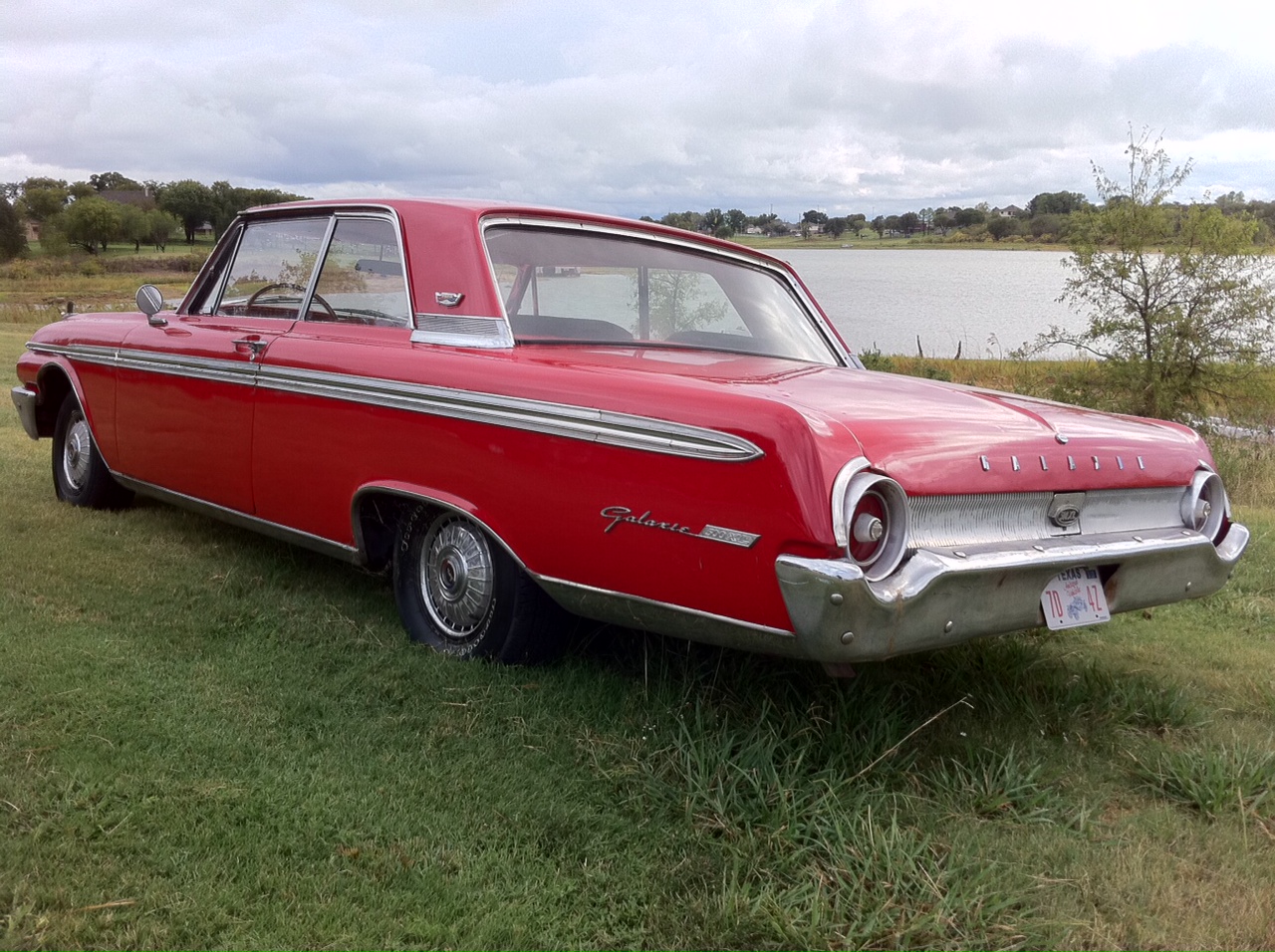
A 1962 Ford Galaxie Two Door Hardtop was the first car for my father and his brother, Jack. A man whom owned the car dealership in Winterset had bought one for his wife.  Then, in the middle of 1963, in order to compete in NASCAR, Ford came out with the Fastback. Today it’s referred to as a ‘1963 and a half.’ His wife wanted one of those instead. Her ’62 had a console and bucket seats. This was the cat’s meow at the time, at least before the fastback anyway, and Dad and Jack now had a car which sported them.

I had been looking for one for Dad, and I had some hope of finding one so he and Mom could get some enjoyment out of it yet this fall. I found several listed here and there online. This particular one I came across in a print ad in Hemmings Motor News. What caught my attention was the “new paint and interior,” as well as the price. The car was listed as being located in the town of Little Elm, Texas, forty miles north of Dallas. There was no picture.

I called the owner, who said he had just listed it, and he gave me all the information his ad already contained.

“This car has new paint and a new interior. Why, it’s ready to go.”

“What size of engine does it have in it?”

“A 390, I think. No, wait a minute. I’m not sure on that. It might be a 352. I can’t tell them apart. It has the console, though, and bucket seats.”

“How does it run?”

“It runs good, but it has been sitting awhile. That’s why I figured I ought to get rid of it.”

“Much body putty go into it before the paint job?”

“No.   Just a little, you know. Paint has a blemish or two. It’s not perfect, but it’s pretty sharp. Why if you saw it, I’m just positive you’d like it. And the interior, why in my opinion that’s the sharpest interior Ford ever had in a car. Seats have never been sat in.”

“Could you send me pictures?”

“You bet. You got one of them emails? My son can send you pictures.”

The pictures came the next morning and seemed to support his previous testimony. It was 10 o’clock, and I called him back.

“What were you wanting for this car again?”

I had his ad in front of me, and he quoted me a price $500 below what was printed there.

“How would you want paid?”

“Well you could send a check, and I’d hold the car for you. You could come down and load it any time after it cleared. A cahiers check would be better, and of course there is always cash.”

“All right,” I said, as excited as a boy that got his date to the prom. I hung up and called Dad.

“Too wet to do much of anything today isn’t it?”

“I think so.”

“Come over here, I’ve got something for you to look at.”

When he arrived, I showed him the pictures, and we both agreed the old thing didn’t look too bad.

“Looks like the bumpers have some rust, probably have to re-chrome them. It would look nicer with some sharper wheels under it.”

“What are you thinking?” he asked.

“Well, we are not going to know anything until we see it. Let’s get a trailer, pack a bag, drive most of the way down there this afternoon and drive back tomorrow. It’s ten and a half hours away. We could make Oklahoma City by tonight.”

We got away at 3:00 in the afternoon, and made the outskirts of Oklahoma City by 11:30 that night. We ate breakfast early at the hotel, and the only company to be had was an elderly couple who were traveling from Pella, IA. I mention them because later that morning, thinking I was making good time to Texas, we were passed by a car with Iowa plates, and a couple of familiar senior citizens in it. Since I couldn’t beat them, we joined them, and followed them up and over the Arbuckle Mountains and into Texas.

Little Elm is only a few miles from Interstate 35, and I was convinced that I must have drove past the house, when we saw the rounded tail lights sticking out of an attached garage on a home right on the reservoir. As I pulled in, a man in his early 80s emerged to greet us.

“You guys have traveled a long ways. You’ve only got a few more feet to go. She’s right over here. Dad took the driver’s side of the car, and I took the passenger’s. As I rounded the rear corner, my heart sank. The passenger side of the car rolled like the Flint Hills of earlier. When he said it had only a little putty, he meant in comparison to all the putty that was ever made, he only used a five gallon bucket full. The new red paint was new 15 years ago, and it was ample enough to make me think someone had applied it with a roller. When I got to the passenger door, I opened it, and was greeted by a rusty vise grip attached where the window handle should have been, a much sought after option for 1962. Inside, lay various pieces of trim still not attached yet. Some appeared to have been missing all together.

The console was there, but it was recently installed.  To the steering column someone had affixed a piece of tin, hiding where the shifting lever had been.  The indicator was still there, and they had applied bright red paint to it in order to camouflage it with the rest of the interior.  It blended in as much as if I had smacked my thumb with a hammer, and laid its swollen carcass on the steering wheel.

My head emerged to find Dad about ready to pop the trunk. I joined him and found the missing interior trim lying next to the spare. He reached up and pulled the carpeting back near the passenger rear wheel well, and was greeted by a tarry looking goo, which I was certain I could put my finger through and check the tread on the rear wheel.

“I think we should let this car go,” Dad said. It seemed like the thing to do. I only wished we were letting it go off a cliff with the owner inside it, and yet for some reason there is always this desire to hide our disappointment.

By this time the car’s owner had pulled up his 4wd golf cart and told Dad to hop in. He wanted to show him the rest of the cars he had out back. His son was with him, and as the owner and Dad headed off, he stayed to visit with me. At some point I figured we had gotten to the part where they killed us one by one, hoped it was cash and not a cashier’s check in the pickup, put us in it, and rolled it into the lake.

My last meal was going to be a continental breakfast consisting of a dried up biscuit with cold gravy over the top. There wasn’t a damn thing I could do about it except hope to punch the guy before he shot me. But lo and behold, here came Dad and the owner back. Dad must have told him we had opted for the cashier’s check.

Now most would think a man would be disappointed right about now, but we were only mildly so. The car was a P.O.S. No man is afraid of buying a P.O.S. In fact a P.O.S. gives a man some pride when he relates to the story to others, for inherent in the story is the fact that he was smart enough to recognize it. No, what a man is truly afraid of is a lemon. This is a P.O.S. in sheep’s clothing, which he purchased anyway, and is now stuck with. That is disappointment.

We stopped for lunch at a neat little BBQ joint we had passed not far from the Interstate. We licked the wounds of whatever slight damage had been made to our pride while we ate. I suggested to Dad that we had an envelope full of cash and could always pawn the neighbor’s trailer for pistols in our boots, and begin a life of crime. He frowned on it. It seemed like the thing to do.

Driving home, no longer preoccupied with the car we hadn’t seen yet, it left one’s mind free to gravitate towards other things. Mine drifted to the armadillos, which always greeted me along the side of the road, four feet in the air, from northern Texas to central Kansas. I thought if they could tag them, the Department of Transportation might save some money on mileposts.

Many people think these armadillos are dead, but that’s because they don’t know the armadillo’s ancestry. Which is a shame, because it is really not hard to guess at. You can just look at one and see the armadillo is the result of a brief love affair between some ancient snapping turtle and a possum. From the turtle it inherited its armored shell, and from the possum its remarkable ability to play dead.

Stopping for gas, it let a local behind the counter know that I was wise to this little known fact.

“We’re from Iowa,” I said, “and boy I tell you what, I thought a possum could play dead, but they don’t have anything on these armadillos. How do you suppose they do that?”

“I think getting hit by a car has something to do with it,” he said.

Of course it does, I thought.  Aren’t the best performances always those after a tragedy?

photo_2