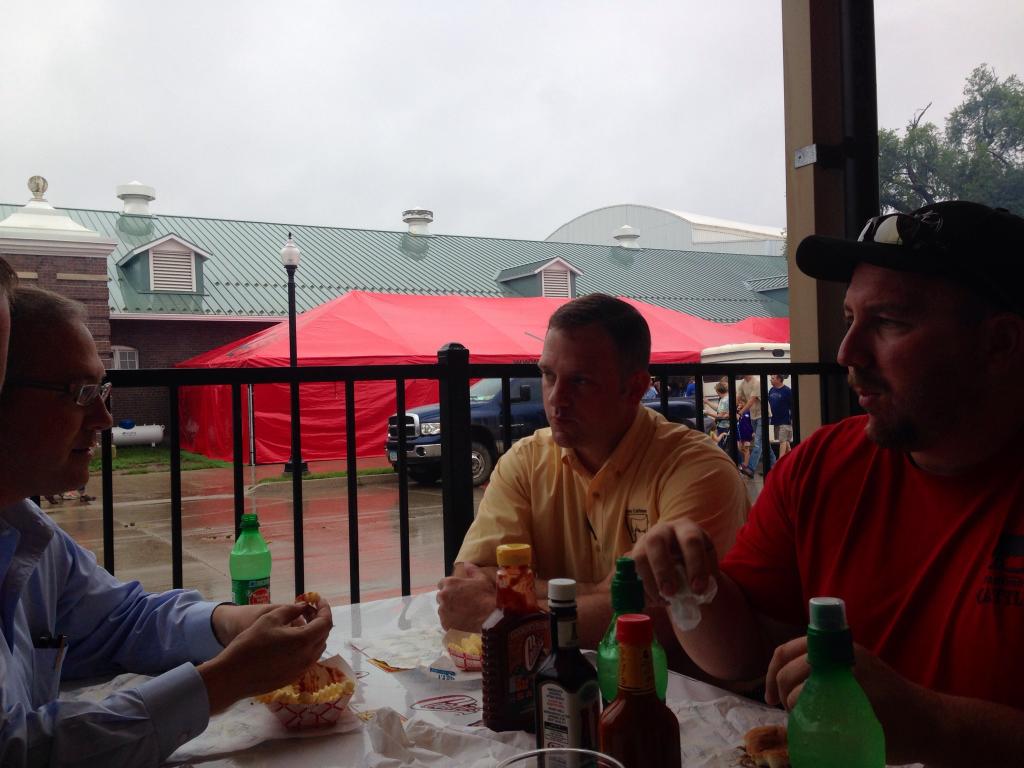
David Young on the left, ICA CEO Matt Deppe in the center, and Isaiah Shnurman on the right.
When David Young and Staci Appel met for a debate last night, in their battle for Iowa’s 3rd Congressional District, I thought that both candidates might alter their appearances. Up to this point, David Young seems always immaculately well dressed: sharp glasses, sharp suit, and sharp shoes. One looks at him and thinks “businessman,” or, worse yet, “politician.” The connotation for either is that he is quickly capable in making assessments of both what you want to hear and how to make it sound like he’s saying that. Staci Appel, on the other hand, generally looks like the overly anxious mother you can’t carry on a conversation with because her mind is occupied with all the potentially dire outcomes of the actions her children haven’t even conceived of taking yet.
If I thought they might alter their appearance, I thought wrong. You can find numerous photos online this morning, and for the most part, the two will look exactly as I described them. Appearances can be deceiving, however, and the actual experience of either can move us well past them. I’ve never spent any time with Appel, and I doubt she is as she appears to me. I did spend a little time with Young, though, and found he wasn’t either.
I met with David Young the first day of the Iowa State Fair. He had contacted the Iowa Cattlemen’s Association about wanting to meet with cattle producers in his district during the fair’s opening day. Since the Madison County Cattlemen always help staff the Iowa Beef Quarters the fair’s first afternoon, I received a phone call asking if two or three of us particularly interested in legislation could meet with him. Two of us were able to, myself and a young producer named Isaiah Shnurman.
I have about 60 cows, and run them with another 60 my family owns. Isaiah has a few head as well, and has recently started a business providing ultrasound services to other cattle producers. He’s hard working, he’s sharp, and he’s articulate. In short, he’s everything you hope the future of agriculture looks like, and I’m sure when he’s my age he will have much more to show for it.
I mention our backgrounds, because if all you know of the ICA is what you read as articles and comments in the paper, then you would probably suspect Isaiah and I were a couple of the corporate heads of “big agriculture,” or at the very least somehow related to CAFOs.
(As an aside, I always have trouble remembering if “CAFOS” is meant to dehumanize the multi-generational family farm cattle feeders in the state or dog owners. When I think of “confinement,” I think about how it must mean the tight quarters of a kennel more so than the open lot of a feedyard. Then I remember the “f” stands for feeding and that nearly no owner feeds their dog in their kennel.)
Given the above, you might have also expected for us to meet in an oak paneled backroom someplace, smoking cigars and drinking scotch provided by the Koch brothers. Instead we were out in the open, at the Cattlemen Beef Quarters, eating roast beef sandwiches and drinking iced tea. Alas, life appears so much better in a Bruce Braley commercial.
Next to me was David Young, whom I was seeing for the first time. He was wearing what I had described to you above, save that he traded the suit for jeans and a nice button down shirt. I was wondering what I had gotten myself into while the two of us told him about ourselves. The funny thing was, though, I never did have the feeling he was making a quick and sly assessment during the process.
When it was his turn, he started, “I grew up around Booneville. Do any of you know the Forretts, or the Golightlys, or the Wallers.” I told him I considered them neighbors. “I worked for most of them as a kid.” He briefly continued about who he was and where he had been, and then he did something I wouldn’t have guessed. He listened.
He listened to Isaiah talk about the hurdles facing a young person trying to get established in the cattle business. He listened to our concerns with the Farm Bill, and our concerns about the impact the Conservation Reserve Program appears to have had on some of the economies of southern Iowa. He was generally reserved, and when he did speak he was soft-spoken. I began to wonder how he had got the gumption to run for office in the first place, and in the end I thought in some ways he embodied the public persona of his old boss.
I suppose he could have slipped on the new cowboy boots and white straw hat so many feel obligated to don when they talk to farmers. He could have really leaned into the table and told us about some other sob story he had heard, which is the accepted substitution for empathy and understanding these days. But he did none of that, and the absence of those things made you feel as though you were in the presence of someone genuine. It crossed my mind that perhaps this was a guy who knew who he was and where he came from, and was thus free of the insecurity of wondering what he looked like.
Before we could break out the cigars and scotch, we were surrounded by a class of first graders. I was about to push ahead anyway, never leaving home without either, but I remembered the cardinal rule of first grade, “Only if you brought enough to share.” I wished I had. It would have been quite a photo op.
As we left, Young said something about having to appear on the Register Soapbox on the main concourse at the fairground in a few days.
“God, I bet that’s fun. Standing up there on the podium while anybody can shout whatever they feel like at you,” I said.
“Oh, it’s part of the process, you know?” And on that matter of fact note, the conversation came to a close without him ever once having practiced his stump speech or setting foot on a soapbox. Neither did he utter so much as a joke towards the other candidate or her party.
A week later, having concluded the interview with Van and Bonnie, I walked through the door only to find Young there, waiting to take be interviewed when Jan Mickelson came on. He knew the fellow I was with from when Andrew had worked for the Romney campaign, and they talked a little while. I didn’t expect him to remember me, when he wheeled, extended his hand, and said, “How are you, Dan? Haven’t seen you in a while.”
“I see you survived the soapbox.”
“Yea. It went great actually. You know, we’re going to do this.”
And even in his final comment to me, I sensed no trace of the over the top bravado that one might expect from an individual in politics. Nor was it the speech of a general, out to rally the troops. Rather it was as though he was confiding in you what he felt to be true. In his absence of swag and once worn cowboy boots, and in the presence of the sharp glasses and shoes, I find myself agreeing with him.
 True Stories and Tall Tales