The Tree in Your Yard

Tree at my window, window tree,

My sash is lowered when night comes on;

But let there never be curtain drawn

Between you and me.


Vague dream head lifted out of the ground,

And thing next most diffuse to cloud,

Not all your light tongues talking aloud

Could be profound.


But tree, I have seen you taken and tossed,

And if you have seen me when I slept,

You have seen me when I was taken and swept

And all but lost.


The day should put our heads together,

Fate had her imagination about her,

Your head so much concerned with outer,

Mine with inner, weather.


Tree at my Window  -Robert Frost

At one time, while this place was still being settled, people would plant trees in their yard. They say it was for the shade mostly, but seldom have I ever seen anyone sitting in the shade of the tree in their yard. I suspect it was to make a new home homier, for a tree is nearly as fine a thing to come home to as a house is.

Some people still plant trees, but the country is settled now. The existing ones go along with the houses they are attached too. Whatever dreams were to have taken root with them, whatever hopes and longings, they are now simply included in the purchase price. “Thrown in” as they say, given the fact that they never impact the price in the least. It seems the highest hopes and the highest dreams trade at the same rate as the lowest of them.

All our hopes and dreams appear to be of equal value. If not to us, then to the next ones.

One evening last week I got home in time to take my daily hike to the mail box and see if I got anything of note beyond the political mailings, limited time offers, and bills the day typically offers. I had not. I seldom do. I thought of taking the mailbox down altogether but then thought I might get something of note someday. So I left it up. As I walked back, I glanced at the oak in the corner of my yard.

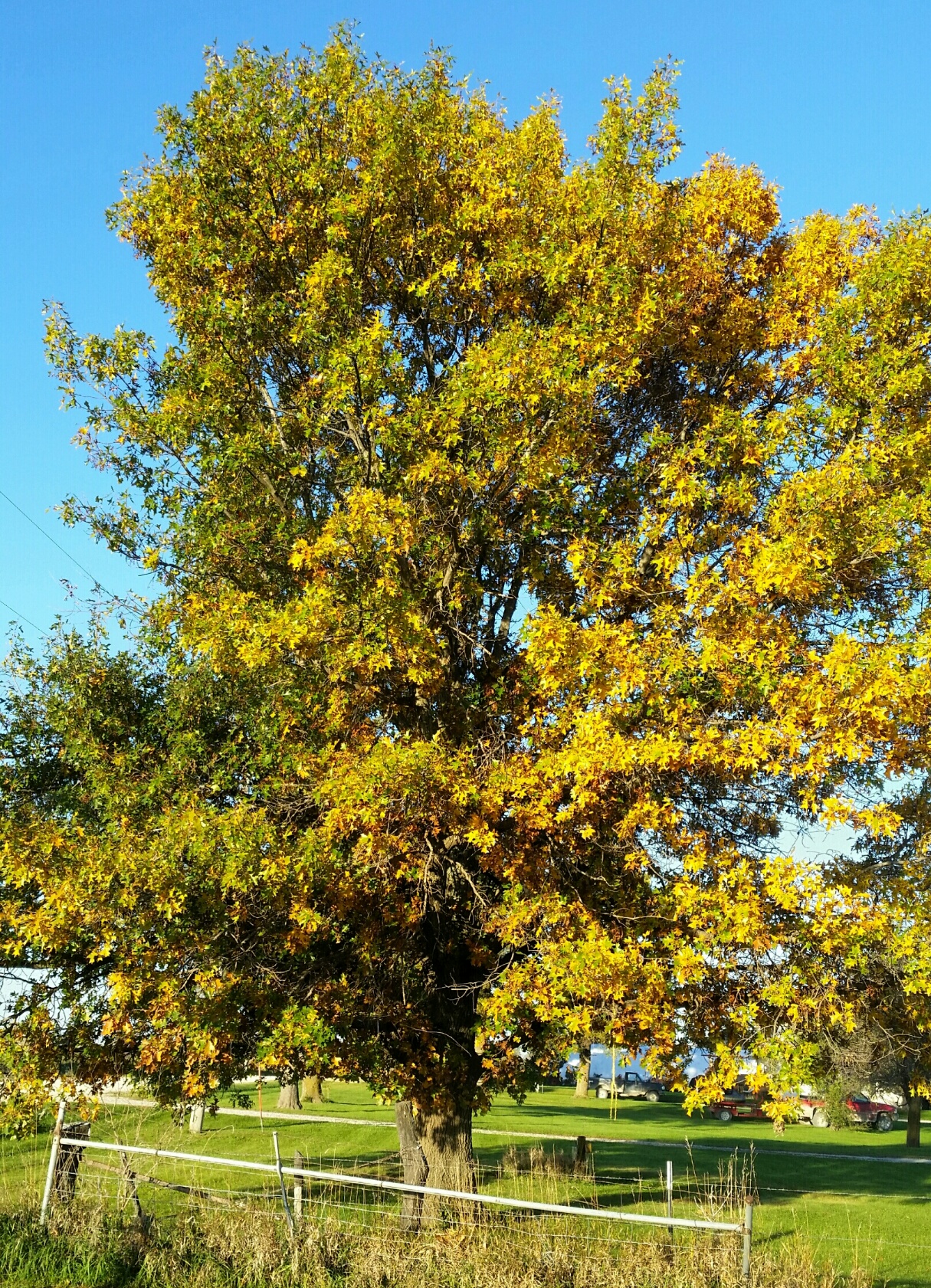
There, in the light of the early evening, I found half the tree a magnificent gold and speckled in green. The other half was a dark, somber green speckled in yellow. It seems the tree was at odds with itself on whether to embrace the current season upon us, or hold on to the summer that had passed. I too get at odds with myself on such matters, and think I might make a fine tree someday. That is if one should someday take me up and relieve me of being part of the plain, ordinary grass.

I wouldn’t help its value none, but I wouldn’t hinder it either, I suppose.

2014-10-23_07.26.21_resized_1

Taken the next morning, and already decidedly more yellow.

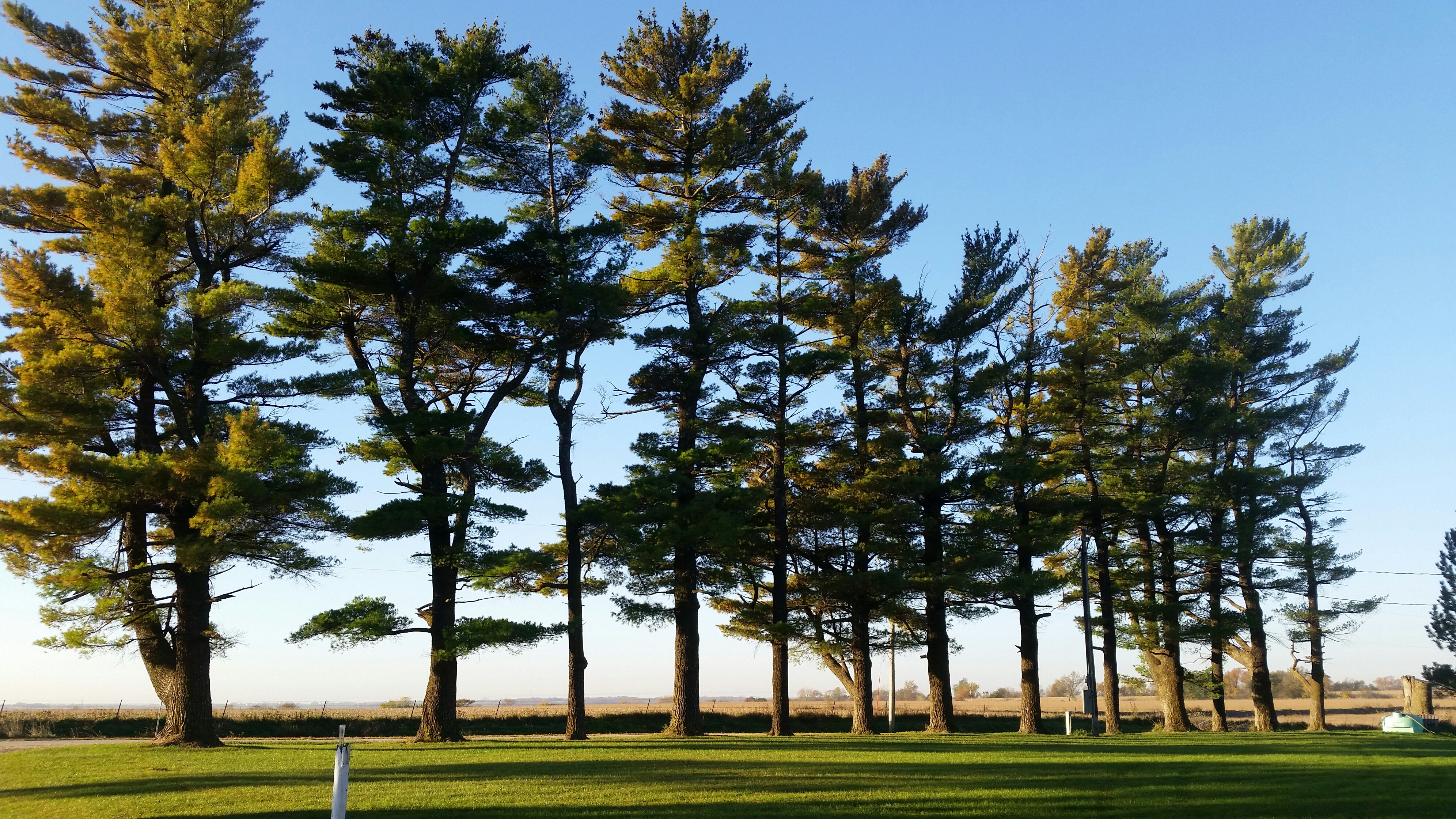
Across the way, at my parent’s home, stand a row of pine which witnessed the rise and fall of the family that planted them, and still hang around, ever green, for whatever it is that will happen next. Not being native, they shed a few needles in the fall and make an attempt to fit in. This is the tree equivalent to crocodile tears, however, and as winter arrives and their neighbors disrobe, revealing the spindly and knotted nature their leaves had been concealing, the pine attempts to keep its dignity.

Planted by the Breen family around 1885.  They were to have had an abundance of potatoes in their cellar, and so they threw a few in the bottom of each hole.

Planted by the Breen family around 1885. They were to have had an abundance of potatoes in their cellar, and so they threw a few in the bottom of each hole.

It keeps so much of it, though, at times it looks down right gaudy. In trying to maintain dignity’s appearance, it forsakes most of it. This not unlike the new neighbor, coming over and partaking in your Busch Light, only for you to visit him one day and find his fridge stocked with various micro brews.

In my yard, though, sat a red oak. This is the tree which keeps its dignity. Its leaves would turn, even if half of them didn’t know it yet, and what will happen when they do gives the oak the dignity denied the pine. Instead of discarding the old, dried out remembrances of what was, the red oak keeps clothed in them until it catches a glimpse of spring. It neither throws what happened to the wind, nor maintain a false green countenance to suggest nothing did.

This particular tree was planted in 1975, when my grandfather and grandmother built a new home, leaving the old to Mom and Dad so they would have a house big enough to raise a family in. During the drought of 1977, it seemed the tree had died, but in three shoots showed up at its base in the spring of 1978. The new shoots became small talk between my Dad and Grandfather as the latter battled cancer.

“You should pick the strongest one,” he told my father, and so my father did.

I suspect the other two’s leaves would have been as much at odds as this one’s was, and I suspect they would linger just as long as this one’s will. What then was it that made this one the strongest? I don’t know, and no one will ever price it.

Noah and Jonah Walk into a Bar (Part One)

Charlie was 12, and while his father waited at the top of the stoop, outside the large, dark door of St. Martins, Charles was content to stand in the grass. The church sat in the middle of downtown. On either side of it were four lanes of traffic, four headed north and four headed south. Together the church campus and the streets served to create an opening among the downtown buildings, allowing the young Charles a view north to an unobstructed sky.

It was a hot July day, and while the sky directly north of him was blue and cloudless, a large line of storms were beginning to fire. He could see thunderheads quickly billowing on either side of the clear patch ahead of him, poking out from the tall buildings of the downtown skyline which framed his view. Down the backside of the west thunderhead glimmered a shimmering silver sprung from the sun behind it, as though a lightning bolt had got caught and hung along its edge. The upper reaches of the east cloud were in full sunlight.

The boy stood fascinated by the scene before him and took it all in, the expansion, the juxtaposition of the light and dark, and the absence of all in the clear blue expanse at the center. In the seconds before the door opened, his father, Francis, turned to look at him, saw where his son’s gaze was, and had his eyes join in. As they did, they were drawn further and further in, until they became focused solely on the mad billowing of the clouds.

How unearthly, he thought. It hardly looks real.

Yet he knew it was real, and that the realness of it had been present many times.  And many times had he neglected to take the time to look.

“Hello, Red,” said the aged priest as the door swung open and Francis turned back to where it used to be. “I see you’ve brought someone along with you. Hello, Charles.”

The boy was small for his age. He wore glasses, and though they were wire rimmed, it still looked like his ears would fail under their pressure and send them slipping down the long, slender slope of his nose. The priest may have called him Charles, but his father still called him Charlie. His mother called him seldom, though frequently, when she did, she had been drinking.

His mother had drank for as long as he could remember, and he knew if he could remember back farther she be drinking even then.

“Well come on in, Charles. I just got done with Wednesday evening mass. I’m about talked out by now, perhaps you could do some of it for me. How old are you?”

“Twelve.”

“I should think a young man of twelve would have all kinds of things to talk about. We will be just fine, Red. I’ll see you in an hour.”

Along one end of the sacristy ran an old church pew and drawn up next to it was an old dining room chair with a cane seat. Tom chose the pew, and the priest chose the other.

“Did your father tell you why he wanted us to talk, Charlie?”

“Yes. He wants me to talk to you about my mother.”

“Do you want to talk about your mother?”

The boy shrugged his shoulders and looked at his shoes. “Yes. We could, I suppose.”

“Yes, well if you want to talk to me about your mother, then you should think of talking to me as talking to a friend, Charlie. Someday I might be that to you, if you wanted. Of course there are people who think all priests ought to be their friends. They forget we are just like everyone else.” Then, after pausing and looking over his shoulder, he dryly added with a wink, “There’s even one or two I can’t stand myself.”

Charles smiled. So did the old man.

“I might give you my thoughts as we go along, but they are only my thoughts, Charles. You’ll find it’s the tendency of the old to give their thoughts to the young. I don’t know what we do it for. I figure at my age I’ve wore them all out, and what good are old, worn out thoughts? Perhaps they will fit together with yours, or perhaps they’ll just fall straight out of my mouth to the floor. It’s of no matter.  The latter has happened many times, quite a few of them have been right back here.  I suspect the floor is used to it by now.

As we go along, I want you to remember one thing. If things seem particularly overwhelming, or difficult for you to make sense of, there are others you can talk to who might be better able to relate to a young man of your age, than this old man, who’s never been married and has no children of his own.”

At that remark Charles looked back up at the slate blue eyes across from him and dropped down to the square jaw sitting just above the white collar. The mouth above it, which had been parallel to this jaw, broke into a slight smile. Charles smiled a second time.

“If you decided you want to talk to someone like a therapist, someone who has training in these matters, I can help you with that. There is no shame in it, and I know some good ones.”

“Okay.”

“Well then, Charlie, tell me, why did your father feel you and I should speak?”

“It’s not much of a story really. Last Monday I was supposed to spend the afternoon with Mom. Dad was there when she came for me, and he thought he could smell that she had been drinking. He apologized, but told her that I couldn’t go with her. She asked why not, and Dad told her and said it wouldn’t be safe for me to get in the car.”

“Was your father angry?”

“No. He said it all in his very matter of fact way.”

“How did your mother respond?”

“She’s the one that got angry. She said it was her time to see me, and Dad was just making an excuse so she couldn’t. Dad invited her to spend the time at our house, and she said he had lost his mind if he thought she was ever going to step back in there again. Dad said he wasn’t denying her the opportunity to see me, but he wasn’t going to let me to get into a car with her. Anyway it ended with Mom saying if he didn’t let me go she was going to call the police.”

“Did she?”

“Yes.”

“What happened next?”

“They wound up arresting her in the driveway for drunk driving.”

“Not exactly how your mother envisioned things, I suppose.”

Again he saw the corner of his mouth lift into a slight smile, but Charlie didn’t return it.

“No.”

“Have you spoke with your mother since?”

“Yes.”

“Did the two of you talk about what happened?” Charles nodded. “What did she tell you?”

“She told me the cops didn’t know what they were doing and how they had just taken Dad’s word for everything. She said she had hired a lawyer, and somebody was going to have to pay for all of this.”

“I see. Well, what do you think of all of that?”

“I guess I wouldn’t expect her to say anything different, Father.”

“And the rest of it? How do you feel about that?”

“I didn’t want to go anyway, Father.  As far as the rest of it, I wish a lot of things were different.”

“Well there is no problem with that, Charles. Do you think your mother might feel the same way?”

“No. It’s what she wants.”

“Are you sure about that, Charles?”

“Yes. It’s been like this forever.”

“Hmm. Sometime I need to tell you about all the horrible parts about me that have been that way forever too.”

“But you are a priest.”

“There you go, Charlie, thinking we are different than everyone else. Do you know who the first drinker in the Bible was?”

“No.”

“Noah.”

“Noah?”

“Noah. He gathers everyone and everything up, gets them on the boat, and sails and sails until he hits dry land, never once questioning God. The boat must have smelled like a zoo, and why that never drove him to drink is beyond me,” said the priest with a twinkle in his eye.

“What drove him to drink then?”

“The Bible doesn’t exactly say. Some speculate he was wondering whether or not he was any different than all of those men, women, and children who drowned. Personally, I think that is a compliment to old Noah. Usually we reassure ourselves of our own righteousness, don’t you think?

As I said, the Bible doesn’t mention Noah’s thoughts on this, but it does mention another story right before his drinking.”

“What story is that, Father?”

“Well the author tells us that God had already decided in His heart never to destroy the world again, but our man Noah doesn’t know that. All God tells Noah is that He won’t do it by a flood again, and then He adds that as a sign He will place His war bow in the sky to serve as a reminder.

It had to have been unsettling to Noah to think God would need a reminder. More unsettling was that the reminder, a rainbow, only comes once the rain is over. And more unsettling still is the fact that some translations seem to have God saying to Noah, ‘Oops.’ God seems to be having a little fun at Noah’s expense. Noah fails to see the humor in it.

What do you think Noah wanted?”

“What we all want, I suppose.  A better promise and perhaps a better justification for what had happened.”

“A promise about what?”

“About what the future will be like and that what had happened in the past won’t happen again. We all want that, Charles, and more often than not, we are all denied it. As near as I can tell, that can drive good people to drink.”

“Well it’s wrong, Father.”

“Charlie, I’ve heard a lot of confessions back here in my time, an untold number. Many confess the same things over and over again all the time I’ve been here.”

“Well they need to quit doing whatever it is that they are doing, Father.”

“You’ll find out it’s harder than it looks. But you are right, they haven’t, but they know it. It bugs the hell out of them.  God bless them, Charlie. They’ve taken the terms “right and wrong” and instead of applying them to others, they applied them to themselves.

Do you know what ‘relativism’ is Charles?  They say it is the thought that there is no right and a wrong anymore. I wonder if that is any less relative than all the time we have spent using the actions of others to define those terms for us? We’ve been doing that for years, I think, and the Pharisees for years before us.

Now you think you know what’s in your mother’s heart, and that this gives you license to judge her. I’ve never spoken with your mother, but my experience, back here in this room, is that rarely do we know what lies locked up in the heart of another. In that light, perhaps we ought to have some compassion for old Noah, ‘the only righteous man of his time,’ the Bible tell us, and perhaps we could find some for your mother.”

“But there is wrong, Father.”

“Oh most assuredly, Charles. There is wrong.  Sometimes I think that’s what the other great sea story of the Bible is about. You may think your mother is hell on wheels, Charles, but she’s got nothing on the old Assyrians.”
Fall in Northeast Iowa (Complete with an Artist’s Interpretation)

“The gentle reader will never, never know what a consummate ass he can become until he goes abroad. I speak now, of course, in the supposition that the gentle reader has not been abroad, and therefore is not already a consummate ass. If the case be otherwise, I beg his pardon and extend to him the cordial hand of fellowship and call him brother.”   -Mark Twain

This past Sunday my mother and her sisters were down in Missouri, visiting extended family. I had read, someplace, that it was now peak season to see the leaves in Northeast Iowa. I had been up there before, on a similar trip, when I was married. A few years later we got divorced. I hoped for better results this time.

Now when I travel to see the leaves in Northeast Iowa, it generally places me in proximity to a couple groups of people I disdain. The first are those who drive around in cars with bikes attached to them. These people must be terribly poor at making up their minds.  Perhaps they are first cousins to those I see in the grocery store wearing exercise clothes.

They are not to be confused with those driving around with canoes on top of their cars. While they can be annoying too, I chalk this latter group up to those the Almighty has either blessed with an abundance of prudence or cursed with a particularly acute fear of water. The best I can muster for those in cars with bikes is either that they haven’t gotten around to fixing the fuel gauge or their spare.

The second group falls under the mantle of the term “bird watchers.” I’ve nothing against actual bird watchers, mind you, but I would be surprised if we apply the term accurately to any more than one out of ten. This leaves the other nine armed with all the tools of the trade required to be a peeping Tom, and us having disarmed our suspicions, at least until now.

Particularly troubling is that I’ve yet to meet anyone that can tell difference. Since we can’t tell which is which, it seems the only natural thing to do is to let the Big Guy sort it out. This same thinking has given rise to Crusades and Indian Wars, and it is my hope I should live long enough to see the Gates of Hell unleash its fury once more on anyone dressed outdoorsy like with binoculars around their neck or a camera with a lens big enough to need its own case.

You may object, and that is your right, but tread softly, gentle reader. You tread on my dreams.

Now a fine gateway to any such trip in Northeast Iowa is to see the mill on the Wapsipinicon in Independence. It sits smack dab in the middle of town, stands several stories high, and lies up against the bridge on the main thoroughfare.  This is where we started, but given that I had a better mill in mind, I passed on a picture.

Downstream, towards the town of Quasqueton, is Frank Lloyd Wright’s Cedar Rock. It is a beautiful home sitting in the trees on the bank of the river. Dad and I had each seen it a couple of times and decided against another.  I mention it, though, because there I first became familiar with the legend of how the Wapsipinicon got its name.

The legend tells of Wapsi, a young Indian brave, stumbling upon and falling in love with the daughter of another tribe’s chief. Her name—you guessed it—was Pinicon, and the star-crossed lovers soon made plans to elope. (The next tribe west had a Justice of the Peace, whom looked remarkably like Elvis.) Their respective tribes, realizing they were gone, soon gave chase.

Coming to the banks of the river, the lovers clasped hands, kissed, leapt, and subsequently drowned because neither had a car sporting a canoe on top of it.   I truth, I don’t think they were lovers at all. I think they got caught bird watching.

We made our way through Strawberry Point, and headed up to the town of Elkader, which sits nestled on the banks of the Turkey River. Outside of town was the mill I was most anxious to see, and after a few miles of gravel we finally found it. Parked by it was the customary Subaru with two canoes on top.

Motor Mill2

We turned our sights as far northeast as we could go and traveled to the armpit of Iowa, New Albion. This is not to be confused with Albion, which we had already driven through coming past Marshalltown. In my opinion, when comparing the two, that to term this one “new” was stretching it. They sported a slogan of some sort or other.  Seeing that it did not mention “armpit,” I paid no attention to it. Its omission, combined with their use of the adjective “new,” told me all I needed to know about them. Old Albion was full of liars.

South of Albion lies Lansing. Lansing sports a bridge across the Mississippi. Dad and I stopped along the road, pondering what exactly it was that kept the bridge from falling into the Mississippi. We had been studying it for several minutes when I noticed that behind us, looking out over the river, was a bar. In one window I could see an elderly local, quietly drinking his beer and looking at the same bridge we were.

Lansing Bridge

I figured if he’d been looking at it his whole life and hadn’t come up with anything yet, we were not bound to fare any better, and so we continued on to Effigy Mounds National Monument.

It’s about a mile walk to get from the visitor’s center, up the steep bluff, and to the first substantial mound. Dad didn’t figure he could make it, but encouraged me to go ahead. Part way up, I wasn’t sure I was going to make it either, but I did my best not to make a scene about it and quietly restrained my huffing and puffing whenever I happened upon someone else going up or down.  That is until I passed a guy in a winter coat with gloves on.  It was 52 degrees, and I figured I, huffing and puffing, could look like no more of an ass than he did.

The first thing of interest I came to was this:

Bladdernut

There had been several signs noting the various plants and trees along the way and what the Native Americans had used them for. Now they were noting the ones the Native Americans had no use of. There are going to be a lot of signs, I thought. Seeing the name of the plant, I wondered if it wasn’t a clue as to the natives’ lack of interest. I could offer a guess on what the fruit of the bladdernut might taste like. In fact I could offer two particularly good ones.

On the way to the top, I’d meet kids running ahead on their way down. I would smile and later offer their parents a “hello,” “look like you’ve got your hands full,” or “I had them clocked at 55, and they were still gaining.” Occasionally I would meet other families a little more anxious, warily clutching their children’s hands. To them I said, “It’s all right; I’ve no binoculars. I’m not a bird watcher.”

If you are not familiar with the mounds, they were built by the Native Americans. The National Monument to them is just outside of Marquette and right above the Mississippi. Some of the mounds have animal shapes, and the first one you come to is that of a little bear, maybe 45 feet long.

I call it a bear because the sign said it was a bear.  I am convinced were they to mow the grass a different way they could just easily claim it was anything from a tortoise to a kangaroo. Still, they said it was a bear, and I didn’t see how believing them was going to cost my anything; so I did.

Right behind Little Bear Mound, even with his feet, you’ll note the appearance of a second mound. This one has no name, but given its location I thought of a couple.  Both were based on whatever I suspected the bear had consumed as his last meal. My best guess is that Bob the Brave was buried in that little mound, and the bear that ate him was in the first. That’s because I don’t believe these mounds are as shrouded in mystery as our more learned scholars.  It’s my belief their purpose was quite simple.

“Suzy, don’t you remember what I told you about bears? You don’t want to wind up like Bob the Brave do you? Do I need to take you up on the bluff again?”

As I continued along the trail, I soon found I wasn’t the only one offering interpretations. On my way to the scenic overlook, I passed the first interpretive sign. It told about the native builders and referenced the image above the words by saying: “This is an artist’s depiction of what they may have looked like.”

As I walked on, I thought to myself how we use the term “artist” as though it gives the depiction greater objectivity. In reality what they did was go to an individual whom was well known to be predisposed with an over-active imagination and said, “Draw us a picture.” Any thought to the contrary was quickly dispelled when I reached the next sign, pictured below.

The Dead

The particular sign is an artist’s depiction of a tribal burial. What caught my immediate attention, of course, were the bare breasted women dumping dirt over the deceased.  I also noted a hint of a smile on his face. There are many things I think the Native Americans were ahead of us on, and after viewing the above artist’s depiction, I added their concept of proper burials to the list.  In fact, I placed it near the top.

When I returned to the car, I was going to tell Dad what all I had seen, but wound up keeping it to myself.  He’d never believe it, I thought.

Since Prairie Du Chien was just across the river, we ran over to stake claim on a couple of six packs of Spotted Cow beer, one for me and one for my mother. I was looking for the first place that might sell beer, when we passed a liquor store that had a sign out front claiming over 500 different wines. The store was called Stark’s Sport Shop, and when I went in I was greeted by the 500 kinds of wine, a liquor sectioned that dwarfed the wine section, a cooler from which I selected my beer, rows of lures, fishing poles, ammo, guns, sausage, pickled eggs, and cheese curds. There was a line of ten people waiting for one of two cash registers, and as quickly as one sale rang up, someone else took their place.

“You guys always this busy?” I asked.

“You think this is something, you should have been in here yesterday.”

I didn’t know if I would be able to leave such a den of manhood, but I pulled myself together and wept my way back to the car. Had they sold lazy boys and big screens, I probably would have filled out an application.

Spotted Cow

We crossed back over and continued down through McGregor, which is the closest thing Iowa might have to Deadwood. We stopped at Pike’s Peak State Park, named for Zebulon Pike, the same early explorer Colorado Pike’s Peak is named after. In 1805 he identified the site as an excellent spot for a fort.  They built it in Prairie Du Chien instead. It’s hard to compete against a place selling guns, liquor, fishing supplies, and pickled eggs.

A couple of years later he headed for Colorado on horseback. I have it on good account that he had a jackass strapped across the back of it. It’s a shame. I could have understood a dugout canoe.

Pike’s Peak looks out onto where the Wisconsin River enters the Mississippi. It was there that Louis Joliet and Father James Marquette became the first white men to set their eyes on the Mississippi.

Pikes Peak

The Wisconsin River runs along the bluff on the right side of the picture.

Our final stop was Balltown, where we ate at Brietbach’s Country Dining, Iowa’s oldest restaurant and bar. How it maintains this designation is unknown to me. The original owners were not named Brietbach, and the original building burnt to the ground in 2007. Ten months later it did so again. It seems they change their restaurant as frequently as the oak changes its leaves.

The thought that the designation of ‘oldest’ needed neither permanent establishment nor name, let my thoughts naturally wander to ancient Adam. He was separated from me by more names than even the Bible could inventory. Each one of those names was on a building which sprang up and was gone, only to have a new one take its place. If I was eating in Iowa’s oldest bar, I was doing so as the oldest man alive.