The Stone Masons

“Duane Honnold died this morning.”

This is how I was greeted the 7th of March, arriving at the Madison County Livestock Auction to look over a set of yearling bulls.  We were in the midst of an unusually mild string of March days.  The bulls looked nice on display.  Either of these would have been normal starters for conversation, but on that day they were just too common to do.

Duane was 90, and I had only really gotten to know him over the last few years as I became more active in the Madison County Cattlemen’s Association.  A cattleman is how I will remember Duane, but like most cattlemen, he was a lot more than that.

He was a stone mason, a teacher, drove a truck, drove a school bus, was building inspector, the past president of the county pork producers, the county cattlemen, a county Farm Bureau member, a commissioner on the Madison County Soil and Water Conservation Board, a 4-H leader, a Lion’s Club member, an elder of his church, and the list goes on.  Longer than he had done any of those things, however, he had been a husband to his wife, Edna, for 71 years.  They enjoyed the type of collaborative partnership nearly all hope for in getting married, but plainly speaking, most find elusive.

Duane struck me as a man who was very particular about what he wanted.  What he wanted was the best, and naturally those who were affiliated with him benefited from the results.  The results live on in Madison County and beyond, from the stonework of the north shelter house at the Winterset City Park to county fairs around the country and their peddle tractor pulls which he’s given credit for establishing.

Edna is every bit his equal, and I always wondered how that worked.  How could two people, equally particular on what they wanted, form such a strong bond with nary a quarrel?  I finally figured it out a couple of county fairs ago.  Outside the fair booth was Duane’s domain.  Inside was Edna’s.  Duane never forgot that, and Edna never had to remind him.

Together they were a power couple long before anyone had ever coined the term “power couple.”  They remained so always.

Attending his funeral, I thought I would see Duane one final time, yet when I got there I realized I was mistaken.  What was before me was just his body.  I thought of all the people in my own life that were still living, and I had failed to see any deeper than that.  Duane seemed to see beyond it, and even as a church elder, saw something more in an individual smoking with the sulfuric smell of brimstone like me.  Because of that, he will live on for some time, especially for us fire eaters.

A week later, at yet another Madison county bull sale, Edna, along with her son, Dwight, and his wife, Lynn, came into the sale barn.  They sat up in the rafters, and after awhile I went up and took a seat beside Edna.

I hadn’t visited with her since Duane died, and before I left, she lightly grabbed my arm, looked me in the eye, and said she didn’t want the Madison County Cattlemen to forget about her.  She wanted to stay active.  I was moved.  Edna and Duane had been part of the Cattlemen since the Cattlemen began.

I was also moved by her strength.  Most of us will live our lives convinced if we can only become harder, life won’t touch us.  We will, and it won’t.  Edna reminded me that true strength isn’t shown by us getting harder, but by the ability to be vulnerable to whatever life throws at us.  Our hardness is a crutch for what was already broken.  Vulnerability is nothing more than having the strength to bend.

I suppose understanding that is what made her and Duane so capable in working with us stones.

“And one more thing,” Edna added, “I don’t want to see the Cattlemen go downhill.”

Neither do I.  Judging by the masons, the roof might leak, but the walls are sound.  And God knows, if Edna is willing, there’s nothing going to be headed downhill in the Cattlemen’s booth when fair times rolls around.

Duane

Duane. If I’m not mistaken, in front of some of his handiwork. Photo stolen from the Winterset Citizen webpage.
Tomorrow is a Foolish Thing to Do

At 6 this evening I found I had been tided over the whole afternoon with nothing more than a little bottle of Gatorade.  I had one more trench to dig and another intake to set.  It would be dark in a couple of hours.  Still, it seemed as good a time as any to take a break.

The closest town was Churchville.  The closest real town was Martensdale.  “Real” in this case means a group of houses with a gas station and a post office.  Churchville has neither; Prole has one.

Martensdale also sports a school, and twenty years ago this spring I left it.  I was happy to go; they were happy I went.  I never looked to make sure the diploma was signed; they never looked to make sure it was there.  It was a draw then.

In my day the gas station was known as K&W.  It’s called something different now and is further proof that my day has passed.  Beyond the name I wouldn’t have known the difference until I had either tried to rent a VCR or noticed that John, the man with the curiously long fingernail on his pinky, was no longer manning the register.

Tonight I found the heat lamp trying to culture a science experiment on the jalapeno poppers.  I wagered that the heat of the jalapenos would kill anything that was attempting to grow.  Had I thought it a close bet, I would have hedged it with booze from the cooler in back.

I was in the process of paying for the poppers, a Sprite Zero, and a cheeseburger hardly worth mentioning, when a former classmate walked in.  We caught up, and as we did so my attention wandered down to his son.

“What’s your name?” I asked him.

His son looked surprised that I had spoke to him and bashfully looked up to his father.

“Answer the man,” his father said and pointed in my direction.

“Nolan,” the boy said quietly.

I judged him to be in fourth grade, but I asked to make sure.

“Well Nolan, I’m Dan.  Your Dad and I went to school together.  What grade are you in?”

“Kindergarten.”  And just like that the bashfulness fell away, and Nolan began to talk.  “But nobody believes that, though, because I am so tall.  I’m the tallest one in my class.”

“Have you started playing basketball yet?” I asked with a touch of sarcasm hardly above his head but evidently beyond his grade.

“No,” he said in an honest and puzzled way with the same clear eyes I remember his father having when he and I were boys.

His Dad was there to pick up a taco pizza, and Nolan was excited about it.  I suspected time would cure him of this, and I thought that a shame.  Adults are never satisfied with the right moment unless it comes at the right time.  A taco pizza is nothing to get excited about if the bills are piling up, work is a mess, and the neighbor’s dog is still fertilizing your yard.  To the young, however, the time is always right if the moment is.

No junior high boy worth his keep worries where the girl he’s attempting to steal a kiss from is going to be five years down the road.  He only knows she’s worth the attempt, and that the moment currently presenting itself might not come again.

“Well, Nolan, you pay attention in school.  If you don’t, you’ll wind up like me, digging a ditch someday.” It was my standard joke.

“Don’t let him fool you, Nolan.  He was one of the smartest kids in our class,” said his Dad.

I was trying to instill in young Nolan a certain sense of work ethic.  Work hard, and good things will happen.  His Dad comment, however, might give him the idea it’s mostly for naught anyway.  I suppose it’s best to have the boy see the world for what it is, instead of forcing on him what we hope it to be.  Maybe that’s what being a man is, after all.

Still, when he gets older he should try to steal that kiss when the moment presents itself, even if it is for naught.  Tomorrow might be a foolish thing to do, but today usually ain’t half bad.

https://www.youtube.com/watch?t=24&v=I5j6fcCAF-Q

The Unreported Art of Questions and Trends

“Recently, the Des Moines Water Works announced it would pursue a lawsuit against three northwestern Iowa drainage districts because of record high levels of nitrates in the water flowing from those districts, leaving the job of removing the nitrates to Des Moines Water Works. Do you think the Des Moines Water Works is right or wrong to pursue this lawsuit?”

This is the question that was asked by the Des Moines Register for an Iowa Poll featured in last Friday’s paper.  63% of the respondents were in favor of the Des Moines Water Works intended action.  23% were opposed.  14% were unsure.  Donnelle Eller, whom covers both the agricultural and environmental beats at the Register, wrote the story.

On the same day the story ran, I was taking part in a group that brought together everyday people telling the story of agriculture and rural Iowa so they might share how they do it and what they have learned with each other.  Donnelle had been asked to speak to us.  My impression of her was that of a ‘straight shooter’ and someone striving towards unbiased reporting.  She had a good sense of humor, spoke directly, and was very approachable.  This was all well because a few of us thought the question above was off the mark, and we didn’t miss the opportunity to say so.

“I think it is pretty fair and straight forward.  What do you take exception to about it?” asked Donnelle.

“Why did you need the first sentence before you asked the question?” asked someone.

“It’s accurate isn’t it?”

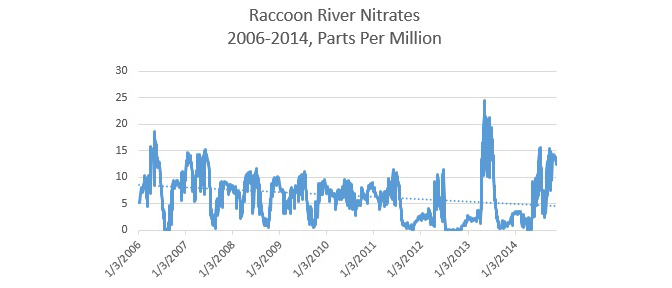
“Actually, I think the Iowa Department of Natural Resources and the U.S. Geologic Survey say it’s been trending lower over the last eight to fifteen years.  I think Des Moines Water Works own data supports this claim.  What would have happened to the poll results had you mentioned that trend?”

Someone else added, “I’ve never read an article in the Des Moines Register which actually examines the trend of nitrates in the Raccoon River.  Did I miss it?  I read Bill Stowe saying it keeps trending higher and higher, and that there is no evidence we are having an impact.  At least two other government agencies and a former governor, the current U.S Secretary of Agriculture, say otherwise.  Which is it?”

“That’s on the top of our list to cover next.”  I think it was supposed to be reassuring.  The fact that it had went unexamined this far wasn’t, however.  “I think Bill Stowe would say that he’s not in the business of dealing in trends, though,” she added.  For not dealing in them, he certainly seems to be selling the hell out of a particular one.

It is frustrating for me.  As an assistant Soil and Water Conservation Commissioner in Madison County, I get to see first hand the waiting list of farmers wanting cost share assistance for large scale conservation projects.  This assistance isn’t just in terms of dollars, but also design and engineering.  As a commissioner and a contractor, I got to witness a staff laying these projects out as fast as they can, but hardly keeping up with contractors also facing the same workload.  As a farmer I know firsthand how these new practices will compliment existing ones already in place and are part of a long term plan for the future.

In terms of the trends involved, one can do a Bing image search of “nitrate levels in the Raccoon River.”  The two graphs below will pop up.  One can see how both trends can be argued at the same time.  What do they look like to you?  Does it impact how you would answer the poll?

I would like to be able to tell you how all the stakeholders involved collaboratively view the below, but unfortunately I can’t.  One of them has not been in a collaborative relationship with the rest for some time.  For my part, as a farmer, contractor, and assistant commissioner, you get up every morning, try to do the best you can, and try to figure out how it is you can do better.  In this effort I get assistance from all groups but one.  It is harder because of their absence and will likely be harder if attorneys get involved.

RaccoonRiverNitrates2006-2014

Basic RGB