The Great Danes

“The world is a very big place.”  This is something we tell our children to keep them from overly focusing on themselves.  I couldn’t argue with the truth of it, but in the world’s entirety the only thing I seem to find any hope in exercising control over is myself.  My efforts have served to keep my hopes modest, but if we are to try to control something, controlling ourselves is probably the best course.

Someone once told me that wanting others to do what you want them to do is a sign of immaturity anyway.  I would find that true enough as well, were it not for the fact that it might also be a sign of a natural inclination towards politics.  The truth of whether or not the two are related I’d leave up to the reader.

In doing so, I’d simply comment that the things which generally harms us most are the things we think we know that aren’t so.  We naturally refute anyone who tries to correct us on those topics, and we are left to discover the errors ourselves.  It is an uncomfortable thing when we do, so we quit looking to avoid it.

Last Saturday we helped host a group of 25 Danish farmers for part of the day.  I was excited to do so. It seemed like an opportunity to pay back the hospitality I was greeted with a couple of years ago in Ukraine.

Being the oldest of my siblings, I’m particularly predisposed in trying to figure out what others’ expectations are, how I might meet them, and what kind of job I’m doing along the way. Feel free to tell me how, ‘It’s a big world out there.’  It so happened I was with 25 of the rest of them.

We had a farm style lunch for the day, with the county cattlemen grilling steaks and sides and deserts from the Machine Shed Restaurant.  While they were eating it, I was thinking about how much they seemed to enjoy their visit with our neighbors, the rest of the day’s schedule and weather, and whether or not they were enjoying their meal.  As they began excusing themselves to get pie, one returned with a, “Now there’s an American-sized portion.”

He had a slice of lemon meringue, the meringue being twice the thickness of the deep pie and foreign to him.  Another had returned with a slice of the Snicker pie, took one bite, looked at me, and said, “How do you say….that’s rich, yes?”  The sweetness was foreign to them as well.
Lynch's

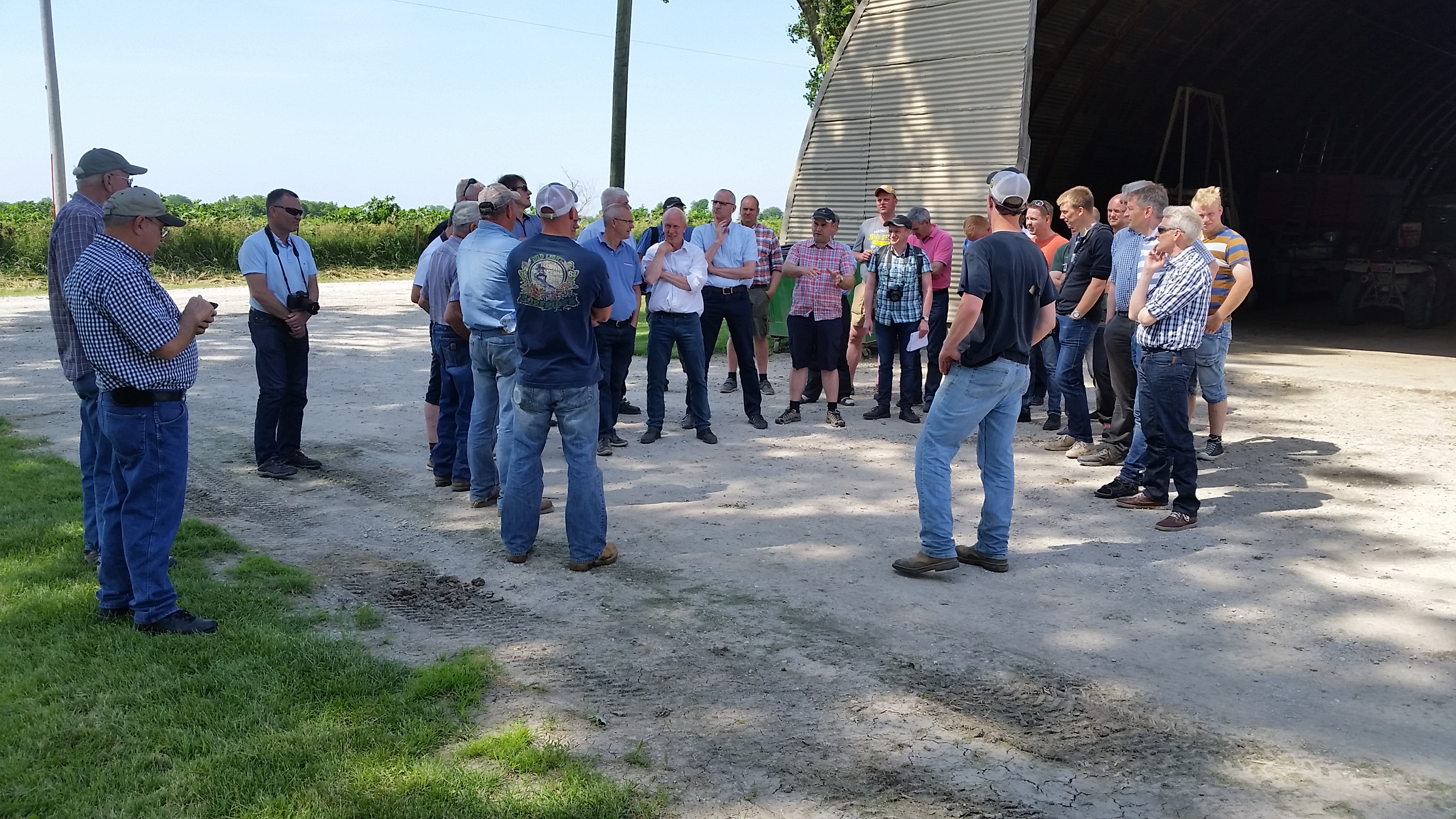
The Danish group enjoying a taste of typical American farming at the Lynch’s.

My train of thought would have took me through the rest of the afternoon, were it not for a tall, raw-boned young man I was sitting next to.  I would have took him for an American were it not for the accent and his near perfect English.  The Madison County Youth Beef Team had helped serve the meal, and he wanted to know what effect I thought they had on advocating to the local public on behalf of those involved in agriculture.

“What’s the relationship like between those in agriculture and the general public in Denmark?”  I asked him.

“The two groups are very much disconnected.  We are labeled all sorts of things, both good and bad, without any real understanding.  A large part of the public thinks of us as being bad for the environment for instance.”

“In Denmark?  All thought all the European regulations were supposed to have fixed that,” I said with a smirk.

“Yes, yes,” he smiled back.  “The fact is Denmark prides itself on being even more restrictive than the EU.  Everyone is for “less fertilizer,” but no one has any real understanding of what it means beyond the few of us in agriculture.

Here I am amazed at the efficiency your farms operate with.  We use so little nitrogen we are at a fraction of it.   It is so difficult we are now having other countries reject our wheat shipments because the wheat is not high enough in protein.  It is not high enough in protein because it is malnourished.  We import some livestock feed because we can get a higher quality grain elsewhere.”

“Is this making an impact on the people in your country?  Are they seeing the light?”

“No.  They are as convinced as ever that they are doing the right thing.  They don’t understand what they are doing.

I like farming.  I like the lifestyle.  I have two young sons, and I enjoy being able to take them to school in the morning and pick them up.  I wonder what it will look like if they ever want to do what I do.”

Perhaps the world isn’t as big as we make it.  Maybe we don’t know what we think we know.  Perhaps we are never as great as what we think we are.  Maybe someday the public will have the courage to take a look again.
Pasture

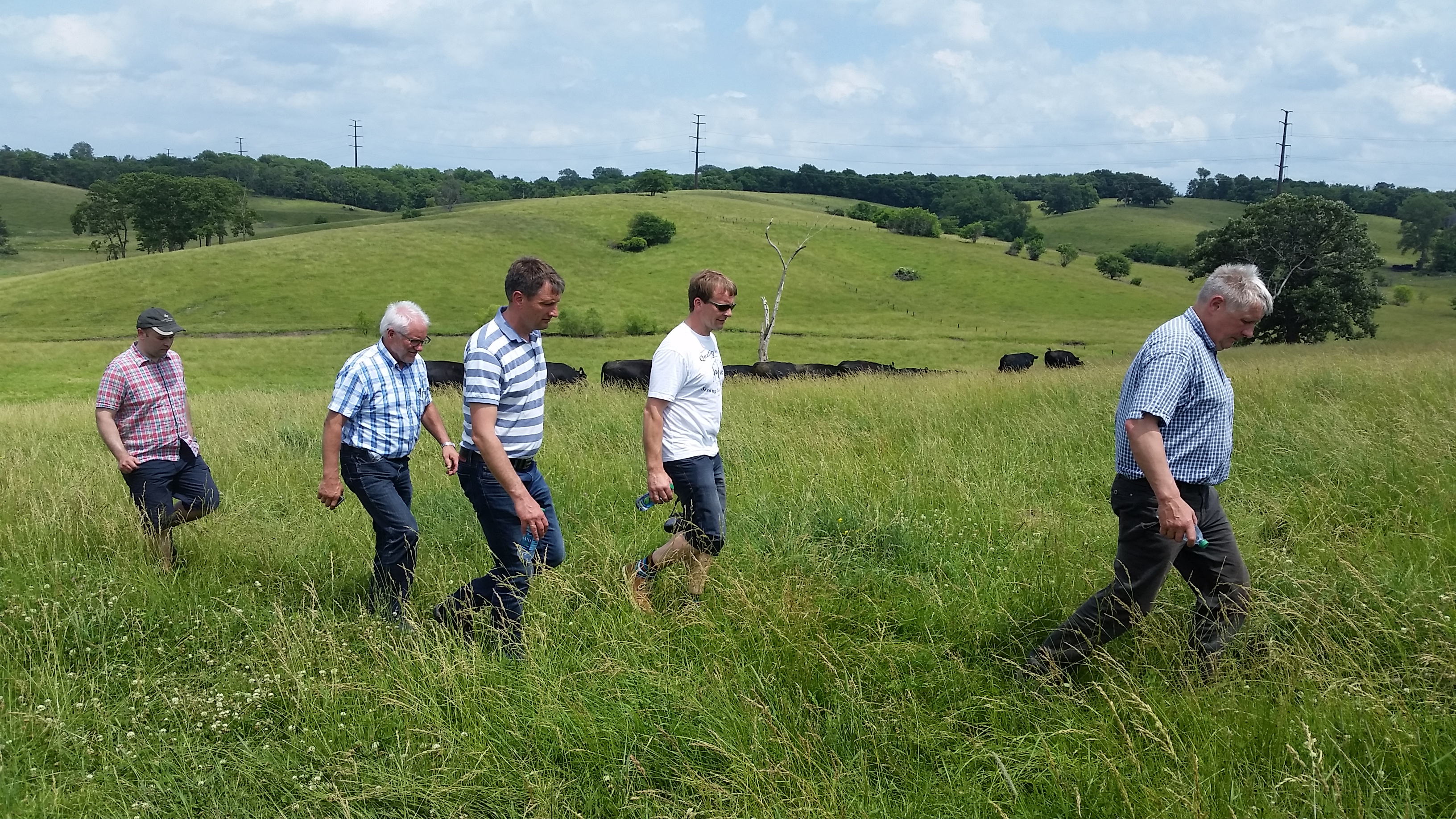
The final few Danes leaving our pasture to begin their journey home.
Sustainable Beef and a Lesson in Humility

June 11th was the Iowa Cattlemen’s Association’s Summer Policy Conference. It is an annual effort by the group to identify current issues in the beef community and to educate members about them. The keynote address was given that morning by Dr. Kim Stackhouse, whom has headed up the National Cattlemen’s Beef Association’s look into our industry’s sustainability.

It had been three years since I had made one of these conferences. The last was made when I was part of the Young Cattlemen’s Leadership Program. (I take comfort in the fact that my youth is not more than three years behind me.) As part of that program, we discussed how NCBA was then getting the ball rolling on Stackhouse’s work.

I wrote a little editorial at the time which found its way into an online part of Beef Magazine. Twenty people probably saw it. It was titled “Is Our Use of ‘Sustainability’ Sustainable?” In it I was critical of NCBA’s efforts in chasing a term they seemingly had no control of the definition of.

Activists groups, some of who were intent on putting us out of business, had been so successful in their definition that in 2007 Time Magazine proclaimed “a 16 ounce T-Bone is the equivalent to a Hummer on a plate.” In 2010 San Francisco passed a resolution which made them the first “Meatless Monday City.” Despite the urge of some of us to ‘hunker down,’ NCBA entered into the conversation.

Three years later, hearing Dr. Stackhouse, it was readily evident my bunker mentality had been in error.

Sustainable Beef1

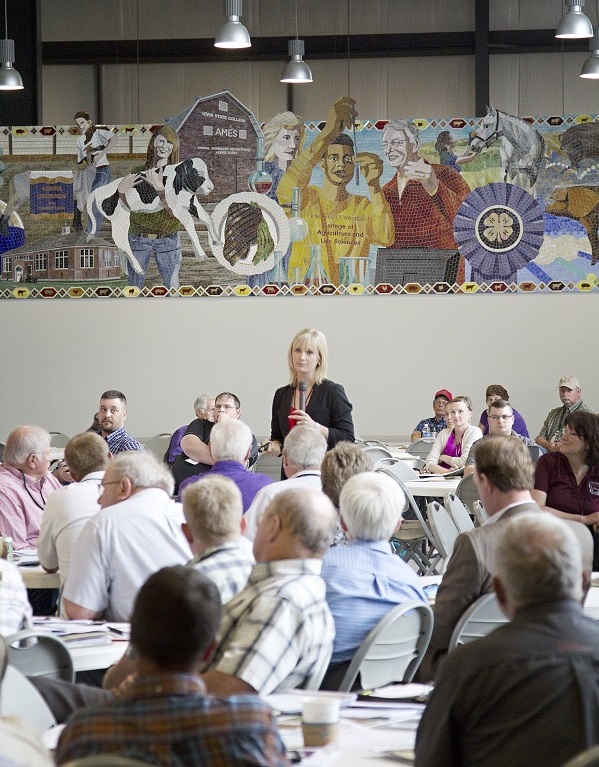
Dr. Stackhouse addresses beef producers from across the state. Photo courtesy of Iowa Cattlemen’s Association.

“We will never have a consistent definition of sustainability,” Dr. Stackhouse said, but taking us step by step through her years of work, it quickly became apparent that thanks to her efforts the beef community will have a fair sized seat at the table as it is being debated, discussed, cussed, and reviewed. The community got this seat by engaging in the argument armed with facts, and these facts came from Stackhouse’s research. She had created a ‘Life Cycle Assessment’ for the entire beef industry, looking at all the system’s inputs (right down to counting rolls of toilet paper a packing plant uses in a year) and weighing them against the system’s outputs. To date I believe it is the only life cycle assessment that has been completed by a major commodity group.

There were two goals in doing the assessment. The first was to establish based on facts where the industry was. The second was to establish based on the same facts what the trend was in beef production. Were we becoming more or less sustainable?

They looked at 2006 to 2011 and found that while there was no organized effort to improve sustainability, it had happened anyway. There had been a 5% improvement over those 6 years. Also notable was the new light shed on how many factors seemingly outside beef production impacted it.

1/3 of all energy use of all energy used in the system is actually used by the consumer in their homes. Believe it or not, your in house refrigerator pales in comparison to the efficiency that a packing plant operates at. The system also has to account for the food the consumer wastes. 1/3 of the world’s food is wasted. If consumers could merely cut their waste of beef in half, we would realize a 10% boost in sustainability overnight.

Acquiring and putting such detailed data to use has allowed NCBA to spearhead roundtable discussions on sustainability that groups like McDonald’s, Walmart, and Costco have sought to be part of. Whether or not Stackhouse is present during these discussions, her voice certainly is. “Zero impact is not possible. There are tradeoffs; always have been and always will be. The questions are what is the trend overtime and is technology part of the solution?” To the latter the data shows it has been, and with a needed 70% increase in food production by 2050 to meet world population growth, it had better continue to be.

Luck placed me behind Dr. Stackhouse in the lunch line. I found her quick witted and a joy to talk to. “It’s a pleasure to be in Iowa where so many of you are so progressive,” she said.

“It’s rare that anyone considers me progressive,” I quipped back.

Somewhere in cyberspace is an editorial which underscores it, but what can I say? I was young then.

The Farmer at the Farmers’ Market

IFFP 2

A few weeks ago I got a call from Nancy Degner of the Iowa Beef Industry Council.  A group called The Iowa Food and Family Project was partnering with the Mills Civic Hy-Vee, and they had invited six people and their friends to spend an evening making a week’s worth of meals for their families.

The meals were designed to be taken home, froze, and ready to use when needed.  Since May was Beef Month, they decided on a “beef” theme and wanted a local cow/calf producer to come in and address the group.  Being close to Des Moines, Nancy contacted me.  I was happy to go.  Our local Madison County Cattlemen Association has always been on the lookout to find ways to have a greater footprint with our urban neighbors.

This happens to be the mission of the Iowa Food and Family Project:  Connecting families, farmers, and food.

The evening went well.  I burnt nothing.  The guests had a good time.  Nancy even treated me to supper at Hy-Vee’s in store Chinese Express afterwards.  The only wrinkle was that they were about to close, and their beef options were exhausted.  Later, as the 12 participants filed past us, half of them took time to comment on my choice of Sesame Chicken.

There are at least 10,000 comedians out of work in this country.

I volunteered additional time if the Iowa Food and Family Project ever needed it, and last Saturday they took me up on my offer.  They had a booth at Des Moines Downtown Farmers’ Market and wanted help staffing it.  I navigated through a parade of runners participating in the annual Dam to Dam race and made my way to Court Avenue.

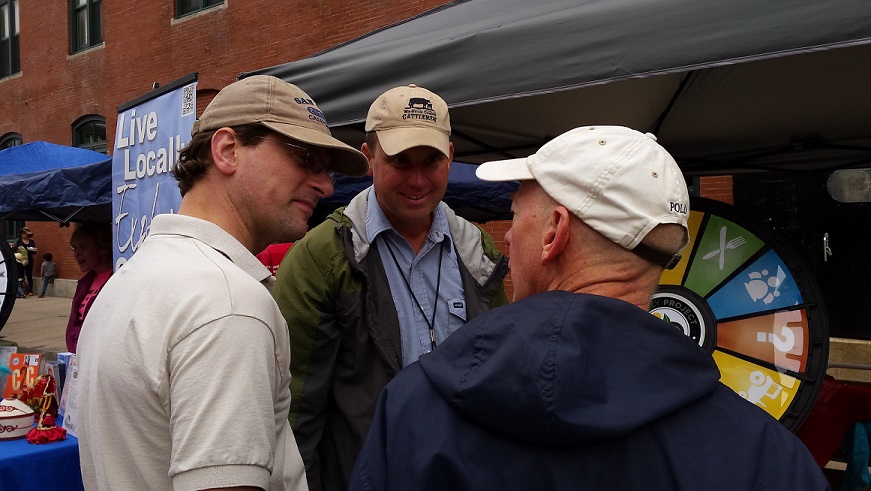
IFFP features the work of two bloggers, Kristin Porter from Iowa Girl Eats, and Cristen Clark from Food & Swine.  Last Saturday Cristen was on hand, signing copies of the Iowa Food and Family Cookbook we were giving away.  The book contained recipes from both bloggers, as well as additional ones from farm families across the state.  I provided relief for her husband, who had been in charge of spinning a wheel where guests were asked random questions on agriculture in exchange for a free Subway sandwich.

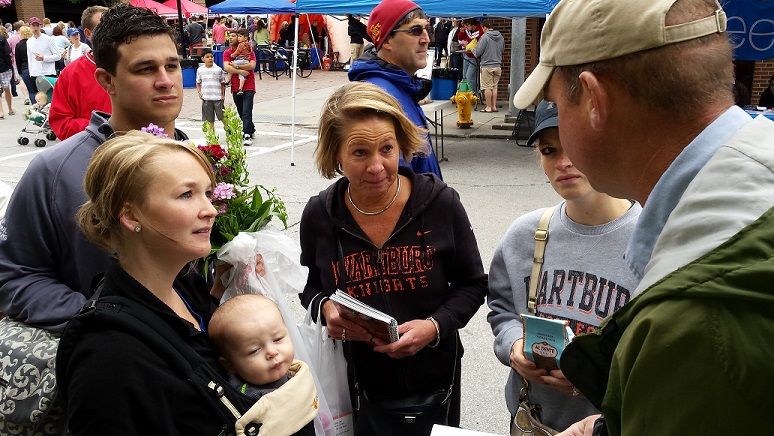
In no time flat my mouth was in gear, and in no time flat, with never a down moment, three hours passed. Somewhere in the process I got a bottle of water.  I never had time to open it.  Cristen had signed so many cookbooks, they gave away 700 that day, I was surprised her hand hadn’t fell off.

They estimated a couple of thousand people went through the booth.  I would call that conservative.

Conversations ranged from the Des Moines Water Works lawsuit, GMOs, organic foods, support of Iowa’s agriculture, animal care, and Fred Hoiberg coaching the Bulls.  For my part, I learned it took 48 hours to get milk from the farm to the grocery store shelf, that Jethro’s restaurants purchase over one million pounds of pork annually (making them the largest independent purchaser of pork in the state), and that 11 million turkeys are raised in Iowa (making us the largest supplier for Subway and Jimmy Johns restaurants).

There were two questions I used particularly for their advocacy.  The first was in detailing what a bioreactor is and it’s role in removing nitrates from agricultural drainage water.  The second was about the inability to find a nutritional difference between organically raised and conventionally raised produce.

In regards to the first question, I got to witness one guest accurately describe to another the Des Moines Water Works lawsuit in 30 seconds.  I was impressed.  With regards the second, I had one boisterous guest take issue on it.  With regards to the cookbooks, I had one turn it down because it didn’t look very vegan.  I think it was the pot roast that gave it away.

Make that 10,001 out of work comedians in this country.

IFFP 1

The cookbook was free. The information about agriculture was free. Putting babies to sleep was a bonus.

 Iowa Food and Family Project:  http://iowafoodandfamily.com/

Food & Swine:  http://foodandswine.com/

Iowa Girl Eats: http://iowagirleats.com/