June 11th was the Iowa Cattlemen’s Association’s Summer Policy Conference. It is an annual effort by the group to identify current issues in the beef community and to educate members about them. The keynote address was given that morning by Dr. Kim Stackhouse, whom has headed up the National Cattlemen’s Beef Association’s look into our industry’s sustainability.
It had been three years since I had made one of these conferences. The last was made when I was part of the Young Cattlemen’s Leadership Program. (I take comfort in the fact that my youth is not more than three years behind me.) As part of that program, we discussed how NCBA was then getting the ball rolling on Stackhouse’s work.
I wrote a little editorial at the time which found its way into an online part of Beef Magazine. Twenty people probably saw it. It was titled “Is Our Use of ‘Sustainability’ Sustainable?” In it I was critical of NCBA’s efforts in chasing a term they seemingly had no control of the definition of.
Activists groups, some of who were intent on putting us out of business, had been so successful in their definition that in 2007 Time Magazine proclaimed “a 16 ounce T-Bone is the equivalent to a Hummer on a plate.” In 2010 San Francisco passed a resolution which made them the first “Meatless Monday City.” Despite the urge of some of us to ‘hunker down,’ NCBA entered into the conversation.
Three years later, hearing Dr. Stackhouse, it was readily evident my bunker mentality had been in error.
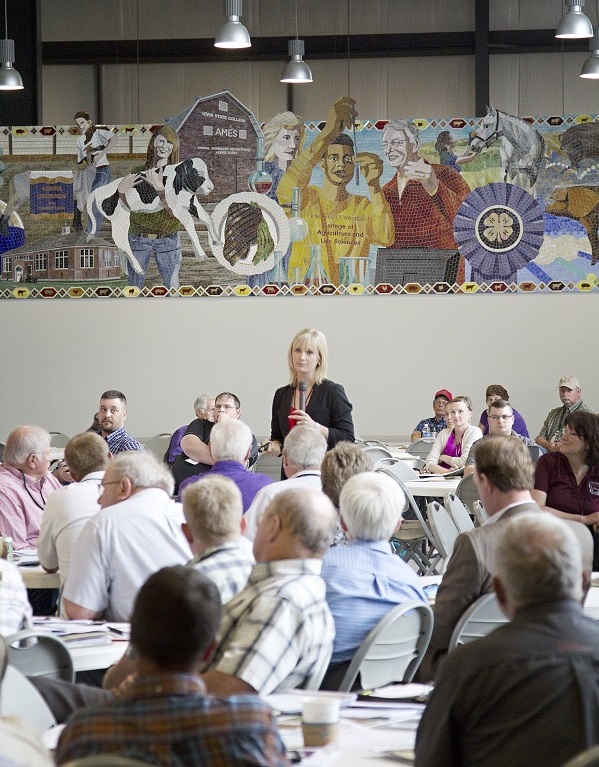
Dr. Stackhouse addresses beef producers from across the state. Photo courtesy of Iowa Cattlemen’s Association.
“We will never have a consistent definition of sustainability,” Dr. Stackhouse said, but taking us step by step through her years of work, it quickly became apparent that thanks to her efforts the beef community will have a fair sized seat at the table as it is being debated, discussed, cussed, and reviewed. The community got this seat by engaging in the argument armed with facts, and these facts came from Stackhouse’s research. She had created a ‘Life Cycle Assessment’ for the entire beef industry, looking at all the system’s inputs (right down to counting rolls of toilet paper a packing plant uses in a year) and weighing them against the system’s outputs. To date I believe it is the only life cycle assessment that has been completed by a major commodity group.
There were two goals in doing the assessment. The first was to establish based on facts where the industry was. The second was to establish based on the same facts what the trend was in beef production. Were we becoming more or less sustainable?
They looked at 2006 to 2011 and found that while there was no organized effort to improve sustainability, it had happened anyway. There had been a 5% improvement over those 6 years. Also notable was the new light shed on how many factors seemingly outside beef production impacted it.
1/3 of all energy use of all energy used in the system is actually used by the consumer in their homes. Believe it or not, your in house refrigerator pales in comparison to the efficiency that a packing plant operates at. The system also has to account for the food the consumer wastes. 1/3 of the world’s food is wasted. If consumers could merely cut their waste of beef in half, we would realize a 10% boost in sustainability overnight.
Acquiring and putting such detailed data to use has allowed NCBA to spearhead roundtable discussions on sustainability that groups like McDonald’s, Walmart, and Costco have sought to be part of. Whether or not Stackhouse is present during these discussions, her voice certainly is. “Zero impact is not possible. There are tradeoffs; always have been and always will be. The questions are what is the trend overtime and is technology part of the solution?” To the latter the data shows it has been, and with a needed 70% increase in food production by 2050 to meet world population growth, it had better continue to be.
Luck placed me behind Dr. Stackhouse in the lunch line. I found her quick witted and a joy to talk to. “It’s a pleasure to be in Iowa where so many of you are so progressive,” she said.
“It’s rare that anyone considers me progressive,” I quipped back.
Somewhere in cyberspace is an editorial which underscores it, but what can I say? I was young then.
 True Stories and Tall Tales