After the Deluge

https://www.youtube.com/watch?v=_hxc6Vnph4E

Jim sat at the counter, with his blue, pin-striped overalls on.  They were immaculate.  In the breast pocket was a ball point pen clipped neatly next to the horizontal spiral atop the bright yellow cover of a now defunct feed company.  His hat was sponsored by a seed corn company now next to the feed company in defunctness.  It’s bright yellow bill and large badge sat ahead of the white mesh that brought up the rear.  All of them laid over the well-groomed, grey hair trimmed only a couple of days ago.

He had got up early to get to the counter and hear the reports of last night’s rain as they came in.  His furrowed hand produced a thumb and middle finger which held the handle of a white porcelain coffee cup.  The index finger tapped the top intermittently, as though he would think of the line of a song and then think of another.  He stared at the line the contents made on the inside of the mug.

It was then he glanced to the side and caught Ted, walking with the knees of a hog farmer up to the counter’s end to pay the bill his breakfast had left.

“Did you get any rain last night, Ted?”

“Oh, we got just a skosh, you know.  The gauge had five inches in it this morning.”

“I had around five and a quarter at my place.”

“Well, the devil always did take care of his own,” said Ted with the same smile Jim returned.

Some would say Jim had told a little lie, but he could argue there had been profit in it, and surely the profit made it excusable.  Jim would say he told no lie at all.  He only suggested he got around five and a quarter.  In truth he had, within a quarter of it.  For Jim it was the its status as a suggested quarter that made it defensible, and it yielded to him the same advantage an actual quarter would have.

The line in the mug dropped lower.  The songs changed several times.  Finally, Jim glanced to the side and caught the bow-legged gait of the mustached horseman called Russ.

“I got around 5 and a quarter,” said Jim, now with some confidence, blinking his eyes as he spoke.  “What’d you get?”

“We got six.”

“You don’t say?”  His confidence deflated, but opportunity seized the moment.  “Is that the most you’ve heard of?”

“I thought I heard them say behind me that the Meadows boy got 7 south of town.”

If the suggested is every bit as good as the actual, having gotten the most rain is every bit as good as having found out who did.  Yes sir, it had been a productive morning in deed, and the tapping began for the rhythm of several happy tunes.  The young waitress walked by, and Jim opted for one more cup.  Waiting for it, he caught sight of the confident walk of a young man who looked but vaguely familiar.

“Did you get much rain last night?”

“Five and a half,” Jim replied, “but the Meadows boy was in this morning and he told me he thought he had over seven.”

“You don’t say?”

“Yep.  That’s what he told me.”

“Well I thought I heard that too,” said the Meadows boy who was smart enough to keep his mouth shut.

Now John had sat there, long and tall as ever, taking it all in as the egg yolks got cold in his hash browns.  He too would pass Jim on the way to the register.

“I suppose you got us all beat,” were the words that came from the down turned eyes underneath the yellow bill.

“I suppose I do,” said John.

“How much did you get?”

“We got enough that last night the bar in Bevington was the driest spot in town.”

Yes, Jim thought, it had been a very productive morning, and he laid down a two dollar tip for the gal who had been filling his cup.
Me and Bobby McGee

Jindal2

Photo courtesy of Justine Stevenson

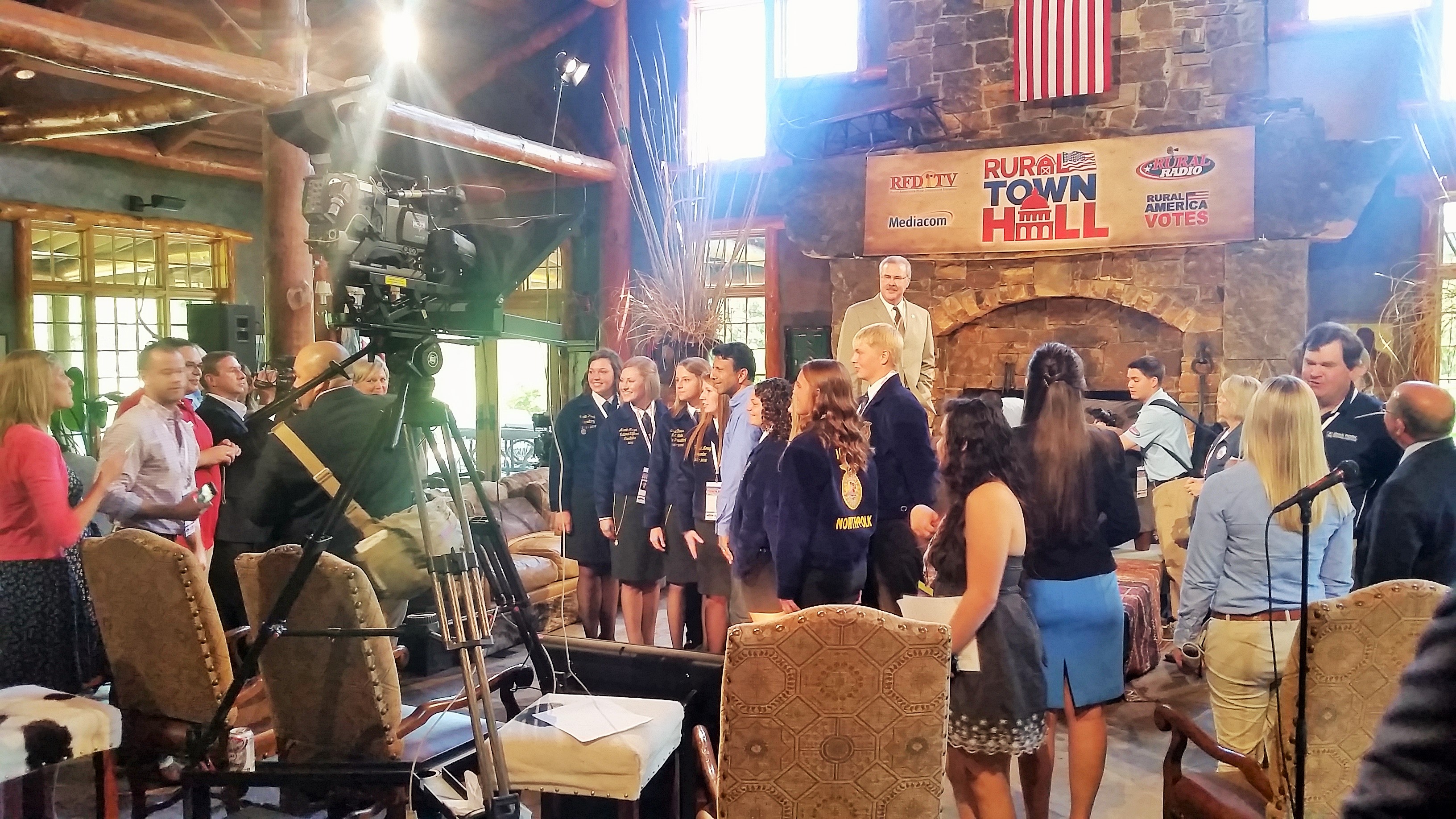
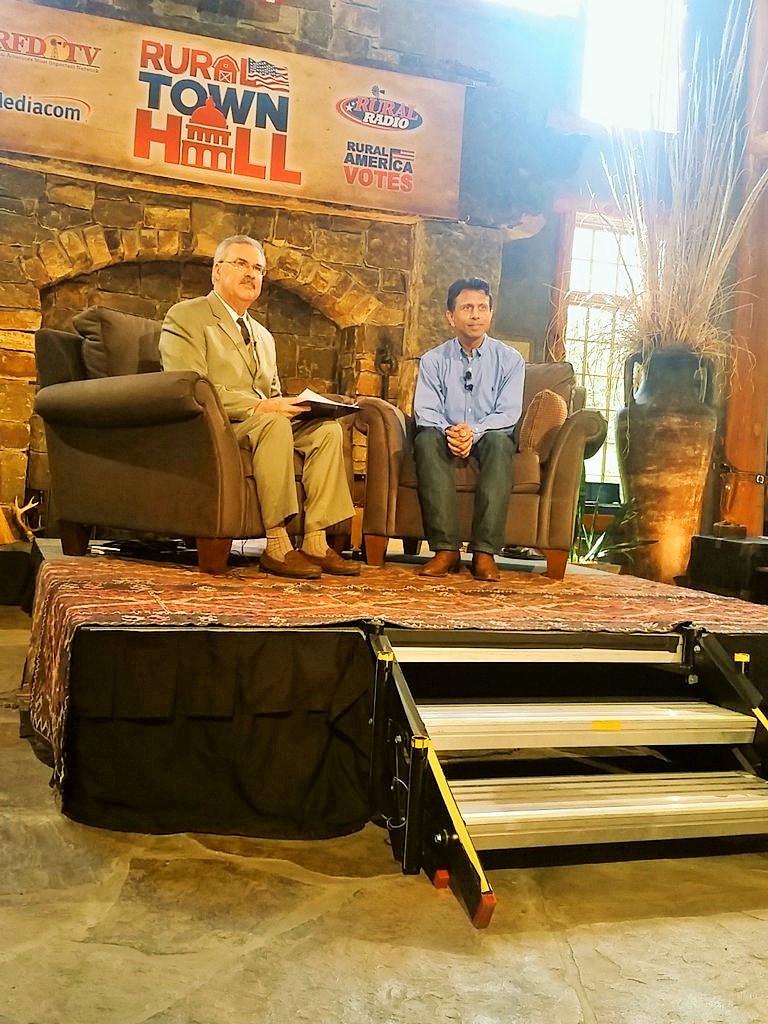
I suppose it was a combination of my own dumb luck and others’ busy schedules that had Justine Stevenson with the Iowa Cattlemen’s Association contacting me to see if I would be interested in participating in a rural town hall meeting with Louisiana Governor Bobby Jindal.  I had just broke down my recently repaired tile machine half way up a pastured hillside.  20 acres of late oats needed mowed to boot.  Still, I said yes.  Someday the phone won’t ring, but I’ll taste every grape on the vine I get offered until then.

The meeting was to be held at the Stine Barn in West Des Moines.  I had never been.  It’s quite a place in the middle of town, and I was in awe as I parked my car on the grass ridge above it.  A man in a golf cart was right behind me, waiting to give me a ride back down.

“A healthy young man like you I ought to let walk,” he smiled.  He knew how to bullshit.  We would get along fine.

“What’s your name?” I asked extending my hand.

“Johnny Rodgers”

“I’m Dan Hanrahan.  Beautiful day isn’t it?”

“It better be for a Husker to be in Iowa.”

“I went to Iowa and Iowa State, so I got you covered either way,” I laughed.

“We tied Iowa State in my last season.”

“I’m sorry, did you just say you played for the Huskers?”

“Yea.  I played for them.  I was also the first one of them to win the Heisman Trophy.”  With that he raised his right hand, and it was then I noticed the ring.

“So what are you doing in Iowa?” I asked.

“I’m working with RFD-TV now.”  With that Nebraska’s Player of the Century dropped me off, but not before I shook his hand again and shared one more smile.

RFD-TV and Mediacom were sponsoring the day’s town hall.  It was to be the first of ten or so, featuring many of the Democratic and the Republican candidates for President.  It is hoped this series will bring light to the issues rural America is facing concerning agriculture and beyond, not only for the candidates themselves but also for our urban counterparts.

Several groups were invited to participate in the meeting and submit questions to the candidate.  The Des Moines Register was there, there was a group representing rural hospitals, youth from FFA and 4H, Farm Bureau, the Soybean Association, the Pork Producers, the Corn Growers, and the Renewable Fuels Association to name a few.

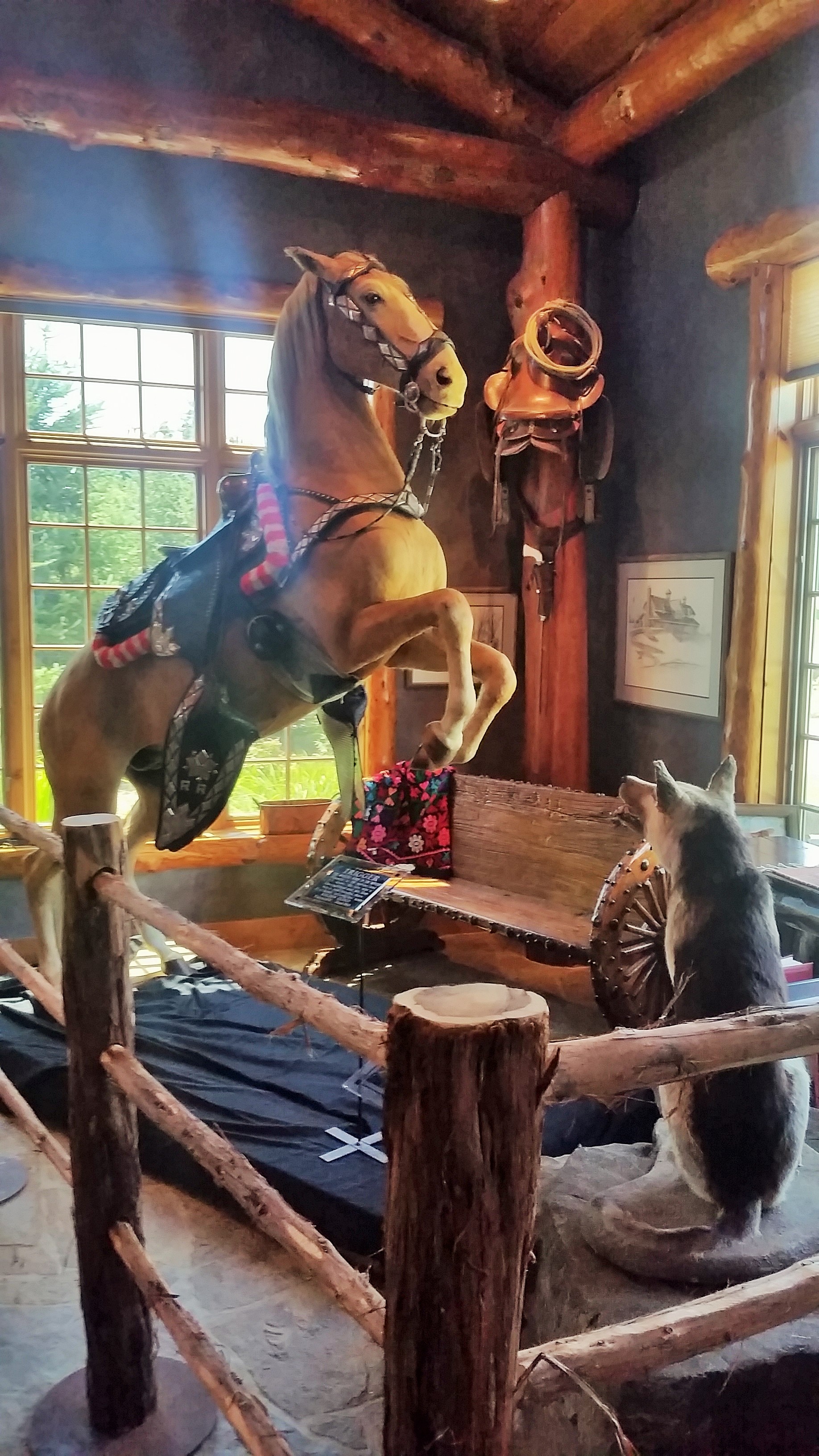
Trigger

Trigger and Bullet

The town hall was to be an hour long, and we were seated somewhat in order of the questions we would ask.  Most of the seats were taken, when I looked up to see Craig Hill with the Iowa Farm Bureau beside me.  I suggested to him that perhaps one of us would get to sit on the horse over in the corner.

Craig smiled as large as Johnny Rodgers had.  “That would be quite a seat.”

The horse, Trigger, had belonged to a different Rodgers.  That one was Roy.   In front of Trigger was none other than Roy’s dog, Bullet.  It wouldn’t have surprised me to find Roy himself behind a door somewhere.

After instruction on how to ask our question, we remained silently seated while we waited for the Governor to show up.  While I waited I wondered how much of rural America would really be represented here.  How long would it take for this candidate to seek cover by wrapping himself in the flag or wandering off into the topics of Iraq, Iran, John McCain, or all our gods?

Beside me was a reporter from the Des Moines Register.  She’d been covering the Jindal campaign, and she was to ask a question the paper had submitted.  The paper had several people present in the small, invited audience, and I would guess it was a member of the Register Editorial Board that came over to visit with her as we sat.

“Do you think I can modify this question?” the reporter asked.

“No.  Ask it as it is written.  There is supposed to be a follow-up which will hit on the other topic we are interested in.”

As I wondered if even the audience would play ball, Jindal stepped in.  He’s short, skinny as a rail, and didn’t even have time to say ‘Hello,’ before the crew started the whole thing rolling.  There he stood, patient as Job, at the back of a room of strangers, waiting for the cue to hop on stage.Jindal

The audience stuck to their questions, and Jindal stuck to the topics they asked, never veering from them.  I’d only seen a few television ads of his and was surprised in the soft way he spoke.  He had an engaging sense of humor and used it to discuss the items in both a length and depth that left me impressed with his substance.  He gave some answers that might be a tough sell in Iowa, but it is my view that as the first one out of the gate, he set the bar high.

Substance, I should think, could be an appealing alternative when the feeling good of ‘hope’ or the faded feeling of fear leaves one busted flat (in Baton Rouge or elsewhere).  Still, perhaps substance is overrated anymore.  The hides of Trigger and Bullet are sure to get air time during the broadcast at 9 central Thursday evening.  I bet you don’t see Johnny Rodgers once.

For what it is worth, Jindal might be in this race for awhile.  (Edit:  He wasn’t.)

The West Always Begins a Little Sooner Than You Think

James (2)

Where do the daydreams of little boys go when they become men? Some speculate they get left behind with other childhood things as we age. I wonder if we ever truly leave anything behind. At best we cover it up, and inadvertently drag it around with us when we think we left it behind. If not you, me then.

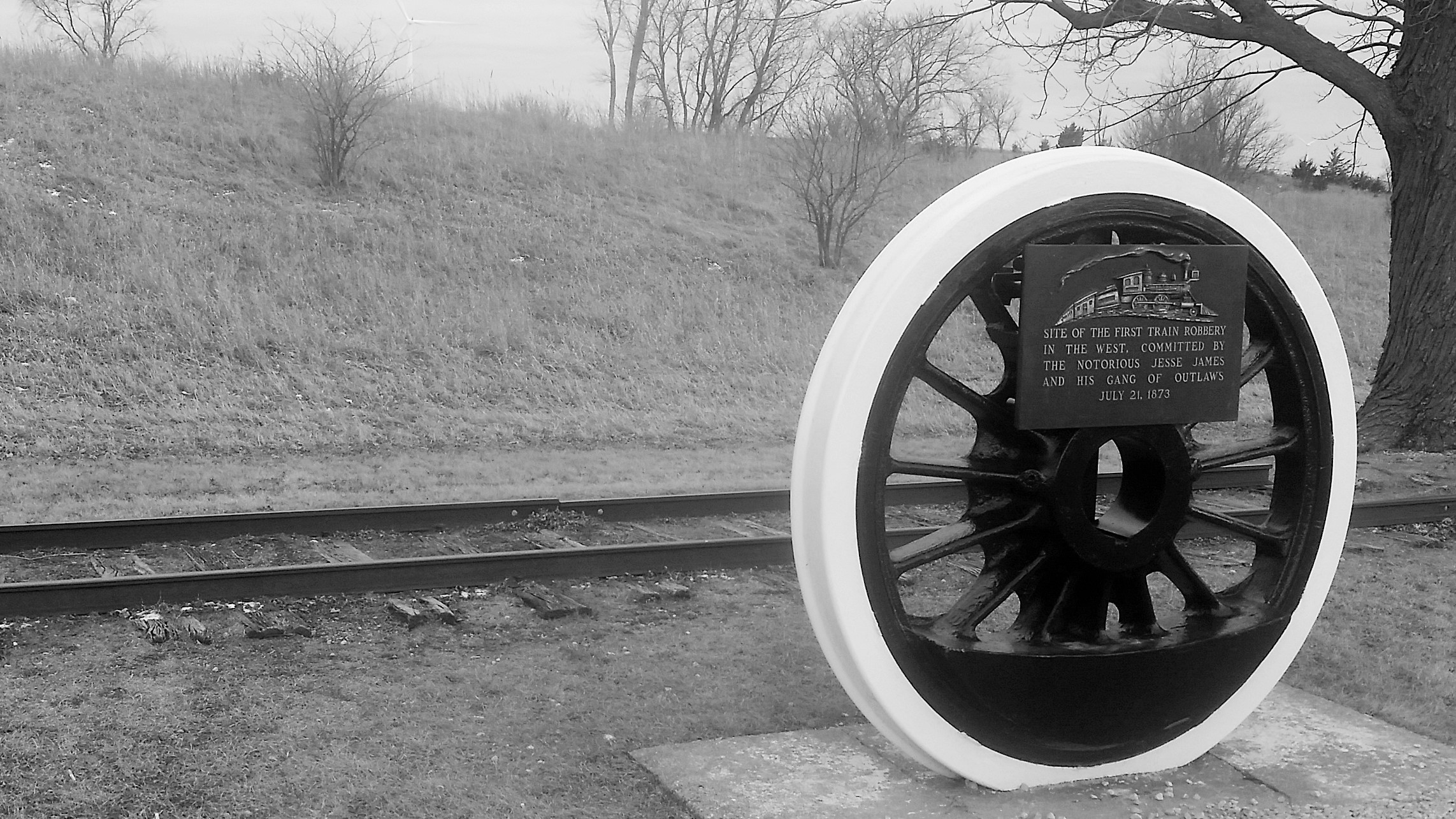
Perhaps one site in Iowa would invoke boyhood daydreams beyond all others. It sits near the town of Adair, a mile south of Interstate 80. Tomorrow, July 21st, is the anniversary of the 1873 day that gave it significance.

That year the town of Adair was celebrating it’s first birthday. Previously the site had been known as Summit Cut, a name it received by being the Iowa high point of the Rock Island Line. It sits on the Iowa Divide, leaving each raindrop in apprehension as to whether it would be going to the mighty Mississippi or the muddy, and less prestigious, Missouri.

All those drops will eventually end up in the Gulf of Mexico, but even when we know the destination, we have to fret on how we are going to get there.

Some speculate the town’s setting on the ridge was one of the reasons Jesse James and his brother, Frank, selected the area as the site of the first train robbery in the west and the first moving train robbery of all time. The theory is that the train would be going slower as it approached the ridge. In reality they selected the site in the belief that the engineer would be preoccupied gawking at the wind turbines.

If you find it curious that “the west” includes Iowa, you’re probably not alone. The site doesn’t even muster a sign on the interstate, where daydreaming boys and the fathers that supplanted them drive by in droves. It is as though most consider the event an accident of history, which should have happened elsewhere, and they are doing their best to pretend it did.

The train was to have $75,000 in its safe, the equivalent of 1.5 million dollars today. The gang camped outside of town, then bought pies from the wife of the section foreman of the railroad, while others raided an outbuilding in the backyard for the tools they would use to loosen a rail. Once the rail was loose, they tied a rope to it, and pulled it out of place when the engine approached.

The wreck killed the train’s engineer, John Rafferty, and would go on to kill its fireman, Dennis Foley. The guard, John Burgess, was forced to open the safe and hand over its contents: $2337.

No doubt the gang was disappointed. Burgess was likely pleased. He had achieved the fame of Rafferty and Foley, and he would get to tell others about it.

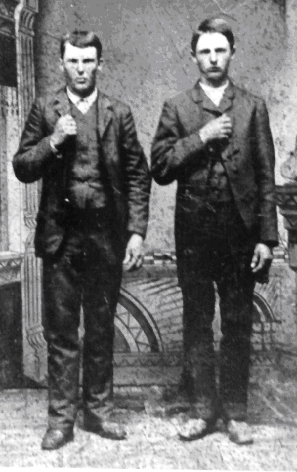
Jesse (25) and Frank (29)

Jesse (25) and Frank (29) in 1872

Trying to bolster the loot, the gang passed the hat and managed to eek out another $700 from the passengers. In all my life I never knew the James’ were Catholic, but where else would they have got the idea for a second collection?

Burgess ran to Adair to raise the alarm, only to find the town hadn’t got around to putting it up yet. Local hero, Levi Clay, would run (since Adair was a one horse town, and that horse was out at the moment) to the neighboring town of Casey.

There he sent a telegraph, which should be reaching your smart phone one of these days. My best guess is that it will be between 3 and 4 am.

The James’ got away, but of course they had the advantage. Which ever direction they went was downhill, with the wind from the turbines pushing them along. Running along behind them was what they had hoped to leave behind. It would catch up to them, just as it always does.

Through Albia on Independence Day

It was the Fourth of July, and I was making my way home from Rathbun Lake.  It was nearly dark, and I was hoping to make an hour and a half drive without introducing a deer to my Galaxie.  I was alone, and there was one more party I was headed to.

Rathbun sits just across from the southern border of Monroe County.  Monroe was first known as Kishkekosh, named after an prominent Indian of either the Saux or Fox tribe.  Frank Hickenlooper, who wrote the history of the county in 1894, said translated the name meant “a savage biter.”  Perhaps someday it will resurface for a new species of mosquito.  Others say it meant “man with one leg.”  Perhaps someday it will resurface for a new, one-legged species of mosquito.

The county seat is Albia, and I was coming through the town, snaking around it’s beautiful square in what was now darkness.  Sitting at a stop light I couldn’t get over that on the Fourth of July there was absolutely nothing going on.  Out my driver’s window was a concrete soldier atop the Civil War monument in front of the courthouse.  The butt of the gun rested on the ground, both his hands held the barrel, and he gazed off serenely in the direction I was headed.  He seemed to have no intention of doing anything either.

In the darkness on the edge of town, I came upon a cluster of cars I took for a used car dealership.  That is until I noticed the silhouettes of those seated in lawn chairs, on tailgates and trunk lids, and standing with old friends.  Block after block was lined with them and their cars, and everyone was looking over the open field to the east, waiting.

The old veteran was looking in the right direction after all.  I thought of him and my neighbor who did three tours in Iraq as the shelling of Albia commenced in the rear view of my ’64.  Pandora was finally getting my tastes down, a deer was nowhere in sight, the cool evening air was rushing in my windows, and I couldn’t help but think how it all felt perfect.

Off in the west sat Jupiter and Venus on the level, not unlike Christ’s mother would have seen all those years ago, minus the haze of a Canadian forest fire.  In that haze I could see the bombardment had began in Knoxville.

There we were on Independence Day, all of us in it together in the darkness on the edge of town.