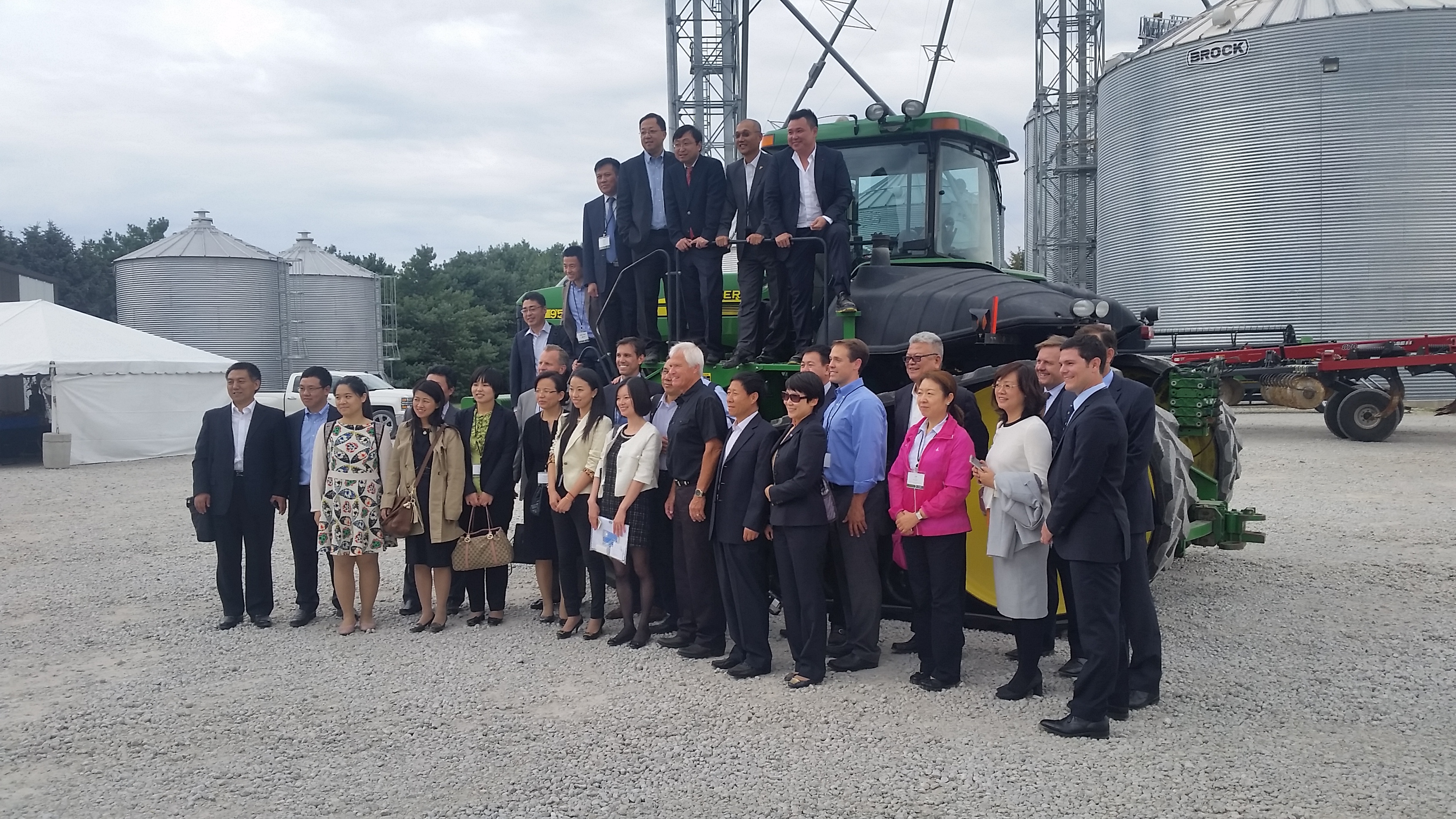
The Delegation

The Delegation

The Delegation

From the 34th floor of the Ruan Building, the day was drawing to a close.  34 floors wouldn’t be much in some places, but in Des Moines there would only be a few stories left.  Outside the clouds were moving in, and inside, at my table, talk momentarily centered on the clouds moving in elsewhere.

We were eating with a delegation of 49 from China.  I had got to tag along as a farmer.  Back home, in their country, the robust Chinese economy had caught a cold.  Here an agricultural economy, the likes of which we had never seen before, seems to be winding down to an uncertain future.

Sitting at my table was a member of one of the various commodity groups.  We had met earlier that day and had just concluded spending the afternoon together.  Unlike some, he had survived it.

“Agriculture is a place for optimists.  I’m one myself, and proud of it.  Even I am worried about what might lie ahead, however.”

Earlier on this floor in the mid-day sunshine, the delegation had been joined by an assortment of executives from the world’s major grain merchandisers.  Louis Dreyfus, Cargill, ADM, and others had filled the long table at the front of the room to sit side by side with their Chinese counterparts.  Together they signed contracts totaling 5.3 billion dollars and 13.8 million metric tons of soybeans.

If you are unfamiliar with the Chinese appetite for soy, you should know that one out of every three Iowa rows you drive past will ultimately make their way to feed it.  In fact to fill the contracts signed that afternoon, it would take nearly every Iowa soybean raised this year.
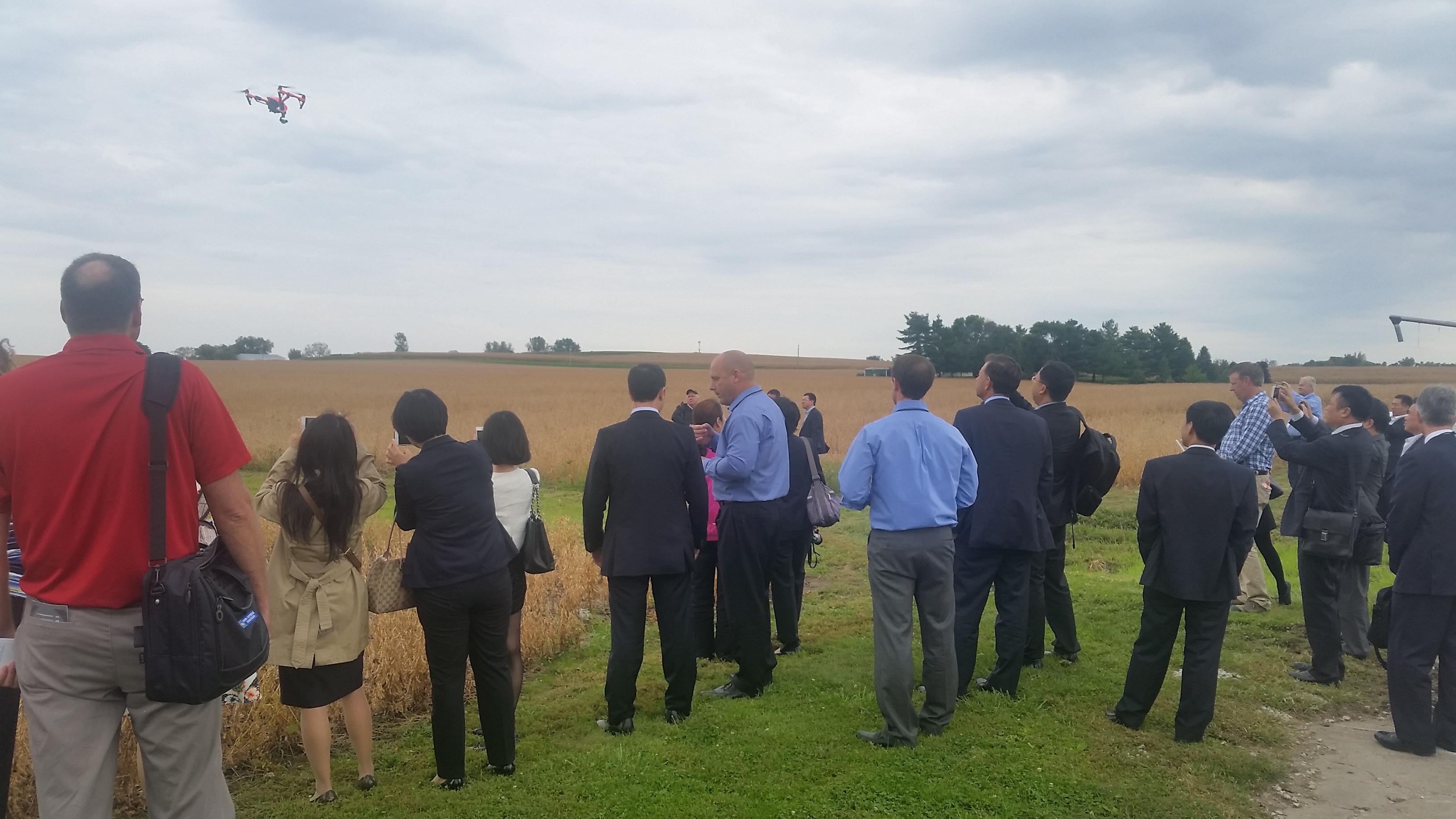
The delegation views the most cutting edge drone on the market, likely made in their own country to begin with. They went right by two state of the art John Deere tractors and a combine to view it.

The delegation views the most cutting edge drone on the market, likely made in their own country to begin with. They went right by two state of the art John Deere tractors and a combine to do it.

One of the morning speakers had offered investment advice to those in attendance.  I would paraphrase it here:

Pursue investments strategically.  If you are going to invest, be sure to convey the value and influence you offer as an investor.  Never quit verifying the assumptions you’ve made about your investment and its strategic fit into your portfolio.  Finally, always stay abreast of the synergies your investment might make available.

He delivered his remarks using dense, multi-syllable words delivered in a staccato that resembled plunging knife strokes to drive his point home.  He was a good speaker, and I suspect Americans, like me, took note of it.  I suspect the Chinese, here with a population of 1.3 billion people at home, had mastered it some time ago.

The afternoon featured a farm tour and another slate of speakers.  One presented the thought that if you are buying one out of every three rows, you’re not really a customer.  You are a partner.  Our partner, China, faces two hurdles.  First, it has an immense and growing population.  Second, that population has an evolving diet.

In order to continue to feed it, the case was once again made for GMOs.  80 percent of the soybeans grown worldwide are already genetically modified.  Almost all are in the US.  This has translated into more bushels per acre, but often lost is the yield to be gained in other areas.

High oleic soybeans are right around the corner.  These will have 0 trans fats and will create better oil, with higher protein contents, better antioxidants, and better lubrication.  Coming with this line are other lines generating significant bumps in oil and protein content.  Not only will beans yield more bushels, but the bushels they yield will go farther, requiring less land, less shipping, and less of an environmental footprint.

When dinner was getting underway, the dignitaries present were invited to speak.  One representative from the Chinese delegation joined them.  As he did, we put our ear pieces in to hear his remarks through the interpreter in the back of the room.

He described their visit, beginning with their initial stop in Seattle, Washington.  He shared his observations about what they had seen that day.  Then he said his only sentence in English:  “This is the last stop, but this is the most important stop.”

This farmer would concur, and finds himself back where we started.  There are still a few stories left.

Harvest and the seasons to come.

Harvest and the seasons to come.

The Negotiator

“What can you tell me about Sam?” she asked.

There was a short pause, and he wondered if that had been a question or a demand.  It really didn’t matter.  He was quite taken by her.

“Sam is a unique personality,” he said.

Her brother was driving, and conversation had been mostly up to the two men until now.  Upon hearing the remark her brother laughed.

“That’s a hell of a description, Bob.  You couldn’t have said it any better any quicker.  Sam is a unique individual, Nicole.  Yes he is.”  He gave a low chuckle after the final line, amusing himself mostly, Bob a little, and his sister none.

She was all business most of the time.

To his credit, her brother had managed to get through the morning without drinking much, though mostly it was due to his having to see his sister.  Later he would drink a great deal.  That would be due to his having seen her and also having gone the morning without drinking much.

Their relationship was tainted in part by the bitterness she felt for her father having devoted the later part of his now spent life to the care of his son.  Wasted, she thought, on a lost cause.  Her brother wouldn’t have argued.  He was convinced he was a lost cause some time ago.  He never complained, though.  He drank instead.

Bob couldn’t help but like him.  He liked most people.  The brother’s drinking would probably kill him.  That was a goddamn shame, but the world is full of goddamn shames.  It would never notice the weight of this one.

Christ might, but He seemed quiet on the matter.

Bob couldn’t help but like him any more than he could help being taken by his sister.  That might have been a goddamn shame too.  The world was no heavier for it either.

“What else can you tell me about Sam?” she asked, ignoring her brother, and casting her eye across the fence to Sam’s property.  “I’m going to have to negotiate with him.  I’m looking for what I can use for leverage.”

She would let Bob into how her mind worked from time to time.  I suppose he was supposed to be impressed by it.  It seemed it worked in a way that was geared to getting others to do what she wanted.  She took pride in that.

In life she hadn’t always got the best end of the deal.  She trying to make amends for that, but in her line of work others had to do what she wanted.  Outside, in the real world, the weight of what we want others to do is of no consequence either.  That’s another goddamn shame.

What do I tell her about Sam? he wondered.

Once Bob and him had too much to drink.  Drinking had drowned the anxiety first, and the inhibition, and they had eventually got down to what we work so hard to cover up in our sobriety.  Sam had described slipping extra painkiller to a family member in hospice, after they had pleaded with him for days to simply let them die.

Sometimes people feel guilty about how all of that works.  It was never clear to Bob whether it was because of what we’ve done, or the fact that we have to work to cover it all back up again.  Later, when he was sober, Sam never appeared to mind.

Maybe he wanted to be found out, Bob thought.  I wonder how any of that would work for leverage?

“You won’t have any trouble with Sam,” he said.

“Why’s that?”

“Because at the end of the day, I’m sure you will be able to convince him of anything.”

She smiled.

A goddamn beautiful woman, he thought.  Probably doesn’t drink a drop.

Later, when her brother left, she asked him how he’d been.  She hardly ever asked that.

“I’ve been fine.  Doing well.”  Looking into her eyes he said, “I think about you.”

“I think about you too.” She said in an awkward way that made him think she was being open.  He wanted to move closer to her.  So he did.

They continued to speak until she got emotional.

“Damn it, Bob.  What is it with you?  Why do I get like this around you?”

“I don’t know.  Is it a bad thing?”

“No,” she smiled, wiping an eye.  “It’s not a bad thing.  It’s a good thing, but I am afraid I’ve got to go,” and she approached him opening her arms for a hug.

He placed the tips of his fingers in her back, holding her as tight as she held him.  He would have to let her go.  So he did.

As she walked away he wondered how long it would be before he saw her again.  Instinctively he grabbed her arm, pulled her back one more time, and raised her up with his fingers in her back again.  Spinning her around, he set her back on her feet, and slowly tried to kiss her.  She turned her head down slightly, and he settled for a cheek and her forehead.

Afterwards she would tell him it had been a long time since anyone had picked her up like that.  Later still he would get an email informing him she was seeing someone else.  It would be distant, even harsh.

Why she didn’t mention it in person, or in any of the months which preceded it, he didn’t know.  Nor did he know why she couldn’t have afforded just a bit of kindness.

In the end perhaps it was all about leverage and doing what she wanted him to do.

Chicago and the Midas Touch

This August I attended the wedding of my first college roommate.  It was in Itasca, a Chicago suburb, and on a Sunday.  That morning I stopped to see a classmate, her spouse, and their two little girls at our hotel.

It had been a couple of years.  We hugged.  I said hello to her husband and shook his hand.  And then I looked down into the gaze of their oldest daughter, a third grader named Willa, who was holding her hand out for mine.

“Come here,” she said.  “I have something to show you.”

She led my cumbersome self across the hotel room to the window making up the opposite wall.  We sat on the heat register and looked down from seven stories to the pond behind the Westin and a family of geese and an assortment of ducks whom called it home.

“Do you see them down there?”

“I do,” I said.

“I’ve been watching them all morning.  They’re really something.”

I was watching them from seven stories.  Willa, I would bet, was right down there with them.

The next morning I was in the middle of downtown Chicago walking sidewalks crowded with a few early tourists and those headed to work.  I was waiting for the Chicago Institute of Art to open, and my killing time on Michigan Avenue placed me in front of my favorite building there.  On the sidewalk beneath it was a lowly pigeon, colored nearly the same as the structure was.

The building was crowned in gold, however.  Gold seems to be the color nature keeps out of nearly anything touchable.  As a consequence Man applies it liberally, and the Carbon and Carbide Building is crowned with the laurel God denied the pigeon.

I was looking down on yet another bird who rightly should have been looking down on me.

I reached downtown via a commuter train, where I had taken a perch on the upper level.  That Monday morning it was loaded with those who seemed to already carry the anxiety of the week ahead.  I had momentarily traded my mine in for a map.

Summer was drawing to a close.  School was around the corner.  I thought I could see the apprehension of these commuters’ children stretched out over the dwindling blue, still waters at the city pool we passed in Franklin Park.  I thought I could feel the family’s in the pent up, crowded houses of the living.

It was only broken by a green and open field, boasting acre after spacious acre and housing the dead insulated from all of it, still lying in the rows their loved ones had placed them in.

When the museum opened, amongst American Gothic, A Sunday Afternoon on the Island of La Grand Jette, and Nighthawks, was one painting seemingly out of sight in a corner, as the mostly black attendants were from the mostly white portraits and the mostly white audience.

It was Aert de Gelder’s “Portrait of a Young Woman.”  The hook was the glassy, penetrating stare of her 325 year old eyes.  She looked neither up nor down to her observer.

I suppose Willa wouldn’t have either, were she taller.  Perhaps, were she 317 years older, Aert would have painted her picture instead.

Headed out from downtown, occasionally we would pass a train headed in.  On that train were people just like us, and I would try to catch a glimpse of them as we passed.  It was as though they were invisible.  I could only see through the other cars’ windows to the same cityscape I had seen before, crowned in untouchable golden sunlight, which rained down on the cheap, showy, and selective gold of man.

God, I do love Chicago.

Portrait of a Young Woman