Online Dating

Fifteen minutes in, the gal across from me asked if I had ever considered being a priest.  We had just met.  I figured I had a couple of options.  Either she was telling me she felt comfortable sharing her story, or she was kindly suggesting that I should consider a life of celibacy.  Just then, her phone went off.

We had met at 10:30 on a Sunday night, just after the first of the year. She thrown it out as a possibility because it would be another two weeks before she had a free night. As I drove to the west side, I wondered who would want to meet me for a beer at this hour.  I was pleasantly surprised.

“Do you need to answer that?”

“No, I’ll just text her.  Sorry.  It’s a friend of mine checking in.  I got to wondering who I might meet at 10:30 on a Sunday night.”

I smiled.  “I wondered that too. Do I pass?”

“Barely.”

In some ways dating is different at 39, and in some it remains the same.  The classroom of my youth has been replaced by an online dating site, and notes are now passed electronically and without check boxes.  It’s for the best.  Grownups don’t feel the need to take time saying they aren’t interested.

At some point numbers get exchanged.  When I was young, this was done to call.  Now it is done to text.  The young have no idea what the real world actually looks like and are eager to find out.  Grownups do, however, and seem content to keep it at bay a little while longer.

“What’s been your experience on Match?”

“I haven’t been on it long.  I feel I’ve met good people. It always amazes me what two strangers wind up talking about.  It’s like the profiles, though.  No one wants to put themselves out there until the other goes first.  You?”

“I was only on for a few days.  It was so overwhelming I got off.  I haven’t dated in a long time, and I’m still trying to figure out if I’m ready yet.  All I have to offer right now is a friendship.  Most guys aren’t interested in that.”

“I think I’ve got room. Why did you reach out to me?”

“You put yourself out there.  I liked that.  What else have you learned online?”

“Seems like everyone is looking for whatever they were missing in their last relationship.  The problem was the last guy, and the answer will be in the next.  It’s hard for people to look at the fact that the most common denominator in our failed relationships is ourselves.”

When it is two strangers, the tendency is to lay it all out there, at least for me.  That night I was reminded that I tend to overdo it.  I looked up to find her large, deep eyes damp.

“I know I’m the common denominator. I look at my past and struggle with what that says about me.”

“I wasn’t directing anything at you.  I’m sorry. For what it is worth, I am a common denominator too.”

“I think you are right about people. I’ve spent the last few years trying to become the person I want to meet.  I have no idea how I’m doing.  It is hard. How do we know when we are ready?”

“Well I’m enjoying meeting you.  I don’t know how we know when we were ready. Maybe we don’t until we are in it.”

“What are you looking for?”

“Mutual respect, I think.  If one can keep that intact, maybe however things turn out doesn’t matter.” Even at 10:30 on a Sunday night.
Just Around the Corner

He was older than how he spoke.  I suppose it was the way God had left him here to share his time with us.  Once I had spent part of an afternoon with him, and finding him now, standing up against the corner of a wall, I made my way over to say hello.

“Do you remember me?  We worked together last fall.”

“Yea.  You’re that nice guy that’s easy to talk to.”

Unprepared for that, I rolled out the standard, self-deprecating humor.  “You must have me confused with someone else.” I smiled and look up in time to see him lose his.  He thought he did.

As his eyes turn down to his feet, I understood the dignity I had denied him by refusing the kindness he offered.  It felt shameful.  I tried again.

“It was a poor joke.  I meant that I don’t think most people would describe me that way.”  And his face lit up again, and we were off in conversation, from trains to baby calves and any place he wanted to venture between.  Before long it was time for him to go.

“You are welcomed to help us anytime, you know?”

In him I could find no malice, no reservation to share what made him happy with others, nor any inkling of fear about the dark recesses of our hearts.  It was easy.  As he left, I suppose a little shame lingered at how I, like most of us perhaps, work against myself to make it hard.

Maybe someday we will round the corner.

Logging the Section

Logging the Section

The Section

My great grandmother was born on St. Patrick’s Day, 1862.  It’s not a bad birthdate if you are Irish, and I’m sure that’s something my great grandfather must have thought himself.  They would start a family, and she would share with her children what most parents do:  her earliest memory.

Hers was remembering the relocation of Indians as they traveled through the woods near her home.

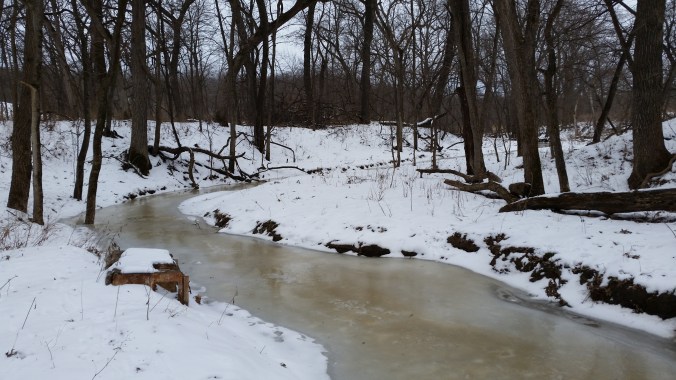
Today those woods are known as ‘The Section,’ or in some cases ‘Section 10.’  The vast majority of the 640 acres that make it up are still standing silently in timber, divided only by North River which meanders its way amongst them.  This was the river the Indians and their escorts were traveling along and camped near, building a fire a mile south of the young girl and her window.

Her son, who I can’t remember, would tell his children the same story about the grandmother they didn’t know.  Afterwards, they could lay in their beds like their dad and his siblings had, looking out their own windows, seeing the same bright glow in the darkness of the night, and fearing that the whole world might catch fire.

The things that were possible in the days before yard lights.

The orginal fire was likely a paltry thing, fueled only by wood.  Yet in the retelling it grows, fueled now by wood and imagination.  The world survived it, though my great grandmother, the Indians, and the original fire they shared are long gone.

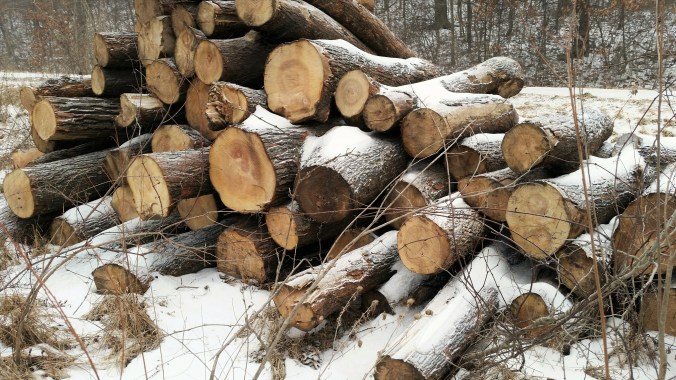
The walnut trees that witnessed the event would last another hundred years.  They never viewed it with the apprehension the young girl did.  They had seen plenty of Indians before.

In the 1960’s the trees would be logged.  Iowa, in case you didn’t know, grows some of the finest black walnut in the world.  Those particular trees were of such exceptional quality and size they were exported to Japan.

Somewhere in Europe, perhaps, a beautifully grained walnut veneer lies across a fine table.  There in the veneer, underneath the varnish and the wax, lies the last physical connection to what my great grandmother saw all those years ago.  Some will bemoan the logging of the old walnut, thinking it would have been better had the tree fell and rotted naturally into obscurity.  Perhaps they are jealous of it.  As for me, I think I could appreciate the table.

Wandering down my own path, I sometimes come upon the memories and experiences others have drug out of the woods to me.  A few I’ve drug out myself.  Occasionally, I do what many do.  I pull a sliver out of this one or that, and try to build something that will last.

“I can sum up everything I’ve learned about life in three words:  It goes on.”  Sometimes in a story, or a table, a part of us goes on with it.

Logging the Section2

Coffee

Devotion
The heart can think of no devotion
Greater than being shore to ocean –
Holding the curve of one position,
Counting an endless repetition.
-Robert Frost

He was a faithful man, and over the time I got reacquainted with him I saw that faith grow.  It had grown through the loss of a partner and now, after the Holidays, through the sudden loss of his job, leaving him with the girls who depended on it.

A week after, I took part of the day to grab a coffee and find out how he was doing.

“It’s been a big struggle, but sometimes I find this incredible sense of peace.  It surprises me.

I think it has to do with having the strength to let go, and the courage to remain vulnerable and let new people and experiences enter my life.  In the last week I have found friends I never knew I had.  It’s been humbling.

I talk about remaining vulnerable with a mentor of mine, but the first one that suggested it to me was a certain friend I know.”

It was lunch time, and the place was full of diners.  We hogged a whole booth to ourselves, without an appetite and only two cups of coffee between us.  Even our waiter had lost interest.

“This friend you talk about, God only seems to speak to him in silence.  He has a humble house he doesn’t own, and the walls of it have blown flat many times.  Sometimes he’s tired of putting them back up.  If you’re looking for peace, he hasn’t found it.  I’m not sure he’s the one you should be taking advice from.”

“I never said he was a carpenter.  How’s work?”

“Won’t be long now.  By Sunday it will be cold enough the ground will have a pretty thick crust on it.”

“At least we aren’t like the ground, then.”

He isn’t.

20160109_120053

Before it All Goes Green

20160106_095123

After the pirates but before the looters.


Beneath the curved trees of Art Nouveau,
along the Modern consciousness of the stream,
remained a hulk of old Art Deco
for the Postmodern me to see.

Seventy years removed now
from the time it first hummed
in a kitchen for its owners
who couldn’t believe what the future brung.

It was the fridge that saw the arguments,
before the kids got home from school,
As the arm from a white-t fished inside
for a beer that was mostly cool.

Now partly buried by the bank,
like a sunken pirate’s chest,
holding an untold treasure
for the boys who’ll come upon it next.

Digging with the finger nails
their mothers will make clean,
while I take note of the countryside
before it all goes green.

An Old Tune, in the Key of Affluence

The winter always seems so Christ-less right after Christmas, and people always act like it is a sin to mention it.  The nights are long, the days are hard and cold, and all of it serves to make the very thought of spring seem foolish.  I was thinking about all of that on the 30th of December, headed into a local grocery store to eat lunch with my father.

We had just passed an old man walking out.  His beard was scraggly and long.  He had on  a pair of dirty blue jeans, mostly tucked into rubber overshoes.  The right side of his shirt was tucked beneath his belly, and the left side hung loose, flapping in the breeze from the bottom of his old coat.

In his hands he clutched two grocery bags, holding two buckets of fried chicken and three 2 liters of pop.  It would be his meal for the next few days.  Santa doesn’t make the rounds for grown ups, I guess, and on the whole we don’t do it often either.

A couple of days later, courtesy the Stanford Marching Band, people would be up in arms over the band’s portrayal of rural life.  Being part of an area damned by a marching band didn’t offend me none.  It had already been damned by a President as “clinging to its religion and its guns.”  What was the damnation of a marching band compared to that?

Somehow the President and the band had missed “clinging to buckets of fried chicken and two liters,” but I have some hope they will correct it next time.  It is an old song anyway, always played in the key of affluence, and always tone deaf to the world outside my door.  It’s sung by the President, it’s played by the band, and lest I watch it, it is hummed by me.

Last year I read a Facebook post hoping for the day that beef production in this country ceases.  I objected to their desire to put my neighbors and friends out of business.  They offered me the assurance that it would only be done after an extensive retraining program, moving all of us onto bigger and better places in life.

A bucket of chicken in every bag, I suppose, and when we get them retrained there is always tofu.

“Like we did with the coal miners in Kentucky, then?”

Sturgill Simpson could have told him how that worked out.  We don’t hear Sturgill, though.  We don’t see the guy coming out of the grocery store.  We never notice the sour note of that which we think we know but isn’t so.  And the band always plays on.

Old King Coal, Sturgill Simpson

Many a man down in these here hills
made a living off that old black gold.
Now there ain’t nothing but welfare and pills
and the wind never felt so cold.

I’ll be one of the first in a long, long line
not to go down from that old black lung
My death will be slower than the rest of my kind
And my life will be sadder than the songs they all sung

Old King Coal what are we gonna do
the mountains are gone and so are you

They come from the city to lend a hand
carrying signs saying, Shut the mines down
We ain’t looking for pity and you don’t understand
So go back to your city now cause this ain’t your town

My Great Grandfather spent his days in a coal mine
and his nights on the porch in a chair.
Now he’s in heaven and down here in hell
the rivers run muddy and the mountains are bare