Putting the “F” in Gymnastics

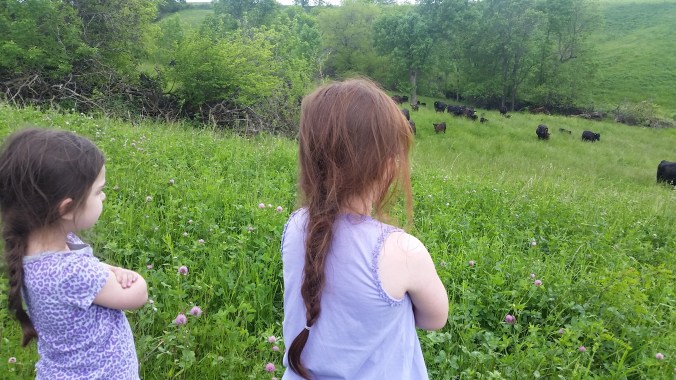
Margaret was 5.  She and her sister Willa, 8, were in the backseat of my car and we were headed to get lunch at Winterset.  They had just got done looking at cows.

20160523_120830

I hadn’t seen them since last August.

“What do you like to do Willa?”

“I like archery.”

“Really?  I don’t think I’ve ever met a gal that likes archery before.”

“My cousin does it, so I tried it, and I’m really good.”

I believed her, but I wasn’t about to go placing an apple on my head just yet.

“What about you, Margaret?”

“I like gymnastics.”

Somehow she had managed to place an “f” in gymnastics.  I would have never thought that was possible, so I asked again.

“What was it that you enjoy?”

“Gymnastics.”

Yep.  There it was.  I can’t say exactly where, but you couldn’t miss it.  I found it admirable.  I had always thought I could work an “f” into anything.  I’ve got nothing on a 5 year old.

Wet Concrete

20160504_182346

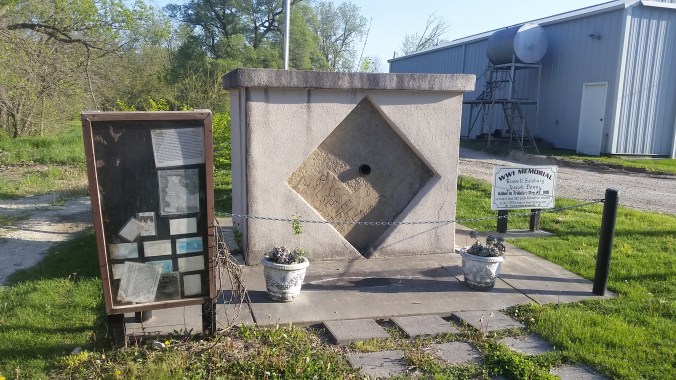
The last few days have left me traveling through Patterson, Iowa.  It’s a small town with a zip code but no post office and sits just off Highway 92, east of Winterset, Iowa.  On main street, near the boxes where residents now get their mail, is a dilapidated old memorial to two young men.

They were Jesse Russell Salsbury, a one time resident, and his buddy from Illinois, Joseph Downs.  The pair met in the Iowa National Guard in 1917.  Later that year, preparing to leave for France, they erected a flag pole in the Salsbury yard in Patterson.  In the wet concrete they both inscribed their names, below which they each wrote “Shot in France.”  On May 27th, 1918 the pair was killed there in a gas attack on their trench.

In 1923, the town stood the slab on end and made a monument of it.  You could crisscross this country a thousand times and never see it once.  The story is only a local one, and there are no signs directing you to it from the highway.

20160504_182409

Perhaps someday, in an effort to raise funds for the memorial, they will set another flag pole in the Salsbury front yard and raffle chances to leave an inscription on it.  Were I to buy that winning ticket, I’d write, “Dan Hanrahan–Died in his sleep.”  When the crowd had left, I’d might add another name or two before the concrete dried.

Children inherently know real places aren’t found on maps.  Somewhere along the line we convince ourselves they are.  We grow old, and believe the lies in our old age our young minds no better than to entertain.  Somewhere in between all of it were Salsbury and Downs.  Its youth that is unable to resist the temptation of wet concrete, and old age that knows how hard it gets.

At the actual site today is the remains of a wreath, having lost its round and unrecognizable.  Above it is an enclosed case, detailing the story. Alongside the story are pinned a few photos, all bleached and faded beyond description. All but one. The lone picture that survives is of J. Russell Salsbury and his friend Downs. Wherever they are standing, it isn’t found on any map.  Someplace just as real now as it was then.

20160504_182356

The Miracle

When I got to my inbox this morning, there was an email informing me that Fr. Jim Kiernan had died.  One could write several books about Fr. Kiernan.  He had a folksy way of delivering a homily, no doubt a product of the Irish appreciation for telling a story.  Before I head out my door this morning, I’ll share one I remember.

“When I taught at St. Albert’s, sometimes the kids would ask me, ‘Father, how come there are no miracles anymore?’

I would tell them I don’t know.  Maybe God at one time thought we needed miracles, and He simply doesn’t now.  Maybe it was how He communicated with us once, but now He communicates in a different way.  Maybe it has nothing to do with God at all.

Imagine, if you would, a world where everything was brown.  Now, I don’t know the science behind that, I don’t know how such a world would work, but imagine it, in your mind, a world where everything was brown.

One day, here in Stuart, Iowa, right in your own backyard, something green begins to grow.  Can you even imagine that?  A color no one had ever seen before begins to emerge right there, behind your house, in the midst of all that brown.  Why think of how excited your kids would be.

And Stuart, well it’s a small town, and you know how the news would travel.  Your neighbors would come over first, and then those from across town, and behind them those from the countryside, all coming to your place to see what was growing in your yard.

Could there be any doubt that the Des Moines Register would be interested in a story like that?  Or the local news channels?  Why before long the national press would descend right here in Stuart, Iowa, with an assortment of microphones in your face, their news trucks in your driveway, and helicopters hovering over your home.

Yes, sir.  That would be big news for Stuart, Iowa.  How long, do you suppose, it would take for someone to utter, ‘It’s a miracle.’?

But you know what?  It happens everyday, the whole world over, and no one even notices.”

Josephine

Jo Snyder died yesterday morning.  I can’t claim to have known her well, but I don’t need to in order to claim her as a favorite of mine.  I got to know her over a couple of years in teaching a confirmation class, along with Larry Lantz and Fr. Dan Kirby.

She was the type of person you’d go out of your way to say “hello” to.  She had large, bright eyes and an infectious laugh.  Jo, her eyes, or her laugh were more than enough on their own to make you smile.  I can’t recall a time when I didn’t get all three.

Given her spark plug nature, I wasn’t surprised a year ago to catch sight of her and her husband, Randy, in their new Polaris Slingshot.  It seemed to fit her personality as much as her eyes did.  It fit Randy, an avid motorcycle enthusiast, just as well.

I was surprised a few short days later, after seeing Randy at a confirmation rehearsal.  He looked weak and was on oxygen.  When I got a chance, I asked Jo, “I don’t mean to pry, but what kind of health trouble is Randy having?”

“Randy has cancer of the kidneys,” she said in a matter of fact way.

“What’s the prognosis?”

“It’s terminal.  He’s fought it for some time.  They say he’s got just a little way to go.”

The gal that kept everything organized, always brought the extra things the kids might need, and who hadn’t missed a class I could remember, had all of this going on in her life.  I never knew.  Yet what took me back even more, was her manner.

That night Randy mentioned he was feeling a little better.  They laughed like they always did.  When it was over, the two of them got in the Slingshot, got their helmets on, and headed out to enjoy life.  Behind they left me with a view of what faith must look like.

A few days later the kids got confirmed, Randy went into hospice, and on the 14th of May, 2015, he left it.  It seemed to me Jo largely chose to go on in the same manner she always had: the same bright eyes, the same warm laugh, the same faith.

When life ends abruptly, there is always the sentiment that someone else needs to do something about it.  We legislate and litigate as though the combination of the two will someday outlaw death.  Perhaps the more pertinent message, though, is that we need to do something about it:  stop taking if for granted.  Jo Snyder understood that.

Along the way we find causes worth fighting for.  Jo had one in her faith, one in her care for others, and another in the National Kidney Foundation.  The latter went beyond Randy’s ailments.  Jo had donated a kidney, and life itself, to a neighbor.  I think Jo simply strove to be the change she wanted to see in the world.

I’m sure in her life she struggled like the rest of us.  I hope she understood part of the impact how she chose to handle it had on the lives of others.  I do know that a few hours with her were enough to make better my own.  This happened because Jo Snyder lived.