The Ump

20160729_200715

It was a 70s’ themed bar and offered the beer that had been trendy then but no longer.  Still, the place was not without its popularity.  At the bar sat a well-fit man sporting what appeared to be cowboy boots but of a delicate, soft leather.  Designer jeans hung from his slim waist, and tucked into them was a button down shirt that gave the appearance of being tailored.  His face was a smooth as a baby’s ass.

He was our age, and I fancied to think a few years back when he would have wore the coarser leather of an unscuffed workboot, tucked underneath the upturned cuff of a heavier denim, below an unwrinkled flannel, which gave way to a immaculately trimmed beard topped by black, horn-rimmed glasses, and an oversized wrist watch above his hand.  Either outfit fancied a little ruggedness, but there was nothing rugged about it.  Perhaps there never is about a trend.

With me at a table, was one who wore a beard trimmed just enough to keep from being confused with a biblical prophet.  It lay over a simple t-shirt above shorts as he drank his beer from a can.  He looked to me the same he always had.

“Did you guys catch the first one?”

“Caught the last couple of innings.  Got to see you behind the plate.”

He winced.  “There were two strikes that game I called balls.  That shit haunts you.”

“How’s that?”

“You never worry about the balls you call strikes,” as he took a drink.  “Earlier this year, I had a kid up at bat, and the pitcher was just painting the corners with what he was brining in there.  He threw one right up and in, the batter turned away from it, but it came back and hung over the inside corner.  ‘Stike,’ I called.

The batter turned and shot me this look.  Next pitch the pitcher goes away and loops one in right across the outside edge.  ‘Strike,’ I called again, and I got the same look from the batter.

The third pitch got away from the kid on the mound, hung way outside, and came into the catcher’s mitt a good foot off the plate.  ‘Strike three,’ I barked, and I rung him up.  He looked at me in total disgust but silently went to the dugout.  The next batter was settling in when I heard his coach bust out, ‘What the hell did you think was going to happen looking at that man like that?’

The balls you call strikes don’t matter.  It always the strikes you call balls that get you.”

A fellow umpire reminisced.  “Martensdale-St. Marys used to pay $67.50 to call a game.  You’d take that check over to that bar in town…what’s the name of that place?”

“Northside.”

“Yeah, that’s right, Northside.  You’d take your check over there, ask, ‘Could you cash this for me, Darlin,’ order a cheese burger and fries, have a few beers, and have to stop on the way home and put gas in your car.  Nobody is here for the money.”

Why trends pay better, I don’t know, but sorting out strikes and balls never goes out of style.  The world is always in need of it.  And god damn, it’s a rugged place.
Tokyo

In Tokyo you would go to bed tired, sleep soundly for a few hours, and be wide awake at 4.  It was light by 4:30.  You’d give up going back to bed, you’d shower, pull your boots on, and walk out to the shore of Tokyo bay on the man made island of Odaiba.

Generally you met fellow Iowa Farm Bureau members who couldn’t sleep either.  Rarely did you see any local running around aimlessly.  I thought it a sign of cultural advancement, until I noticed the large logo of a local Starbucks.  Pluses and minuses, I suppose.

20160707_055805

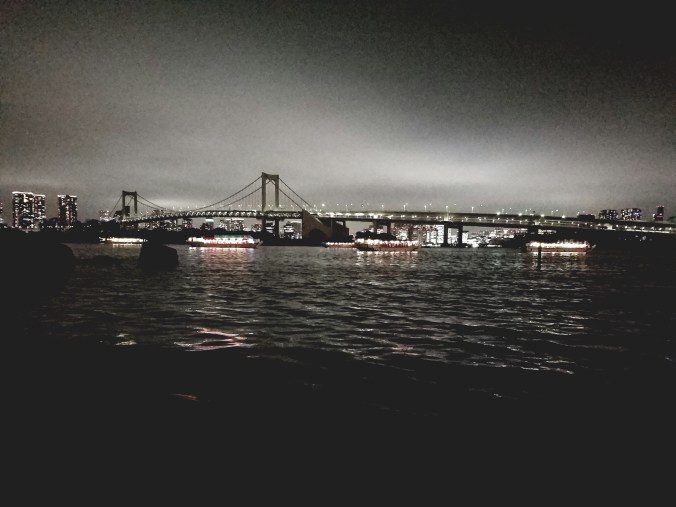
The Rainbow Bridge and some of the original Odaiba Batteries

Back at the hotel, breakfast was very American.  There was bacon and sausages, orange juice and coffee, and pasta and Caesar salad.  (I’m sure someone read about the latter combo in a book somewhere.)

After we would board the busses in front of the Grand Nikko Hotel and take the Rainbow Bridge into Tokyo.  In the bay beneath us was an old island.  It was the sixth of the six original man made islands that bore the name Odaiba in 1853.  They were batteries to keep out Commodore Mathew Perry, his Black Ships, and the Americans they represented.

Japan had been closed to the West for 200 years prior.  It would be closed no longer.  Today hotels and western shopping centers stand nearly on top of them.  So much for isolationism.

Coco

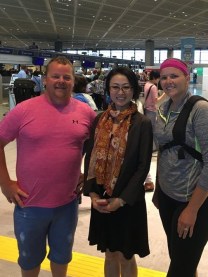
Coco and her admirers

“What did you know about Tokyo prior to coming here?”

“I knew it was clean.  When people would  describe it, nearly all would say, ‘You don’t even see a cigarette butt lying on the ground.'”

“Did that surprise you?”

“Not until I realized how much the Japanese still smoke.”  I smiled.  She laughed.

“My boyfriend smokes, but I usually make him do it under the range hood of the oven.”

20160709_051631

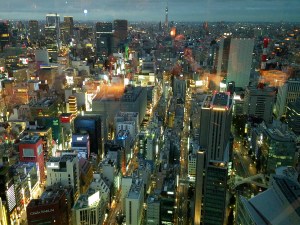
View from the Oregon with the Skytree in the background

The attractiveness of a woman telling a man what to do is universal.

Her name was Coco.  Part of our group was enamored with her.  I had just met her as we sat down for dinner.  We were on the 42nd floor in an American-style restaurant called The Oregon Bar and Grill.  Beneath us was part of the heart of Tokyo.

Down there, among the neon lights, were the androgynous looking youth that had packed our train at each stop from our hotel.  They were headed out.  We were headed up.  Tokyo is big enough to head anywhere.

FB_IMG_1468851933609

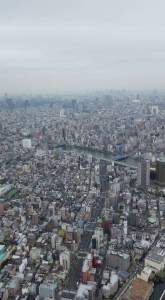
Tokyo from Skytree

In 2015 Tokyo had a population of over 13.5 million people.  Chicago, in comparison, had a population just under 3.  If we were to include the Chicago metro, we could boost the number to 10.  If we were to do the same for Tokyo, we would jump it to 37 million, housing more than 25% of Japan’s entire population.

It’s the largest metropolitan area in the world.  On those morning busses, you couldn’t help but stare out the window and marvel at the 20-story apartment buildings which sprouted out of the ground feet apart and stretched to the horizon without end.

Tokyo’s population is like its humidity.  You swam in it.  It stuck to you.

It was a clean stickiness, with a Western feel, on a belly full of pasta, OJ, coffee, and croutons.  If only I had a cigarette.

Farmers: The Accidental Diplomats

20160707_162203

Rainbow Bridge Tokyo

Sitting in the US Embassy in Tokyo, we were getting briefed on the current political climate in Japan.  A door at the back of the room opened, and making her way to the front was US Ambassador Caroline Kennedy.  Her slight build and soft voice gave one the impression of a certain amount of shyness.  There was also something about her quietness that made an impression of her resolve.

Agriculture must look the same way at times.

Ambassador Kennedy looked out on a crowd of over 120 people, there as part of Iowa Farm Bureau and making up farm families from across the state.  For many this was just the first or second time they had stepped over the US border and dipped a toe in the rest of the world.  At the same time, as Iowa farmers, we’re on the world stage every day.

20160707_203716

The Marketplace

“I hope you understand the tremendous value your presence has here in Japan, and the value the Japanese place on personal relationships,” the Ambassador said.  She subsequently underscored this by repeatedly coming back to it.  She did this by stretching it out over the framework of Iowa’s involvement with the Prefecture (State) of Yamanashi.

A typhoon hit Yamanashi in 1959, devastating the area.  An Iowa Sargent, Richard Thomas, would frequently visit the area while he was stationed in Japan post World War II.  Having returned back to Iowa, he asked fellow Iowans to help come to the aid of  the region.

He received 36 hogs and 60,000 bushels of corn.  The hogs, 8 boars and 28 gilts would have 500 descendants in 3 years time.  By the end of 9, they would have 500,000.  In the aftermath of World War II, Thomas’ simple effort underscored the powerful but quiet diplomacy agriculture brings in making peace.  It’s power lies in the quiet resolve of bringing food to those who need it.  It’s brought by the relatively sedentary life of farming, as long as governments stay out of their way.

20160707_203254

Old and New in Japan

That morning Iowa Farm Bureau President Craig Hill spoke to the fact that 2/3 of the world’s middle class will be located on the Pacific Rim.  Potential for Iowa agriculture abounds, if those in our government will simply remove the barriers to trade.  The protectionist or isolationist push against doing such is as productive as trying to hold the waters of the Pacific back with a fork.  All the commotion created is an opportunity for someone else, just across the way, to slip in.

At dinner that evening, I wound up sitting across a large table from the Vice Governor of Yamanashi.  She’s a woman who seems to have held every position one could hold in agriculture, similar in build and manner to Ambassador Kennedy, and a similar sense of resolve.  The words that kept appearing in her remarks when she addressed the group were in thanking our state for its kindness over 50 years ago.

Kindness and agriculture can get by without a translator.  Just look at how well those Iowa hogs did.

20160708_041756

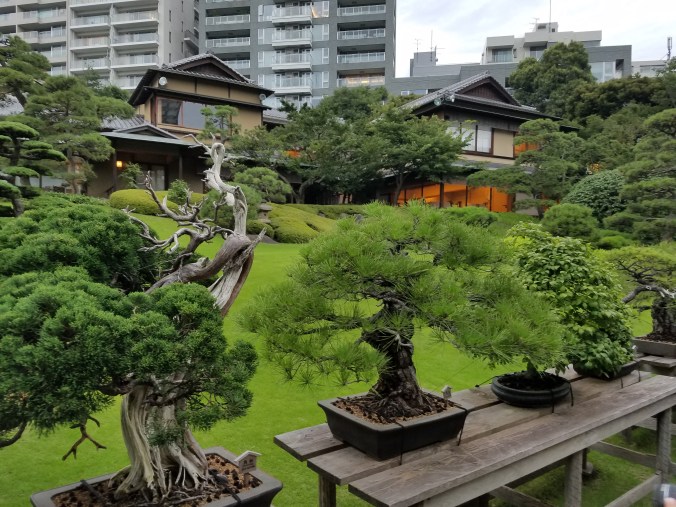
Small but Mighty:  The bonsai tree on the left is over 500 years old.