Fideli Certa Merces (Part III)

In 1951 Ernest Hemingway might have been considered to be something of a has-been when he sat down to write The Old Man and the Sea.  He wrote it in eight weeks, about a washed-up fisherman who idolize a great baseball player who was at the end of his career.  It was also about faith.  When published in 1952 it would take his fame beyond anything he had known.  It would be his last major work published in his lifetime.

The exploits of Joe DiMaggio and his New York Yankees make up the background of Hemingway’s book like white noise, though there is much that’s missed in the intricate details Hemingway wove in.  Because of the box scores, it seems you can pinpoint the time of the book to a particular season, and with that you can estimate the age of the character the old man refers to as a “boy.”

Books are like people.  You can read all kinds, but it will take a lifetime to know one.
Resized_20160817_192813

The Brewers bus had come and gone, and we walked over to the opposite side of Wrigley so the girls could try for an autograph from a Cub or two.  I was with a high school friend.  The girls were his, and despite how much they hoped, no players would sign.

Their father and I nearly rubbed shoulders with Theo Epstein.  The girls wouldn’t have known who he was.  We did, but he looked busy.

It was getting late in the afternoon.  In a half hour the gates would open.  The diehards were already in line for the bleachers.

“I bet they have tickets available,” I said.

“God, I’d love to go again,” said he.

“They do.  I just looked it up.  My treat.”

“I afraid the youngest might revolt.  She has her heart set on deep dish Chicago pizza.  Why don’t I take her, and you take my oldest in.”

“Are you sure?”

“Are you kidding me?  You’ve seen how she’s been the last hour.  Do it.”

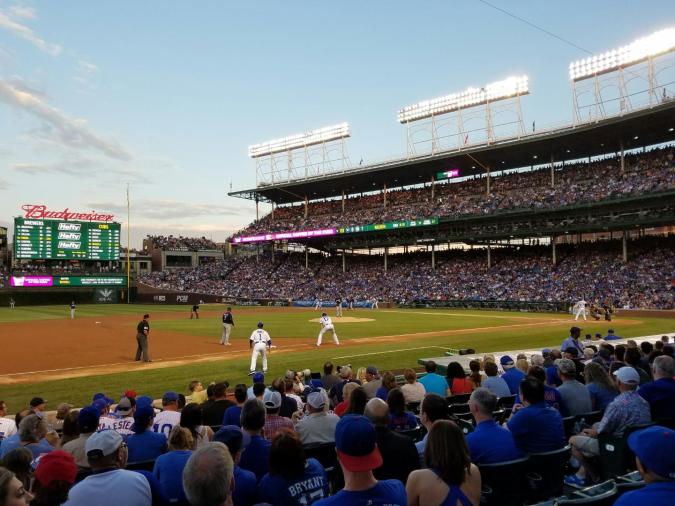
At the ticket window I bought two tickets just off the end of the Cubs dugout, ten rows back.

“You still got that ball Braun signed?”  I asked.

“Right here in my pocket,” she said.

“Let’s see if we can get a few more on it.”

“I’m going to get one from Ben Zobrist.”

“How do you know that?”

“Because he’ll come out by the dugout again, right after the game, just like he did last night.  This time I’ll be there when he is.  I just know it.”

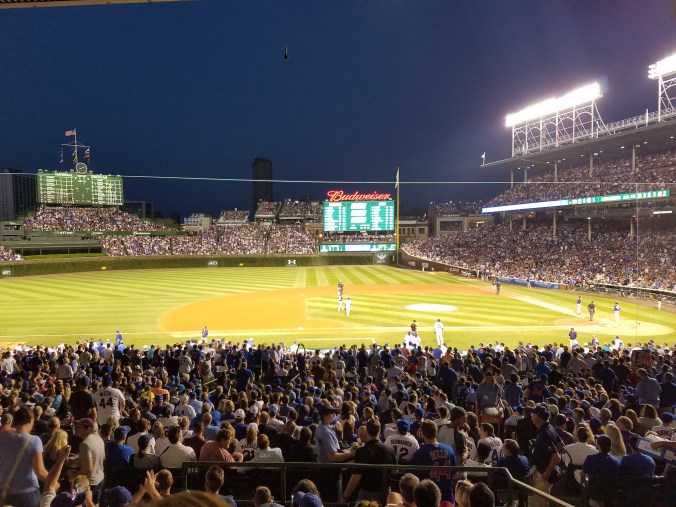
When the gates opened we found our seats, and she headed down by the infield to get autographs from the pitchers.  Aroldis Chapman dwarfed her and the ball his hand engulfed.  I worked on a bag of peanuts, sipped a beer, and talked to the man occupying the only seat to our right.

“Your daughter?” he asked.

“No.  My friend’s.  Her younger sister opted for pizza.  She opted for autographs.”

He smiled.  “I see she’s getting a few.”

“She’s not bashful about it is she?”  I observed.

An hour before game time they scattered the kids from the wall.

“What do you want to eat, Boss?”

“I can’t eat another hot dog.  I had one last night and one for lunch today,” she said.

“One more wouldn’t hurt anything,” I smiled.  “I saw burgers, though, and chicken tenders.”

“Chicken tenders sound good.  I’ll get some.”

“I’ll go with you.”

“I know where they are.”

“Need money?”

“I got some.”

I let her go, as though she were on her own, and then lazily followed behind to get an Italian Beef.  My Cardinals have a great item with the Killer Pastrami Dogs you can get at Kohn’s Kosher Corner right behind home plate.  But they are only second to the Italian Beef found at Wrigley.   Together the chicken and the beef would be joined by super rope licorice, ice cream in a Cubs helmet, a Bud Light (also mine), two souvenir cups of pop, and a bottle of water.  In between we talked baseball, the day behind, and her belief in Zobrist ahead.

When the game ended, she made a bee line for the other end of the dugout with me in tow.

“I’ll wait for you here,” I said.  The day before was a double header.  It was getting late.  I had my doubts on Zobrist, but she was happy and I didn’t figure she needed to know how the world worked yet.

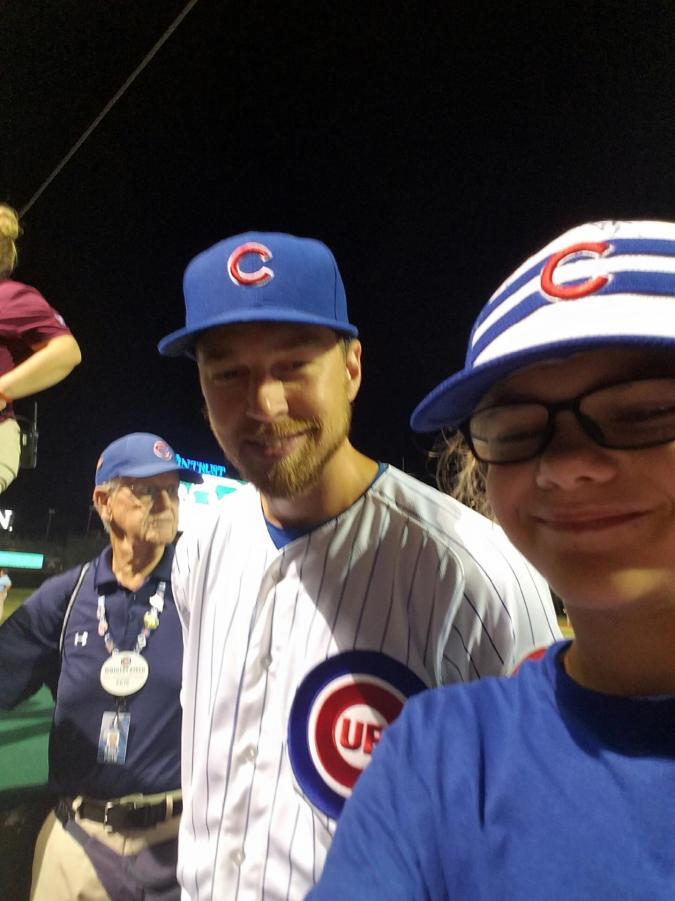
Losing her in the crowd, I spotted her blue and white Cubs hat all the way down in the front row.  She looked back at me and smiled for some reason.  And then in front of her, just like that, came the second baseman out of the dugout.

He was the only Cub that showed, signing balls and caps and taking selfies with the kids.  She was there, and she hit for the cycle.  I couldn’t have been more happy if she were my own.

I thought of the cynic I had been, while she beamed with a youthful joy.  I felt like an old man myself.  A drunk one row down stood on his seat, chanting, “Thank you, Ben Zobrist.  Thank you, Ben Zobrist,” over and over again.  The intoxication that comes, from finding those who get it.

Sometimes we nearly lose all faith.  If we are lucky, we remember or are reminded:  To the faithful, reward is certain.
Resized_20160817_220750

Fideli Certa Merces:  To the faithful, reward is certain.
 

The Ball Boy (Part Two)

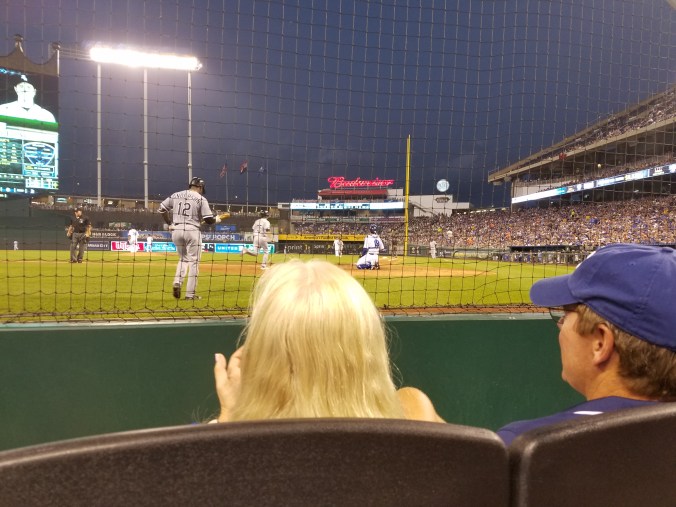
Ten days before Wrigley, I had been part of a group of guys who had splurged on Crown Club tickets in Kansas City.  The ticket gives you access to the rows directly behind home plate.  It also gives you access to an all you can eat and drink buffet in Kauffman’s basement.  We tried to make sure they lost money.

As we got ready to head outside, one of our group didn’t get up. So him and I remained, across from each other.

“You know I always thought if I had a son, I’d like to treat him to something like this.  I wouldn’t want to spoil him, but when I was a kid we always sat up in the cheap seats.  My folk’s busted their ass.  I’m just in a position where I could do better.  It’d be fun, you know, to share a mutual appreciation with your kid.”

Like a lot of men, we were talking baseball…baseball and other things.  Unlike most, we understood each other.

When I grabbed my seat, I could look into the dugout of the visiting White Sox.  They had all headed in, but bullpen catcher Mark Salas remained.  He stood at the top of the steps that headed down into the stadium and looked above at the kids vying for a ball from batting practice.  A muscle-bound and over-tanned dad in a tank top was pointing to his daughter, a shy girl of about 10.

“I thought I already gave you one, Miss,” said Salas.  The girl put her head down, but her father kept pointing.  Finally Salas pointed too, so there was no mistake who the ball was intended for, tossed the last one up to her, and disappeared into Kauffman.

The rest of the kids left, but the girl, a boy I assume was her older brother, and her dad gathered together in a row of seats just over the rail behind us.  The boy had on a backpack, and slipping it gave some indication of just how heavy it was.  His father unzipped it and pulled out an oversized Ziploc bag 2/3rds full of baseballs.

The girl placed hers into the bag and looked down as her father fished another out of the pocket of his running pants.  He returned the bag to the backpack, put the backpack on his son’s shoulders, and up the stairs they went:  the shy girl, the encumbered boy, and their orange meathead of an old man.

If they don’t appreciate it, I suppose you can always force them to do it anyway.  We can tell ourselves its for them, but we know its for us.  Salas had left, but he was already familiar with the script.

Anderson

Anderson comes up the top of the 5th

In the top of the 5th, the Royals were enjoying a 3 to 1 lead with two quick outs.  A recently called up kid, named Tim Anderson was coming up to bat.  A man in his 60s ahead of us, pencil necked and sitting with his wife, decided it was a perfect time to talk shit.  Being on the other side of a backstop is pretty empowering I guess.

“You haven’t hit anything today, Anderson.  0 for 2.  How you liking Kauffman?”

Anderson watched a 94 mph fastball go by for a strike.  Then he took an 81 mph curveball and drove it, beginning a two out rally the Royals would not recover from.  Whether a kid is appreciated or not, they grow up all the same.  Hopefully some of them get around on it.

Wrigley (Part One)

20160816_201130Wrigley Field is like a dilapidated, old hotel on the north side of town, which owes most of its existence to the fact that anyone who’s anybody still goes there.  Folks like me go there too.  We sit down on a late summer evening to the smell of beer, and yesterday’s beer, and body sweat.

You’ll find men wearing salmon shorts with their long sleeves rolled up and their sunglasses on top of their heads, women wearing salmon shorts with their long sleeves rolled up and their sunglasses on top of their heads, and those trying to get a few more days out of their white pants before Labor Day.  Occasionally you’d catch the glimpse of a whisper that mauve is the new salmon.  One is as poor to look at drinking beer as the other.

There are men trying to look important, and those unashamed to have come up from their parents’ basement to see the Cubs play.  The late day sun makes them squint.  There are 65 year old women trying to look 30, and those that have aged gracefully, young at heart, and comfortable being at the game alone.  There are mothers and fathers bringing their kids to the park with different partners than they began summer with, and there are the families you’d hoped you’d have someday.

Just which is which can be tricky.  Life does a poor job of separating out the genuine from the bullshit.  Stuck, I suppose, in a revolving door, round and round, confusing motion for movement.  Our eternal hope is that the divine will separate it someday, but for today we have baseball, which has attempted to separate the genuine from the bullshit since the days of Abner Doubleday.

Wrigley is uniquely situated in that regard:  a ballpark atop an old Lutheran seminary.

A friend and I and his two girls caught the nightcap of a doubleheader, and the next morning we all headed downtown.  The youngest insisted on visiting the American Girl store on Michigan Avenue.  I insisted on letting the family of three have at it.  While I was elsewhere, their father looked back to a discover a familiar face behind them waiting in line at the cash register.

“Excuse me.  Are you Ryan Braun?”

Ryan Braun is a Milwaukee Brewer, who was the 2007 National League Rookie of the Year.  He was named to five straight All Star Games from 2008-2012, was the National League MVP in 2011, and led them in homeruns in 2012.  He also sat for 65 games at the end of 2013, suspended for violating league policy on performance enhancing drugs.  For that, even in The Friendly Confines, he was booed the night before.

“I am.”

“I know you are with your family, and I don’t want to bother you, but could I introduce you to my girls.”

“Absolutely.”

Ten minutes later, he was filling me in.  “Think I did the right thing in not asking for an autograph?”

“I do.  I think it showed the girls some class.  What do you think?”

We had a tour that afternoon of Wrigley.  We spent time afterward in Wrigleyville, grabbing a late lunch, letting the girls find some last minute Cubs gear, and getting ready to find a cab back.  On the backside of Wrigley stood a boy with a three ring binder and his Dad.

“Is this where the Brewers come in?”

“That’s what we were told.  My boy is hoping to get an autograph or two.  The girls, their Dad, and I spent the next 30 minutes waiting as well.  When the bus pulled up, only one Brewer would sign.  It was the girls’ old friend, Ryan Braun.  Perhaps in stopping, he taught them something about movement and the work of trying to sort it all out for our self.

20160818_215623

Ryan Braun, just off the bus, wearing salmon.

Elie the Farmer

“What do you do?”

The question was posed to Elie Wiesel.  He was 15, and he was at Auschwitz.  It had been posed by Dr. Mengele himself.  Elie, who had already lied to an SS guard about his age, lied once more.

“A farmer.”

It is stated that anywhere from 75% to 90% of those that arrived at Auschwitz were killed on arrival, that is to say within 30 to 35 minutes.  Just minutes before his family had come to a sign which read, “Men Left, Women Right.”  They followed it.  It was the last time he saw his mother and youngest sister.

He and his father would have died as well, but a worker instructed them to lie about their age.    Elie lived to be 87 and died the 2nd of July this year.  In his time, he authored nearly 60 books and won a Nobel Peace Prize.  Perhaps his most famous work is “Night,” a memoir of his time in the Auschwitz and Buchenwald concentration camps.

A couple of days after his death, I discovered a copy of that book in my office.  It had been a gift several years ago from one of my sisters.  I peeled off the label that proudly heralded it’s selection into Oprah’s Book Club, and I set in on the thin, 115 pages, passing the time before fireworks that evening.

It is amazing how quick a read an eternity can be.

In the book are passages that will never leave you.  If you chose to hear them, then you must put down the affluent-laced ideas that everything happens for a reason and that it is all going to work out in the end.  You’ll get a sense of the urgency that seemed to guide the active engagement Wiesel pursued life with.  If we give it time, I suppose it will mostly pass.

Elie Wiesel was a farmer.  From a barren field, devoid of life, he harvested something not to be found in our abundance.  From it he took seeds, and he planted them on paper. Harvesting what he grew is up to us.