Preaching to the Choir

He had a friendly southern draw, conveying a sense of southern hospitality, while producing words in the quick paced way of a man that is busy.  Sunglasses dangled from his neck as he spoke after lunch in the little town of Lyon, Georgia.  While one hand held the podium in place, the other would work to make his point.  Visually he would have fit right in with the group of Iowa farmers listening, but we were listening because he was a Georgia one, growing among other things, the Vidalia Onions Toombs County was known for.  He was 38.

“Now who of y’all wants to ask the first question?”

“A lot of our crops in Iowa use biotechnology.  It’s something some express concerns about.  You guys have huge urban centers in Georgia.  How does agriculture interact with those consumers?”

“At least two of your all busses have visited Pittman’s right?  They’re the produce farm with the country store.  Any of you all know what Silver Queen Sweetcorn is?  Down here it’s the sweet corn all the supermarkets carry.  They have for years.  It’s all most people have ever known.

Folks will drive out to Pittman’s, who sell sweetcorn, and they’ll ask Mr. Pittman, ‘You, uh, you got any of that Silver Queen Sweetcorn?’

‘No, sir.  I sure don’t.’

‘Why, uh, why don’t you have any of that Silver Queen?’

And he’ll answer ’em, ‘Well y’all didn’t drive out here in no Model T Ford did ya?’

Up north you have BT Corn.  Down here we have BT Cotton.  You have it for your friend, Mr. Corn Borer.  We have it for ours, Mr. Boll Weevil.  In 1996 I could have used 14 different pesticides to keep him at bay.  I don’t have to use any today.  I know which one I prefer.

Some consumers are using bad information.  That’s on them.  Sometimes we aren’t doing a good putting information out there.  That’s on us.  We’ve never had to do it before.  It’s important to understand how to do it without driving wedges.”

As a spokesman for agriculture, he was bona fide, in every sense of the word.
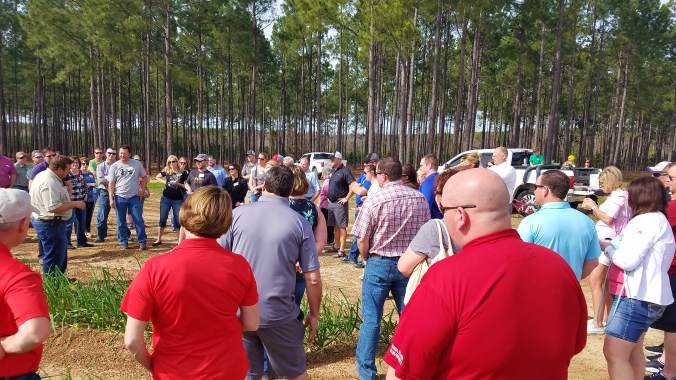
20170220_144208

Visiting the farm after lunch.

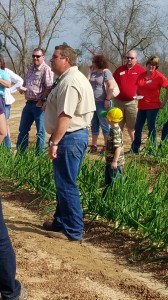
After lunch, our bus came to a stop in 20 acres of Vidalia Onions.  There we met the rest of his family, in the back of a pickup, serving up boiled peanuts to their third bus load of guests.  Their two sons, 7 and 3, danged their feet over the side of the box and took it all in.

“I’m sure you’ve noticed in your other stops how pebbly our soil is.  When my grandfather was looking for land, he’d look at them stones.  What he wanted to see is what y’all are seeing here today, good red rock.  If he saw quartz, then that land was of no value to him.  It is red rock that takes in the heat from the sun, keeps our ground warm even in the winter time, and allows us to do what we are doing here.  By April these onions will be harvested, and peanuts will be growing in their place.”
20170220_150204

Taking it in

Two Georgia boys were getting their own chance to soak it up, in order to keep it going.  Meanwhile their father preached to the choir; looking, I suppose, for a few more preachers.  We need ’em.


The Fuzzy Math for Conservation

A recent Des Moines Register article made a passing note on Linn County’s purchase of 500 acres for 7.2 million dollars.  A Linn County supervisor seems to be quoted as calling the purchase an investment in “conservation.”  Conservation is a broad term.  It could mean a lot of things.  The trouble is the article continues with a direct quote from the supervisor on what the purchase is meant to stem.  “They {residents} go to lakes and find them covered in algae.”

Most of the time numbers are numbers.  Sometimes they get personal.

As a commissioner on the Madison County Soil and Water Conservation Board, we oversee state cost-share funds for conservation on the county’s 359,680 acres.  These are the funds local farmers and landowners will match to establish waterways, build terraces, and construct ponds.  This year the amount of state cost-share we will be in charge of spending will be somewhere around $110,000.  The Linn County purchase could fund our county cost-share for 65 years.

In fact the Linn County purchase comes is very close to funding the 7.5 million dollar state budget for cost-share programs in 2016.  In the state’s case, the Iowa Department of Agriculture and Land Stewardship notes that Iowa farmers matched it with 8.7 million, giving a total investment of 16.2 million.

I serve as a trustee of the local Badger Creek Watershed.  The County Soil and Water Conservation District is in charge of maintenance and improvement of numerous structures and investments previously made in the watershed’s 33,581 acres.  Our annual budget to do so is $84,942.  The Linn County purchase would fund that budget for 85 years.

It is a shame the Register article makes only a passing note of the Linn County purchase.  The real story, the one most uncomfortable to read, is that some might think spending 7.2 million for 500 acres is a feasible way to measurably improve water quality across the state.  It might be laughable, if it weren’t so sad.

Just two days ago I was the Iowa Statehouse to visit with my legislators about Iowa Farm Bureau’s number one legislative priority:  finding a larger, dedicated source for soil and water conservation funding.  This is the funding that will increase in value by being matched by the state’s residents.  I think this is the funding that will continue making measurable progress in soil and water conservation as we adapt to the challenges of today and look ahead to tomorrow.  I’m sure the 7.2 million Linn County spent will make a fine park.

Swiss Coffee

The lights were dim in the Des Moines coffee house, mostly coming from strings of lights that would bow intermittently from the ceiling above.  On the far wall, above each table that sat against the big windows that kept the patrons from the street, stooped a solitary light for those beneath to share.

With me there sat a man with clear blue eyes and the face of a priest.

“I drink coffee now,” he said with his graying hair curling up against the bowed down edge of his ears.  “At one time I used to come to a place like this to smoke.  Then those damn Democrats over there took it away from me,” nodding over to the group of college students, huddled around a large table, some sporting t-shirts that gave an idea of their politics.

“Could have been worse, I guess,” he continued.  “A hundred years ago the group behind you would have took away my cocktails.”  I didn’t have to look for the bible study group.  I had already seen them.

“I’ve never been here before.”

“It is quite the place.  Very different people at different tables, all in the same room.  How one hasn’t protested the other’s existence, I don’t know.  I have been coming here for years.  I’ve seen no fights.”

“Perhaps the coffee is Swiss.”

Unamused, he continued.  “Do you know why I think people read what I write?” he asked, leveling his glare at me and exhaling like a man who still smoked.  “I write about being lonely.  Being lonely has no party.  It relates to everybody.

It makes them equally uncomfortable.  I have no idea if I write well or not, but I do take comfort that no book of mine makes someone feel better about themselves or worse about someone else.  Sometimes I wonder why anyone reads them.”

“There’s a truth to it, isn’t there?”

“Do you think people like that?” he laughed.

“I don’t know.  Perhaps a lot of us just respect it, especially when it’s delivered softly.”

“Respect.  Ha.  Some here would talk to you about personal responsibility, some about privilege.  Both represent the idea that someone else didn’t suffer enough.

You write.  You must look at people.  Have you ever seen someone that hasn’t suffered?”

“I’ve seen some that work like hell to avoid it.”

“Where does that get them?”

“More suffering.”

“Ha.  We sit in one big room together.  We drink our coffee together.  And we suffer together, whether we are at different tables or not.”

“Sounds a little depressing.”

“No.  What’s depressing is how we waste it and let it push us further apart.  I always find it hopeful coming here.”

“What do you do with it?”

“Me?  Well I write.  Occasionally, though, I shrug personal responsibility and in my privilege sneak an occasional cigarette.  But a coffee…sometimes a coffee will do.

What about you?”

O Ye of Little Faith

20170207_072521

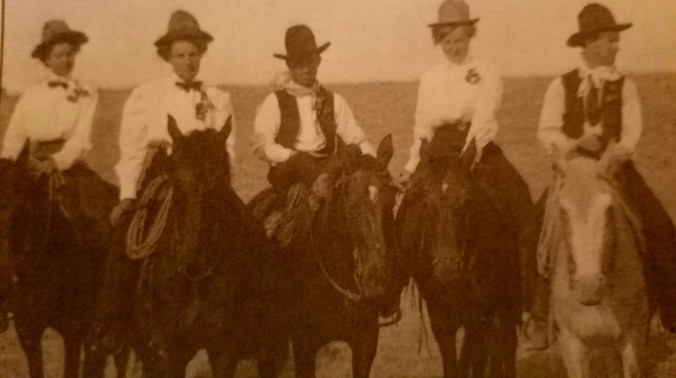
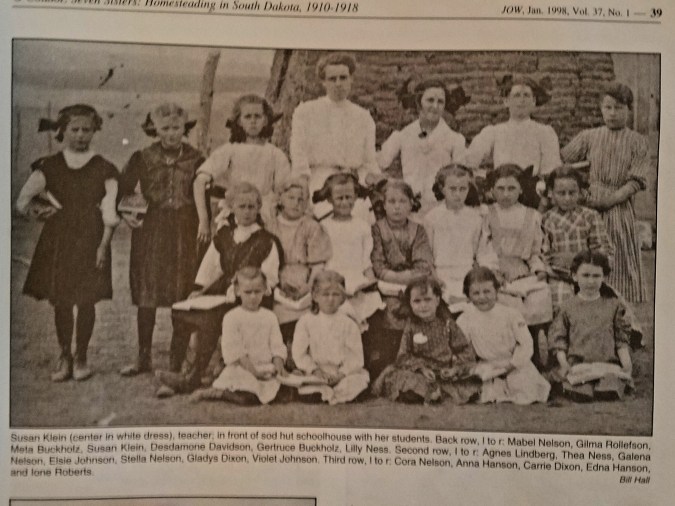
In 1918, Susan Klein Funk was 31 years old.  In her last few years she had acquired a husband, a 3 year old daughter (Margret, my grandmother), a 1 year old, and a newborn.  In the few years which preceeded that, she had proved up her own claim for 160 acres of land she had homesteaded.  There she’d built her own cabin, shot her own game, roped and branded cattle with her sisters, and found time to teach school.

Her last days in 1918 found her with apendicitis.  The nearest hospital also housed wounded veterans of the First World War.  They carried the Spanish Influenza.  There was no cure.  Susan was exposed, and in that hospital she died.

By her side was her sister, Mary.  She had been for some time.

20170207_072012

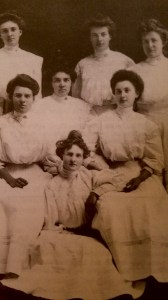
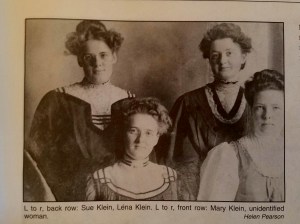
There were seven Klein sisters in Waverly, South Dakota.  Several were seamstresses.  They had all grown up on the farm.  Three were married.  The reminaing four, Magdalena (Lena), Susan (Sue), Victoria (Tory), and Mary, ranging in age from 22 to 27, were considered past their marriageable prime.

The federal government was opening up new territory in the western part of the state.  Anyone over the age of 21 was welcomed to stake a claim.  In 1909 the four struck out on their own.

They each selected a 160 acre tract not far from the emerging town of Faith.  Over the summer and fall of 1910, each built a sod house on the corners at the adjoining tracts central point.  Within 15 feet they’d find water.  It was considerably more to find wood.  They could still find “buffalo chips,” however.

The Klein girls (as they were called) relished the big waves in the new territory.  They had their work.  They had a countryside full of eligible men.  They had dances and excitement in the new town of Faith.  In 1911 they took a one month trip to the Blackhills and the Badlands.  Susan kept a diary of their time.  Her brief entries came to an end with one final line:  Sure saw some country and had a fine time.  End.20170207_072709

The oldest of the four, Mary, was the ring leader.  On her shoulders would forever lie her own mother’s blame for the taking of four of her daughters, and I suppose one’s death.  Fiercely independent, she’d fight for the right to work off her poll tax in order to vote.  She’d be the last to marry.  At 92, she’d be the last to die.

She was stubborn enough to disregard the good consuel of the day and fearlessly care for my great grandmorther in the hospital.  Most wouldn’t be.  After Susan’s death, her coffin was brought home, but fear over infecting her family would keep it out of the house.  Instead it was briefly laid open on the front porch for her children to say goodbye.  At least one of her sisters wished to do so as well.  She loaded up her family and ventured as far as the farm drive before turning around, unable to run the risk.

55 years later, Susan’s husband, Francis, would make his way back to Faith to rejoin her.  Out of respect, I suppose, for that Klein stubborness.  Or perhaps for a journey that began in Faith.

We should live the life we are called to live.  Some will stay in spite of the waves.  Some will come around.  Some will be attracted to it.  The rest is not our business.

20170207_072102

From l to r:  Lena, Sue, Roy Hall (Lena’s Future Husband), Tory, and an unidentifed man.

All photos from Journal of the West.  Vol. 37, No. 1.  January 1998.


You and Me and the CRP

You won’t have to go to far in your day to run into the polarized political debate that is currently raging in our country.  Many voices compete to be heard, and while shouting is not without merit in acheiving that, it is often at the expense of a much more substantive debate we need to have.  One federal program that might illustrate that while minimizing emotional fallout is the Conservation Reserve Program or CRP.

The program came to prominence under the 1985 Farm Bill, though it had existed three decaes prior.  It targeted highly erodible land, placing it under vegetative cover for a period of 10 to 15 years and removing it from production.  These acres were essentially rented to the federal government.

There had long been a conservation push to expand the program, but the push was coupled with the collapase of the farm economy during the Farm Crisis of the 1980’s.  A farm family could now enroll their acres for a guaranteed yearly income and for a guarenteed length of time.  This contract gave families something firm to restructre their debt and removed acres from production that might boost sagging markets, saving farms and saving soil.  5 million acres were under contract in 1986.  40 million would be enrolled by 1990.

The program began with great intentions on all fronts.  As time has went on, however, concerns have arisen.  One can see many of them by simply travling down Highway 34 or Highway 2 in Southern Iowa.

Southern Iowa was hardest hit by the Farm Crisis.  Its rolling hills were also prime targets for the erodible acres sought by CRP.  Some of those acres can be seen today, unfarmed and ungrazed.  You can also see the impact it has had on local communities.

No seed, fertilizer, or equipment is needed on those acres.  No hardware store, or repair shop, or gas station sells anything of note to service them.   No steward is needed.

Many wonder if this is what conservation needs to look like.

The CRP rate can create competition in rental rates for other cropland.  In some cases it can set a floor that raises the barrier for entry for young farm families.  In some it simply offers a higher rate of return, attracting acres not for their conservation merit, but simply for the return that might not ever reside in the local community.

The rental rates can also prohibit cow/calf producers from competing for those same acres, who would leave them in grass, but generate prodcution from them.  Attempts have been made to change this, but to date each attempt runs into some dedicated to the idea that conservation needs to look presettlement.  The farmer, last in line, is often left without something practical.

It isn’t hard to envision an attempt to change the program being shouted down as an attack on the environment.  Shouts won’t extinguish embers that still smolder in rural communities from the meltdown in the farm economy.  Being faithful to both is how the program took root in the first place.