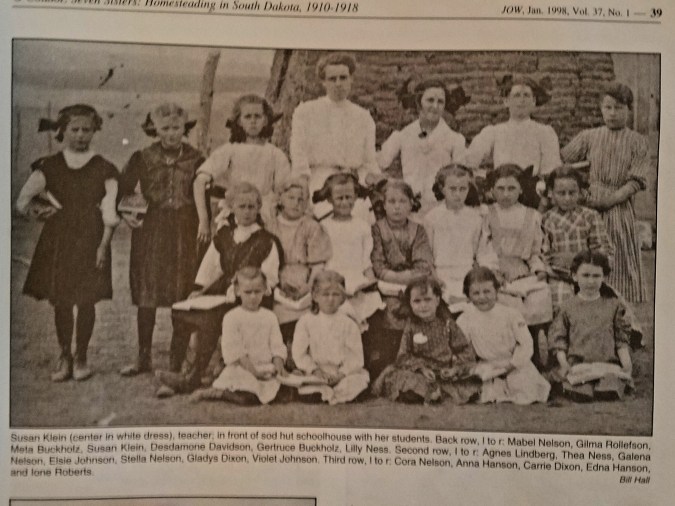
In 1918, Susan Klein Funk was 31 years old. In her last few years she had acquired a husband, a 3 year old daughter (Margret, my grandmother), a 1 year old, and a newborn. In the few years which preceeded that, she had proved up her own claim for 160 acres of land she had homesteaded. There she’d built her own cabin, shot her own game, roped and branded cattle with her sisters, and found time to teach school.
Her last days in 1918 found her with apendicitis. The nearest hospital also housed wounded veterans of the First World War. They carried the Spanish Influenza. There was no cure. Susan was exposed, and in that hospital she died.
By her side was her sister, Mary. She had been for some time.
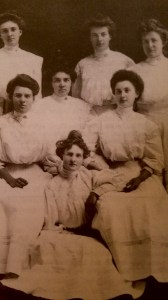
There were seven Klein sisters in Waverly, South Dakota. Several were seamstresses. They had all grown up on the farm. Three were married. The reminaing four, Magdalena (Lena), Susan (Sue), Victoria (Tory), and Mary, ranging in age from 22 to 27, were considered past their marriageable prime.
The federal government was opening up new territory in the western part of the state. Anyone over the age of 21 was welcomed to stake a claim. In 1909 the four struck out on their own.
They each selected a 160 acre tract not far from the emerging town of Faith. Over the summer and fall of 1910, each built a sod house on the corners at the adjoining tracts central point. Within 15 feet they’d find water. It was considerably more to find wood. They could still find “buffalo chips,” however.
The Klein girls (as they were called) relished the big waves in the new territory. They had their work. They had a countryside full of eligible men. They had dances and excitement in the new town of Faith. In 1911 they took a one month trip to the Blackhills and the Badlands. Susan kept a diary of their time. Her brief entries came to an end with one final line: Sure saw some country and had a fine time. End.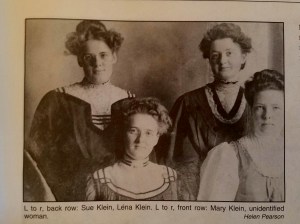
The oldest of the four, Mary, was the ring leader. On her shoulders would forever lie her own mother’s blame for the taking of four of her daughters, and I suppose one’s death. Fiercely independent, she’d fight for the right to work off her poll tax in order to vote. She’d be the last to marry. At 92, she’d be the last to die.
She was stubborn enough to disregard the good consuel of the day and fearlessly care for my great grandmorther in the hospital. Most wouldn’t be. After Susan’s death, her coffin was brought home, but fear over infecting her family would keep it out of the house. Instead it was briefly laid open on the front porch for her children to say goodbye. At least one of her sisters wished to do so as well. She loaded up her family and ventured as far as the farm drive before turning around, unable to run the risk.
55 years later, Susan’s husband, Francis, would make his way back to Faith to rejoin her. Out of respect, I suppose, for that Klein stubborness. Or perhaps for a journey that began in Faith.
We should live the life we are called to live. Some will stay in spite of the waves. Some will come around. Some will be attracted to it. The rest is not our business.
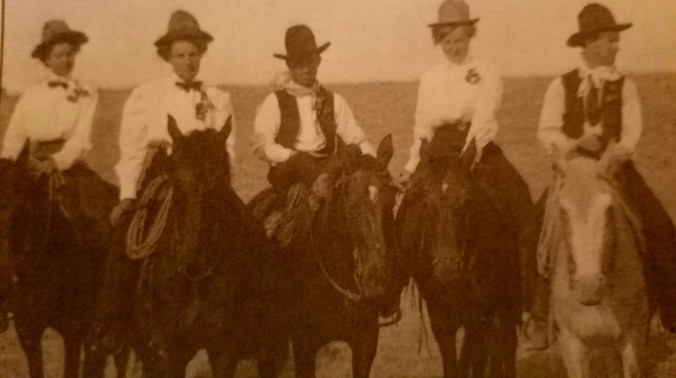
From l to r: Lena, Sue, Roy Hall (Lena’s Future Husband), Tory, and an unidentifed man.
All photos from Journal of the West. Vol. 37, No. 1. January 1998.
 True Stories and Tall Tales