The Pole Bender

Sometimes a man don’t know
When he’s supposed to walk away.
Heath

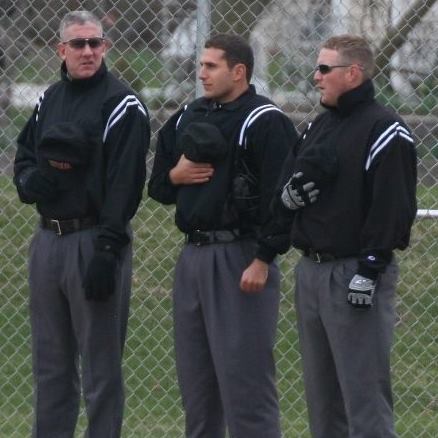
“Mad Dog” Joe Nelson, Pat Hoberg, Heath “Wild Man” Banks, back when they were fat.

“Hi, Terry,” said the MLB umpire leading us back to the elevator that would take us back to the seats of Kaufman.

“Hi, Pat.  How are you doing today?” said the coach with a fifth grader’s enthusiasm.

The umpire was Pat Hoberg.  The coach was Terry Francona of the Cleveland Indians.  We were on our way back from the field, where we had just been shoulder to shoulder with their All Star Lindor as he signed autographs for the kids at Kaufman.  It was neat to be close to a player of his caliber.  It was neat to find that caliber coupled with that humility.  But brushing shoulders with Francona, the coach who just been in the World Series without his two top starters and had managed his ass off only to lose in 7 anyway, was more than neat.  It was something a man could get swept up in.

“I enjoy getting a chance to get people down on the field if I can,” Hoberg had explained earlier as he stood along the fence of a press dugout.  His eyes turned from the field, as though he wanted to emphasize the point.  “It always impresses me how they look at it, wide-eyed and all that.  It reminds me to appreciate what it is I do.  I tend to just look at it as my job.  Sometimes I forget just where it is I work.”

The Indian taking BP crushed a ball just then.  By sound alone, Hoberg’s eyes jolted back and found it mid-flight, like he knew exactly where to expect it.  It sailed to center and was gone.

It’s a strange thing.  You know the ball will come down, yet the mid-flight feeling taps in to something eternal.  The presence of all things in a brief instant.

His eyes never strayed from the field of play again.  It was hardly some super-human quality.  It was simply his job.  His job was not to get swept up in it.

A couple of buddies had umped high school and college baseball games with Hoberg.  It was that connection that had brought me along.

“How did you come to ump with Hoberg?”

“We were umping a game, Joe and I, and the third ump hadn’t showed up.  We were needing to get going.  Joe had called Pat’s games when Pat was in high school.  He spotted him in the crowd and told him he was needed on the field.

‘I don’t know what the hell I’m doing,’ he said.

‘Sure you do.  Will cover you.  We just need the body.’

Turned out, he was pretty fucking good.”

“Do you have a favorite story?”

“Yea.  The three of us were calling a Carroll game.  They’re always good, and going into the bottom of the fifth they were up 8-0.  Two more and they would ten run it and end it early.

The catcher from the other team was a whale of a kid.  I could hardly see around him.  It was a bitch trying to call the plate.

This kid from Carroll was batting with a man on.   All of the sudden I heard that crack, and I knew he had gotten around on one.  Smoked it.  Problem was I had never seen the ball come off the bat.

I looked up and I couldn’t find it.  I had no idea where it had went.  ‘Fuck,’ I thought.

I glanced at Hoberg, and I could tell he hadn’t seen it either.  I looked over at the third base coach, and he had his arm out, pointing fair.  It was all I had to go on.  I put my finger in the air, ran them home, and Hoberg and I trotted off for the locker room.

We were talking about where we were going to get beer on the way home.  I was pulling off my shin guards.  That’s when he asked me where the hell Nelson was.  On cue the door bust open, and Nelson came in, face beet red and his eyes bulging out of his head.

‘What the hell just happened out there, guys?’ he asked, running his fingers through his scalp, exasperated.

Two run homer.  Walk-off.  10 after 5.

‘Walk off, huh?  Did either of you see the fucking ball?’

No.  All I had to go on was the third base coach.

‘Do you know why you didn’t see that ball?  You didn’t see that ball, because it was so far foul it’s sitting in a cornfield in Nebraska right now.  It’s a shit-storm out there.  Where the hell do you think I’ve been for the last twenty minutes?’

The shit storm outside wasn’t the worst part.  The worst part is that we periodically get reviewed, and there was a guy from the state in the stands that night.  Of all the damn nights…I spent the next few days waiting on a phone call.  It never came.

I ran into the guy a few weeks later.  I asked him, ‘Hey uh, did uh, did you hear anything on that Carroll game?’

He smiled.  ‘Yeah, I got a phone call wondering what the hell had happened over there.’

‘What did you say?’

‘I told him the truth.  Don’t really know what to tell you.  Damnest pole bender I ever saw.'”

The guy umping the umps hadn’t got swept up in it either.

“How did it end with you guys?”

“Joe had been to umpire school.  He mentored me.  When he thought I was ready, he encouraged me to go.  I didn’t make it.  When Pat came along, he followed our same footsteps, and then he just kept going.

The guy that taught Pat had went through school with me.  At night my phone would ring.

‘Man, I just don’t know.  I don’t know if I have what they are looking for.  I can’t tell how I’m doing down here.’

‘Oh my God.  This kid…he’s like no one else down here.’

I’d just listen, never able to tell the other where the other was at.”

“I used to think people knew how good they were.  Maybe everybody wonders.  Do you suppose Francona wonders?”

“I suppose he wonders how he is getting back to The Series again.”

“Maybe that’s the trick.”

“What is?”

“The trick is to keep going, home run or pole bender.  The ball will come down on its own.”

How in the World?

I suppose some think that to tell a story you need to invent it first.  It simply isn’t true.  Life will do it for you.  In a pinch, the life of others will work too.

“Where in the world did this idea of providing unconditional love come from?  Can anyone tell me?  This is how parents think they are to raise their children of late.  How has it become so widespread?

Has anyone ever asked themselves if this is something we, as human beings, can even provide in the first place?  Have we asked ourselves if it is really in our best interest to tell those we care about, ‘You can do whatever you want.  I will still love you.’?

When I think of a generation being raised with this mindset, I’ll be honest.  It scares the hell out of me.  I worry that despite everyone’s best intentions, it can be crippling.

There was a teen girl hospitalized in a mental health unit.  She refused to communicate with anyone.  A team of doctors oversaw her treatment, and each day, at the appointed time, they would go in and try to make her talk.  It was as though they could make a bean grow by pulling on it.

This approach yielded the predicted results.  The more they tried to make her talk, the more she resisted.  Eventually a new team became involved.  The woman heading this one up knew something about systems thinking.

She decided no one was to try and make the girl talk at all.  Instead someone would go in, an hour each day, and simply be present with her.  If the girl wanted to sit there in silence, they would sit there in silence, but they would remain present.

They persisted in this line of action for several weeks.  The mental health professional would sit attentively in a chair.  The girl would sit with her head down, arms crossed, and closed off.

Finally one day the girl rose her head, looked across the table, and exasperatedly asked ‘What?’

With little reaction came a simple response.  ‘What are your goals?’

‘Pfffft,’ with a roll of the eyes.  Head went down, arms crossed, and the session ended.  A week later she again asked, ‘What?’  Same exchange.

By asking the question, they began an internal dialog within the patient.  What are my goals?  What do I need to do?  What am I trying to accomplish?

They didn’t provide those answers.  We never help by doing for someone what they could do for themselves.  They also didn’t wash their hands of her.

Some therapy today is awash in delving into and swimming around in emotion.  It is as though a good therapy session is one in which we cry in.  It may feel wonderful at the time.  The question is does it help?

Focusing on goals introduces the idea that the best way to sail through life’s rocky seas is to chart our own life course.  We can do this by using and gathering the best information we can get our hands on.  We can do this by trying our best to recognize the anxiety life and our relationships generate for what it truly is:  energy.  Energy we can use to get there.

This is the path that teen girl was able to take.  No one wrote her off.  No one promised unconditional love.  In not telling her what to do, which includes telling her she didn’t need to do anything, they respected the dignity of the person.

In our own lives it must take a lifetime to make sense of it all.  I guess it is up to each of you.

A Game of Inches (and Partial Ones)

Towards the end of June I awoke one morning to an 80 percent chance of 1 to 2 inches of rain.  We really needed it.  Our last, significant precipitation had been a half inch a few weeks earlier.  It came on oats I had seeded down for cover in our cattle lots.  It was dry enough the half inch soaked right past them and never got them to sprout.

By 3 pm the chances for the day had dropped to 20 percent.  By the end of the day, they would be reduced to zero.  It had become depressing.

The Fourth of July brought inch and a half amounts within just a few miles of the farm.  For us, it brought a sprinkle.  The brown yard crunched.  The corn rolled.  Late soybeans remained the same height they were a month ago.

Now the extended forecast showed 7 days of 90+ degrees and no rain in sight.  I thought about the neighbors’ crops I drove past.  I thought about the neighbors.  I wondered how much more grass remained for our cows.  I wondered what it was we were going to do for hay.

It’s such a funny thing this day and age to be in a profession still held on pins and needles by the uncontrollable, and still unpredictable, weather.  A little like financial markets, I guess, minus much of a reason why emerging from the aftermath.

Last night, with the same 20 percent chance, we got half an inch.  It is nice to know it can do it again.

Parts of the state are much drier than us, and parts of the country are drier than them.  Perhaps we will have no more than a whiff of a drought.  A whiff is plenty.  Perhaps this half inch of rain will be short-lived.  This morning it is enough.

A Fifth of Plochman’s on the Fourth

Another figure looming large in the ability to properly tell a story is a cousin of mine.  He’s the most talented storyteller I’ve ever come across.  He especially shines when it comes to humor.

Most stories involve a cast of his friends, and mostly he refers to them by their last name alone.  It gives the audience a sense familiarity to those they may have never met, and supports a belief that were they to someday, they would be their friends too.  Nearly all tales include an incidental character whom will loom large in the story to come.  Whenever possible he somehow pulls out from the recesses of his mind this character’s full name, reinforcing the thought that whatever it is you are about to hear actually happened.

Employed in the story’s telling are phrases like “remember how it was…,” “you know how it used to be…,” or “it was a day not unlike today…,” and they serve like stitches, connecting the audience in the present day to the setting of the story and offers a sense of mutual recollection about an event the listener can’t recollect at all.  In some places, words are dropped altogether, replaced by replicated looks and gestures that ask that the listener supplying his or her own words, and permeated by the pauses that give them the time to do just that.  Soon, one is no longer listening at all.  They are there, in the story, as an active participant.

“It was the Fourth of July and Baker’s parents were having a party.  We were just out of high school, and the whole gang was there, waiting until it got a little darker and the adults got a little more intoxicated so we could make our own way to the keg.  A pack of vultures really.  Baker’s Mom’s Boss was there, and so was Baker’s Mom’s Boss’ Husband.  Guy’s name was Randy Peterson.”

“It was about this time of day,” he said, looking out on the day behind him.  “Everyone had been nursing a beer, except Randy Peterson.  He had his own tumbler, with a gold bracelet around one wrist, and a shirt unbuttoned a third of the way down, exposing a chest which already that summer had got too much sun.  He’d been mixing his own drinks.  He’s toasted.

He comes staggering over our way, and singles Baker out of the crowd.  He steps up to him and says, ‘(inaudible mumbling) I hear you (inaudible mumbling) like to wrestle,’ as his head bobbed to and fro.  ‘(inaudible mumbling)  Think (inaudible) you can take me (inaudible)?’

Baker said yes, he used to wrestle in high school, but ignores the rest of it.  Peterson continues to stand in front of him, and gives Baker a push on the shoulder.  His wife sees what’s going on and embarrassingly begs him to stop, ‘Oh, Randy.  Why don’t you leave those boys alone?’  Randy won’t be denied, though, and steps up closer to Baker and really sets in to pushing him around.

All of the sudden Baker grabs ahold of his shoulders and takes him down right there in the yard.  Everyone laughs, but by this point Baker is pissed off.  You see him for a split second gets his hand on the back of Peterson’s head, bite his lower lip, and really shove his face in the dirt, letting him know he’s about tired of fucking around and trying to get the guy to back off.  Then he lets them up.

Peterson is belligerent.  Comes at him again, and again starts shoving Baker around.  Down they go a second time.  This time he eats some dirt a little longer.  His wife comes over and pulls him away.

After awhile it is dark.  We’d all found an empty milk jug, which someone would haul over to the keg and bring back to divide among us.  We all drink way to much.

At some point Minella and I step in Baker’s house.  There on the sofa lays Randy Peterson.  He’s got his wallet hanging out of his back pocket, and with it is a patch of sod from the yard, like he was trying to stow away a memento of having come so close to getting his ass kicked.  I was making my way to the kitchen to raid the fridge and sober up.  On the bottom shelf I find a bottle of Plochman’s Mustard.

The little ones, the ones most people got, sat chest high on the shelf at Fareway.  But beneath them, if you remember, down at your feet was where they kept the big ones.  It was one of them.  I grabbed it and made my way over to Peterson, twisting the red tip open as I went.

Minella started giggling as I inserted the tip next to his wallet and squeezed.  I filled his pocket full and was giggling myself about how funny it was going to be when he reached for his billfold.  All of the sudden he moved.

We froze for a second, realized he was out cold, and I found my eyes drawn to the 3 or 4 inches of plumbers crack now exposed from the waist of his jeans.  I looked at Minella, smile, and then shoved the red tip of the Plochmans as far past his belt as I could get it.  I straddled his legs, and with both hands around the bottle I laughed out loud and squeezed for all I was worth.  I wanted to get every drop, and I continued till all I heard was the unproductive wheezing of the empty bottle.  I screwed the red tip back down, and placed the jug back in the refrigerator.

An hour later the remains of the party was moving inside.  With them was Randy’s wife.  Finding him passed out on the sofa, she shook Randy’s shoulders, woke him into a stupor, and told him it was time to go home.

‘Sure, Honey.  (inaudible)  Just a sec (inaudible),’ his voice trailed down the hallway as he staggered like a sailor to the bathroom door to relieve his bladder of the whiskey and Coke.  Minella and my eyes never left the door once he closed it.  The anticipation was killing us.  He lingered in there forever.  Finally, it opened.

If he staggered like a sailor going in, he was as sober as a judge coming out.  His eyes were so big around I had to bite my tongue to keep from laughing out loud.  He scanned the crowd, who hadn’t noticed him, and moved around the room like a kid afraid of heights on a balcony, shuffling along with his back to the wall.

‘Time to go, Diane,’ he says, clear as bell, adding a wave to everyone as he continued to work his way around the room.  Poor guy had to have thought his liver had gave up the ghost in his pants.

I often think about that car ride home must have been like.  Did he tell his wife?  Was he praying a silent litany vowing to God that he would never drink again?  Did he make a doctor’s appointment?

Mostly I wonder if he ever came to appreciate the humor of what it was that had just happened.

Minella and I woke the next day sprawled out in the living room, with Baker’s Dad fishing a left over brat of the fridge.  In his hand was that same jar of Plochman’s.  He hoisted it above the brat, and all it produced was the same wheezing sound it had ended the night before with.

‘Sumbitch.  Who the hell used all the goddamn mustard?’ he shouted.  He tossed it in the trash can, and I breathed a sigh of relief that the little red tip had never touch his breakfast.”

I had become uncertain whether or not I would wet myself.  I wasn’t sure when I would breathe again.  Taking in the present company, in the throes of laughter, what I was certain of was that I had witnessed nothing short of magic.  It was like lightning in a bottle.