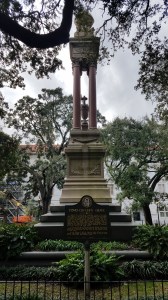
The Gordon Monument
I have no idea if the gray squirrel let loose with a rebel yell when he stepped off the curb and charged onto Bull Street in front of Wright Square in Savannah, Georgia. Two feet in a car tire had struck him down, rendering the question largely moot. He said nothing now.
More tires had come, as if to drive the point home, and it was now nearly impossible to tell where the deceased ended and the road of progress began. I had wondered about his rebel yell only because his tail still stood erect, springing from the concrete. Was a final act of defiance or simply what happened once you were dead?
People walked by on the sidewalk, cars still rounded the street, and as near as I can tell the world went by without notice.
Had he crossed Bull Street and made the square he would have been in the shadow of the William Washington Gordon Monument. It rises 47 feet, and near its top four twelve-foot columns support four winged Atlantes hold a globe. It commemorates the life of the aptly named William Washington Gordon I, who presided over the state’s first railroad. It was to that distinction that the monument was built, albeit if it stands out of proportion to his current fame.
It wasn’t the first monument to be in Wright Square. To build it in 1883 they had to clear a pyramid of stones which dated back to 1739, when the square had been known as Percival. That was the year James Oglethorpe, the founder of the colony of Georgia, buried his Indian friend, Tomochichi.
Oglethorpe had personally carried him to the second of the four Savannah squares he had designed. He buried him there and ordered the grave marked with a pyramid of stones. In the process he created Savannah’s first monument.
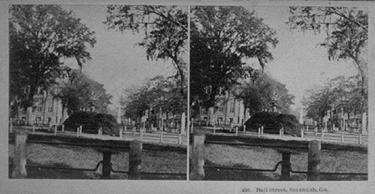
Tomochichi’s Grave (Photo taken from https://blog.visitsavannah.com/arts-culture/commemoration-tomochichi/)
Oglethorpe had planned for Savannah to sit on a 40 foot bluff that was home to a small group of natives, known as the Yamacraw, who were exiles from two local tribes. It is thought they numbered around 50, and beneath them, on the ship Anne, sat the 120 passengers Oglethorpe had brought with him. The English had no right to settle on the west side of the Savannah River, and Oglethorpe had no reason to think the natives would be amicable.
Historians place Tomochichi around 90 at the time of the meeting. He greeted Oglethorpe, expressed no offense, and stated a desire to have his tribe educated. Oglethorpe was 36.
He had crossed the ocean to found a new colony to buffer the existing English colonies in the north from the Spanish in the south. He had brought with him those from London’s debtor prisons. He was convinced what separated them from everyone else was that no one had afforded them a chance yet.
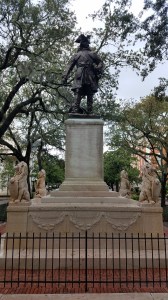
James Oglethorpe
The leaders of the two bands of outcasts hit it off. Tribes never did think much of pragmatists. Fortunately, from time to time, they hold sway in a world beset with indifference to anything practical.
Oglethorpe settled, and in Georgia protected the Indians from the traders that had taken advantage of them elsewhere in the colonies. In turn Tomochichi convinced the neighboring tribes that Oglethorpe was a man they could trust. In time they did. Oglethorpe would go on to meet chiefs from much larger and more powerful tribes, but he never let any of them displace Tomochichi.
Some accounts suggest that in building the Gordon Monument remains were found. Some accounts say Gordon’s daughter had them transferred over 15 years later to a large stone she placed in Wright Square to re-remember the dead Chief. Some accounts suggest that the remains found were strewn all about the square. Others suggest no one even took the time to look.
Today in Savannah’s green and open squares, which now number 22, Spanish moss fancifully drapes itself over the live oak, indifferent to it all. Around many of those squares stand stately mansions, harkening to a different time, colored in earthy tones. Sometimes one thinks it is the bitterness of the passing years that have ate them to their marrow. Sometimes I think iy was the moss, sitting on high, belly full with its meal half ate, lazily waiting to come down and feast again.
 True Stories and Tall Tales