 This week marks Soil and Water Conservation Week here in the state of Iowa. It also marks the beginning of May is Beef Month. The fact that these two overlap shouldn’t come as a surprise. It doesn’t for me. Cattle have helped us achieve our conservation goals for some time in the northeast corner of Madison County.
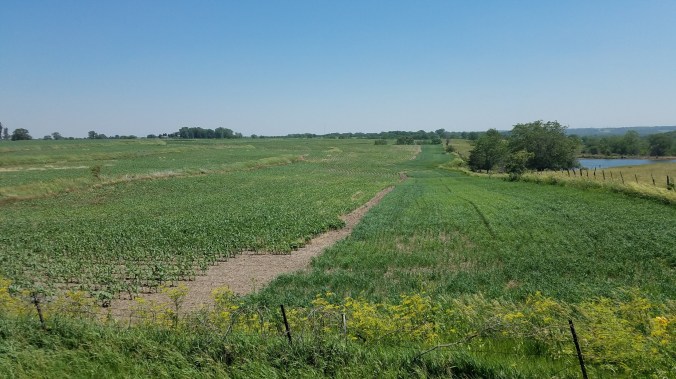 Here beautiful ridges of corn and soybeans break into the rolling hills of grass our cow herd calls home. The transition between the two has long been where our family has focused their conservation efforts. Initially, acres not fully suited to continual crop production would be seeded down in rotation, providing corn or soybeans some years and providing forage for the cows during the rest of them. My father and his brother terraced this farm in the 1980’s, extending the good ridge that ran through it down a series of three steps in the landscape. In doing so, more acres could sustainably be moved into continual crop production.
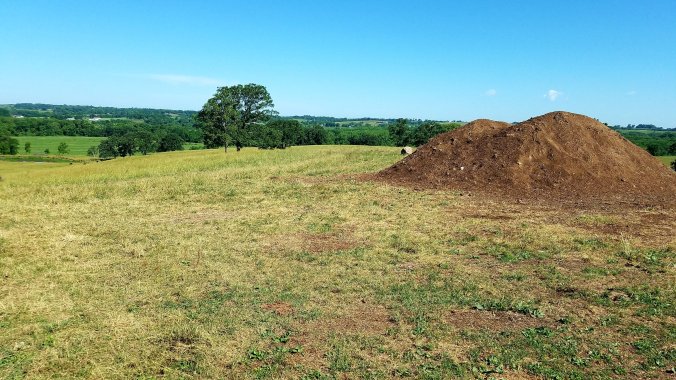
In the years that have passed, we have maintained that trend, and the number of terraces on our farm seem to increase each one. Though the crop ground is now leased to a neighboring family, we all work together to keep advancing conservation practices on our farm. We couldn’t do it without them. In the photo above, we’ve begun to transition some hay ground from side hills now protected by terraces to serving as a buffer along field borders, and in this case, above a neighbor’s pond. Below you can see we have done the same along a large ditch that runs through another.
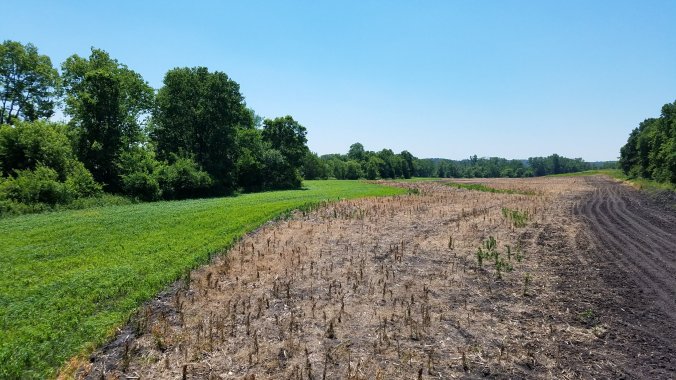
Instead of just taking the ground out of production for an environmental benefit, having cattle gives us an option of keeping some acres sustainably in production, while still maintaining an environmental benefit. These buffers will now help not just to hold soil in place, but also to filter the water that moves across them before it leaves the field or enters the ditch, catching soil and nutrients as it does.
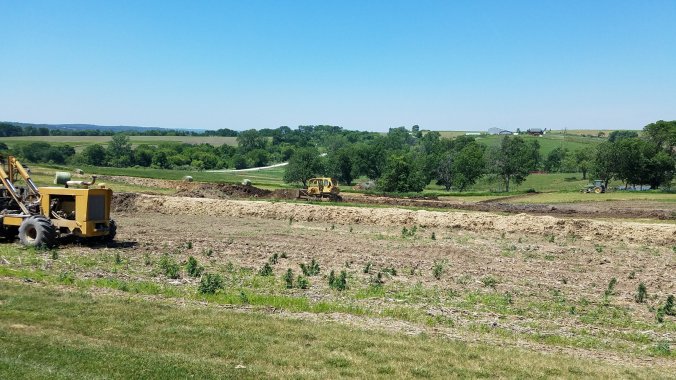
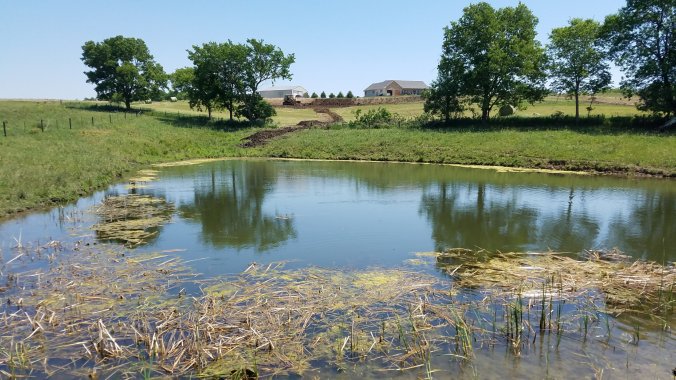
We have built a farm pond a year for the last decade, which help us to better manage the pastures, provide a cleaner source of water for the cows, and act as another filter for the water moving across the fields. Above, a couple of terraces we built late last spring are going to outlet in the pond the next ridge over, the tiny splash of blue on the right of the photo. The additional water will provide more volume to keep the pond full and allow to filter even more water coming off the landscape.
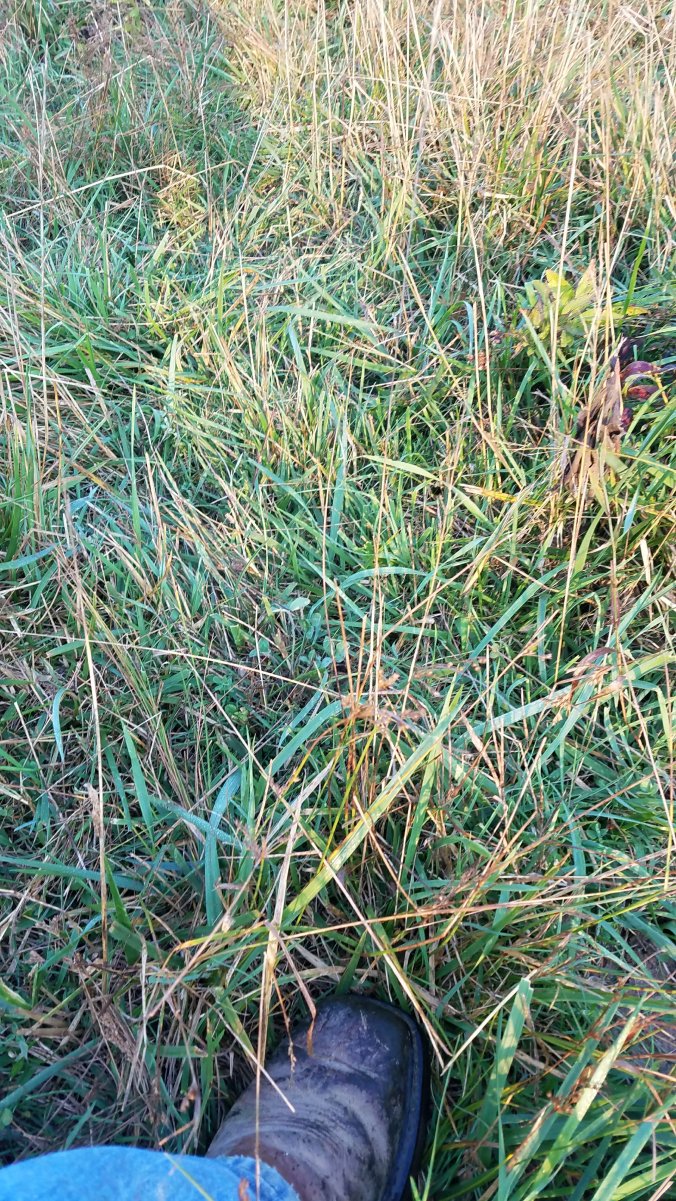
Along with the ponds have came better management of our grazing acres, which has produced more grass of better quality for the herd. Year in and year out, it should all work to translate to more head and more pounds of beef off the same acres, while improving their body condition and pregnancy rates. For the last couple of years we have used poultry litter to help boost soil fertility in order to make the most of our improvements.
We monitor our progress with regular soil testing. Once the fertility levels are where we want them, the natural nutrient cycling that happens as cattle graze should in large part keep them there. Of particular note has been the boost we’ve been able to make in soil organic matter. In the photo below it is at 6.7%.


This boost allows more carbon into the soil, increasing soil health, dramatically impacting water infiltration thereby reducing runoff in storm events. You can’t go to a conservation meeting now days and not run into a discussion on soil organic matter and soil health. Cattle, due to the role they play in recycling nutrients, seem destined to play an integral role in that.
This year we will begin to soil sample acres that we have rotationally grazed, along with those we have in the Conservation Reserve Program. We expect to notice a difference between the two in soil organic matter, and we expect the acres that have been devoted to cattle production to have the advantage. A few years from now, when those acres come out, we should have the rest of the farm in a position that allows us to bring those acres sustainably back into production.
Smart farming looks differently today than it did when my grandparents watched over the place. It looks differently than it did when my father and his brother started. It looks differently than it did 20 years ago, when I and my siblings were still in school. It is a concept constantly evolving. We simply aim to keep up with it.
In todays water quality efforts, some look at agriculture and point only to the challenges, as though one could slice the issue so thin that it only had one side. It’s a shame. In agriculture today, both in row crops and livestock, also lie the solutions. Conservation and production are not mutually exclusive. They need to go hand in hand.
 True Stories and Tall Tales