It sounded as though he spoke in English broken by German phrases. In truth, it was the opposite. He was in his late 50’s, and it gave him a high forehead and receding hair line. He stood slightly hunched over, as though he had spent his life down here between the brick walls and low ceilings of the catacombs under Stephansdom (St. Stephen’s Cathedral) in Vienna, Austria.
“And in the next room you will see their bones, Und im nachsten raum wirst du ihre knochen sehen, stacked like firewood, gestapelt wie brennholz.”
His large, balbous eyes, fluent in both languages, bulge even larger when he arrived at “firewood” and shortly thereafter at “brennholz.” Each pulse brought a brief smile across his face, as though his eyes and the corners of his mouth were attached to each other. The former moving out pulled the latter up.
“Often if you try to tell people what you observe in real life they will never believe you,” I confided to one of my travel companions, Allen Burt.
“You know what I think?” he asked. “I think this guy really loves his job.”
A few minutes prior we had been waiting for our tour on the main floor of the church, at the top of a staircase leading down to a heavy wooden door with an arched top and a window with a wrought iron grate. I had been canvasing the crowd, looking for anyone who resembled a guide. Instead we heard a bolt being drawn back, the creak of the door on its hinges, and from behind emerged our guide venturing forth from the land we ventured to.
Back below ground, those further ahead began to move down the narrow, dim, brick hallway to see the next room the guide had spoke of. As they made their way, I took the liberty of stepping back to peak at the iron stair disappearing in the small round hole in the floor behind me. It descended a mere foot or two until it disappeared into a pool of ribs, clavicles, and shoulder blades. The only thing that appeared to have used this particular stair in recent history was mustiness.
It was our turn to move, and we went down the hall, looked to our left, and found the room exactly as he had described it. Through a window were rows of femurs neatly stacked three feet high for a run of twelve feet. Here and there, a bone meticulously extended a few inches, and on this extension sat a skull. These skulls formed a diamond pattern down the length of the pile, and they gazed across at those that looked back from the stack a couple feet over.
All in all, there was something noticeable in how the American reacted in the group. As though in our relative abundance of space and relative shortness of time, we still possess some naiveté about our dead. Her there were 11,000. As the catacombs got full, prisoners were given the task of going down and clearing space for more, stacking the bones into the space saving arrangements seen today.
Waves of emotion had battered those interred here once. Once oceans of delight had washed over them. They are forces even mother nature would be challenged to account for. But here, dry bones bore witness to a delicate precision their earthly bodies were liked to have scarcely known.
A few more steps, and we began to climb the stairs back to the surface. The tour was over before we knew it. Our guide stopped half way up and let us pass.
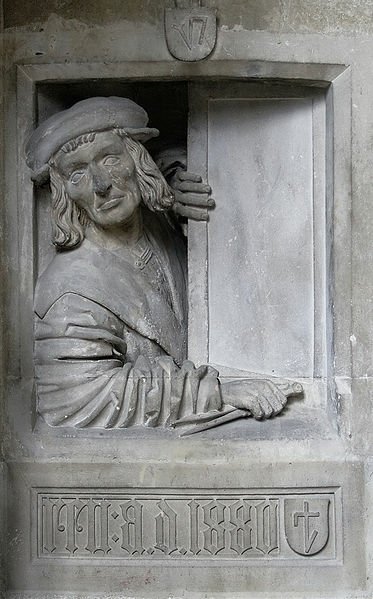
Fenstergucker commons.m.Wikimedia.org/wiki/File:Stephansdom_Fenstergucker.jpg
Upstairs, in the second largest of all European cathedrals, stands a large stone pulpit. Elaborately carved in the 1400’s, it contains numerous features of note. One of them is found seemingly out of the way, close to the cathedral floor, beneath the stairs it features. Gawking (German: gucken) out a half open window (German: fenster) is a stone mason. He is known as Fenstergucker. Many believe it is a self-portrait of the sculptor himself.
He holds a chisel, and wears a cap which reveals a high forehead with a receding hairline. He appears to popping up from below. From time to time, he gives tours down there.
 True Stories and Tall Tales