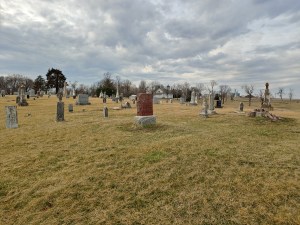
St Patrick’s Cemetery, Irish Settlement
In 1863 a diptheria epidemic came through St. Patrick’s Irish Settlement. Diphtheria is an airborne disease, transmitted by coughs, sneezes, and saliva. Eventually a thick gray matter covers the back of the throat, making breathing difficult. Before a treatment the CDC states that it was fatal in up to 50% of cases. Today, it is prevented by a vaccine.
Often it was referred to in some variation of “The Strangler.” This may trace back to a breakout in 1613 in Spain. The Spanish would come to refer to this period as El Ano de los Garrotillos (The Year of Strangulations). In the centuries that followed, it was a leading cause of death among children.
In 1895 production and testing of a diptheria antitoxin began in the United States. This antitoxin was commonly in short supply, and it is reported that sometimes parents had to choose which child it was administered to. An outbreak in Nome, Alaska lead to the 1925 “Great Race of Mercy,” which brought antitoxin to the community covering 674 miles in five and a half days. This event is annually commemorated in a race now known as the Iditarod.
No sled dogs would come to the Irish Settlement.
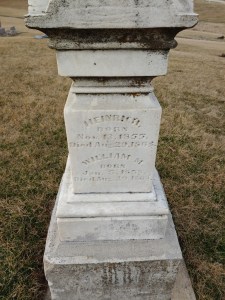
The Weil Stone
I became acquainted with the story as a kid, hearing John Connor tell of the family of Casper Weil. In the midst of the epidemic, families dug their own graves, to save someone else from bringing it back to their families. Heinrich Weil, age 8, died August 29, 1963. His parents left to bury him at St Patrick’s Cemetery. When they returned, another son ,William, 5, had died as well. They had to go back.
Their son Thomas, age four, and daughter Mary M., age one and a half both died September 11th of that year. The McDonnells would lose three children. Roseanne, 8, died on April 14th. Catherine, 16, and Ellen, 6, both died on April 25th. Other families lost one or two children. The Butler and McCusker families are also mentioned in experiencing great loss, but those graves are unidentified.
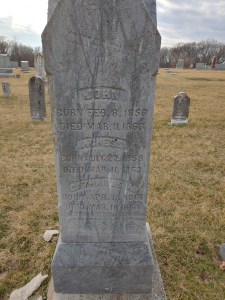
The Harrington Stone
Not far from the Weil stone is one for the Harrington family. J. and B. Harrington would lose three children on March 11th that year, John, 7, Agnes, 5, and Catherine, 2. September 22nd, 1863 saw the birth of their son, Thomas. The worry and fret that must have caused them would be difficult to imagine. Thomas would survive the year and die in August of 1871.
Merriam-Webster says an epidemic “spreads over a wide are and many individuals are taken ill at the same time…,” and that a pandemic “affects an even wider geographical area and a significant portion of the population becomes affected.”
I suppose they mean ‘significant’ as in number, as though you were lofted above until people and places and times all looked the same. Closer to the ground, the world is a little more personal than that. Even if it isn’t the one you now know.
 True Stories and Tall Tales
Well researched history in an excellent story.
These were my great grandfather’s younger brothers and sisters.
Dad and I rebuilt the monument. Met John Conner when we doing it.
Mike Weil