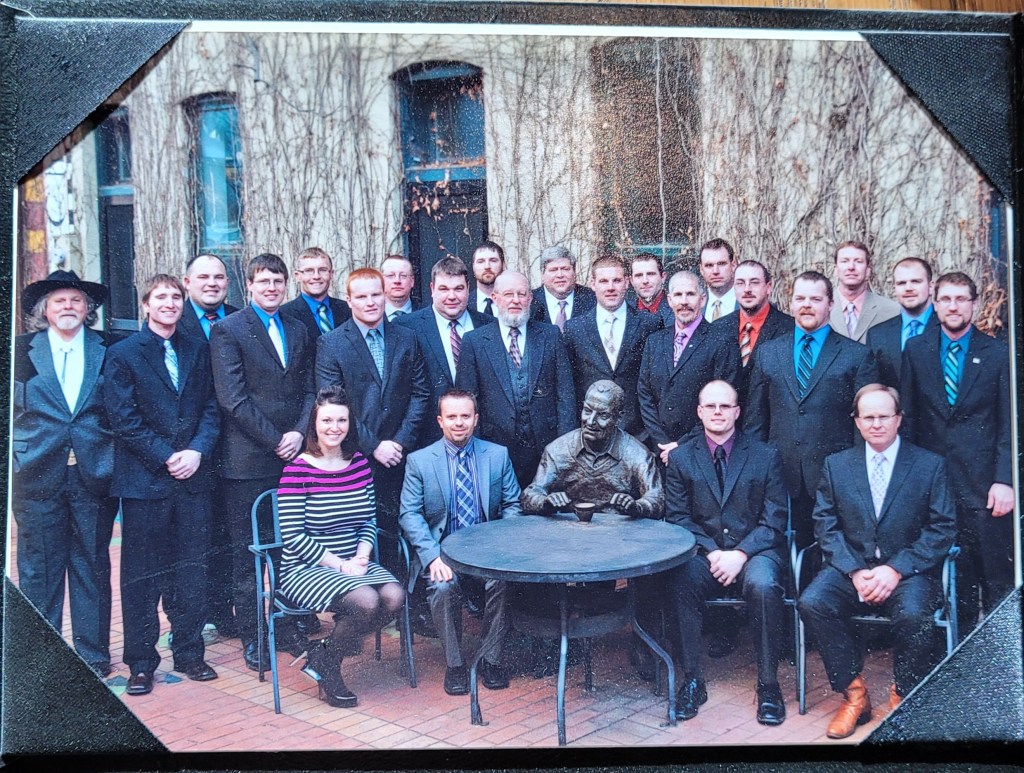
In 2013, I participated in the Iowa Farm Bureau’s Ag Leaders Institute. I credit a lot to that experience. This morning, as I write, I’ve been trying to figure out why.
I had participated in other leadership programs before. Most of them had left me trying to figure out how to fit in with the group. Ag Leaders began to teach me how to more better develop myself. This was due to the program, headed by Mary Foley Balvanz, and it was due to the people I found myself surrounded with.
At some point, Mary gave us a creative writing assignment. For some reason I didn’t phone it in, but rather tried to string a few sentences together in a way I had hardly done since college. Reading it before the group, I could feel my face getting flush, and thought about how stupid it must sound, and wondered why I ever thought it was a good idea to attempt it in the first place. I quietly took my seat and sat there until we took a break, at which time Chris Prizler came over before I could get up and said, “Man, that was amzaing.”
I’d go on to write a little about my experience that summer, during an Iowa Farm Bureau Market Study Tour of Ukraine. Eventually I began a blog, and later I’d mostly give it up as I became part of the Des Moines Writers Workshop, which helped me get feedback from other writers and challenged me to try to make myself a better one. Occasionally, I’ll still post, most of which has been to celebrate the life of a late friend or advocate on the topic of mental health.
In the workshop, I’d cross paths with the late Mike Beecher. I began to write so that I might hear a particular comment from Mike, “I think that took a great deal of courage.” I supposed he helped me realize those were the only topics worth writing about.
At some point, I also began to realize there was safety in writing for me. I could do it as I felt motivated. I could edit endlessly, always going back and recrafting until I was saying just the right thing, exactly how I wanted.
I used to think life was about learning to say the right thing. I realize now saying the right thing is but a small part of it. People say the right thing all the time, but they say it in a way that doesn’t let it be heard. They confuse the fact that they aren’t heard for some type of martyrdom, when in all reality they are a step short, refusing to self sacrifice the last bit that gets in the way.
Beginning a new year, I decided I wanted to leave the safety of writing behind. I had mostly fallen out of practice anyway. I want to focus on being better at speaking, talking about a thing that took some courage. I reached out to Mary, and I asked to speak on the topic of mental health in agriculture to her current Ag Leaders Class. She was receptive, and in August granted me a part of the day’s program to give it a go.
It was a topic I had talked a lot about before in one on one conversations with folks I knew. I had written about it, and I think the fact that I had written about it made the topic more approachable for people I knew to bring up. That and I guess the fact that folks often feel comfortable sharing where they are at with me.
This would be to a group of relative strangers. I’d be giving it cold, without an exchange on niceties, and our families, crop prices, and the weather. I knew what I didn’t want it to be. I didn’t want a powerpoint presentation. I wanted to try to make it conversational so I scribbled a couple pages of handwritten notes, and in the days leading up to the event, I’d practice as I drove around in how I might deliver them.
I was terribly nervous, which was to be expected. People want an anxiety-free life. People also want to feel like the have lived a life well lived. I have never found them to be particularly suited to each other.
I started talking about my old Ag Leaders group. I knew that would make me comfortable. And then I transitioned qucikly in the following way:
“It’s a funny thing getting to know new people. The things you share. The things you don’t. That group that year wouldn’t have known that I was recenlty divorced, or that I was trying to manage a new business, or that my father had been diagnosed with a terminal illness, or that I was consumed about what that meant for him or the farm. I certainly wouldn’t have told them that I was talking to a therapist, or if you prefer, a coach. Yet here I am today, still talking to them every month and telling a group of strangers about it.”
I suppose it was a group of 25 people or so, and while I typically maintain good eye contact while I speak, I had taken a brief break from it to deliver the lines above. When I looked back up, I felt I had every set of eyes in the room squarely on me. Then I did feel nervous.
I’m no stranger to the idea that establishing an emotional connection with you audience helps them connect to what you are trying to say. I just didn’t anticipate the connection I felt at that moment, and what followed for me was the most I had struggled in delivering remarks to a group in a long time.
Amid the nerves, I tried to continue on.
Mental health is health. Talking to someone on a regular basis is someting I do. For a long time, there hasn’t been the feeling of something chronic. You look at life, and try to figure out how to be more present and accounted for to yourself in your relationship with others. For me mental health is professional development. It is about becoming better at self management, more resilient, and more effective in how you communicate.
There’s a stigma surrouding it and it cuts both ways. People worry if they talk to someone, folks will think they have “problems,” whatever that means. But the reality is when I speak to folks about why they don’t seek help, they usually say they don’t think their “problems” are big enough. I don’t know what your problems pile up to, but I do know you and the people you care about are worth it, 100%
I told them I was talking to them about it because I figured I was a lot like them. The more you do, the more people give you. “I bet a lot of you don’t say “no” very often.” There’s nothing wrong with that, but things can really stack up. The ability to withstand one storm is often tested by an even larger one, or ones in quick succession.
It’s further complicated in agriculture. Your friends see their family on holidays. We work with them every day. Along with it comes huge generational pressure. The pressure to keep it going, admist markets and weather that we aren’t in control of. Not to mention that the distinction between life and work is difficult to find most times.
“A story I often go back to is that at the end of the day, we are all dealt a hand of cards. Many we don’t have much control over. Where we are born at, for example. If it rains this year, for another. You’re going to find folks that you feel have been dealt great hands, but won’t make the effort to learn how to play their cards. You’re going to find folks that have been dealt extremely tough hands, and play the hell out of them. You’re going to find yourself hoping for better cards. We can’t deal those to ourselves, but in playing our own hands better, perhaps we can deal them to others.”
It writes much better than I spoke it. I havent struggled that much in a long, long time. The group was kind enough to ask questions, and with a face flushed I answered them. It felt remarkably similar to a spot I had found myself nearly 10 years before.
When they were done, I made my way back to a friendly face at the back of the room. I heard Mary say, “He writes this wonderful blog “True Stories and Tall Tales.” He used to write it regularly. I wish he would again.”
“This would make a good blog post,” I thought, and I wondered if I had ever told her how impactful she’d been in all of it. “Maybe that would make a nice blog post too.”
Sometimes I hear someone say what they think leadership looks like. Most of what I hear is bullshit. Folks will tell you leadership is the offspring of courage and confidence. I think we mostly say it because we want to believe it. This in spite of the fact that personal experience will tell you most folks with confidence would be better off if they had a little less courage.
When I see leadership around me it’s usually a product of courage and anxiety. Either someone dipping a toe into something new, or someone having done so once sharing what they learned. Mary Foley Balvanz taught me that. She and the Ag Leaders Class of 2013 gave me a little courage. The anxiety I brought myself.
 True Stories and Tall Tales