Yesterday, the Des Moines Register asked this question when it comes to water quality in the state. I understand why they are asking. Folks wonder about the impact they are having on the environment around them. It’s a question I ask myself here on our Madison County Farm.
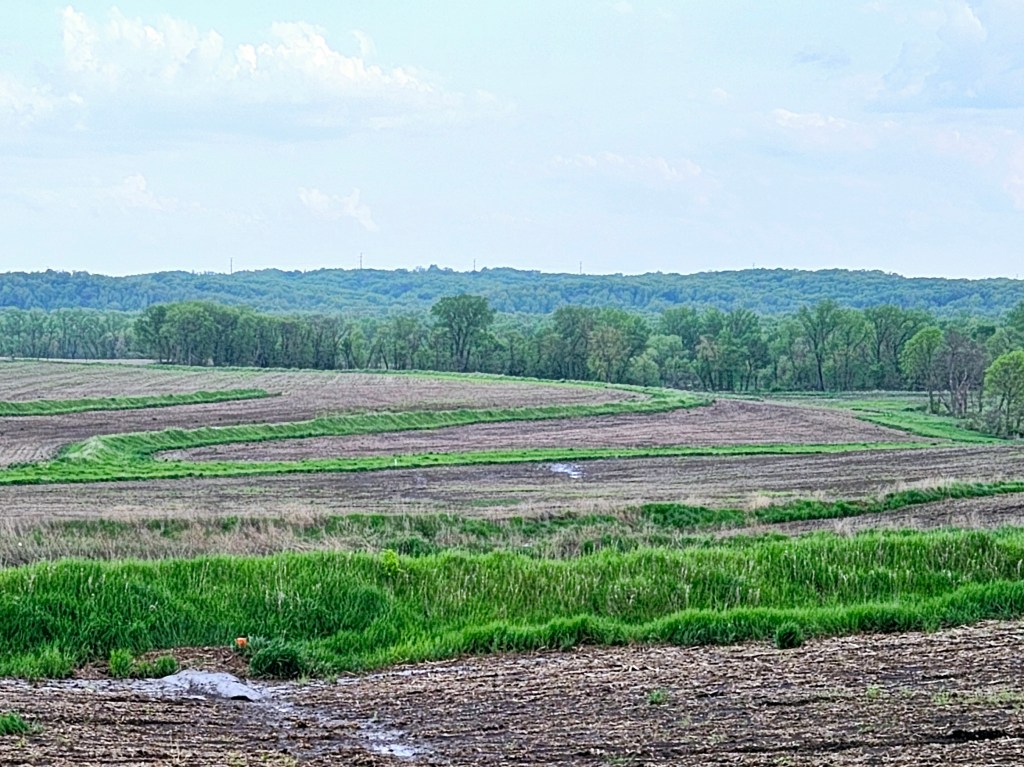
I can look out my window right now and see two sets of terraces leading down to an acre farm pond, none of which was present 10 years ago. What was in their place was a troublesome grass waterway in a crop field and an active cutting ditch in a pasture.
The waterway was troublesome, not because it was present, but because it wasn’t doing its job as well as we wanted. Not only have we limited the erosion, we have kept the silt from moving downstream, and we’ve greatly reduced the volume and velocity of the water as it leaves our property and continues down the watershed.
Right now, I’m thinking of the coming decades of service those structures will continue to provide. I know in the coming decades that work is going to be added to and built upon. Hopefully, for a couple of those decades, I’ll be able to continue to play a role.
Are we making progress? I don’t know how the answer to that is no. That doesn’t minimize the work left to do, but it is an accurate reflection on where we have come from.
I recently heard a voice on water quality issues in Iowa pronounce that those terraces aren’t doing any good. That’s baffling to me as a farmer. I see the good they are doing every time we get a significant rain, and every spring there isn’t erosion to mend.
Below is a picture from an intense downpour a few weeks ago. Can you imagine what would have happened without the terraces pictured? Right there, in the bottom of the photograph, you can see the work they do.
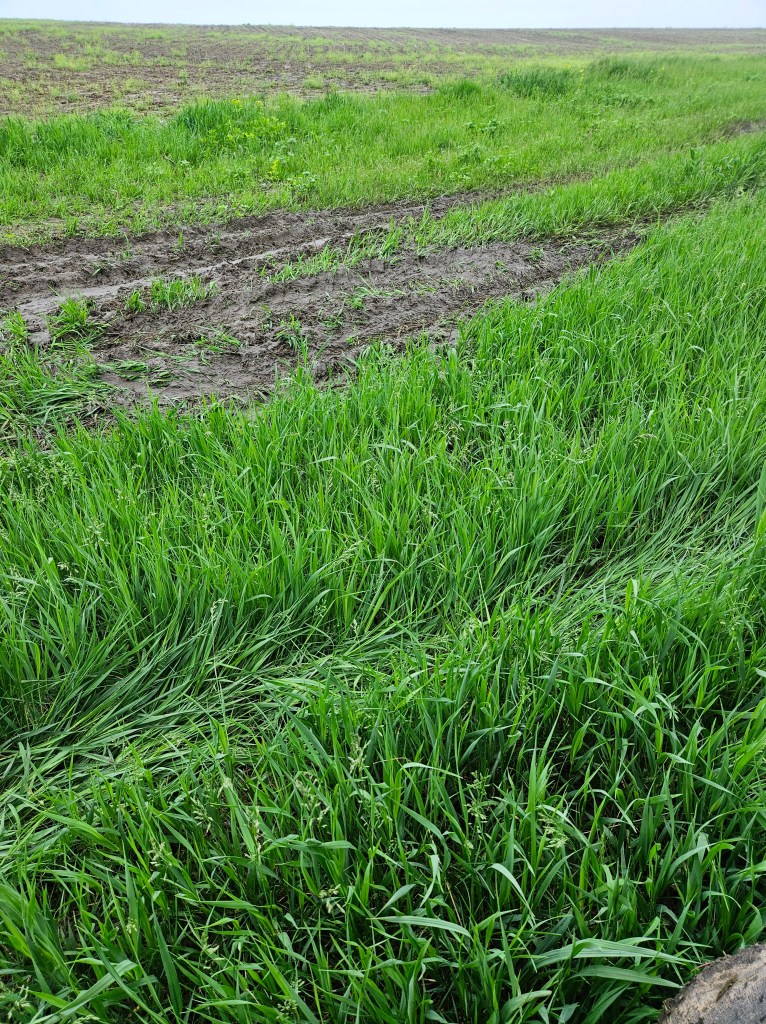
On the right side of the photo, you’ll see a strip of grass along the little creek. It functions to filter out any sediment from the field to its bank. Even though the soil wasn’t tilled, some sediment did move. It moved until it hit the buffer.
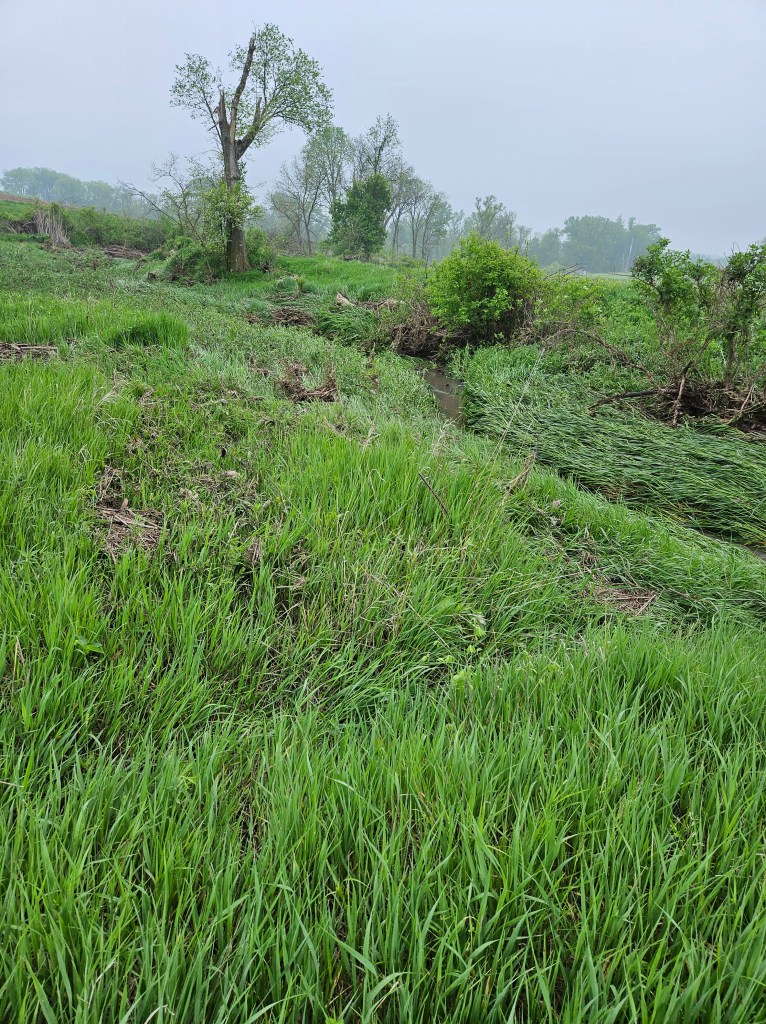
The rainfall was sufficient that the little creek left its banks. The grass along it laid down flat and kept the soil in place. It also caught some of the debris the water carried.
Critics will argue that our farm is an exception. It isn’t. Hop in with me, and I’ll take you down the road.
There are 40 acres on here on the northside that are farmed. It is terraced with 2 farm ponds bow it. 80 acres on the south, terraced with a big pond in one of its main draws. To the east are 80 acres that are terraced, and a 40 on the southside with a farm pond and a sidehill in grass.
In the fields to the west of us are terraces, a several acre pond which serves as flood control and a giant filter catching anything that moves from several hundred acres above it. West of that more terraces, another pond, a CRP sidehill in permanent vegetation, an 80 with grassed waterways and cover cropped. North of that terraces, more terraces, more terraces, more terraces, a series of ponds, and then the flat creek bottoms of Badger Creek.
We just traveled six miles. None of that was here 40 years ago. In that time, the way folks farm have changed, their practices have changed. All of that continues to evolve, and the work they’ve done continues to be built on.
I’d like to tell you it’s perfect. It isn’t. But the work here is hardly an aberration.
I was in the field pictured above, after the downpour, to take account of what it is we might do next. I’m wondering the same thing as I sit here and look out my window. Are we making progress? Yes. The question is how do we continue to build on it?
 True Stories and Tall Tales