Josephine

Jo Snyder died yesterday morning.  I can’t claim to have known her well, but I don’t need to in order to claim her as a favorite of mine.  I got to know her over a couple of years in teaching a confirmation class, along with Larry Lantz and Fr. Dan Kirby.

She was the type of person you’d go out of your way to say “hello” to.  She had large, bright eyes and an infectious laugh.  Jo, her eyes, or her laugh were more than enough on their own to make you smile.  I can’t recall a time when I didn’t get all three.

Given her spark plug nature, I wasn’t surprised a year ago to catch sight of her and her husband, Randy, in their new Polaris Slingshot.  It seemed to fit her personality as much as her eyes did.  It fit Randy, an avid motorcycle enthusiast, just as well.

I was surprised a few short days later, after seeing Randy at a confirmation rehearsal.  He looked weak and was on oxygen.  When I got a chance, I asked Jo, “I don’t mean to pry, but what kind of health trouble is Randy having?”

“Randy has cancer of the kidneys,” she said in a matter of fact way.

“What’s the prognosis?”

“It’s terminal.  He’s fought it for some time.  They say he’s got just a little way to go.”

The gal that kept everything organized, always brought the extra things the kids might need, and who hadn’t missed a class I could remember, had all of this going on in her life.  I never knew.  Yet what took me back even more, was her manner.

That night Randy mentioned he was feeling a little better.  They laughed like they always did.  When it was over, the two of them got in the Slingshot, got their helmets on, and headed out to enjoy life.  Behind they left me with a view of what faith must look like.

A few days later the kids got confirmed, Randy went into hospice, and on the 14th of May, 2015, he left it.  It seemed to me Jo largely chose to go on in the same manner she always had: the same bright eyes, the same warm laugh, the same faith.

When life ends abruptly, there is always the sentiment that someone else needs to do something about it.  We legislate and litigate as though the combination of the two will someday outlaw death.  Perhaps the more pertinent message, though, is that we need to do something about it:  stop taking if for granted.  Jo Snyder understood that.

Along the way we find causes worth fighting for.  Jo had one in her faith, one in her care for others, and another in the National Kidney Foundation.  The latter went beyond Randy’s ailments.  Jo had donated a kidney, and life itself, to a neighbor.  I think Jo simply strove to be the change she wanted to see in the world.

I’m sure in her life she struggled like the rest of us.  I hope she understood part of the impact how she chose to handle it had on the lives of others.  I do know that a few hours with her were enough to make better my own.  This happened because Jo Snyder lived.

Catholics Come Home

It was mentioned once that I should refrain from going on crusades.  I can’t seem to help it, though.  I’m Catholic.  It’s in my blood.

Recently the Des Moines Diocese took up a campaign that has made its way throughout the country, known as “Catholics Come Home.”  It is an attempt by the Church to bring back into the fold the many Catholics that no longer active in their faith.  Chances are by now you’ve seen a commercial or two on TV.

The little rural parish of St Patrick’s discussed how they would like to take part in the effort.  Letters were sent out, and advertisements were ran in the local paper.  Not long after our decision to do so, Catholicism was making headlines.

An archbishop in another state had sent a letter to those under his care cautioning them about buying cookies from the Girl Scouts.  His objection was to a part of the policy behind the organization and where a small part of the proceeds may be devoted.  Not longer after the letter, other religious leaders of other faiths were quick to announce their support of him.

I thought it a shame that in our discussion of where to run our ads, we had never thought of running them in the St Louis Post Dispatch.

Under the Archbishop’s care are fathers more caught up in distant political events than they are their own families.  There are mothers more dedicated to living longer than they are anything else.  There are children who don’t understand the freedom found in freely choosing to submit.  There are those that are pro-life only as far as birth, those wanting someone else to change how they live so they themselves don’t have to, those who think charity is something that happens on election day, and those moved with mercy and compassion for their fellow men, but have none for any in particular.

All of these things lie somewhere in my own heart, and to all of these, the topic the Archbishop felt most needed a letter urging an examination of conscience was the Girl Scouts.  Some will be critical of my being critical of the Archbishop.  Most of them are freely critical of the current Pope.

Early Christians, I suppose, interacted with the Roman children whose parents killed them for sport.  They followed a radical Christ.  In His life He seemed to keep reminding the religious of the day that faith should be about how we live our own lives, not how someone else lives theirs.  There was a minority receptive to the idea.  The rest crucified Him for it.

The hypocrisy that sometimes surfaces is why some have left their faiths.  Christ remained, though, and who am I to argue with that?  To ultimately find that hypocrisy I need to look no farther than myself.  My journey is an imperfect one to say the least, but in spite of that and the hoopla around the Samoas, it is the one that will take me home.

Ocean View

That old ocean out before us,
just trying to climb ashore.
Did you ever stop to wonder,
what all its climbing is for?

It’s been forty years now.
That old ocean looks the same.
But my in all that time,
how you and I have changed.

I see you looking out there,
scared to make a sound.
If I could I’d walk there,
just to turn right back around.

I’d have what I always wanted,
that old ocean view,
it couldn’t be more beautiful,
the one it has of you.

It laps against the shoreline,
while your toes are in the sand,
That ocean has still got no one,
and we’re back where we began.

That old ocean out before us,
just trying to climb ashore.
Did you ever stop to wonder
what all its climbing is for?

The Late, Great Fred Johnson

20160227_131305

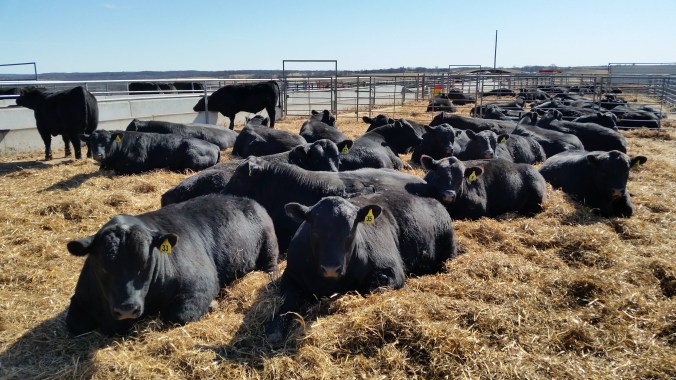
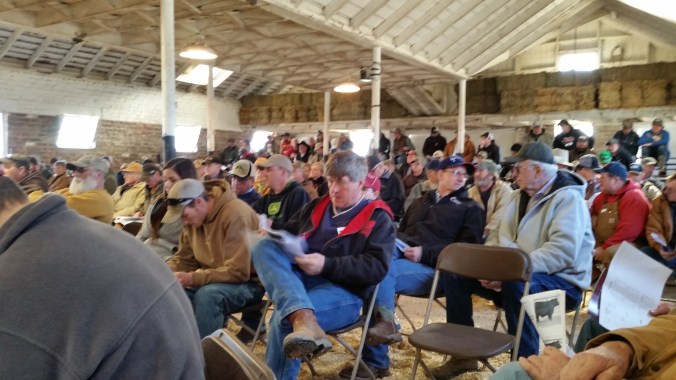
This year’s offering at High Point Genetics in Osceola, Iowa.


Bull sale season is wrapping up now, and it hardly arrives or passes without my mind still going back to the late Fred Johnson.  As I got to know him in my early 20’s, he was getting into his 80’s.  Once a year we would visit for an hour or so, and in the process he would always relate the little stories that carried with them a lifetime of observation.

“You know I was once at a big Angus sale in Upstate New York.  I had wound up sitting beside a guy who owned a fine New York City steakhouse.  He had decided he was going to get into the Angus business, and he did so by giving $20,000 for a $500 heifer calf.

We had talked a little prior, and right after his purchase he turned and asked me, ‘So, is there any money in this business?’

I replied, ‘You’re damn right there is.  I’ve sunk a fortune into it.  The trick isn’t putting it in, though, the trick is getting it back out.'”

You’ve probably never heard of Fred Johnson, nor his now gone ranch of Summitcrest, but if you’ve ever heard of Certified Angus Beef, then you are probably familiar with his accomplishments.  And if your childhood memory is like mine, and you remember the lime green and yellow tile floor at the local McDonald’s, then you remember the culmination of the Johnson family’s Summitville Tile business.

The purebred business is a funny thing, made up of all types of folks, just like life is.  For some it’s the image of rugged independence, steadfast loyalty, and high regard for a reputation.  Fred never seemed overly concerned about these at all.

What is rugged independence, after all, but dependence so great it drives one to isolate themselves?  What is loyalty, but the willingness to do what someone wants you to do for them rather than doing what you should do for them?  And who, at our age, would be unable to come up with a whole list of the disreputable things we’ve done in order to keep our reputations?

The first time I spoke to him, he asked me if I knew what the most important part of a registration paper was.  After some hesitation, I simply admitted I didn’t.

“It’s the breeder’s name at the top.  If you can’t believe that, then nothing else really matters.”

Perhaps in order to believe it, you need someone who recognizes the dependence the next owner will have on it.  Someone who’s willing to tell you what you don’t want to hear.  Who has the humility to tell you what they don’t want to say.  I believed Fred Johnson.

In one of his obituaries, I found that Fred had been injured in World War II, and left on the battlefield for dead.  A couple of days later, they found he wasn’t, and he began a several month process of making it back to the living.  I suppose he had plenty of time for reflection.

It seemed Fred put his whole self into his life, with a tenacity and determination still evident in his early 80’s.  Maybe that is the trick, then, that allows someone like me to still get a piece of it back out.  We are all worth the same, some just have a knack for adding value.

20160227_125534

My father and Tom Judy, who managed Fred’s Iowa ranch, and cut from the same cloth.

Paper Hearts

A folded newspaper, with scissors in hand,
a child goes to work,
cutting paper hearts from the jumbled words of Man.

Producing a string, one for me and one for you
and I suppose all our neighbors,
Yes, I am sure they once had one too.

Decades of jumble, for hearts paper thin,
folded them back to the paper lines,
Children will cut them from again.

But why don’t we pull that edge there,
and let’s release our grip,
and smooth out all the creases, and never mind the rips.

And we will let the neighbors, keep the kids employed.
Up above the jumble, and the hell with paper lines.

Eamus Catuli AC0871108

babe-ruth-swing-big-quote-sports-poster-print

If I had to guess, I would say he had once been a hippy, but those days were past him now.  Now he found whatever was to be found in the working of a 9 to 5.  He had just a few more years to go.

“Man, did you really see the World Series?” he asked, looking at my jacket.

“Yeah.”

“Well you should be happy.  Your team won the whole damn thing,” he smiled.

I laughed.  “Actually, my team is kind of the Cardinals, and I went in 2014.  The Royals won Game 6 that year, but they didn’t win 7.”

“Well this year they didn’t need 7.  Did you see any Cardinal postseason games, then?”

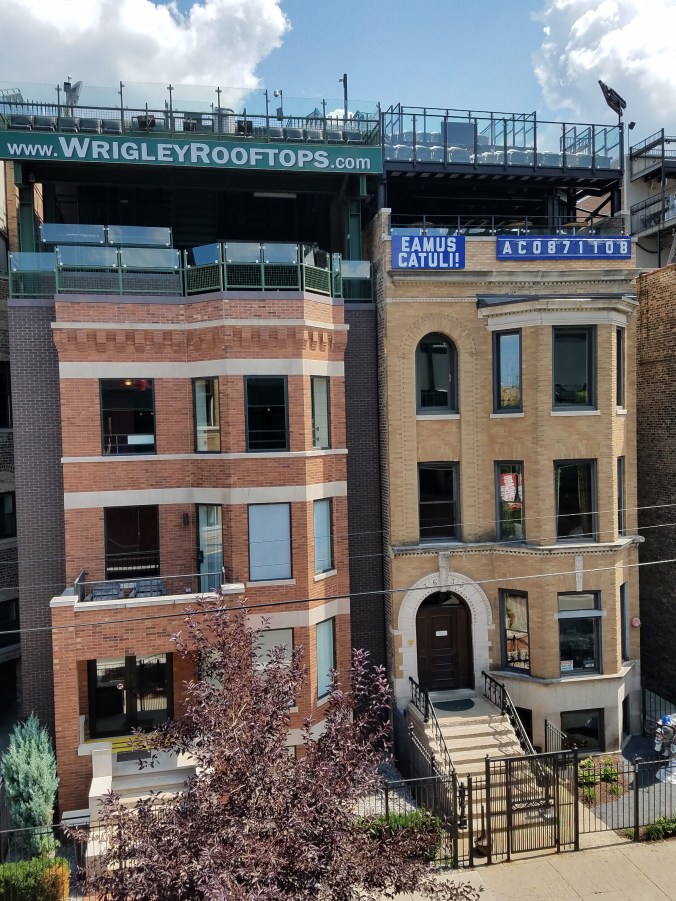
“Last fall I saw Game 3 of the Division Series.  First time I was ever at Wrigley.”

“That was your first time at Wrigley?  Man, I would have love to have seen that.  I’m a life long Cubs fan.  What did you think of The Friendly Confines?”

“I had a pole that blocked my view of home.  The upper deck was right above us.  That was the game they set the record for homeruns.  I’d hear the crack of the bat, a ball would could barreling out from behind the pole, shoot up out of sight above the deck, and I would watch the outfielders to see if it was going to stay in or not.  Best seat I’ve ever had.”

“I took my boy to Wrigley.  We just got it in our heads we were going to drive out there, so we did.  I pulled up at 10:30 in the morning, went up to the ticket window, and told the guy I needed two.

He said, ‘I’m sorry man, but we’re all sold out.’  I was heartbroken.  Walking back to break the news to my son, he called out to me.  He said, ‘I can get you two tickets, but they aren’t going to be next to each other.  There will be 6 or 7 rows between you.’  I told him that would work.

Turned out it rained just ahead of game time.  It was a short delay, but hardly anybody showed.  We got to sit wherever we wanted, like we had the whole place to ourselves.

The Cubs were down 6 going into the ninth.  It was getting late.  I told him we ought to head for the car, but you know how boys are.  He was convinced they were going to pull it out, and he begged me to stay.  So we did.

Would you believe they won that damn game?  I still can’t believe it.  Best day of my life.”

And there he was, just in front of me, and back at that day at Wrigley, like he’d been a thousand times.

On his hand he wore no ring.  I went on to ask him about his son, and the conversation always remained in the past tense.  This man thanked God for his work.  He also thanked Him for baseball.  I thanked Him for a jacket.

Something More Than Free


20160817_124758

Spring

20160229_095639

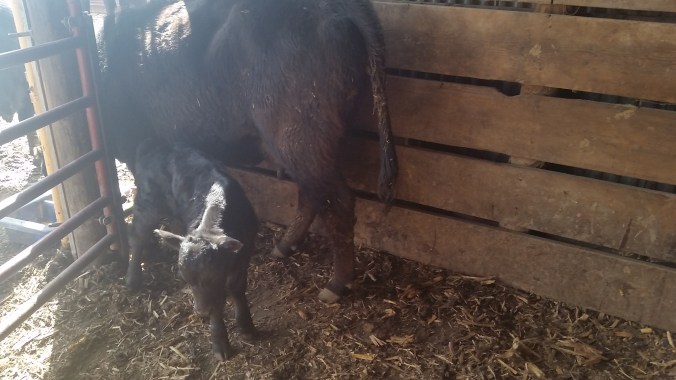
Our first calf of the year was out of a bull called Woodhill Gusto.  The calf, also being a bull, I dubbed Gus.  His mother has raised a couple of calves by now, and given the two she raised and the calf before me, I expected Gus to be a good one.

He was a thick rascal, had good, heavy bone, and his rear legs looked like springs still trying to uncoil.  He was particularly quiet, and his mother was particularly cautious.  I was particularly pleased.

“We had a calf this morning,” I told my father, as I hurriedly changed direction to get on with the rest of the work of the day.

“What was it?”

“A bull,” I said, keeping my expectations to myself.

My father, about to be 70, checked the group Gus was in the next day.

“That little shit is running and hopping now,” he said with a smile.  I partially acknowledged it.  Something new had no doubt come up, and I was once again in a hurry.

The next morning was my turn again, and I found Gus on a pile of cornstalks.  Secretly wanting to see the same performance Dad had, I went to get him up.  He was lethargic, as new calves can often be, and his mother wasn’t around.  Sometimes, when they become fully alert, they panic and take off in any direction, so I was content to let him be.

That evening, making the rounds, I found him in a different spot on the same pile, dead.  I had a veterinarian do a necropsy on the calf, and we found his abdomen pooled with blood.  On his liver was a two inch laceration, barely more than a scratch.

“I think this calf got stepped on,” was the pronouncement.

Spring was here.  New life brought into the same old one.

A few days later, with more calves on the ground, I came home to find a heifer needing help.  I had to pull the calf, a big, bulky thing.  While the mother had no trouble mothering him, he couldn’t seem to get the whole nursing thing figured out.

Twice a day I’d latch her in a headgate, get the calf’s mouth in the right vicinity, and wait.  An index finger in the corner of his mouth would try to entice him to get the party started.  If it didn’t work, you’d milk her out and try it with a bottle.

One morning you walk out and finding a standing calf and cow.  The cow has a teat that’s wet.  The calf is looking at you like, “What the hell are you doing here?”  And they are off and running.

This is spring, too.  From the old one, new life.  It’s no wonder they placed Easter here.

20160316_152146

Namaste


20160306_073708

I once listened to a man speak about how to make it through life while keeping our head above water.  Someone asked him about meditation.

“I tend to view meditation as an escape from the world, a form of distance.  We all have our escapes.  I find the world is always waiting for us when we get back.”

“Isn’t the point of meditation:  to escape the world in order to come back refocused?”

“That’s always been the idea, I think.  I’m just not sure I’ve ever seen it work.  It feels good, but distance usually does, and we tend to make whatever form we chose an end in itself.  What I’m interested in is how we might deal with the world by remaining and  becoming more present in it.”

For some men, to meditate is to fish, and it has been that way since ancient times.  Even Christ called a few of them from their boats.

20160305_065059

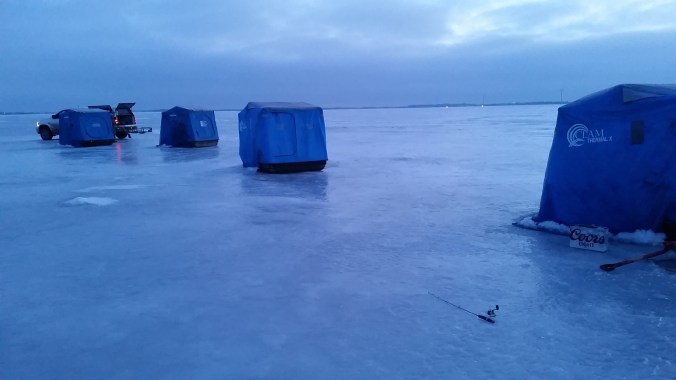
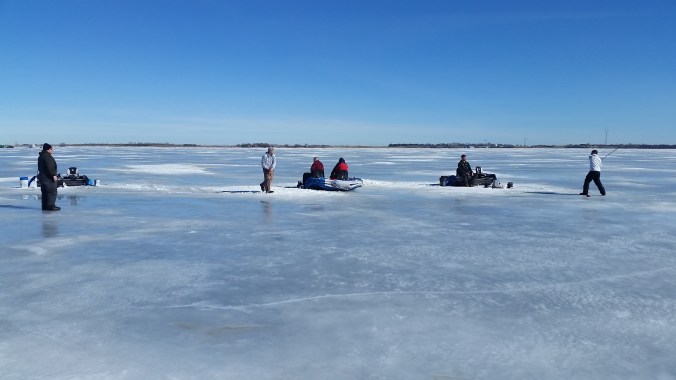
For me, on the ice of Devil’s Lake, North Dakota, in a shack with a partner, over the low roar of the propane heater and staring at the lights of the Vexilar, I wasn’t aware of any distance.  In the stillness of waiting for a fish to bite, I thought it was all present.  The past, the dead, present worries, and the future.

A fish would bite, and they were gone.  Then things would get still, and they would come back.  Perhaps I never was much of a fisherman.

Sunday morning was the start of the third and final day.  At 6 am it was already starting to get slushy on the ice, as we drove down a boat ramp and out onto 90 miles of water in a Chevy Tahoe.

“You know I was nervous enough on Friday, when it was cold,” I commented to our 19-year-old guide.

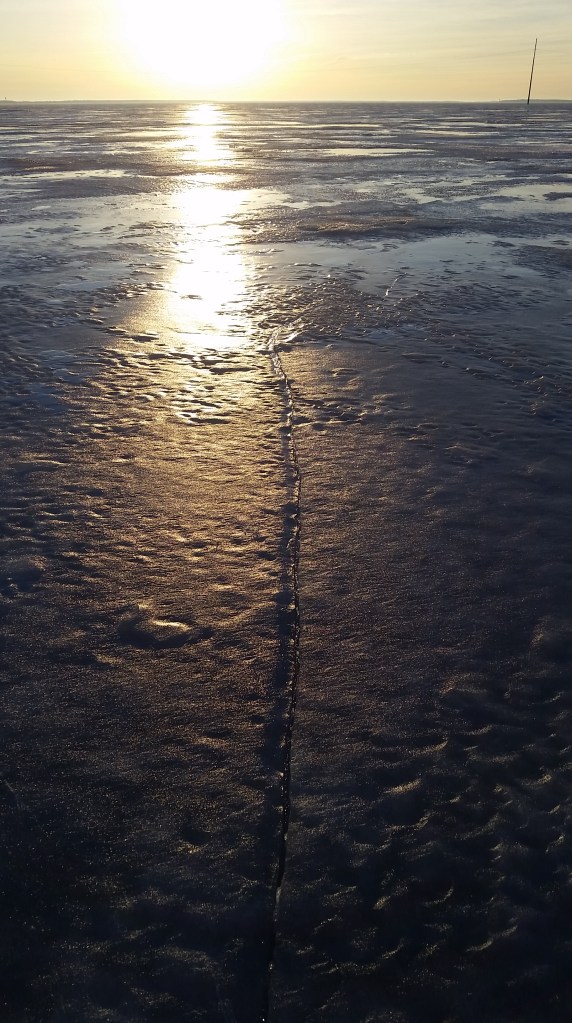
“Don’t worry about the water.  It means the ice is still strong beneath it.  I don’t start to get nervous until the water disappears.  That means it is soaking through.

After it soaks through long enough, it leaves the ice honeycombed and gives it a hollow, crunchy sound.  When you hear that, you panic.  You’re about ready to fall through.

Today will be the last day we drive trucks out here.”

“Have you ever went in?”

“Last year was the first time.  The ice was getting thin and I was on a four-wheeler with my father.  He tried to blow over a crack in the ice, but the shelf he crossed over on was broke as well.  As he drove onto it, it stood up.  Dad jumped, but I was backwards on the rear rack and daydreaming.  When I hit the water, it was so cold I clenched my fists, and rode the four wheeler all the way to the bottom.  It felt like it took five minutes to get to the surface again.”

“What did you think of that?”

“That will wake you right up.”

I had no doubt.

20160305_150803

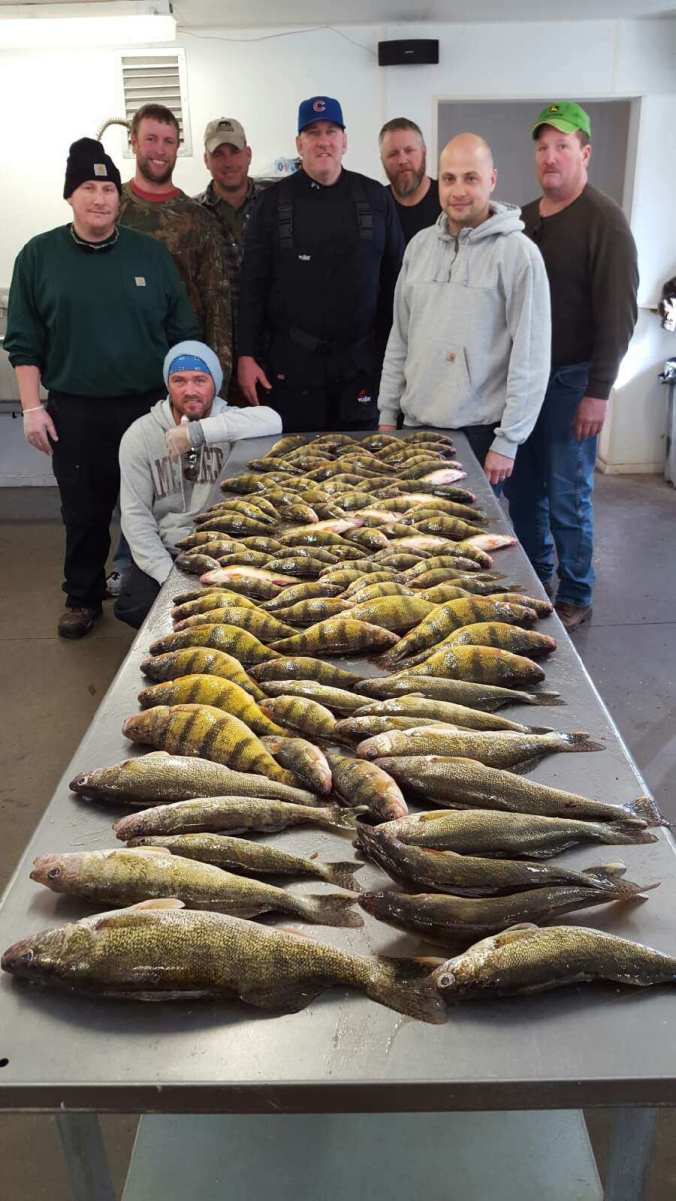
Friday was cold and blustery, and I spent most of the day with my foot holding the frame of our shack down so it didn’t flip over.  Saturday was the big day catching fish.  Sunday we caught walleye before the sun came up, but after that, moving to deeper water for perch, all most of us caught was a buzz.

We wouldn’t mind it none.  The temperature climbed into the mid 50’s.  The sun above us beckoned.  One by one we flipped back the tarps which had been keeping the cold out and our thoughts in, and we sat on the ice in the sun.

Looking out at the expanse we sat on, I thought of our guide.  Someday we will all make the plunge beneath the cracked and shrinking ice.  Today wasn’t the day, though.

We set our poles down, and on the winter ice, in the springtime sun, the boys of summer played ball.  On Friday we caught the wind.  On Saturday we caught fish.  On Sunday we caught a good time, with the whole world beneath our feet.  Namaste.

20160306_114406

Dignity

Out of the pocket of her robe she produced a cell phone, and with the press of a couple of buttons she placed a call.

“They got the tests done, I’m just waiting for someone to take me back to my room.”

Her voice fit who it came from.  The person on the other end asked no questions.

“I just wanted to let you know how it went.  I’ll talk to you later.”

The business with the phone had startled me.  I had been watching her, and up till then she seemed largely unanimated.  When the call was over, she returned to her previous state.

Earlier, when I had sat down, my attention was drawn to the wall-mount television on my right.  I was trying to make sense of both the words and the volume, as I looked over to see Donald Trump speaking about how he wished someone would punch someone else in the mouth.  I lost interest, and my eyes would come to rest on her.

She sat in a wheelchair ahead of me at roughly the same distance I sat from the TV.  Of all those in the room, she seemed the least likely to look back.  There was safety in that.

Hunched over in her hospital gown, she wore a robe over her shoulders for extra warmth.  He hair, still mostly brown, spilled down over the robe, as her head followed the curve of her back and tilted forward, leaving her mouth open and her eyes staring down blankly at her lap.  One leg protruded at a 45 degree angle and at its end it produced a pale-white foot, wrapped in a snow-white bandage.  Her mouth had no teeth, and beneath the bandage were no toes.

As she hung up the phone, it appeared that she was going to look out over the rest of us.  I looked away.  Eventually, an orderly showed up, and I looked up to find the person that had briefly appeared before me was gone again.

“All right, are you ready to get back to your room?”

There was a nod.  The orderly reached down, released the brakes, and they were on their way.  Finally, she had some company.

In greeting friends and family in the hospital, we use flowers and a smile, but in greeting the sick we don’t know the preferred method seems to be looking down at our own shoes.  Our mothers told us not to stare, and so we put it into practice by not even daring to look.  I think one is the same as the other.

Lazarus

Presiding over mass that Sunday was a rather nondescript, retired priest, who had sat quietly beside the altar, and when he rose to deliver the Gospel, he approached the lectern slightly bent with age. With a slow and steady voice, he read the following passage from Luke:

There was a rich man who dressed in purple garments and fine linen and dined sumptuously each day. And lying at his door was a poor man named Lazarus, covered with sores, who would gladly have eaten his fill of the scraps that fell from the rich man’s table. Dogs even used to come and lick his sores.

When the poor man died, he was carried away by angels to the bosom of Abraham. The rich man also died and was buried, and from the netherworld, where he was in torment, he raised his eyes and saw Abraham far off and Lazarus at his side. And he cried out, ‘Father Abraham, have pity on me. Send Lazarus to dip the tip of his finger in water and cool my tongue, for I am suffering torment in these flames.’

Abraham replied, ‘My child, remember that you received what was good during your lifetime while Lazarus likewise received what was bad; but now he is comforted here, whereas you are tormented. Moreover, between us and you a great chasm is established to prevent anyone from crossing who might wish to go from our side to yours or from your side to ours.’

He said, ‘Then I beg you, father, send him to my father’s house, for I have five brothers, so that he may warn them, lest they too come to this place of torment.’

But Abraham replied, ‘They have Moses and the prophets. Let them listen to them.’

He said, ‘Oh no, father Abraham, but if someone from the dead goes to them, they will repent.’

Then Abraham said, ‘If they will not listen to Moses and the prophets, neither will they be persuaded if someone should rise from the dead.’

Fr. Pfeffer paused a moment and stretched out both hands on either side of the lectern, wrapping his fingers around its edge. He looked down once more at the text and then scanned those assembled. When his eyes reached the far wall, they followed it upwards as he drew a deep breath. Finally, he spoke.

“You know, I often wonder what the rich man did to earn an eternity in Hell. He never beat Lazarus. He wasn’t verbally abusive to him. He didn’t spit on him, nor mock him, nor go out on the street and try to shoo him away.

Instead, it appears the rich man didn’t even notice him. I suppose that, my friends, is enough.”

And with a final look at the text, he unwrapped his fingers from the lectern, walked back to his chair, and sat in the simple silence of the place.