The Lovers’ Lock

Lover's Lock

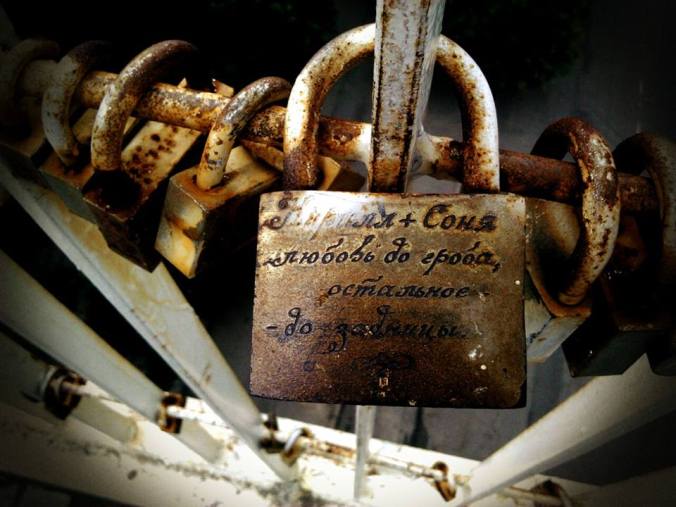
Lovers have placed padlocks on the Teschin Bridge in Odessa for decades, often on their wedding day.  After clasping the lock, they walk down to the shore of the Black Sea and toss their key into its waters.  Then they go home and do their best.  The locks remain, though, and are viewed by some as a testament to the permanence of the one feeling they hope won’t fade:  true love.

Being from Madison County, an area prone to linking unrealistic romance with bridges, I felt for the Ukrainians.

We rarely know where our feelings come from, we have little control over them while they are here, and all too often we wake up with no idea where they’ve gone.  We spend our breath, we cover the miles, and we devote our dollars to chase the unattainable.  Perhaps we damage love most by forcing on it our own definition of what it is supposed to look like.

In doing so, it’s not the lock that is symbolic.  It is the key.

Several stories exist concerning why the Teschin Bridge was constructed.  One of them states that a high ranking party leader lived on one side, and his mother in law lived on the other.  Every morning she would cook him pancakes, and every morning he would trek down the side of his ridge and up the side of hers to breakfast.

Some will reason he loved pancakes.  Some will reason hers were exceptional.  If reason is the goal, however, then I suspect neither he nor his wife could cook, and the price was right.

Even more realistic yet, I bet pancakes got old after awhile.  I bet burnt ones became more and more common.  Yet the husband continued for the same reason every husband does what he does not want to do:  his wife.

He chose it.  He chose it every day.  He chose it in spite of the pancakes her mother burnt.  Perhaps she threatened him every morning with a rolling pin, or perhaps he knew love was something more than a feeling.  It’s a choice, and every time he made it he clasped the lock again.

The Cattle Sale

20160101_112805

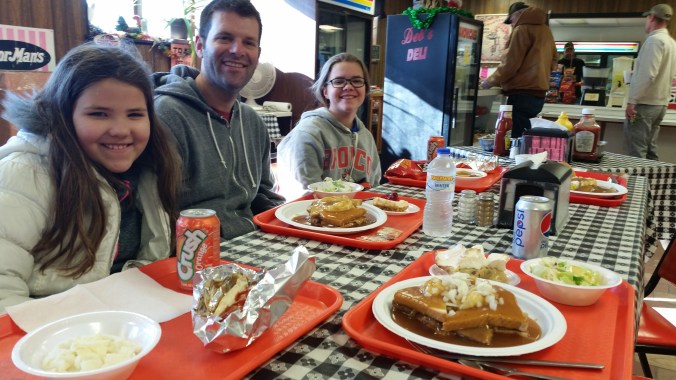
We had lunch at the barn and were now heading in to see our calves sell.  Joining us was a high school buddy of mine and his two daughters.  Lily, 10, was beside me.

“Have you been to a sale barn before?”

“No.  This is my first time.”

“Well, I’m sure your father told you, but try not to look the auctioneer in the eye.”

“Why?”

“If you do and make the slightest movement, he’ll call it a bid.”

“But…I can’t buy anything…I’m just a kid.”

“Happens all the time, Lily.  Some kid sneezes and BAM!  He bought a pen load of cattle.  I’m really surprised your dad didn’t warn you.”

The joke has been around as long as there have been auctions.  I heard it when I was 7 or 8.  I now have friends who are auctioneers.  I still don’t trust them.

Lily sat on her hands for the next hour and a half.

20160101_115618

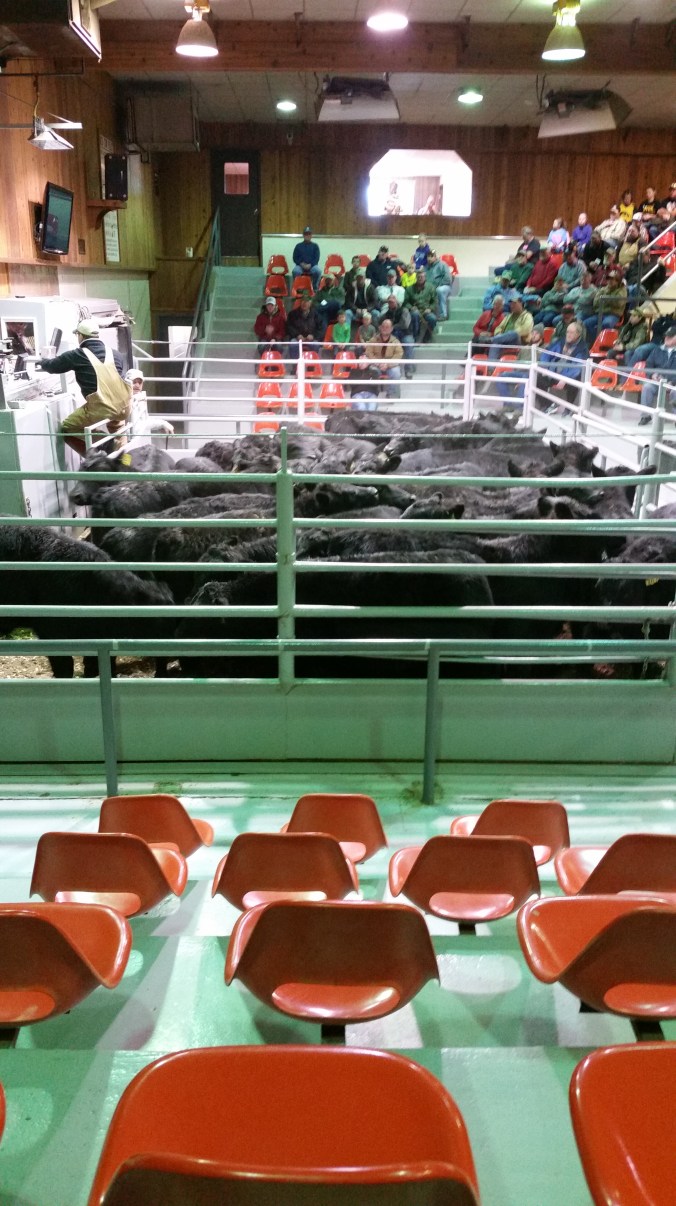
“That guy in the window is buying almost all of them,” observed Abby, 8.

“He’s what they call an order buyer.  He’s buying cattle for several different places, likely in several different states.  This guy over here by that phone is one too.”

“What are they going to do with them?”

“Well, right now they’re about half-grown.  The buyers will raise them the rest of the way.”

“Will they all be beef?”

“No.  The steers will, but some of the heifers will go back to be cows someday.”

“What if we wanted to buy some calves?”

“We would have to bid against people like the man in the window, and get your sister’s hands out from under her.”  They both smiled.

20151101_165553

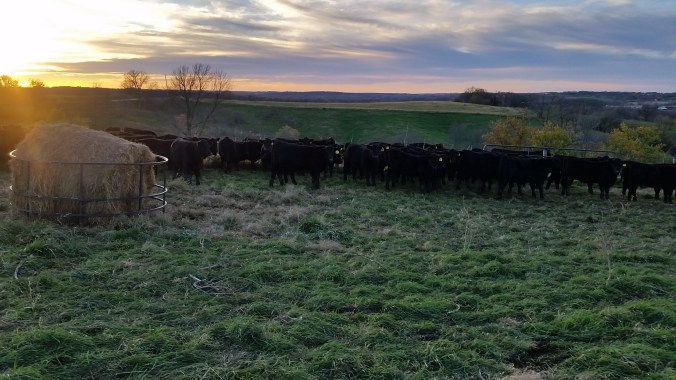
The calves were weaned the first of November.  They were weighing around 600 pounds then.  Here, on New Year’s Day, they were weighing just under 800.  They had been healthy, beat the mud, and looked good.  They sold well.

“Are you happy with what they brought?” their dad asked.

“I think so.  It’s just over $600 a head less than they did last year, though.”

“Did you say $600 less per head?”  I nodded.  “Wow.  That dollars up in a hurry.”

“Yea, but we are lucky.  The market had a little bounce the last ten days.  Some saw well over a $700/head difference.  Last year was exceptional.  This year is fairly similar to where they sold two years ago.”

“Were people expecting last year’s prices to stick around?”

“Almost everyone was predicting they would.  Some took those predictions with a grain of salt, but I don’t think anyone was expecting this swift of a correction.  It is putting a ding in quite a few pocketbooks.”

“What will people do?”

“Same thing they always do.  Try and make it.”

As we made our way out, Lily was beside me again.

“That was neat,” she said grinning ear to ear.

“It looks to me you’ve found out who the happiest person after an auction is.”

“Who is that?”

“The one that still has all their money.”

The Memorial

“So what’s your process?  What do we need to do to get the magic to happen?  Crown and Coke?”

I smiled.  The thing about the Hawks is their hospitality.  Their kitchen alone is the size of a home.

I was offered a seat in the middle of the kitchen table, in front of a laptop with two Word documents.  The first was the prepared obituary that had already ran in the paper.  The second was the notes from the night before, made as each shared their stories.  Whoever typed them had done well.  Each condensed a story into single line.

Surrounding me was the family of Jim Bussanmas, now deceased.  I was nervous.  A little Crown and Coke should help with that, I thought.

A little is key.  In writing one searches for what we all search for:  redemption.  It’s best not to get sloppy going after it.

“What’s this line,” I asked, taking the first one off the screen:  “‘I never thought I would live so long and have this much fun?'”

“He said that when he went into the VA for the last time.  He was always trying to reassure us.  He did a good job at that.”  As stories continued about his final stay, I placed the line at the top of the obituary.

“It’s quite a quote.  It also says he tried to enlist at 16?”

“He sure did, but they made him wait.  He went in at 18 and became a Seabee.”  Adding that detail to the account of his military service, I looked up to find a picture held in front of me of Jim when he enlisted.  He looked more man than boy.  “Look at how trim he is.  Ladies must have went crazy for him.”

“Dad had a great appreciation for women.  It started with his devotion to Mary, and he would call all of us his ‘dollies.’  He loved my mother, and after she died he would come to love Rozella.  They were quite a pair.”

As this was being said, another picture was selected and held in front of me.  “When the two of them got to laughing the room shook until you thought the walls would come down.”  And as the stories continued, I found the sentences that mentioned both women and added another:  “In their company he was happy.”

The story of an old RV, “Holy Moses,” became a vehicle itself, conveying his love of faith, family, conversation, and travel.  Another paragraph would catch other lines that made his family’s eyes glisten.  One final sentence would capture the story that made eyes more than glisten and would mention the man that called him “Dad.”

A couple of hours, and it was done.  A few more sentences to sum up the years.  I was thanked for writing them, but I hadn’t of course.  Jim had, and a lifetime, and a family, and redemption.  And what were those but all the ingredients necessary for the magic to happen?

Snow and Cows

Reports of a potential blizzard began a week ago.  They always seem to set in motion basic human instincts that remain intact no matter how many generations we might be  removed from the farm.  Last night in the milk or bread aisle of any Des Moines grocery store one could find the proof.

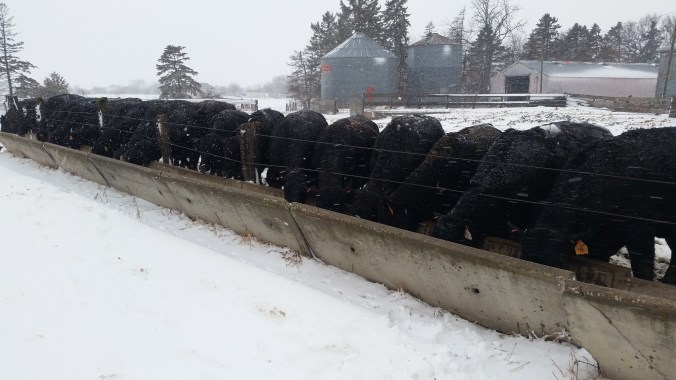
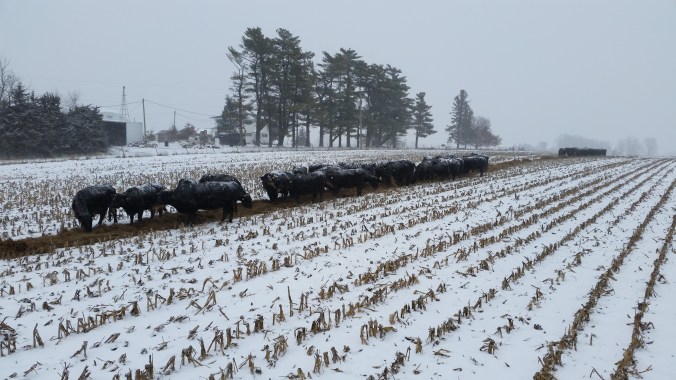
The instincts are just as alive on the farm.  Cows fan out over the corn stalk fields they’ve wintered on to dine on the leaves and husks they’ve passed over many times.  Choice alfalfa hay awaits them in a ring, but they lose interest to devote themselves to finding whatever goodies the snow might cover up.

20160201_125845

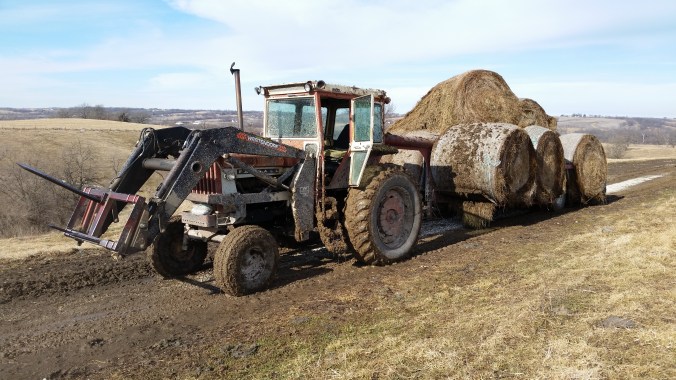
We were gathering too, making sure we had plenty of feed on hand.  Since this storm was coming a month and a half prior to calving season, we took Saturday to sort our way through the various groups of cattle and regroup them according to age and need.

20160202_091317

First were the 2 year old bred heifers above.  They will begin to have their first calves after the beginning of March.  They are faced with the nutritional demands of continuing to grow, carrying a calf to term, and successfully getting bred back this summer.  Current nutrition will impact all of that, and right now they are enjoying an extra 3 pounds of corn each.

20151228_100416

We sorted through our largest group of cows, made up of those that have had two calves or more.  We looked for any that could use a little more “condition” or fat cover.  While all of them were adequate, we like to send them into calving 80-100 pounds above their average weight of 1350.  We feel it aids them in raising healthier calves, helps to ensure healthier mamas, and sets the foundation for a successful breeding season.

We moved 5 head of older cows off this group and placed them with the 3 year old cows getting ready to have their second calves.  Like the 2 year olds, the 3 year olds are still continuing to grow.  Often raising their first calf left them with less condition than their mature counterparts.

The forecast called for a mix of rain and snow coupled with heavy winds.  A cow’s hide will loose most of its insulation value when it is wet, and this places a great nutritional demand on the cow to burn enough calories for heat.  During these conditions or periods of extremely cold temperatures, we will put out a week’s worth of a self-fed supplement, helping to cover any caloric deficit.

Finally, the cattle will naturally seek out cover provided by the environment.  On the left, our heifer calf crop takes advantage of the windbreak behind the farmstead, while on the right, our mature cow herd takes advantage of one across the road.  I don’t know what amazes me more, some of the places they pick, or how consistently they pick the same places year after year.

In the end, the blizzard was a bust.  The cows and I didn’t mind.  Here’s a link to a year old Des Moines Register video with yours truly talking about taking care of cows in winter and setting the ground work for the topic of this blog next week:  http://www.desmoinesregister.com/videos/money/agriculture/2014/11/30/19700233/

Online Dating

Fifteen minutes in, the gal across from me asked if I had ever considered being a priest.  We had just met.  I figured I had a couple of options.  Either she was telling me she felt comfortable sharing her story, or she was kindly suggesting that I should consider a life of celibacy.  Just then, her phone went off.

We had met at 10:30 on a Sunday night, just after the first of the year. She thrown it out as a possibility because it would be another two weeks before she had a free night. As I drove to the west side, I wondered who would want to meet me for a beer at this hour.  I was pleasantly surprised.

“Do you need to answer that?”

“No, I’ll just text her.  Sorry.  It’s a friend of mine checking in.  I got to wondering who I might meet at 10:30 on a Sunday night.”

I smiled.  “I wondered that too. Do I pass?”

“Barely.”

In some ways dating is different at 39, and in some it remains the same.  The classroom of my youth has been replaced by an online dating site, and notes are now passed electronically and without check boxes.  It’s for the best.  Grownups don’t feel the need to take time saying they aren’t interested.

At some point numbers get exchanged.  When I was young, this was done to call.  Now it is done to text.  The young have no idea what the real world actually looks like and are eager to find out.  Grownups do, however, and seem content to keep it at bay a little while longer.

“What’s been your experience on Match?”

“I haven’t been on it long.  I feel I’ve met good people. It always amazes me what two strangers wind up talking about.  It’s like the profiles, though.  No one wants to put themselves out there until the other goes first.  You?”

“I was only on for a few days.  It was so overwhelming I got off.  I haven’t dated in a long time, and I’m still trying to figure out if I’m ready yet.  All I have to offer right now is a friendship.  Most guys aren’t interested in that.”

“I think I’ve got room. Why did you reach out to me?”

“You put yourself out there.  I liked that.  What else have you learned online?”

“Seems like everyone is looking for whatever they were missing in their last relationship.  The problem was the last guy, and the answer will be in the next.  It’s hard for people to look at the fact that the most common denominator in our failed relationships is ourselves.”

When it is two strangers, the tendency is to lay it all out there, at least for me.  That night I was reminded that I tend to overdo it.  I looked up to find her large, deep eyes damp.

“I know I’m the common denominator. I look at my past and struggle with what that says about me.”

“I wasn’t directing anything at you.  I’m sorry. For what it is worth, I am a common denominator too.”

“I think you are right about people. I’ve spent the last few years trying to become the person I want to meet.  I have no idea how I’m doing.  It is hard. How do we know when we are ready?”

“Well I’m enjoying meeting you.  I don’t know how we know when we were ready. Maybe we don’t until we are in it.”

“What are you looking for?”

“Mutual respect, I think.  If one can keep that intact, maybe however things turn out doesn’t matter.” Even at 10:30 on a Sunday night.

Just Around the Corner

He was older than how he spoke.  I suppose it was the way God had left him here to share his time with us.  Once I had spent part of an afternoon with him, and finding him now, standing up against the corner of a wall, I made my way over to say hello.

“Do you remember me?  We worked together last fall.”

“Yea.  You’re that nice guy that’s easy to talk to.”

Unprepared for that, I rolled out the standard, self-deprecating humor.  “You must have me confused with someone else.” I smiled and look up in time to see him lose his.  He thought he did.

As his eyes turn down to his feet, I understood the dignity I had denied him by refusing the kindness he offered.  It felt shameful.  I tried again.

“It was a poor joke.  I meant that I don’t think most people would describe me that way.”  And his face lit up again, and we were off in conversation, from trains to baby calves and any place he wanted to venture between.  Before long it was time for him to go.

“You are welcomed to help us anytime, you know?”

In him I could find no malice, no reservation to share what made him happy with others, nor any inkling of fear about the dark recesses of our hearts.  It was easy.  As he left, I suppose a little shame lingered at how I, like most of us perhaps, work against myself to make it hard.

Maybe someday we will round the corner.

Logging the Section

Logging the Section

The Section

My great grandmother was born on St. Patrick’s Day, 1862.  It’s not a bad birthdate if you are Irish, and I’m sure that’s something my great grandfather must have thought himself.  They would start a family, and she would share with her children what most parents do:  her earliest memory.

Hers was remembering the relocation of Indians as they traveled through the woods near her home.

Today those woods are known as ‘The Section,’ or in some cases ‘Section 10.’  The vast majority of the 640 acres that make it up are still standing silently in timber, divided only by North River which meanders its way amongst them.  This was the river the Indians and their escorts were traveling along and camped near, building a fire a mile south of the young girl and her window.

Her son, who I can’t remember, would tell his children the same story about the grandmother they didn’t know.  Afterwards, they could lay in their beds like their dad and his siblings had, looking out their own windows, seeing the same bright glow in the darkness of the night, and fearing that the whole world might catch fire.

The things that were possible in the days before yard lights.

The orginal fire was likely a paltry thing, fueled only by wood.  Yet in the retelling it grows, fueled now by wood and imagination.  The world survived it, though my great grandmother, the Indians, and the original fire they shared are long gone.

The walnut trees that witnessed the event would last another hundred years.  They never viewed it with the apprehension the young girl did.  They had seen plenty of Indians before.

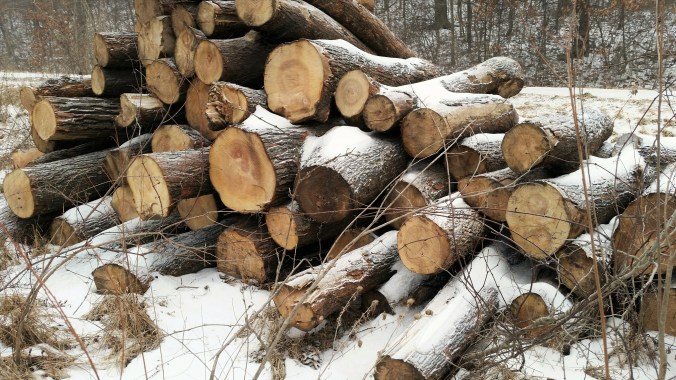
In the 1960’s the trees would be logged.  Iowa, in case you didn’t know, grows some of the finest black walnut in the world.  Those particular trees were of such exceptional quality and size they were exported to Japan.

Somewhere in Europe, perhaps, a beautifully grained walnut veneer lies across a fine table.  There in the veneer, underneath the varnish and the wax, lies the last physical connection to what my great grandmother saw all those years ago.  Some will bemoan the logging of the old walnut, thinking it would have been better had the tree fell and rotted naturally into obscurity.  Perhaps they are jealous of it.  As for me, I think I could appreciate the table.

Wandering down my own path, I sometimes come upon the memories and experiences others have drug out of the woods to me.  A few I’ve drug out myself.  Occasionally, I do what many do.  I pull a sliver out of this one or that, and try to build something that will last.

“I can sum up everything I’ve learned about life in three words:  It goes on.”  Sometimes in a story, or a table, a part of us goes on with it.

Logging the Section2

Coffee

Devotion
The heart can think of no devotion
Greater than being shore to ocean –
Holding the curve of one position,
Counting an endless repetition.
-Robert Frost

He was a faithful man, and over the time I got reacquainted with him I saw that faith grow.  It had grown through the loss of a partner and now, after the Holidays, through the sudden loss of his job, leaving him with the girls who depended on it.

A week after, I took part of the day to grab a coffee and find out how he was doing.

“It’s been a big struggle, but sometimes I find this incredible sense of peace.  It surprises me.

I think it has to do with having the strength to let go, and the courage to remain vulnerable and let new people and experiences enter my life.  In the last week I have found friends I never knew I had.  It’s been humbling.

I talk about remaining vulnerable with a mentor of mine, but the first one that suggested it to me was a certain friend I know.”

It was lunch time, and the place was full of diners.  We hogged a whole booth to ourselves, without an appetite and only two cups of coffee between us.  Even our waiter had lost interest.

“This friend you talk about, God only seems to speak to him in silence.  He has a humble house he doesn’t own, and the walls of it have blown flat many times.  Sometimes he’s tired of putting them back up.  If you’re looking for peace, he hasn’t found it.  I’m not sure he’s the one you should be taking advice from.”

“I never said he was a carpenter.  How’s work?”

“Won’t be long now.  By Sunday it will be cold enough the ground will have a pretty thick crust on it.”

“At least we aren’t like the ground, then.”

He isn’t.

20160109_120053

Before it All Goes Green

20160106_095123

After the pirates but before the looters.


Beneath the curved trees of Art Nouveau,
along the Modern consciousness of the stream,
remained a hulk of old Art Deco
for the Postmodern me to see.

Seventy years removed now
from the time it first hummed
in a kitchen for its owners
who couldn’t believe what the future brung.

It was the fridge that saw the arguments,
before the kids got home from school,
As the arm from a white-t fished inside
for a beer that was mostly cool.

Now partly buried by the bank,
like a sunken pirate’s chest,
holding an untold treasure
for the boys who’ll come upon it next.

Digging with the finger nails
their mothers will make clean,
while I take note of the countryside
before it all goes green.