An Old Tune, in the Key of Affluence

The winter always seems so Christ-less right after Christmas, and people always act like it is a sin to mention it.  The nights are long, the days are hard and cold, and all of it serves to make the very thought of spring seem foolish.  I was thinking about all of that on the 30th of December, headed into a local grocery store to eat lunch with my father.

We had just passed an old man walking out.  His beard was scraggly and long.  He had on  a pair of dirty blue jeans, mostly tucked into rubber overshoes.  The right side of his shirt was tucked beneath his belly, and the left side hung loose, flapping in the breeze from the bottom of his old coat.

In his hands he clutched two grocery bags, holding two buckets of fried chicken and three 2 liters of pop.  It would be his meal for the next few days.  Santa doesn’t make the rounds for grown ups, I guess, and on the whole we don’t do it often either.

A couple of days later, courtesy the Stanford Marching Band, people would be up in arms over the band’s portrayal of rural life.  Being part of an area damned by a marching band didn’t offend me none.  It had already been damned by a President as “clinging to its religion and its guns.”  What was the damnation of a marching band compared to that?

Somehow the President and the band had missed “clinging to buckets of fried chicken and two liters,” but I have some hope they will correct it next time.  It is an old song anyway, always played in the key of affluence, and always tone deaf to the world outside my door.  It’s sung by the President, it’s played by the band, and lest I watch it, it is hummed by me.

Last year I read a Facebook post hoping for the day that beef production in this country ceases.  I objected to their desire to put my neighbors and friends out of business.  They offered me the assurance that it would only be done after an extensive retraining program, moving all of us onto bigger and better places in life.

A bucket of chicken in every bag, I suppose, and when we get them retrained there is always tofu.

“Like we did with the coal miners in Kentucky, then?”

Sturgill Simpson could have told him how that worked out.  We don’t hear Sturgill, though.  We don’t see the guy coming out of the grocery store.  We never notice the sour note of that which we think we know but isn’t so.  And the band always plays on.

Old King Coal, Sturgill Simpson

Many a man down in these here hills
made a living off that old black gold.
Now there ain’t nothing but welfare and pills
and the wind never felt so cold.

I’ll be one of the first in a long, long line
not to go down from that old black lung
My death will be slower than the rest of my kind
And my life will be sadder than the songs they all sung

Old King Coal what are we gonna do
the mountains are gone and so are you

They come from the city to lend a hand
carrying signs saying, Shut the mines down
We ain’t looking for pity and you don’t understand
So go back to your city now cause this ain’t your town

My Great Grandfather spent his days in a coal mine
and his nights on the porch in a chair.
Now he’s in heaven and down here in hell
the rivers run muddy and the mountains are bare

The Stray

The next day, headed out to do the morning chores, I walked past the abandoned dog house of a farm dog that had died.  There, curled in the back of it, red-haired with wide, white eyes, was a stray.  Something someone had perhaps once loved but abandoned.

Dogs from the city get dumped in the countryside all the time.  Often the dog will linger a few days right at the very place, as though it thought its owners had made a mistake and will be back.  How the owners think it will all play out, I’m not sure, though I am sure it usually plays out contrary to them.

“You know I try not to judge, but sometimes I judge people.”

“Who do you judge?”

“Those who should know better, but they don’t.”

“It’s all right.  Sometimes maybe I judge them too.  Is it that they don’t, though, or is it that they can’t?”

The way the dog was pushed back into the corner, the way he held his eyes in terror, and his total and absolute stillness, told me he already knew most of the dark little secrets of man.  Maybe I should feed him?  No, it might scare him off.  He’s found a spot to hide.  Let’s give it a day.

The next day he was still there.  Looking to the back this time, curled up and pressed against the far corner in the same stillness that suggested once again he didn’t want to be disturbed.  One more day, then.  One more was enough.  On the third day, as I went to bring him a handful of food, he was gone.

Whatever happens to all our strays?

Christmas

As a child I remember riding the two short miles to the rural church of St. Patrick’s for Christmas Eve Mass with my forehead pressed against the cold, hard car window.  I was scanning the starry sky for the streak that would represent Santa Claus coming to carpet bomb my parents’ living room with presents.  The next morning, in each wrapped mystery, I expected to find a happiness I had not known before.

Those days are past me now, and even if they weren’t, I have no desire to keep such ambitious anticipation of the presents of Christmas from its rightful heirs.  Anymore,  I think of the gifts that presented themselves all the other days of the year, and how for most of them I never got around to even getting the wrapping off.  Sometimes what keeps us from opening these isn’t a lack of that ambitious anticipation, but excuses made of more fiction than the jolly fat man in the red suit ever was.  Perhaps peeling that back is a small part of what Christmas is supposed to be about in the first place.


This Christmas, if you need to, may you unwrap a few of those.


The Bends

I was walking along a tile ditch in the dark, hoping to find the hand level I had left behind me.  I’m always going back for what I’ve left behind.  While I’m gone, the world goes on without me.  This is the principal difference between myself and it.

In the distance the windmill lights twenty miles south blinked in unison.  Although I knew these lights were perched upon their tall towers, they looked to sit on top of the horizon, as though I could simply cover the miles and touch them.  I have tried that many times, only to find them beyond all reach.

Curvature of the earth, I thought.

Finding the level, I headed back with the tool that was supposed to trump my own perception and keep me on grade, an instrument of reason, I guess.  Had a boy held it he might have thought with that little three foot level he could plot a straight course through the world we are in.

It was no longer a boy that held it, though.  I was old enough to understand the same gravity that kept the bubble centered was also the same force that would bend it around the world, bringing me back to where I started if I could fly high enough over the valleys, dig deep enough through the mountains, and find a way to sail its immense seas.

There are some convinced that the pursuit of their own particular truth is taking them in the same straight line the boy once dreamed of.  I think the world is a big place.  It’s big enough for it all to be true, and sooner or later our own particular ones get bent by that.

Our reason leads us back to the same place our heart does:  our beginning.  The only differences are circumference and time.

Mud

20151130_082847

I could begin by saying I once met a farmer who liked the mud, but that would be a lie.  No farmer likes the mud.  I’m hardly a stranger to telling lies, but some even I dare not utter for fear of the repercussions.

In this case I’d probably lose my farmer card.  The impact on my life would be devastating.  Areas I now enjoy full access to would face restrictions.

Take the farm and home store, for instance.  No longer could I carouse about the whole thing, wandering aisle to aisle.  Instead I would be confined to paints, furnace filters, and anything else I needed to make a mess of my home’s electrical and plumbing systems.

The local elevator, where I pretty much grew up and over who’s counter I was free to speak on anything from politics, to crop prices, seed corn, fertilizer, cattle feed, and local gossip, would now restrict me as well.  I would be left to asking about the best feed for my miniature horses or fainting goats, making asinine inquiries about having anhydrous applied to my lawn, and complaining about how the last batch of dog food gave diarrhea to my Pomeranian.

Finally, at the equipment dealer, I would be relegated only to getting high prices belts for my lawnmower and making statements like, “Boy those new combines sure are something, aren’t they?  How much does one of them suckers cost?”

Other areas, like the local livestock market, would be off limits entirely.

Beyond the day to day impact, I’ve got my future to think about.  I may grow old someday.  If I do, I might want to go into town for a cup of coffee.  Without my farmer card, all I would really be able to talk about would be the weather and the diarrhea of my Pomeranian, I suppose.

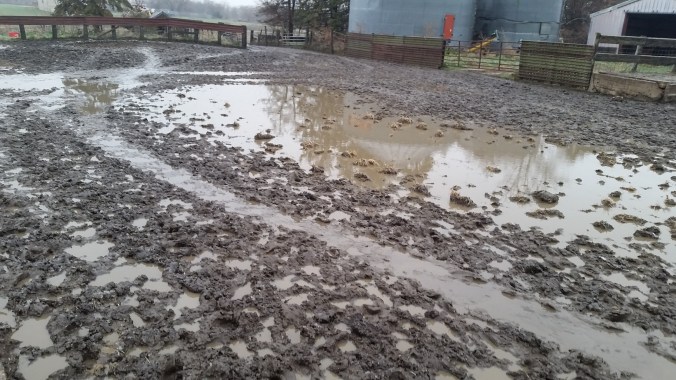
I can’t tell you why every farmer hates the mud.  This morning I was reminded of a few reasons why I do, though.  I hate it in the mornings, before I leave the house, when I put clean white socks through yesterday’s coveralls, marking them in a grimy residue not five minutes after having fished them out of a drawer and put them on.

It’s a two-fold bane on socks.  Whenever you come back in, after kicking off boots twenty pounds heavier than they are supposed to be, followed by the coveralls, you re-grime them and dare not wear them into the house.  Cold, damp feet greet a cold garage floor, and you pick up the dirt you were hoping to avoid tracking across the kitchen linoleum.

Generally I refrain from washing coveralls until you wear them into town and someone offers to buy you a cup of coffee at the gas station.  After contemplating if leaving them dirty might not be more profitable, you return home and throw them into a high efficiency washer incapable of handling the mess because it was only designed to clean already clean clothes.

Then you do it all over again.

In the midst of it is the more serious work of trying to keep livestock comfortable and fed.  Sometimes, after hammering a tractor through a foot of slop, when you are out trying to cut the damp wrap off a bale of hay, hoping it at least doesn’t snow on top of the mess, you look down to find the rat terrier house dog belly deep beside you.

It could be worse.  It could be a Pomeranian with diarrhea.

No, I’ve never met a farmer that likes the mud.
From Somewhere Down Below

20151120_152313

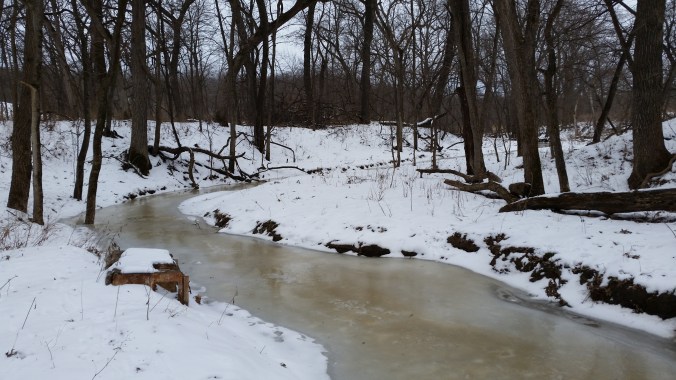
In the springtime comes the grass, from somewhere down below,
springing up from the March mud relentless,
as though it would cover the boy of summer,
under the tree at which he dallied.

And so it has, a million times.
Boys no longer dally at trees,
but I suspect it will find them anyway.

The poor southerner has a year long quest to keep it at bay,
but here, after the November rain, we get snow.

Down from above in splendor,
driven mad by the wind,
a blanket descends on the ground below,
making it beautiful once again.

Fleeting and taking nothing
it will not in time give back,
as thought it were a bender
from the anxious grass.

“To Their Deaths, Then?”

“To their deaths, then?”

Being involved in agriculture, I still get some of my news like the generations before me, via the AM band of the radio.  Generally it is intermittent, as I get in and out of the cab.  Sound bytes mostly, delivered in a format still relatively free of commentary.  Unfortunately for you, you won’t get this one delivered the same.

The sound byte was from Jeb Bush, a candidate I thought should have dropped out of the race sometime ago.  I heard it on the day of the most recent terror attacks in Paris, only they hadn’t happened yet.  It had been delivered the night before at an Iowa campaign stop.  It was in response to Donald Trump asserting he would ship all Syrian refugees back the day he took office.

“To their deaths, then?  I mean, what does he think is going to happen to them when they get there?  This is the best answer he’s got?”

I know ardent Trump supporters who maintain the candidate is forcing a long-needed, productive conversation among the Republican party, conservatives, and the country.  Personally, I don’t ever recall a productive conversation coming from someone whose main reasoning seems to be, “trust me folks; I know what I am doing.”  In the interest of full disclosure, I don’t recall a needed one coming from those circumstances either.

Maybe it is Bush, on his way out the door, that’s going to generate it.  He’s the only one that seems to be asking questions, after all.

He seems to be asking whose life are we “pro,” and how “pro” are we going to get about it?  That is a question that has needed to be asked in both parties for sometime.  In some ways what Trump proposes the current administration already seems to have done in other ways.

Will Bush continue to ask it now, bringing the issue out in vivid color, or will he opt as Facebook did, and let that color fade a bit in favor of expediency?

I suppose there is always the chance the voters might ask it themselves.

“To their deaths, then?”

Pond Building

Pond Building

On the core

We’ve completed eight ponds in the last nine years on our family’s property.  Typically a pond is built in July through September.  This takes advantage of the dry stretches of late summer and gets things completed before we start a fall of tile and terracing.

There was hardly any dry stretch this summer, and we were slated to build our largest pond to date.  We started in late September, with water still running through the project.  When we began the dam, we were committed.

Building the Core

The heart of any farm pond is a clay core.

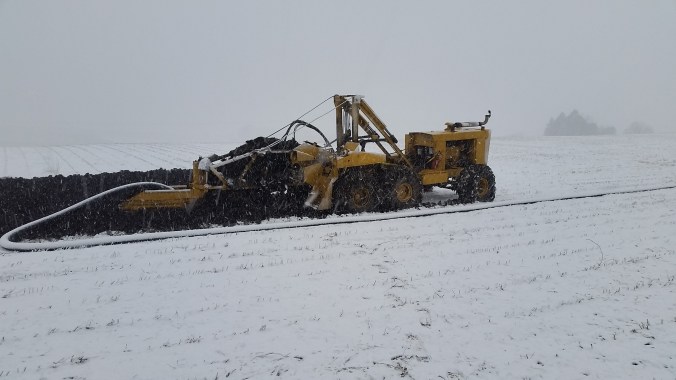
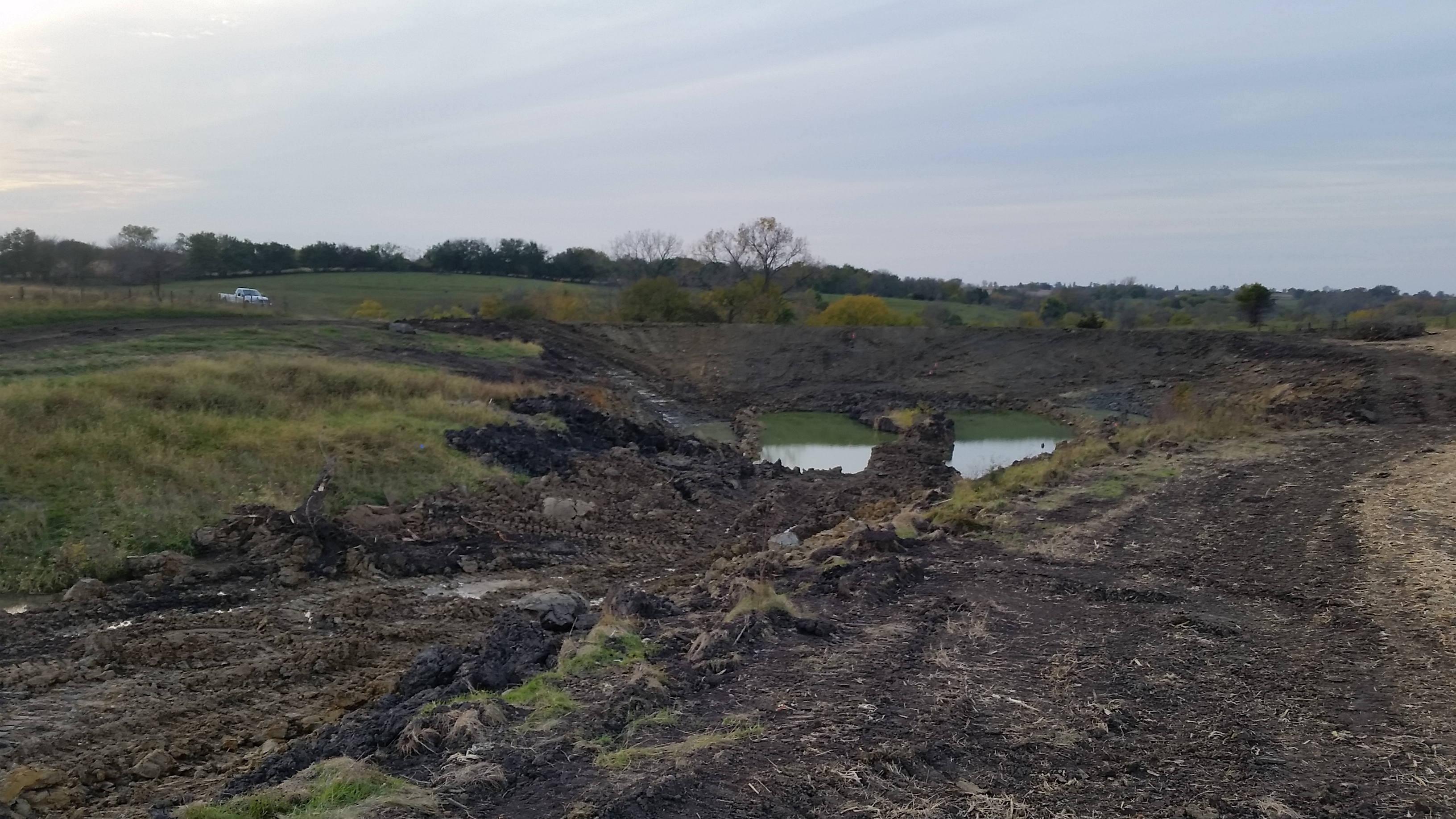
Prior to starting, the pond site was surveyed and staked.  The stakes marked the locations of the center of the dam, projected water level, and where the slopes will begin for the dam’s front and back.  Work began with black dirt being stripped from the work area and pushed to the backside of the site.  You can see that dirt on the left side of the picture above.  Normally we would have pushed more, but an existing fence limited us.

Next we cut a four foot deep trench the width of the dozer blade (about 14 feet) the length of the dam.  This trench serves as the starting point for the clay core, which will makes its way up the center of the dam to just above the future water line.  The trench notches the bottom of the dam.  Should water soak between the dam and the old surface, the notch keeps it from bleeding all the way through and creating a leak.  You can see the bright yellow clay of the core in the picture above.

The core will only be constructed with clay. Here you can see the clay exposed beneath the pond, which we are bringing up to the core.

Here you can see the clay we are bringing up to the core.

As the core comes up, black dirt from the back of the dam is brought up against it. This keeps the clay from spilling over the sides, and speeds up bringing the core to grade.

Black dirt is brought up against the core as we go up. This keeps clay from spilling over, speeding up bringing the core to grade.

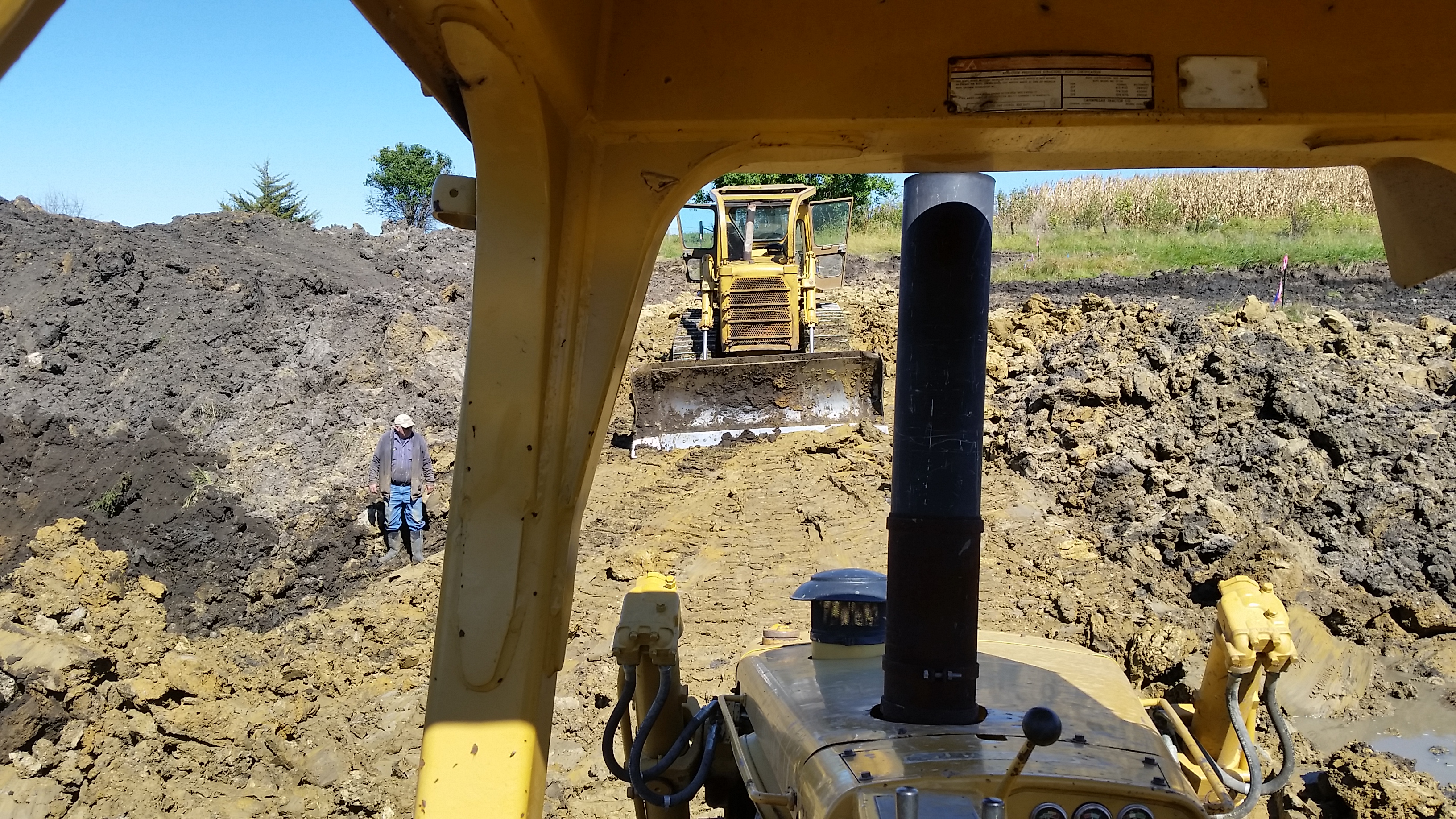
As much as possible, you move dirt in a groove. This keeps dirt from rolling off the end of the blade while pushing it long distances and keeps more dirt in front of you.

Dirt is moved in a groove as much as possible to further speed along the process, keeping dirt from rolling off the side of the blade.

Some grooves are deeper than others.

Some grooves are deeper than others.

Sandy clay

Sandy clay

Only clay goes into the core.  This pond presented a problem.  The west side had sandy clay.  There was enough sand we weren’t comfortable using it in the core.  Such fill could be used on the front side of the dam, and I began making a pile to use there later.  I hoped to eventually dig through it.  No such luck.  We would have to build the core using only the east side of the site.

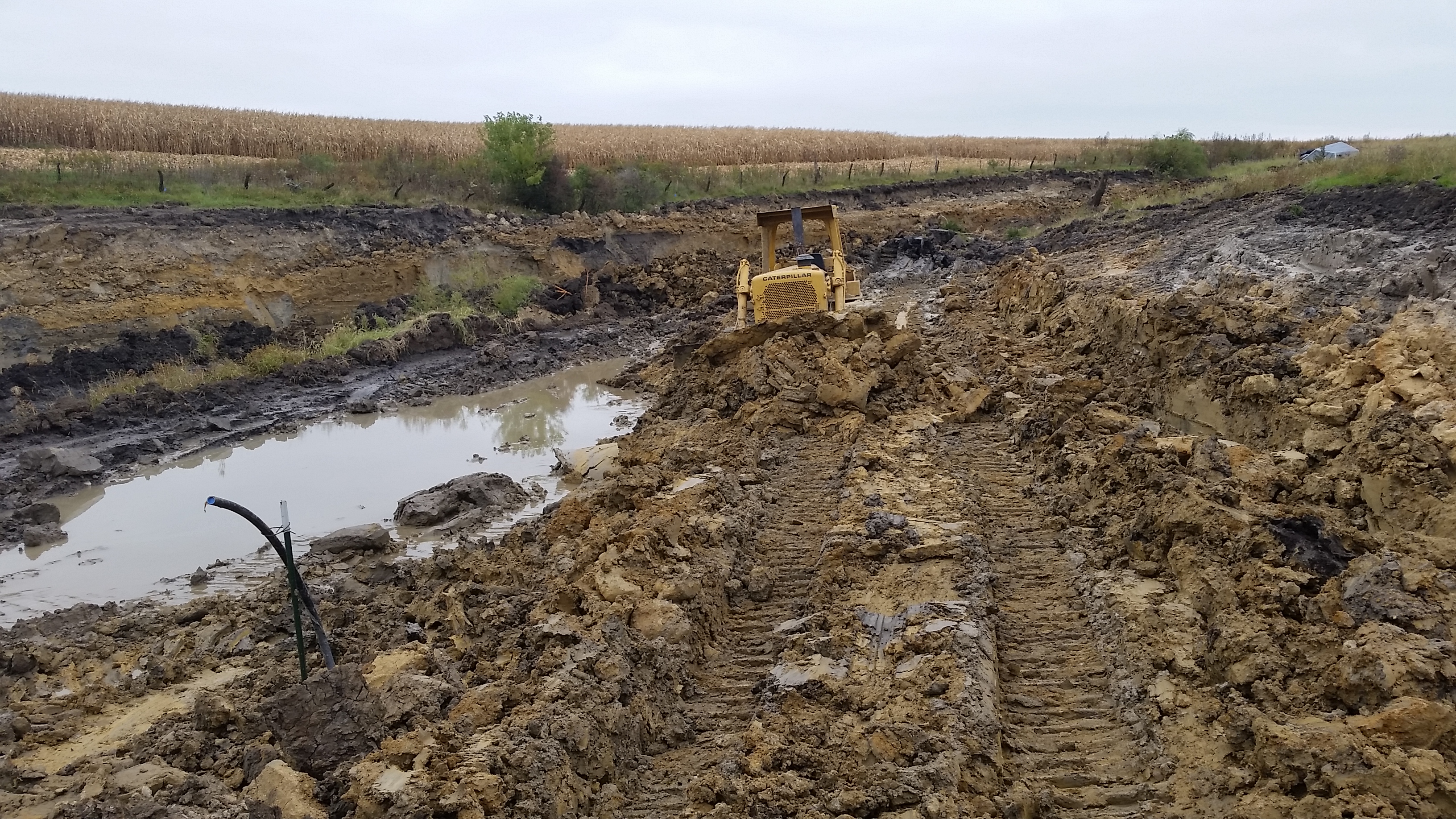
Each morning we would have to skim off the water that had ran into the pond the night before. Abandoning the west side allowed us to try and dam most of the water over there for the time being.

Abandoning the west side allowed us to try and divert most of the incoming water over there for the time being.

After several days of work, the east side was now collecting too much water to deal with. We punch a hole in the makeshift dam at that point, and diverted the water the other way.

When we got all the eastern clay we could, we punched a hole in the diversion and brought water back into the east side.

I started rolling the sandy clay off the side hill, stair stepping my way down to the water that remained. The core was now high enough to push the resulting slop up on to the front side of the dam, spreading some of it out to dry, and piling the rest to peel into later.

The core was high enough to push the remaining sandy clay from the west side onto the front side of the dam, spreading some of it out to dry, and piling the rest for later.

Meanwhile, at the topside of the pond we were ready to lay the overflow pipe. It was a 6

At the topside of the pond we were ready to lay the overflow. The 6″ steel pipe was welded together in 20 foot sections. We set it in place with the excavator and a skidsteer. Around the pipe were welded three four foot squares. These were anti-seep collars and function similar to the notch of the core. If water seeps along the smooth pipe, it hits the collar and can’t continue.  I used the excavator to sink the collars down into the core, and then pack clay around the pipe.

As it dried, the wet muck was spread out on the front side of the dam.

As it dried, the pile was spread out on the front side of the dam.

Both east and west would come to get too much water in it and we would work further east to get the dirt to finish the pond.

Short of dirt, we moved further east to finish the pond.

Final touches would be put on both the back and front side.

Final touches would be put on both the back and front side.

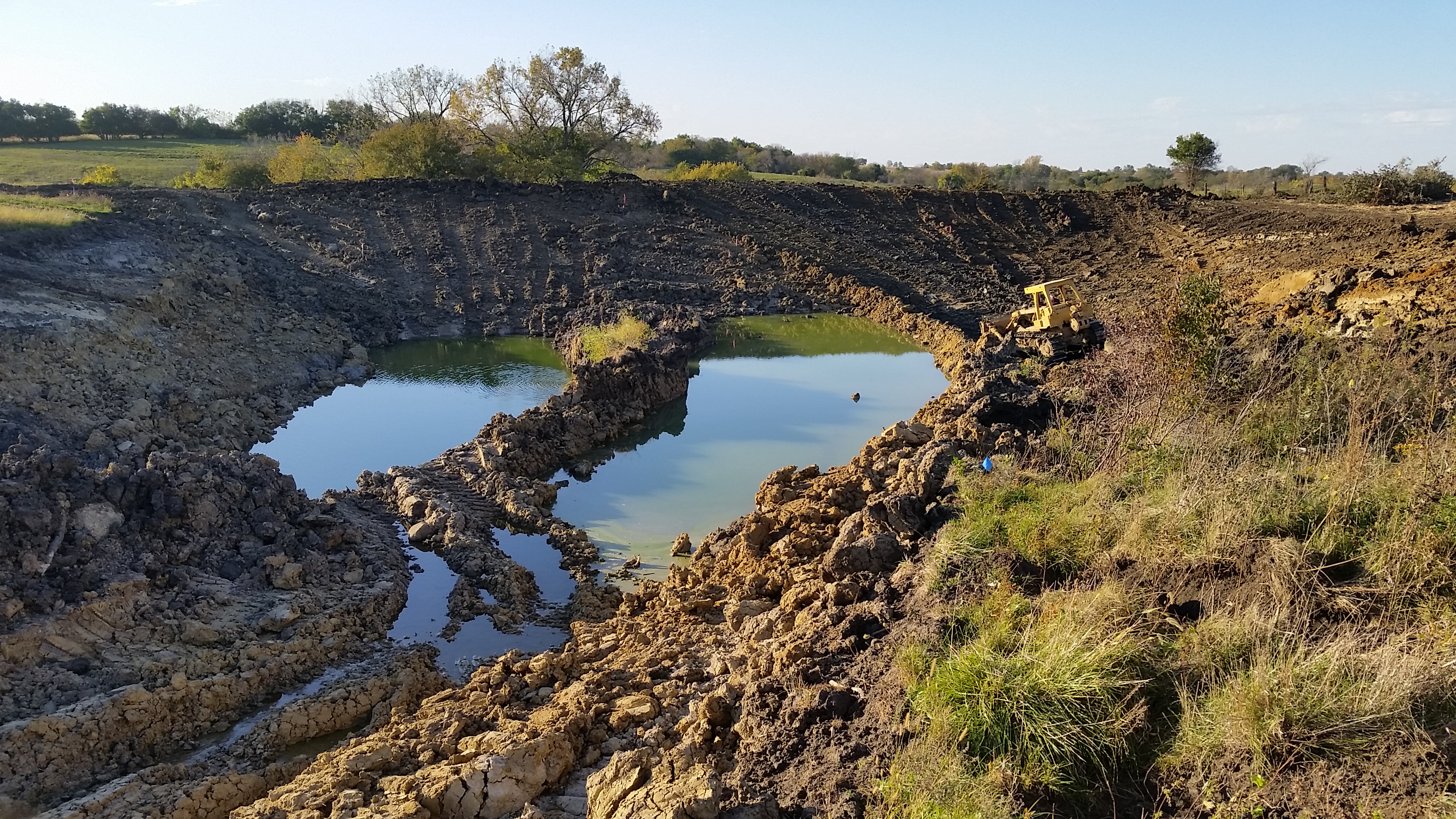
Finally we would have a completed project.

The completed project.

The pond will be able to do what generations before it could not:  stabilize a ditch that had cut across a grass pasture.  It will function as a filter below 40 some acres, catching whatever sediment the grass and newly completed terraces above it might miss and stop it all from moving further downstream.  It will also provide water to further expand a rotational grazing system on the pasture we rent to the north.

The Sting (or On a Personal Note)

“In theory there is no difference between theory and practice.  In practice there is.”

The Tale

I have never written in any great detail about my divorce.  To some degree I’ve never known what to say.  Recently, at some place or another, I heard that writing is to thinking what painting is to seeing.

Perhaps that has been my problem.  Thought leads to thought, and each one skips across the water in a different direction.  Sooner or later it all kind of gets away from you.  Yet why write if not to attempt to understand?

My marriage ended just before Christmas, nearly four years ago.  Sometimes I try to approach the subject when that time rolls around.  Tis hardly the season, however, and sometimes I wonder what my life would have been like if only the timing were different.  In less than two weeks it will be my birthday.  Maybe the occasion of our birth is a better time to think of how we try to be born again.

In the aftermath, all that time ago, came no shortage of advice.  Some of it was particularly good, and of what wasn’t, some of that was at least well intended.  It was offered from the married, the divorced, those never in a relationship, and the lucky who still thought they had something to do with their own good fortune.

Besides the free advice, answers were readily for sale.  A $15 book, for instance, promised to teach me how to free the wonderful child within, who only wanted to love and be loved.  He would lead me to myself, and that would lead me to those wanting to accept me unconditionally for who I am.

$15 seemed a bit pricey for a kid to tell me I’m an asshole.  I’ve gotten that for free once or twice.  I guess I’ve always been lucky that way.  And conditions…well…they are just like assholes.

Instead I wanted perspective.  I thought I would find the answer there.  I suppose we always think that, and it never crosses our mind that we might have to give up on one to get the other.

In all of it I was drowning, and the drowning man will cling to anything.  Only some of which will keep him up.

The Setup

The man whose job it was to talk our way through the day had earlier began by mentioning he lived on an island.  It was nice to know we had something in common.  His island was in Maine.  Mine was in my own mind.

It was my second of these conferences, and it had found me even more nervous than the first.  The fact that most attendees were mental health professionals makes you worry you’ll be exposed for being even more of a sham than you thought you were.  The longer you go without being detected, the more imminent you feel detection is.  We always forget that we are all delusional.

The conference centered on the ideas of Bowen Family Systems Theory, a theory named for Murray Bowen who began to develop it by observing the patients and the families of those suffering with schizophrenia.  What makes it unique in psychology is that it takes a “systems approach.”  After lunch the speaker presented the following example:

Think of a family that has three people in it.  A mother, a father, and their 23 year old son.  The son is making a spring trip home.  He’s rarely been home because he feels as though his parents treat him like a child.  His mother has been excited for some time to see a son she’d like to see more of.  The father is worried that this visit will follow the past, with everyone leaving in disappointment.

When they pick their son up from the airport, the mother greets him and in an effort to express care says, “Why you don’t have a coat on, you must be cold.”  The son immediately bristles at the comment.

The father, recognizing anxiety on the rise, decides to show support for his wife.  “Your mother is right.”

The son feels as though he is being tag-teamed, and begins to withdraw.  His mother senses this.  “Are you sure you are all right?  You don’t seem like yourself.”

The father now teams up with his son and says, “He’ll be fine.”

“There you go, minimizing my worries,” says the mother.

All I have to do is make it through the next couple of days, thinks the son.

For me what makes Bowen Theory, Bowen Theory then, are three things.  First, in the above situation blame falls on no one.  It is not a problem of an “overly-protective” mother, nor an “under-functioning” father, nor an “overly-sensitive” son.  The situation above is the product of a system, a system that likely began before any of the current participants arrived on the scene.

The situation is not a matter of the past simply repeating itself, however.  We actively recreate it in the present.  We all seem to be more comfortable with what we know, however ‘dysfunctional,’ than what we don’t.

Third, the solution isn’t found by making someone whom we have no control over do something different.  No one holds the others captive.  If any of them were able to see the system in place and respond differently, it improves.  Any can keep the past a little more in the past and create at least a slightly different outcome in the present.

In the theory are concepts and terms related to ideas I simply don’t have the space or expertise to discuss here, but in the years that brought me to the conferences, I’ve enjoyed becoming more acquainted with them.  By and large it is easier to see how they impact the organizations we are involved in and the acquaintances we have and act on it.  As we travel in, towards the emotional bonds that form our most significant relationships, acting and seeing gets exponentially harder as the forces become exponentially stronger to stay where we have been.

“Are you a therapist too?” asked one of the guys I was eating lunch with, seemingly with some assuredness.

“No.  I’m a farmer.”

He smiled.  “I think you are the first farmer I’ve ever met at one of these.”

“Don’t hold me against the rest of them.”

I had intended to sit at another table, but I found it already had several women at it.  In the auditorium we were talking about higher functioning in relationships.  Outside I was still in junior high.

“I once had a client who said he could see the theory perfectly in his mind.  He understood why the ones he loved said this, and why he said that.  What he couldn’t do, he told me, was act on it.

In order to truly know where we are at, we need to get it out of our minds and into a relationship.”

The Hook

For me interest in the theory had began the following way:

“I know you think you are doing the right thing, coming in here and taking all the blame.  Honestly, it’s just fractionally better than if you were coming in here and taking none of it.  The real work in life is figuring out what is yours, and what isn’t.  What isn’t you can’t do anything about, but you might be able to for what is.”

There I found the work of a lifetime.

“What are you looking to get out of all of this?”

“I would like to go forward.”

“Well, it looks like we have some direction, then.”

The direction turned out to be mostly backwards and sideways.  She never complained.  It felt like flailing, but I wasn’t drowning.

The Sting

The speaker had begun by sharing some thoughts of a James Shapiro on evolution.  “The role of (natural) selection is to eliminate evolutionary novelties that prove to be non-functional and interfere with adaptive needs.”  He had began with it because in farmers’ terms, what Shapiro was suggesting was a departure from how we’ve typically been taught to understand evolution, and thus part of how we got here.

Evolution did not create the long neck of the giraffe.  Instead, it merely selected against fish that could not swim.  As I thought about “non-functional” and “adaptive needs,” I wondered how long it would be before evolution would come for me.

“I’ve realized something.”

“What’s that?”

“I am never going to be the person I want to be for those I care about.  We think we will save it in the end, and it will look different, but we aren’t getting out of this tunnel.”

“Maybe not, but we can still get up each morning and chip away at it.”

Perhaps I’m overly-sensitive with an overly-active imagination.  Behind it all is an engine for thinking, a brain self-aware and folded in on itself.  This is all part of being human, I should think.  For me it works well for writing and not so much for other things.

Operating together it all creates an anxious wake across the same surface my thoughts go skipping across.  There we do what evolution cannot.  We create, if we chip.