Our Perpetual Lady of 3rd

Seldom do I do requests.  This sounds better than it is.  Seldom do I get them.  I did have a former classmate, Scott Greif, ask me to write a story about baseball.  It was a fine compliment, for Scott would know the considerable talent I lacked in regards to the game.  I figured he thought I could lie well enough to make up for it, and that my vanity would dictate that I would do exactly that.

Our little league team was the Churchville Red Sox, and the first word in our name came from the small, unincorporated community where the field was located.  Its name came from the fact that it did have a church.  In fact it once had two.  The second was moved to Martensdale, bell and all.  How they got it over the hills, I don’t know, save that the move was a joint effort.  The Lutherans were eager to go.  The Catholics were eager to help them.

The world is small when you are in little league, and in that little world we took some pride that we were quite good.  So good, I suppose, we figured God Himself was taking note of it.  Baseball had a long tradition in Churchville.  My Grandfather played for them in the early turn of the century.  If God took note of them, I’m not sure, but His mother was reported to be the third baseman.

In those days there was neither a full-fledged field, nor enough players to field two full teams most of the time.  So Mary, the concrete Virgin which stood watch at the Church of the Assumption, became the designated 3rd baseman.  Having no glove of her own, the rules were simple:  if the ball hit her before the base runner did, they were out.  As to the length of her career, or the chips she took for the team, I cannot say, but she’d had lost her nose with a silent resiliency that was bound to have a profound effect on the rest of the team.

Churchville’s most famous son, Adam Walsh, was born in 1901 and went on to one of the more illustrious sporting careers of any Iowan.  He was the team captain for the 1924 Notre Dame Football squad.  There he played center of the “Seven Mules,” the line that blocked for the famed “Four Horsemen.”  During their undefeated season of 1924, in a game against Army, Walsh is said to have broken both his hands while playing every minute football, never fumbling a snap and defensively making a key interception late in the game.  Their famed coach, Knute Rockne, regarded the effort as the greatest game he’d ever seen a center play.  Walsh is still listed as the center on the All-Time Notre Dame Team, and after his career he coached the Cleveland Browns to the 1945 NFL Championship.

Now if this isn’t remarkable enough, consider the fact that he left Churchville at the age of 6.  Had he a chance to further develop under the Virgin’s tutelage, I suspect there would have been no stopping him.   Those that remained eventually found a field to play on, and a third baseman with a glove.

My grandfather’s favorite story about playing ball in Churchville was that one day an all-black traveling team called the Tennessee Rats came through on the train.  The traveled from town to town, setting up exhibition games against the town teams.  They made a living by charging a gate for their pay.  This was a step up.  In the early days the Rats were a traveling minstrel show.  They added baseball in the early 1900s, with a game in the afternoon and a show at night.  It was all baseball by the ’20s.

The Rats’ full team took the field the first inning.  Only their infield came out in the second.  The rest of the game was finished with their spectacular pitcher and his catcher.  When he finally got a chance to play, my grandfather got the team’s lone hit that day.  He confessed later that it took him a full ten years to realize he had gotten the hit because the pitcher had simply taken sympathy on him, the youngest member of the team.

Family tradition always said the pitcher was the great Satchel Paige, but a little bit of recent research says this is impossible.  Paige never barnstormed across Iowa until my grandfather would have been approaching 40.  If it wasn’t Paige, then who was it?  Had it even happened at all?  Then I came across a semi pro all-black team called W.A. Brown’s Tennessee Rats, and a historian who had become interested in them.

The Rats travelled all across Iowa and Missouri, into the states of Wisconsin, Minnesota, Nebraska, and the Dakotas.  For a time they featured two tremendous black pitchers, who were simply too old by the time the color barrier was broken.  John Wesley Donaldson, “The Greatest Pitcher You’ve Never Heard Of,” played for them in 1911, and in 1914 William “Plunk” Drake threw from the mound.  Perhaps it was the latter, whom my grandfather faced.

When the railroad line had finally been tore up, but before the bike trail had been laid down, we got our chance to be part of Churchville’s baseball lore. The teams we played were from the exotic localities of Milo, Truro, and St. Charles.  Following in my grandfather’s footsteps, I too would see action late in these games, but my age had nothing to do with it.

When I was in fifth grade, we played Milo.  They had a pitcher named Keeney, who should have been in the seventh grade but had been held back a year.  He looked six foot tall, and we suspected that he shaved.  Earlier that year, in a game at St. Mary’s, he hit a kid in the head so hard that it split his helmet right down the seam, with each half symmetrically falling at his ankles.  Kenney should have done it sooner in his career.  The story gave him something few our age were in possession of, a reputation.  It was one he had to have found great value in.

When they came to town, Coach Parker sent our own hard thrower to the mound, Ryan Lull.  Ryan was our shortstop.  As far as I know, he had never pitched.  This was likely due to worry that he could very well kill someone.  We were hoping it was Kenney in the first inning.  During his warm up, as the Milo team watched from the dugout, he sent a fast ball crashing into the backstop a good six feet right of the plate.  This had a level of theatrics W.A. Brown would have been proud of.  Things got pretty quiet.

Tom Lull, Ryan’s dad, pleaded with our coach to reconsider.  He wasn’t sure the family had enough insurance to cover whatever Ryan might do.  I imagine the Milo team could hear the pleas as well as we could.  Someone should have been charging gate.

Coach Parker knew that personal experience trumps a second hand story any old day of the week.  Whatever fear we had of Keeney now paled in comparisson to the fear they had of Lull.

We must have worked up a fair lead in the game, because at some point coach made his way down the bench to tell me I was going in.  He was a kind man, and always wore an expression that he was sorry he’d waited so long to get me in the game.  I always wore one that said it was quite all right, and he really needn’t bother in finding me.  I would have been just as content to sit on the bleachers, but it would have looked odd being the only one there with a uniform on and all.

With my stomach in a knot, I begrudgingly headed to the plate and tried to get as ready as I could for the pitch.  I finally found a spot where I was comfortable when the umpire stopped the game.  It seems I had set up shop a good two feet outside of the batter’s box.  Beyond that I don’t recall anymore particulars of the at bat.  I could offer a solid guess, though.

Having survived it at least, I now needed to take the field, and Coach sent me out to right.  I was hoping for a quick inning, but it was not to be.  The first two runners reached, standing on first and second.  I was fairly deep in right, mainly so I could let any ball drop in front of me.  The third batter nearly hit it to me, and I had to stand around for a while to make up for the fact that I hadn’t been back farther.

When it came down I charged it with great abandon, in case a local sports writer was there.  In case he wasn’t, I was writing the story for him in my mind.  While trying to find the right phrasing for the monumental events about to unfold, I passed the ball as it passed me.  Now I had to change both direction and the story line.  The key play would now be a dramatic throw to the plate, and when I finally caught up to the ball I snagged it and threw it with all my might.  After that I opened my eyes.

At the top of my view was the ball, hurtling straight ahead, and straight ahead was the side profile of the center fielder watching the runners go home.

“Eric, Eric,” I shouted, scared to death I was about to bean him.  He casually glanced my way, and with reflexes much faster than my own, caught the ball just before it nailed him.  This was to be a relay throw unlike any other, but I have lost all heart in writing about it.

Right across the road was the Church of the Assumption, and beside it was Mary still standing watch.  Meanwhile in the outfield, the heavens open and I had an assumption of my own.  I was no ball player.  Mary had suffered enough on my account, and I would make her suffer no more.  Once my 5th grade season had ended, I refrained from going out for the sixth.  Unlike the Virgin, I at least got to keep my nose.

The Bottle Calf Show

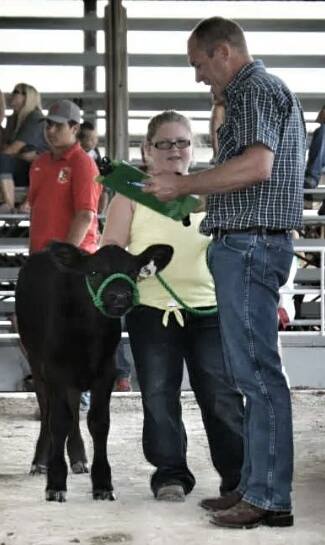
Bottle Calf1 Bottle Calf2The past Madison County Fair Queen, Sarah Al-Mazroa, was about to instruct me and three other judges on the 2014 Madison County Bottle Calf Show. For those of you that don’t know what a bottle calf show is, it’s really quite simple. The calves are generally 3-4 months old and were raised on a bottle. They are supposed to be halter broke. Most of them are twins whose mothers either abandoned them or couldn’t carry two calves. Some are orphans.

The kids displaying them are too young to show the calves’ fuller sized and year older counterparts. They generally range in age from 5 to 10. Prior to the show they submit answers to a variety of questions meant to demonstrate their knowledge about their calf and how they care for it.

“How did I wind up here anyway?” I asked Sarah.

“We made a list of those who would be best for it, none of them could make it, and eventually we got down to you.” This was as I expected.

“I’ve never really judged anything before,” I told her, “I wasn’t even on a judging team in college.”

“Well, you aren’t judging the calf; you’re judging the kid.”

Judging the kid, I thought. I could think of several ways to do that: spelling, their understanding of advanced mathematical concepts, their comprehension of comedic irony, but eventually I settled on the most obvious one: likeability.

“So we pick the kid we like the most then?” I asked. Sarah looked befuddled.

“No. You place them by how they do answering the questions.”

“What if I don’t like the kid?”

“It doesn’t matter.” I sensed she was getting frustrated.

We were to place the kids off of their aptitude. The concept felt outdated. Our education system had abandoned the idea some time ago.

“So for each class we pick first and last place then?”

“Ok, seriously? No.  We don’t pick the kid that comes in last. Who would do that? You place first, second, and third.”

Personally, I thought picking the last place kid was an excellent idea. Sure, first place is something to strive for, but let’s face it, most of us aren’t going to get there. Sooner or later we find the satisfaction of at least not being at the bottom. I would hate to deny any kid that, even if they are 5.

There were 50 calves to go through that afternoon, and soon the first class had assembled. The 4 of us judges were split into teams of 2. Our initial questioning was to be conducted outside the show ring. There we were to pick a couple questions each kid did particularly well on, parade them into the arena, stick a microphone in their face, and hope for the best. While our class was in the ring, the other team would be interviewing the next.

Just before we paraded ours out, I did a head count. We had 4 5 year olds. I grabbed the class sheet. Nearly all of them were in groups of 4. This wouldn’t do.

While it’s debatable how much of my math classes I remember, I do seem to recall three ribbons for 4 5 year olds equals a crying kid and 2 pissed off parents chewing my ass. I objected. As judges we reconvened. They all agreed avoiding a crying kid and an ass chewing were good ideas and decided we would only be awarding first and second.

The questions concerned the calf’s name and how it got it, its sex, how they got the calf, who helps them take care of it, if they had a funny story, if it has ever been sick, and what they learned during the project. We had the sheets they had submitted and were to make sure the kid had taken part in the answers.

3 of the 50 calves had a slight case of pneumonia at one time or another. I couldn’t spell pneumonia if you spotted me all the vowels and a couple of minutes. Their spelling was remarkable. One kid was moving right out with the handwriting you would expect from a 7 year old, but it suddenly broke off when he got to the pneumonia part. In its place, over the top of several remnants of partially erased letters, was printed neatly ‘pneumonia,’ and then the shaky writing of the 7 year old took up again.  I suspected his mother done it.  Either her or the Spelling Fairy.

One of his contemporaries, intent on doing things his own way, had obviously refused help from anyone.  When we got to question about the calf’s health, he simply remarked that his calf had been afflicted with “runny poop, but he got better.” He will make a fine veterinarian someday.

A 6 year old girl made a particular impression by recalling nearly word for word each answer on my sheet. That was until I looked down and saw her reading each answer word for word off my sheet. I was no longer impressed with her recollection. I did become impressed with her resourcefulness.

What every judge is looking for, however, is that one answer that will produce the viral video on YouTube. I thought I had such an answer from Connor, about his calf, Sam.

“Tell me, Connor, how did you get Sam?”

“He kicked the kid that had him before me in the nuts.”

“I’m sorry. What did you say?”

“The kid that had Sam before me got kicked in the nuts by him. After that he didn’t want Sam anymore.”

Lights flashed, bells rang, and I thought to myself, winner, winner, chicken dinner. Victory was mine. Connor was about to become my golden ticket to the Today Show. I moseyed over to my partner partly to tell her the scenario, partly to gloat, and partly to ask that she have her phone ready.

“Do you think I can have him say that?” I asked. A rather disapproving look crossed her face.

“I think you can say he kicked the kid, but I don’t think I would have him say where he got kicked at.”

She was 17 years younger than me and in college. Someday I will have her maturity. Having not got it yet, however, I was disappointed. I told the kid we could mention the kick, but needn’t be so anatomically specific about where it landed. He was disappointed too. Our 15 minutes of fame ended before it ever got started. I have no doubt his mother was pleased.

I was left to quietly abide in the hope that a calf might still go berserk and drag its pint sized handler around the ring a couple of times. That is always good for a laugh or two, but this failed to materialize as well. The 2014 Madison County Bottle Calf Show turned out to be a mundane affair. Still there is always the hope for more fireworks next year. Fireworks, now there is an idea.

With any luck the kids learned someone could stick a microphone in their face and have them talk about what they do, and they would survive it. Some were shy, and it was hard for them. I was shy once too, but got over it. While none of them learned they could be knocked down, drug through the dirt, and survive, I’m not worried. That’s what the Des Moines Register is for.

As for me, I judged the kids quite enjoyable, and it seems my judging stint is not over. Adam Hill with Warren County Farm Bureau has invited me to their fair to judge their cook-off. I’m hoping for barbecue, but wouldn’t rule out a spiciest chili contest. At any rate, with two events under my belt, I won’t be a man without prospects. I have some hope of judging beets at the State Fair next year and eventually working my way up to pies. And perhaps, someday, I too will be able to spell ‘pneumonia.’

Across the Great Divide (A Comedy)

The following started as a bunch of thoughts revolving around in my mind. Their revolution is simply part of being human, and we all turn them, again and again, hoping to make some sense of them and to whittle away what isn’t important and to turn it down to what is. Sometimes, for each of us, a door opens, and we briefly peer into a room that has been beyond us. Why this happens, I don’t know, but it does. It happens to storytellers, husbands and wives, parents and children, and anyone else with a pulse.

For my own part, I would give twenty years of my life to stay in the place where that door is open forever, but it is not to be. The same flash of white hot lightning which opened it, closes it on the return stroke. Like a dream which explained everything and evaporates as we awake.

Left to abide in the hope that someday it will happen again, and that someday we will be present in it always.

A long time ago now was a family which I often likened to the Brady Bunch. In this family was never a quarrel between husband and wife or their children. It was this family I compared all others to.
One day I, visiting with a woman much brighter than I, I spoke of this family.
“How many families do you know like that?” she asked me.
I thought for a while and said, “Only them.”
“Well then, what does that tell you about the family your gauging normalcy by?”
She smiled. I smiled. A door had opened for me, and I tried with all I could to get my ass through before it closed. Conflict is normal.
I believe it changed my life, and will continue to do so as long as I live. I managed to get my shoulders through, but my ass got stuck, and so I alternate between my old life and the new one.
In her estimation, it was conflict that was normal. The thought that it wasn’t, was a sham. The time I spent thinking otherwise was wasted.
Throughout our history there have been people dedicated to finding peace here. I admire their efforts a great deal and respect their calling. But to find peace here they have had to remove themselves from the world. Some have done this physically in the form of communities and communes. Some have done it in their minds. For to remain here in both mind and ass, leaves us with conflict. Perhaps we should figure out what to do about it; perhaps there is no better use of our time.
I suppose it is around the age of eight or ten, when we first get some idea of the liberties that are available for the taking when we are in a different place than our parents. Raids on the candy in the cupboard or cookies in the freezer soon give way to increasingly wild expeditions beginning with the onset of sleep overs, driver licenses, finding love, and moving out on our own. At some point in our life a regression begins, our outings become less wild, and we again find simple satisfaction in the raids which once kept us content as children. For me they have regressed so much so that at thirty seven I am resigned to the simple liberty of writing a story while my parents are on vacation.
A few weeks ago a wicked little storm moved through the area, dumping a couple inches of rain in half an hour with a hard wind driving it. We lost power for a day, but damage was minimal. The neighboring town of Bevington wasn’t so fortunate. There, damage was what one would have expected from a small tornado, but no one knows if they saw one or not. As far as I know the tornado was never really sure whether Bevington, population of 70, was actually a town.
Within twenty minutes or so of its passing my mother came home from there, and I went over to get a damage report. At the end, she asked what I was about to do now.
“I was going to go over to the south pasture and see if any trees fell on the fences. Want to come along?”
“Well there is no power and nothing to do here,” she said. “Sure.”
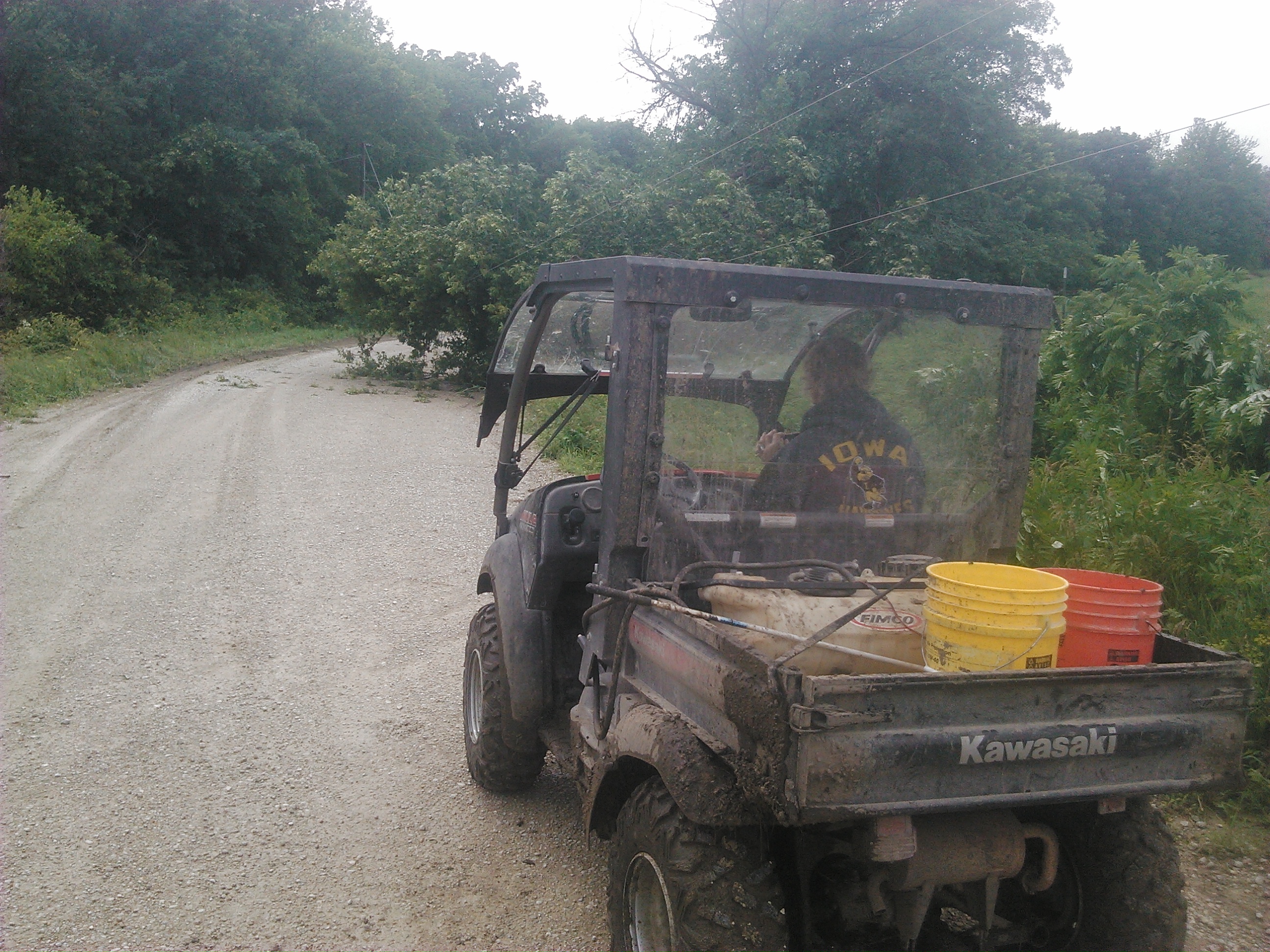
“Fine. I’ll go out and make sure there is gas in the Mule, then bring it around.” I rounded their house to her coming off the back deck in flip flops. Their sole was half an inch thick. The mud was three to four inches deep, but I kept this to myself.
The seat was a little dirty. She asked me if she needed to get a towel. “I think it will be all right,” I said. “Besides, your jeans have holes in them.”
“They are supposed to have holes in them; that’s how they are made.” Thus a conversation I always thought I might have with a child of my own someday, I ended up having with my mother. I kept this to myself too.
To get to the pasture we had to cross North River, and when we got to it, we found it already lying across the road ahead of us. My mother was expecting me to stop.
“You’re going through there?”
“Yes.”
“Do you think that is a good idea?”
“Probably.”
“How can you tell how deep it is?”
“By how far it gets up on the tires when we get there.”
Her hand reached up for the ‘oh shit handle’ welded onto the roll cage just above her. I left mine alone. I knew the Mule wouldn’t float, and had no desire to have a death grip on an oversized boat anchor. Besides, there is nothing more calming than seeing someone else get nervous before you do.
We crossed the river and rounded the corner. There a tree had taken the power line and stretched it as tight as a bow string. It had broken the pole off, but was unable to take it to the ground. Thus the line hung eight feet off the road, with most of the weight of the tree and all of the weight of the pole still on it.
“You are not going under that are you?”
“Yes.”
“Will we make it?”
“Probably.”
“How do you know?”
“We just did.” Emerson said, ‘In skating over thin ice, our safety is in our speed.’ The same is true with downed power lines.
Pulling the long hill out of the valley and stopping at the pasture gate, I got out to open it.
“We aren’t going in there are we?”
“Yes.”
“Well, I think the fence looks fine.”
The pasture is 240 acres, divided into 40 acre lots, and snakes its way back a mile and a half, through ditches, over ridges, and among numerous large oak. By my count there is over five miles of fence on it. From our vantage we could see not quite a third of it. Most of the third we saw at a distance of half a mile or better. I don’t want to doubt my mother, but I was envious of her eye sight. I kept this to myself too.
Most of the cows were in the forty the furthest back, and gingerly in the mud we made our way back to them.
“Are we going to get stuck? I’m not walking. I have flip flops on. We aren’t going to get stuck are we?”
“I haven’t got this stuck yet.”
I left the trail and drove along in the tall, un-grazed grass.
“How can you tell where we are going? I can’t see anything. Can you see what is ahead of us? Watch out for that big rock.”
The rock in question was not as big as a greyhound bus, but possibly larger than a Yugo. Obviously my own eye sight she was not envious of.
“I don’t think much of this excursion. We are not going to get stuck are we? I really don’t think much of this excursion. How much further are they? I don’t think much of this excursion.” The pauses between all of the sentences were removed by me, because it sounds the same all together as it did all spread out.
The final crossing had washed out, leaving a four foot gap where the culvert should have been. I continued along the ditch until I had climbed a steep, bare knob. Below we looked down on the silver and slippery ribbon that was a muddy pond dam, which was our only way back to the cows. On the pond side the storm water laid in a silent stillness, waiting its chance to roar on through the overflow pipe and be off again.
“You’re not going across that are you?”
“Yes,” I said.
“Can you tread water?”
“No. Why?”
“Well I was just wondering what you were going to do when we slid off into the pond.”
“Jump before we get there.” It would have been easier for me to jump. On my side was the long incline of the backside of the dam. My mother’s side was less forgiving. Had I jumped, I would have came back. My own mother had taught me that.
Once Mom and Dad left my sisters and I along the side of the road. When they came back and got us, we were all thankful. Had I jumped and left her, I doubt she would have had the same gratitude we did.
Finally we made it back to the 40 the cows were in.
“Will they come out when you open the gate?”
“No.”
“Are you sure?”
“Yes.”
As I stepped out to get the gate, Mom finally released her death grip of the ‘oh shit handle,’ only to look at her feet and utter, “shit.”
“Mud too,” I reassured her.
As it happened, no trees were down and all the cows were in. Leaving the back 40, after I closed the gate, my mother asked what we were going to do now.
“I’ll get you home,” I said.
“Don’t you have more cows in here?”
“Yes. This year there is twenty head of first calf heifers clear over on the other side.”
“We probably ought to go check them, don’t you think?”
Seems I had made a convert out of her.

Someday, I suppose, when we have completely regressed, we will gladly trade all the liberties we took in their absence for their presence once again. We will realize this as lightning opens its door once more, and we stand on the outside, looking in.

Two Soldiers and a Camp in Patterson

I often wonder how it is that as adults we are content to believe the most preposterous lies that even our children won’t take up. I was reminded of one just this week, having finished a beer, and waiting for the second half of a concert to begin at Des Moines’ Hoyt Sherman Place.

“You know if you are sitting out there in the audience, and you’ve never taken the time to travel across this great country of ours in a way that lets you appreciate the vastness of it, you really ought to. David and I are lucky in that we drive ourselves, and over the years we’ve crisscrossed this country so many times. I still haven’t loss my sense of awe at it all. The climates, the people, and the cultures are so varied, yet here we are, all in the same place,” so uttered Gillian Welch having taken the stage after intermission.

The comment brought lots of applause. Some was from a ghost fluttering around backstage somewhere. Hoyt, onto the side of his stately home this auditorium was built, was surely pleased with Gillian’s call for cross country travel. His famous brother, William Tecumseh Sherman, had the same idea some time ago. He went across Georgia, cutting a swath sixty miles wide.

I have no problem with the wonders of travel, only the subsequent smugness of those whom thought they already had.  What better way to appreciate its vastness than to realize its vastness is beyond our comprehension? Here lies the sense of awe. What more stands in the way of that than to believe one already has?

Every child understands that real places aren’t found on maps. As adults we become convinced of the opposite. The crap that wouldn’t fool a child fools us daily.

At the concert’s start, my father struck up a conversation with the couple ahead of us. He spoke with the wife first, whom had a sense of culture about her. When she mentioned Chicago, Dad naturally asked if that was where they were from.

“Oh goodness, no,” she said. “I’m from Fort Madison, and my husband is from just south of here, Madison County, where the bridges are. He’s from a little town you’ve probably never heard of. We live here in Des Moines.”

They were in their 70s, and if the wife possessed an air of graceful sophistication, her husband, short and thin, bespectacled, and with time having turned his shoulders and back slightly in, was an unassuming man and endearing. He turned and offered a smile as he was brought into the conversation.

“We’d be a little familiar with Madison County,” Dad replied. “We’re from there.”

“You don’t say?” said the man rather excitedly. “Where about?”

“A few miles north of Bevington.”

The smile grew larger, “I was once one of nine in a graduating class from Patterson.”

“Do the two of you come here often?” his wife asked.

“This year we have. It’s our third time. Most recently the two of us saw Lyle Lovett.”

The husband’s smile now gave way to a giddy laugh. “He’s my absolute favorite. I’ve seen him many times. The thing is he always has such good musicians with him, and he’s always such a gentleman on stage, both to the audience and to the band.” He almost seemed embarrassed that he had went on so to strangers, that he had momentarily left the map.

The lights went dim. Gillian and Dave came on, and as they brought their guitars into tune, our man from Patterson laid the backside of his hand on his wife’s knee and she laid her hand in his.

When intermission arrived I went to get a beer, and found the same couple ahead of me.

“So what do you know of where I grew up?” the old man asked.

“Well whenever I think of Patterson, I think of a story my Grandfather was said to have often told. His mother had a poor heart, and in 36’ it was so hot he was afraid the heat would kill her. They say there were 28 days where the high was never below 100. You couldn’t stand to sleep in the house, so they slept in the yard, but the ground would be so hot you’d have to let it cool off.  While they were waiting, he’d get her in their car and they would drive with the windows down, trying to relieve the stress.

There were still salesmen traveling through the area, and some moved from town to town putting on a show. One night there was a fellow in Patterson, so they drove to see him and beat the heat. When he came onto his impromptu stage he related to the crowd the following story:

Folks, I had the most God awful dream last night. I dreamt last night not only that I had died, my friends, but much worse than that. I dreamt I had died and went to Hell. There Lucifer gave me the job of shoveling folks into the fire. God I hated to do it, but he forced me to do it, and so I did.

The first group that came along was a group from right down the road here, in Martensdale. Oh I tell you…they were such nice people. But the Devil bade me to shovel them in, and so I did. And the next group, oh, they were closer still. They were from Bevington, and they were even nicer than the folks from Martensdale. I especially hated to throw them into the fire, but the Devil bade me once more, and I did. But ladies and gentlemen, little did I know that the worst of it was yet to come. Why the third group was a group from right here in Patterson. And they were just as nice as all of you. I cried. I begged, but the Devil spoke, ‘Shovel em in,” and with tears running down my cheeks I did.

But I’ll be damned if those folks from Patterson weren’t too green to burn.”

The husband had found his laugh once again, extended his hand, and told me his name.  “Last nam is ‘Camp,'” he said.  I told him mine.

“It was a real pleasure in meeting you.”

“Very much likewise,” said I.

The most famous story of Patterson, that of Jesse Russell Salsbury and his buddy from Illinois, Joseph Downs, we never got to. The pair met in the Iowa National Guard in 1917. Later that year, preparing to leave for France, they erected a flag pole in the Salsbury yard in Patterson. In the wet concrete they both inscribed their names, below which they wrote “Shot in France.” On May 27th, 1918 the pair was killed there in a gas attack on their trench.

In 1923, the town stood the slab on end and made a monument of it, and you could crisscross this country a thousand times and never see it once. The story is only a local one, and there are no signs directing you to it from nearby Highway 92.

I often thought someday, in an effort to raise funds, they will set another flag pole in the Salsbury front yard and raffle chances to leave an inscription on it. Were I to buy that winning ticket, I’d write, “Dan Hanrahan–Died peacefully in his sleep.” And then, when the crowd had left, but before the concrete dried, I’ll pull from my pocket a list of a few other names with manners of death much more exotic.

I stopped by it this evening, on my home from Creston. Beside the monument is a wreath that has nearly withered away. Above it is an enclosed case, detailing the story. Alongside the story are pinned a few photos, all bleached and faded beyond description. All but one. The lone picture that survives is of J. Russell Salsbury and his friend Downs. Wherever they are standing, it isn’t found on any map, and is as real now as it was then.

Time a Dreamin’

My mother went to an all-girls Catholic school in Des Moines. It was called St. Joseph’s. How St. Joseph made his way into an all-girls Catholic school, I don’t know. I’m sure area boys were jealous of him.   It is unlikely any of them were saints.

She once told me that when she was young a nun had asked them if any of them knew why time went faster as we got older. No one offered any guesses. My bet is that they weren’t old enough to notice yet. It was no matter, their teacher had, and they were going to have to hear about it anyway. This is the process we refer to as education.

“Time goes faster as we get older, because every year a single year becomes less and less significant. When you are five a year represents 20% of your life, but when you are 40 it is but a fraction of it.” The nun was obviously 70 and depressed. She kept a calendar on the wall, not for the dates on it, but rather for the breeze generated as they passed by.

It could have been worse, of course. St. Joseph was well beyond 70 and approaching 2000. Ordinarily he would have been pleased to have had a girls school named after him, but he sneezed and missed it entirely. By the time God said, “I bless you,” it had merged with the boys at Dowling.

My mother related this story to me when I was young, and it sat unchallenged in some recess of my mind for many years. That is until one day when I heard a man describe his 40 year marriage as having only been like five minutes. After a brief pause he simply added, “under water.” It seems he and the nun had a different perspective. Hers had been heavenly, the husband’s something lower. It would appear for him that life was taking forever. Perhaps it was the Devil’s sister he was married to. Either that or he was simply a wise ass, and life was taking forever for her.

It wouldn’t surprise me if he had met her when he was 12, and she was attending an all-girls Catholic school. Perhaps the real lesson of life is to be found there, for it’s the only thing that suggests how we ought to be spending our time, regardless of how fast it moves. We should spend it in pursuit of the dreams we have.

Yes, it’s true: our dreams will never go how we thought they would. They are always going to cost more, pay less, take longer, last shorter than we ever imagined. To pursue a dream is to kill it in a way. But it’s only in pursuing it, it’s only in this killing, that our dreams ever truly live.

Some might think it macabre, this talk of killing a dream, but think of life, think of us, think of those times that we made all the right pursuits only to be left disillusioned when the dream was more expensive, or yielded less, or took longer, or lasted shorter than we thought it should. We took every step except the one that mattered most: letting it be what it is. Instead the dream was traded for the fantasy of what it was supposed to be but wasn’t.

If you are a 12 year old boy, there’s hardly a better dream to have than a cute brunette at an all-girls Catholic school. In fact I would suggest a cute brunette is a damn good dream any old time. It is worth pursuing, and it is worth letting it be what it is.

We tell our kids they should dream, as though that will make them creative, but the fact is it won’t. They could dream the same dream their whole lives, but in order to create something, in order to give it life, they will eventually have to pursue it. Even if in its pursuit life seemingly takes forever, chances are they will love every minute of it. She might too.

The Founding of St. Patrick’s

If you look to the west halfway between the Bevington and Cumming exits on Interstate 35 south of Des Moines, you will see St Patrick’s Church on the ridge above you.  The area used to be called Irish Settlement.  Someday it will be called West Des Moines.  It’s true it could be called West Cumming or North Bevington, but I wouldn’t bet on it.

On this site stood a Catholic church before there was ever one in Des Moines.  In fact, when Fr. Timothy Mullen made Irish Settlement his base in 1852, the next closest priest was in Ottumwa, giving Mullen, and in effect the Parish, an area the size of the current Des Moines Diocese to cover.

Much of the history of the place is owed to one single account of James Gillaspie, a Civil War Veteran, who wrote his recollections down in an article for the Madison County Historical meeting held on March 19, 1907.  He was 77 years old at the time.  He came to the area in 1856 with his parents at the age of 26.  Whether he had much of a memory or gave much an account, no one knows.  He waited to start talking until he was the last one left, however, and this is astute.

His written account was in the process of being lost, I suppose, when in 1956, to mark the hundredth anniversary of the Parish, Fr. John Hart began to put together a more formal history of the place and used Gillaspie’s article as a starting point.  As he branched out to other archives and histories, he found they were celebrating the 100th a few years too late.  Fr. Hart’s history and, thanks to him, Gillaspie’s are still in circulation today.

In his account Fr. Hart makes no mention of his own name, neither as the account’s author, nor even as the Parish’s current priest.  He’s pays particular attention to the facts, and makes a great effort to demonstrate why those facts are so.  This all serves to make it a good account, but not a very Irish one.  I will retell the story of the founding here, in a more Irish fashion at times, with no malice towards the work of Fr. Hart.

Irish settlers had begun to arrive in the area in the late 1840s.  Hardly any of them were from Ireland directly.  Instead they hailed from New York, Pennsylvania, Wisconsin, and Canada.  The settlement was hardly planned.  The first people probably stopped because North River and its timber made the area particularly attractive.  The later ones stopped because their children kept asking ‘are we there yet?’, and mom and dad decided they had heard enough of that so they were.

The settlement laid on both sides of the river, which led to them being at odds with one another when they finally took up the task of building a church.  Each wanted it on their side. The south siders were motivated by pride, the north siders were motivated by condescension. It wasn’t uncommon for a home on the south side to have a wagon out back, sitting up on blocks.  The common wagon of the period was a Camaro.  The south siders took pride in this.  The north siders were disgusted.

They reached an agreement which said the church would be built on whatever side of the river started a cemetery first.  The south siders, to their credit, were patient to wait.  The north siders looked for volunteers but couldn’t find any.

Anyhow the story goes that early in 1852, a government surveyor was returning from farther west.  He was ill and stopped at the house of Patrick Walsh, who lived on the south side.   Not long after stopping he died, and Mr. Walsh and a few of his neighbors set out to find a suitable place on their side of the river to bury him.

In their efforts they dallied, the exact cause of this is unknown.  There are no Walshes in the area any longer, and that fact gives us ample room to speculate.  Generally, just a little room to speculate is more than plenty for the Irish.  Let us speculate together.

After having relieved the former surveyor of the whiskey bottle the men found in his satchel, and having properly lamented the loss of their quite recent, but dear, old bosom friend, they then set out to find the suitable spot previously mentioned.  It was a matter of stumbling mostly.  Most of the whiskey had still been in the bottle when they found it.

(While we are in the process of speculating, then, it would be an interesting aside to note the difference between German and Irish settlement of the state.  Germans had it all planned out beforehand.  They saw the ridge, placed the town on the ridge, and placed the buildings in the town before there was a building or settler even there.  The Irish sense of planning was considerably more immediate.

At Irish Settlement the number of Catholic families dwarfed the number to be found in Des Moines.  Mullen found only 8 on his first visit to the town, but they were 8 German families, and they went on to help produce a state capital.  The Irish were sprawled out all over the country side, never once thought of building a town, and still haven’t today.  Had it not been for figuring out what to do with our late surveyor, they might not have ever got around to building a church.)

The one thing the Irish could do, however, was spread a story, and the death of the surveyor was a hot topic.  So hot, that enough on the north side found out about it in time to organize, cross the river, and relieve Walsh of the surveyor while his party was still out stumbling through the countryside.  They brought him back and buried him on the first ridge they came to.  The debate ended, and a church of logs was built there that summer.  This last paragraph is not speculation, it’s part of an oral history that was first written down by none other than Gillaspie himself.

The log church they built stood in the middle of what is today the cemetery at St. Patrick’s.  As was their custom, the Irish tended to bury their dead right outside the door.  Probably because the pallbearers got tired of other pallbearers asking, ‘are we there yet?’

The early graves were marked with plain wooden crosses and with no good accounting.  A few years later an effort was to be made to better identify the grave sites.  The night before this was to begin a fire swept through the cemetery, and the markers were lost.

Many thought they would be able to locate the graves of their loved ones, but found the blackened landscape held little resemblance to that which had existed prior.  Only some of the most recent graves were found, and today the earliest marked grave in the cemetery bears the date of 1857.

So it came to pass the oldest grave, which was of one who found and founded, now lies lost.

In 1868 Fr. Brazill decided the parish was in need of a new, larger church, and began construction on the one which still stands today.  Evidently unimpressed with the Irish craftsmanship on display in the log church, he hired carpenters out of Des Moines to build it.  They were going to use milled lumber in its construction at which the locals scoffed.  They maintained logs were the only proper way to build anything, and that milled lumber was a fad.  During construction, with the new walls in place, a storm came up and knocked them flat.  I feel bad for the carpenters, for it’s a dangerous thing to have the Irish proven right on anything.  It only encourages them.  I’m sure from that point forward the locals’ advice moved way past the realms of construction, and broadened in scope to the point where even philosophy was breathless.

Still the carpenters continued on, and St. Patrick’s has seen a lot of storms since.  Evidently, they were German.

Hobnobbing

A few days before last Thursday, I received a call. “Hey Dan, there’s a meeting of the International Food Information Council this week at the Pioneer Campus in Johnston. All the major food companies like Kraft, Pepsi, Coke, Nestle, General Mills, etc. will have executives there. On Thursday evening for dinner they would like to have a farmer join each table to talk about agricultural production practices. Would you have any interest?”

“You bet,” I said.

So when Thursday arrived, I found myself in the middle of the bustling suburb of Johnston, right next to the Public Library, on an old farmstead looking decidedly out of place and yet beautiful at the same time. There were twelve Iowa farms represented either by individuals or couples, and we made introductions and small talk awaiting the bus of the said executives to pull up.

We were gathered on a deck outside the hay mow of an old barn. In this hay mow was to be dinner, and a bluegrass group was setting up in one corner of it. In another corner they were setting up the beer. While they did, we ventured into the same conversation farmers have anywhere. Asking each other about the weather and their crops. You could have gathered us all at the steps of Mt Kilimanjaro, and in no less than five minutes we would have got to the same conversation we were now engaged in here in Johnston, on the remnant of a farm.

By us on the deck stood another little, tidy bar. This one only sported champagne glasses. I waited by it to see what the group we were waiting on would do. If they all went for the champagne, I would begrudgingly join them, but should any pass it and go for the beer, my big Irish nose would thank them for not having to spend the evening trying to fit itself into one of those champagne glasses.

The bus arrived, and as they made their way from the parking lot I felt a little nervous for the first time. All of them were bound to have titles of one sort or another. I had none. The feeling was no different than if I had forgotten to put my pants on. Surely I could find some title to bestow on myself too. Suddenly it came to me. I had made myself viceroy of farm drainage and cattle operations. Dad became our chief operating officer, and my mother the supreme allied commander. Doubtful I should be meeting any of those that evening.

If I cracked a smile at my success, it was short lived. A second later I heard from a boisterous blonde, “Oh my God, it’s a farmer. Can I take your picture?” So much for being a viceroy. Evidently the cowboy boots had given it away. I wanted to tell her a better photo opportunity might come should I need to fit this nose in a champagne glass, but I relented and let her take it anyway. As she did, I noticed some of the executives passing up the champagne for a beer. Victory had not been elusive entirely.

In the beer line I was standing behind a gentlemen about my age, tall, incredibly fit, well dressed, and with a perfectly square jaw. He introduced himself and told me he was with Kraft. He lived in Chicago, had three kids, and over a beer we began talking of the Chicago Bulls. Somewhere in the process, Ernest came over, also from Chicago. He was with Mondelez, which is how Kraft was known around the rest of the world, until it had recently spun off. I asked them what they liked about their jobs.

“The thing with our companies is that work is so varied. Some others make chiefly one product, but with us you’re at a macaroni and cheese place one day, chocolate production the next, and processing cheese on the third. It’s always something different. I suppose that’s what you like about farming.” I concurred.

“What do you guys raise, Dan? Corn and soybeans?” asked Ernest.

“Actually cattle,” I replied. “Dad really enjoyed the cattle, so when I went to college I took Agronomy classes to sort of balance him out on the crop side. Within a few years of my return, I found I really liked the cattle too. Mom and Dad rented the crop ground out and we focused on the cows and conservation work.”

“What did you grow to like about the cattle?”

“I don’t know to tell you the truth. There’s just something about them. It’s not like raising a commodity; they’re different. There is a connection with the herd. Down our way there are plenty of people that do something else for a job, but maintain a few cows. Some of them are doctors and lawyers here in Des Moines. There’s a sort of fascination with them that doesn’t exist with a field of corn.”

Everyone started to take their tables, so I took mine with them. The lady who had taken my picture joined us, along with three others.

“So what’s the biggest challenge you farmers face today, Dan?” Ernest continued.

“Well in my opinion, the biggest challenge we face is the growing disconnect between why we do what we do, and why the consumer thinks we do what we do. The second, I guess, would be the ability to transfer current operations to the next generation. It is so capital intensive, it will be a challenge for heirs that want to farm to be able to buy out or come to an agreement with the non-farming ones.”

“We struggle with those challenges too, Dan. Your first point certainly, but your second one as well. It’s a particular issue with cocoa and coffee. No one would believe food companies wonder where their cocoa is going to come from, but we do. Most of it comes from small, family run operations, and we are losing them at an unbelievably rapid rate as their children prefer to work in town. We are trying to figure out as an industry how to keep the next generation on them instead.”

“Speaking to your first point, have you seen ‘Food, Inc.?’” asked the woman whom had taken my photo. “Yes,” I replied. “It’s quite a picture that’s painted there, isn’t it?” she continued. “Monsanto, for instance, forcing upon you farmers genetically modified crops. But that isn’t what happened is it?”

“No,” I said, “I was still farming our row crop acres when Roundup Ready soybeans came out. We gradually planted more and more acres to them. We did so because it made good economic sense. They weren’t forced on us. It was a good product and we chose it. It’s the same with BT corn.”

“Yes, but you see what happens when there is that disconnect? All of the sudden someone else steps in and begins to tell the rest of the world what your motives are, whether they are or not. As consumers have become more interested about where their food comes from, our panel has become more interested, and I can tell you in our travels we’ve found a lot that hasn’t been what it was purported to be. We’re fortunate, but not many consumers get such an opportunity. You guys need to do a better job getting your story out there.”

“Well, we are trying,” I said, “but there is a learning curve. Until the most recent generation, all we’ve ever had to be is farmers, you know? In the time prior most Americans, in one way or another, had a family connection to the farm via their grandparents or aunts and uncles. With that connection came an understanding, and people knew where their food came from. That’s not the case anymore. We are trying to figure out what we can do about that.”

“So are we,” she said. “I use to work for the Food and Drug Administration. When I left I had the option to go into pharmaceuticals or food. I chose food. People told me I was crazy. Pharmaceuticals were more profitable, but pharmaceuticals didn’t interest me. They are pretty cut and dried. As Americans we want our drugs. You see a commercial for some drug on television, and at the end of it is two things. One is a narrator quickly reading a list of scientifically proven side effects as long as your arm. The other is this surreal image of a sailboat going across a wheat field. When it’s over, we all decide we want the drug, side effects be damned.

Our decisions on food, on the other hand, have much more complex emotions going into them. Take your GMOs. I won’t argue with you that they are proven safe, but what is battled is their perception by the consumer. The consumer’s perception is just like yours or mine. It is fickle. There are countless research studies that show that. If we label a food “processed,” it has a negative connotation. If we label it “packaged,” it’s okay. We can do the same thing with “genetically modified” vs. “FDA approved.” Now however we label it doesn’t change what it is in the least, but it certainly changes how it is perceived, and I find that incredibly interesting.

Speaking just for myself, I battle a couple of things with what we are doing as an industry. First, in an effort to feed into the consumer’s desired perception, we’ve started slapping labels on everything. You might have noticed “gluten-free” lately. We are putting it on items that never had gluten in them to begin with. Then we have non-GMO, all natural, and organic. These are all different. Every time someone somewhere has a new concern, we slap a label on our label. Pretty soon we are going to run out of real estate. That is one, and it is simply practical.

My second concern is an ethical one. Some of these processes, or lack thereof, substantially impact the cost of the product. While I certainly think the consumer should have a choice in the marketplace, there is an element of an elitist mentality trying to limit it for others. I balk at requiring all consumers to spend more for something science has shown no value for, especially if they don’t have it to spend. It’s off-base to me.”

“Not to mention the impact it has on those in developing nations we export to.” I added.

“Yes, but you know what? You farmers like to talk about how you feed the world, but any study of consumers will show that is the last thing on our minds when we visit the grocery store. Sure, we all like to talk a good game about how we care about what is happening in a developing country, but study after study show’s it plays virtually no role in why we purchase what we purchase.”

“I know. I’ve seen those same studies. As farmers, we’ve traditionally approached it in a way that isn’t making a connection. For the consumer it is about price, quality, and safety. The ‘feeding the world’ bit just doesn’t seem to have an impact with them.”

Dinner was being served family style, and while her and I were talking, we had been grazing on a caesar salad and a dish of beets, cubed and mixed with something resembling dandelion leaves and sunflower seeds. As the beets made their way around a second time, the tall man from Kraft commented, “Beets are the next big thing, you know.” I chuckled. “No, really. All the restaurants on the east coast are working them into their menus. They are the new kohlrabi. You wait and see.”

Soon the sides and the main course arrived, and I tried to remember the proper procedure for passing the dish around. Offer to the left and pass to the right, right? I debated this quietly, until a dish was finally placed in front of me to distribute. As I grabbed it, I realized I was in the middle of two other dishes approaching from either side. I put mine into rotation behind the one I thought it most went with, and let form follow function.

(Meanwhile the salt and pepper, which Mary Foley Balvanz had always instructed are married, seemed to have met with an unfortunate separation. Salt had flew the coup and was in the process of gallivanting around the countryside, with random partners, while the pepper, meanwhile, stayed dejectedly under the centerpiece and wept.)

It was through the salt that I met Michelle, seated two seats away and beside Ernest. “You know I’m a farm girl from East Texas,” she proudly told me. “We still have the farm my grandfather and grandmother started. All of us cousins own it as shares. We all make general decisions from time to time, and I enjoy that, but I figured I would never be bothered with the day to day of a farm again. That is until recently.”

“What happened?” I asked.

“Well believe it or not, all of the sudden my husband has this crazy idea that he would like to have cattle.”

Ernest kicked me under the table, wearing a large grin. “I told you,” I said. “Everyone would like to have a cow herd someday.” Had Ernest been in town a little longer, I would have had to get him some boots.

Desert was a rhubarb cobbler with ice cream in a mason jar. I took another small victory in the fact that I ate it without wearing it. I soon realized the white tablecloth was less fortunate. It looked like a crime scene missing its chalk line. Before anyone else noticed, it was time for them to board the bus and go.

As a little farmer, I found comfort in their previous willingness to inquire about agriculture, and the understanding they had as a result of it. I was also appreciative of the added understanding they gave me. Underneath the titles of executive or viceroy, holding a beer bottle or champagne glass, and in living an urban existence or a rural one, we were just people. Perhaps the capacities I observed from them were just as capable to be found elsewhere as the topics of weather and crops in a conversation among farmers.

There is an old saying which states the farm market is ruled by both reality and perception. You can have a perfect understanding of reality, and take a position in the market based on that, but if you have forgotten about perception it will come along and kick you in the butt. I suppose you will find yourself eating cubed beets with sunflower seeds and dandelion leaves. Seems the food business is the same way. Here’s to finding a balance someday.

The Veteran

Last Friday found me in a hurry in Winterset around noon.  When you are in a hurry in Winterset, you go to Hardees.  Why that is, I don’t know.  There are several things that are faster—sit down restaurants for one—a doctor’s office—molasses in January.  Most of the faster options require you to get out of your car.  No one has time for that when they are in a hurry.  No, when you are in a hurry in Winterset, you go to Hardees and wait.

This particular visit started very promising, however.  As soon as the woman said, “Hi,” I asked for a “Western Bacon Thickburger, in a small combo with a diet coke.”  For a moment I left her speechless.  She couldn’t ask me if I wanted it in a combo, nor if I wanted to upsize it, nor what I wanted to drink.  I had snatched all those away from her.  Instead all I had left for her to tell me was the total, which she did, and to ask me to pull around, which I did.

I was getting ready to report the feat to the people at Guinness Records, but when I rounded the building I found a beautiful red Cadillac parked 5 feet away from the drive up window with its door opened.  I parked behind it and dejectedly put my phone back in my pocket.

Looking ahead, I could see a knee that made a swinging attempt to free itself from the inside of the car only to come circling back again.  It was not unlike a metronome, and the attempts were sufficient for me to place it in waltz time, hearing my old high school band instructor counting 1-2-3, 1-2-3, 1-2-3 from the recesses of my mind.  Finally, instead of a knee, came an outstretched, frail arm, which trembled in double time and reached to grasp the pant leg of the foot that wouldn’t budge.

The man had short sleeves on, and on his forearm one could just make out the wide black lines that were the final remnants of an old tattoo.  Judging by his age, which I would have guessed in the 90s, he acquired it somewhere in World War II.  My hurry became less important, and I began to wonder, given his age and frailty, how he would be able to muster up enough grip to pull this foot free by the pant leg.  What I had failed to take into account, however, was the strength of his will.  This had got him through the war 70 years ago and was what had recently powered him out his driveway, down the few blocks to Hardees, middle-eastern oil be damned.  His trembling fingers squeezed the back of his pant leg and pulled the foot free from the car’s body.

His arms were 90.  His will was not.

He tried to stand up but was unable.  So he sat on the edge of the seat crossways and leant as far out the open door as he could.  The gal inside leant out the drive up window down to her waist.  She passed him his drink, which I waited to splatter on the pavement between them, but no, sheer will won the war again.  Change was made in the same manner, and then she asked him to pull ahead.  Getting back in was as big of a feat as getting out was, but he managed, all the same.

As I came up to take his place, the woman’s loud voice boomed, “I’m not so sure that old man ought to be driving.  He didn’t even order at the screen.”  How his failing to order at the screen was the biggest red flag for her was beyond me.  I waited for my food while he waited for the rest of his.  Looking ahead, I could see his clear eyes looking back at me through his big eye glasses and the rear view.  His window was down.

The gal inside had assumed the old man simply hadn’t the capacity to know that he shouldn’t be driving, that he was unaware of his own limitations.  It might have been true, I suppose, and were it it would be something in common he shared with the rest of us, all unaware of our own limitations and puttering around anyway.  But as for me, I thought his eyes spoke to something different and fancied instead that he knew what he was doing.

Whatever loss he had seen in service, he himself had survived to witness another 70 years of it. By now he had outlived nearly all of his friends and was seeing their children and perhaps his own die of old age.  While old age had forgot about him, time continued to work and each day took a little more of what was once his.  Perhaps he understood that giving up driving altogether was giving up his lone out now.  He saw it for what it was, the loss of the freedom he had once thought he was fighting for.

From time to time, then, he fought still, to charge the light brigade down to Hardees.

This made it look courageous in a way.  Yes, it was the type of courage that could get someone killed, but by now he had seen his fair share of that.  Besides, I wasn’t worried; I met him parked.  Prior to meeting him, perhaps I had forgot about him, just as most of the world and old age had.  The red Cadillac was a flare letting the world know he was in fact still here and waiting at Hardees like the rest of us.

Disappointments

At times what she felt was similar to what a father once felt, having convinced himself during her first few years that his only child was a genius, only for the next years to pass in a trickle of report cards pointing to something else. Instead, her school years had revealed her to be amiable, strong willed, athletic, and a remarkable sense of empathy for those that were feeling down. All those things, however, just wouldn’t answer for all the investment he had made on behalf of genius.

Although that investment had been a bust, his investment in disappointment was a cash cow. Disappointment bred disappointment, and he always reinvested its proceeds for future earnings. When he finally died, he had left it all to her, his lone survivor.

The profits would continue to multiply, and on some dark days she’d sit and count them. Unlike her father she was humble about her wealth, so she counted them alone and never spoke of the matter.

The man standing in the bathroom doorway loved her without knowing any of this, and wistfully thought afterwards that had he known he would have loved her even more. He wouldn’t have loved her more, of course, but perhaps he could have loved her better.

The report card may have adequately reflected her ability in comprehending school, but it was of no account in her capacity to comprehend the world outside it. She didn’t go to college, and this was a shame. Fools did, and they became educated fools. She would have had much more to show for it than that.

Her view of the world left her conflicted, with questions she could hardly phrase, let alone answer. Her inability to do either simply reinforced what she had been indoctrinated with from square one. Namely, that she was not a genius. Were she, she mistakenly dreamed, things would be so much easier. After all, she thought, it seemed easier for others. It never occurred to her that it was only easy for the cowards, and the rest just faked it.

Her old man had exactly what he had wished for, but he was too simple to understand it, and she had no one else to tell her she was profound.

Where she found herself now, however, was well past those long ago years. She was sitting at the head of his bed, wearing only one of his dress shirts, partly buttoned and hanging loosely on her. She sat on top of the covers with three pillows shoved behind her back, her knees pulled up to her chin, and her feet together. On each knee rested one of her hands, and between them were the loose papers representing the day’s output. She was read it intently as he stood in the doorway with his toothbrush hanging out of his mouth idle.

Looking at her in the lamplight, he remembered how he once believed that one day he’d grow older and find that beauty was only for the young. Here he was, approaching 50, and there beauty was, sitting at the head of his bed. Her long hair may have lost the color of its youth, but it had gained something more. It had aged gracefully. It spilled down in waves from her head, fell gently upon her shoulders and made its way down to her chest. It framed her long, slender fingers, which framed the dress shirt, whose plunging neckline framed a smooth, flat chest, all of which lied behind his few pages of the day’s work. It was a shame the day’s work was in its way.

Suddenly she looked up at him, a large grin affixed to her face, “Oh my God,” she said, “I love it! How do you do that?”

He resumed brushing his teeth. “Do you think it could actually happen that way?” he asked from the corner of his mouth.

She quickly shook her head side to side a little, as though she were in disbelief that he had asked, and said enthusiastically, “Well, yea. I mean I bet it has already happened this way, a hundred times I’m sure, and if not, then it will.” This was the reassurance he was looking for.

As far as writers go, he was okay. Most of the time he was too caught up in his own happenings to get the perspective really good writing required.  The times he wasn’t, he squandered.  But sometimes he wrote beyond what he was capable of. This was one of those times.

“You are absolutely beautiful, you know?” he said. “I couldn’t write the way you look now, sitting there on my bed.”

“This quit being your bed a few months ago,” she chided him, “though I could fix that for you, if you would like.”

“Absolutely not. I want you to stay right there.”

“I want you to finish brushing your goddamn teeth.”

Jesus Christ Almighty, he thought, please let us stay happy. I’ve done my work. I’ve put in my time. Let this work. Don’t let me screw this up.

Pulling the covers back, she was thinking the same thing. After they got into bed together, after they had made love, just before they closed their eyes, they spoke of their hopes, each taking their own turn. In them they were united, but in their silent, hidden doubts they were alone.

The Importance of Being Ernest

My high school English teacher had three names, and used them all nearly always. It was eccentric, perhaps. Sometimes she would exchange her first name for Ms., though she was married, and we all knew it. Once it crossed my mind that perhaps she didn’t, however. Seems doubtful that pertinent fact would have escaped her, but pertinent facts always escape us. It’s difficult to figure out why married people do what they do anyway. Perhaps she thought Ms. had a nice ring to it. I should drop it.

I took a novels class with her, and beyond achieving full mastery of the finite knowledge of her name, I would master little else in there. I did make a lot of introductions, however, and at some point I read a book of Ernest Hemingway’s, The Old Man and the Sea. Having bounced around from author to author prior, I quickly came to devour every last book of his on her shelves.

I had no clue what I was reading, but I liked it. Something similar to falling in love, I suppose.

Finally she said to me one day, “Dan, I appreciate and admire your appetite for Hemingway, but you really ought to try to read something else. There are lots of other great authors out there, and I would think the themes of Hemingway would be a little shallow for you.”

“What do you mean?” I asked.

“Well, Hemingway is so full of himself. He’s all about being macho and brave. It wears a little thin, don’t you think? Besides, he doesn’t write women very well.” And with that I dropped him, for the most part, until a college class with a Jewish Rabbi named Jay Holstein.

Holstein was the darling of the underclassmen. He was a professor of religion, and for him religion was about the pursuit of knowledge and understanding. Hardly a semester went by which didn’t see an article or two in the school newspaper devoted to him. After my time someone even made a film about him. Over the years he had managed to weave together a few eccentricities of his own which had created quite a character for himself.

He had this distinct way of dropping his book bag, clipping on his mic, and jumping right into a lecture. He rarely stood still, and most of his time was spent pacing, strutting like a cock in the henhouse. When he did stop, he carried himself with the demeanor of a drill instructor, standing perfectly erect, on the balls of his feet, ready to spring at a moment’s notice. Instruction was delivered with an almost staccato method, each syllable annunciated to its fullest, and an occasional stutter or curse word added to help keep the beat. Beyond this he also possessed a keen wit.

I adored him too, and as a sophomore I had snuck my way onto the roll of one of his honor seminars. One day, across the grease board which spanned the room, he wrote, “How can you teach what can only be learned?” When he had placed the pen down, he turned and began to tell us of Ernest Hemingway.

“You know I was in class once, and I was right in the middle of telling everyone what a pompous ass Ernest Hemingway was. I was making my way to the front of the room, with my back turned to you all, when suddenly, some kid in the back blurted out, ‘You’re full of shit, and you don’t know what the hell you are talking about.’”

As he continued to describe the incident, I could see it in my mind completely. Holstein spun, pointed a dictatorial finger in the general direction from where the comment came, and demanded to know who said that in the short, annunciated style that would surely quell any rebellion in the ranks.

“I did,” came the response, “and it is true. You’re full of shit and you don’t know what the hell you’re talking about.” This had to have made an impression on Holstein, whom underneath the pomp and circumstance perhaps wondered whether or not he was full of shit and if he did know what the hell he was talking about. I think we wonder this of ourselves, anyway, and I would expect no less of him. He maintained a dramatic pause with a constant glare, which seemed as though it was anything but the hesitation it was.

“I think we need to talk about this after class,” came the terse response, giving the appearance of impending disciplinary action, while covertly giving him a less public opportunity to sort it all out. What this predecessor of ours had told him afterwards, I don’t know, nor ever will, but it was enough that Holstein began reading Hemingway again, and now, years later, we were going to as well.

I would hate to keep such an opportunity from you either.

It was an important time for me. At 20, I was finally going to read for the first time, and by that I mean Holstein was going to ask that we engage a story not from the perspective that whatever it meant to us was the important thing. We were going to engage it from the perspective of trying to figure out what the author had to say. As I got my first look of what he had to say and the skill in which he said it, it was going to dash any hope I had of being a writer.

“The Hemingway story I’ve selected for this class is ‘The Short Happy Life of Francis Macomber.’”

The story is about a husband and his wife, on a big game African Safari with a white, English guide. There’s shooting, and loving, and cursing, and drinking, which are all the makings of an autobiography for the man who penned it. It was written in 1936 and ran in Cosmopolitan Magazine. This was before Cosmo became concerned with the 50 Secrets to the Greatest Sex Ever, finding the G spot (which I would think would have been included in the 50), and all the innumerable ways to tell if he’s cheating.

Having published these secrets once, one would think the story would be out and there would be no demand for Cosmo to follow up. Evidently that is wrong, and all these secrets are required to be republished every two or three months. One might get the idea that these secrets have a secret themselves. This was not lost on Hemingway, pompous ass or not. We can get a glimpse of it too, if we choose.

You can find the text for free in the following places:

A PDF version here: http://www.tarleton.edu/Faculty/sword/Short%20Story/The%20Short%20Happy%20Life%20of%20Francis%20Macomber.pdf

A web based version here:  http://www15.uta.fi/FAST/US1/REF/macomber.html

And if your bookshelf sports a copy of the Complete Short Stories of Ernest Hemingway, you’ll find it as story number one. I would guess it would take 45 minutes to read, and what follows would make little sense without it. If you do so, you will find the athletic and vibrant sentences which made the old man famous, and though he’s long since dead, you’ll find they still live as though they were born yesterday. In fact, if you do read it, you’ll find they were born sooner than yesterday, for they’ll be born again in you.

“If I’m a reader, beginning a story, the first thing I might ask is ‘Why did this author write?’ What good does it do Hemingway to write?” Thinking the question rhetorical, we offered no response other than blank stares, and so he continued, “Writing is a grasp at death. It is a grasp at death because it is a creative act.

I will always bring an assumption to the literature at hand, be it the Bible, or Hemingway, or anyone else. This assumption is what makes possible reading and understanding, and it is simply this: authors are people like you and me. They wrestled with the same questions as our ancient counterparts, one of them being whether we are capable of love, love being a mutual caring made possible by the notion that we are capable of some level of selflessness.

In life we have a hang up with selflessness.  It’s our own selfishness. We need other people. How would we know if an act were selfless?” This question was met with blank stares as well, and so he continued, “Intent. It is not what characters do in a story that’s important, but it is why they do it. What we are looking for is access to the intent of the character. Now who can tell me how Robert Wilson feels about the lion?”

Finally the stares gave way to murmurs, which eventually gave voice to terms like ‘respect,’ ‘trophy,’ and ‘honorable.” Holstein jotted the submissions down as they came, with his back to us, when finally, our own kid in the back said simply, “He loves it.”

At that statement, Holstein wheeled, extended his hand with his thumb folded across his palm and his other four fingers straight ahead, and said appraisingly, “You’re God damn right.  He loves it.  Did Hemingway need to say, ‘He loves it?’  No.  We can figure that out on our own.  So why is Wilson killing what he loves? That’s what this story is about, why the hell do we as humans kill what we love and is there a better way?

What about our author? Where is Hemingway in this story? Where is the author in any story? By that I mean what do we have that we know comes from them? We have the title and the names. This is all we can be sure the author is dealing with us directly in, and in them the author may or may not be dealing with us straight.

Is Hemingway with Wilson? Is Wilson our hero? Is Wilson beyond fault and always correct? Did Mrs. Macomber murder her own husband?”

“No,” I timidly said, taking my turn on the block.

“How the hell do you know that?”

“The narrator tells us she shot at the buffalo.”

This time the four fingers came in my direction. “That’s right. The narrator tells us she shot at the God damn buffalo. What else does this narrator give us and can we trust him or her to be straight with us?”

Now, nearly twenty years later, taking up the hunt of my own lion again, I find the narrator gives us an awful lot. Within the first couple of pages we get the progression of names for Macomber’s wife: Mrs. Macomber, Margaret, and Margot. These change for a reason. The narrator also describes her alone as being ‘handsome.’ In his or her description of all the other main characters, animal and human, eventually their eyes get mentioned. Hers our narrator makes no such note of. In the first few pages we also come across a series of unreturned smiles which will almost continue throughout the piece. Additionally, we get our first reference to a photograph, which we will return to in the middle and at the end of the story.

It’s the narrator which gives us the proverb that will come to challenge Wilson’s own motto. It’s the narrator whom lets us know that where the Macombers find themselves in their marriage is no one individual’s fault.  It’s the narrator that gives us the tribe of the gun bearers, a tribe which has a particular social custom concerning names. It’s the narrator that links the dirtiness of Wilson, whom Francis will call a swine, to the dirty, pig eyed buffs at the end. It’s the same narrator that let us know what Macomber is feeling at the end is a sort of drunkenness, which implies that were he to have lived, he’d sober.

What the narrator doesn’t give us is that Hemingway, wounded in World War I, laid in a hospital bed beside an injured British soldier whom pulled that Shakespeare quote out of his breast pocket to read it to our author. Nor do they give us that Hemingway thought him the biggest horse’s ass he’d ever met in his life.

Should you venture into reading the literary criticism of the story, in most of it you will find little of what the narrator gives us mentioned. Instead you will find the commentary that labels the white hunter, Wilson, as Hemingway’s hero, Macomber as the hero in training, and his wife as the feminine component that always kills masculinity as it asserts itself. It will not only be presented as the critic’s opinion, but as that of Hemingway himself, and so it is used to support an opinion of him similar to that which my English teacher and Holstein once shared. Evidently critics read no better than the rest of us, though they write commentary by the hundreds, most of which is indistinguishable from the next.

Hemingway’s famous quote about writing is, “If a writer of prose knows enough of what he is writing about he may omit things that he knows and the reader, if the writer is writing truly enough, will have a feeling of those things as strongly as though the writer had stated them. The dignity of movement of an iceberg is due to only one-eighth of it being above water.” He took pride in the great deal he omitted, and the critic takes pride at thinking they know what it was.  If their feet aren’t wet, however, we are free to have our suspicions. We might know what he omitted, though, if we’re divers. The Short Happy Life of Francis Macomber is at a depth that will take nothing less.

In the following I make no claims at having gotten a full glimpse. I will only say that young and in this class with Holstein I first got some sense of its immense bulk. When I did, I bolted like a rabbit.  Now I’m trying to do better.

Margaret’s husband’s most endearing human quality, once he was stripped of his confidence, was his vulnerability.  Both she and her husband hated it.  Wilson seems to find himself admiring at times, perhaps since it was a capacity he long ago lost. When Francis finally rids himself of it, there is a nearly remorseless quality that takes its place.  It is one that we seem to find in Wilson.  I think, in giving us the title, Ernest is indicating that were it not a short life, it wouldn’t have been a happy one for its namesake.  It certainly doesn’t look like it’s been a happy one for Wilson.  Francis is killed feeling all the elation of having got to someplace new, without suffering the consequences that come from its being someplace worse.

As I read it, it is with Margaret, whose name means pearl, that Hemingway’s sympathies lie.  She is the only one that seems to have truly engaged in the self-critical thinking Hemingway is writing and engaging in himself.  She seems to have contemplated how her own actions have pushed her husband to where he’s at, possibly about to get himself killed, and feels remorse.  Despite all the previous wounds and not knowing whether he will leave her or not, she shoots anyway to save him, for she loves him.  In doing so, she alone acts selflessly.

It so happened luck intervened, and the first effort any of our characters make to quit killing what they love, winds up doing just that. The truest heroism lies unrecognized by its biggest braggart in Wilson and by most critics, neither of whom have the courage to look critically at themselves.