Crossing Rivers

I had opened my eyes to a mostly dark hotel room. A sliver of early morning light made its way around the fringe of the curtain and threw its force into the darkness. Though in sharp contrast, from the bed I could not tell where the light ended and the darkness began. Maybe the darkness has no beginning. Maybe the light has no end.

Outside, the light the summer had lavished now came into a world that was beginning to know the value of its scarcity in mid October.

I was not alone. Beside me was another bed, and from that one came a soft noise. It was the slight stirring of a man still embraced by sleep.

Here in the outskirts of Chicago, sleep had come easier for me than it had come for him. It had finally came for him, though, and I was reluctant to drive it back. There was no hurry. There was plenty of time.

In my bed I thought of the conversation from the night before, just before we turned in.

“I’ll toss and turn a lot,” he said. “It takes me a while to get to sleep. Usually it doesn’t come until the early hours of the morning. I kind of worry I’ll keep you up,” said the young man with cancer, apologetically.

“I think we will be just fine, Chasen,” I reassured him.

That evening my blood still had beer in it, and I was happy and warm, and I knew I’d sleep the sleep of a child. For some reason knowing he was worried about me of all things made me smile a little more. In the time ahead, I’d continue to find a kindness about him. In the years ahead, I’d admire how he maintained it, and wonder if I had let less in life keep me from the same.

I usually wake up by 9. Will that work for you?” he asked.

“It sounds good. There’s no hurry. We’ve got all day to get back.”

“I had fun tonight, you know.”

“I did too.”

I was still smiling about that the next morning, in bed with light making its way into our room. A portion of that light had come to rest on the back of my hand, popping out from under a pillow. A jolt turned me from it.

Would he think we came all the way out here because I felt sorry for him? The warmth faded. I quietly found my suitcase and headed for the shower.

I suppose I had felt sorry for him once, but now I admired him. It was about friendship now, looking straight across.

I dressed without waking him, slipped out the door, and headed down to the lobby for coffee. ESPN was on the far wall, about to give a rundown of Game 4 of the NLCS between the Cubs and Dodgers. I didn’t need the rundown. We’d seen it in person.

In September he had told me he was lifelong Cubs fan that had never been to Wrigley. I thought I knew someone who could help with that. They did when the postseason came around.

It was harvest, his family was busy, and even battling cancer he was going to be present and accounted for as the crop came out. So when I first called, he turned me down, and yet I just knew he’d call back.

A half hour later he did. “You still got those tickets?”

“I’ve got two. I can run them over. Do you have someone you want to go with?”

“I figured I’d go with you.”

I hadn’t planned on that. We were just getting to know each other.

He was thirty, tall and strong, although cancer and the treatments had left him thin. There was a pain in his leg that would cause him to shift his hips slightly when he stood, but he did his best to hardly mention it, save needing to get out and stretch his leg from time to time.

On the trip out the day of the game, we took a leisurely pace. Farmers were in the field from Knoxville, Iowa all the way through Illinois. We talked a little about everything we could think of. We came to talk mostly about our lives, though, and twists and turns.

There’s a funny tendency when someone is telling you a story. They get to the meat of it, and if we as a listener sense it is a difficult, we refrain from asking them about it. As though the teller, who had already went through it in actuality, would somehow be unable to talk about it in retrospect.

The teller, meanwhile, invariably senses the silence of the listener and thinks they are making the listener uncomfortable, so they stop. It’s like starting a journey and giving the whole thing up when you come to the first river to cross. For some reason that day, we asked questions and forged ahead.

When we finally to our room north of Chicago, he wanted to try for an hour of sleep. “I won’t of course,” he confided, “but I’ve gotten used to that. It does do me some good sometimes just to lay down and shut my eyes.” The hour came, and the hour went, and the results were as he expected.

An Uber driver began the hour drive that would take us to Wrigley. We quickly left main routes behind to avoid the snarled up traffic, and made our way picking throughthe side streets of suburbs and a city lined with homes and business. We rode most of it quietly, taking in the enormity of it all. Back home there were folks who had never made it in to here. Here there were folks who had never made it out.

Sometimes he closed his eyes and picked up where he had left off in the hotel room, flirting with a desire to get a little rest. His leg was getting tight, and he would let his head drop to his hands. I wanted to ask how he was doing.

For fuck’s sake, I thought, don’t ask him that. He’s got to be tired of people asking him that.

Finally, in the midst of a residential district, the driver stopped. “This is as close as I can get,” he said curtly in an Eastern European accent. “Just walk that way. You’ll see it. It’s just right over there.”

I was apprehensive. Traffic had been slow, and even though people clothed in Cubs blue were now on the sidewalks, I wondered how close we actually were. The hesitation wasn’t lost on our driver.

“This is as close as I can get. Just walk that way. Right over there,” came his steady insistence.

“This will work just fine,” Chasen said as he opened the door and popped out.

I followed him. “I hope it isn’t a long walk,” I said anxiously.

“It’s just a walk. It’ll be nice to stretch.”

The driver drove off into the coming darkness. We crossed the street and followed the rest who were making their way. A block or two later I heard him say, “Well there it is.” I looked up from my anixety about what was to come.

In front of us loomed the left field lights so large I hadn’t realized what I was looking at. You saw them without seeing them at first. Sometimes in life it is the sheer scale of things that make them elusive. Such was Wrigley that night.

Its lights, looking like a glorified erector set, splashed light on the final remnants of the day. Beneath them it was better than daylight. It was as if they stopped time or turned it back.

“I thought that driver was just trying to dump us to avoid the traffic. Turns out he left us at a hell of a spot,” finanlly giving voice to the worry he already knew I had.

“I knew we were close,” he said.

“Why’s that?”

“You didn’t see the city snow plow they were using to block the street he wanted to do down?”

Embarrassed, I chuckled. “No. I guess that was lost on me too.”

He kept steadily marching on. Below the outfield scoreboard were the bleachers where the rowdies sat in the summer time and employees told you to keep your kids away. The whole crowd would be rowdy tonight. The Dodgers were poised to sweep.

Construction had begun on the new shops at Wrigleyville. We hopped in one so he could get a t-shirt for his young son at home. Back outside, the mounted police were in the streets on the far side of the barricades we walked along.

Inside, before the place was full, he had his run of it. The only photograph I have of him is from that night as he peeked out from beneath the upper deck on the first base side of home plate, to look up at the broadcast booth and see the late Harry Carry’s glasses recreated on the windows.

During the game, Wilson Contreras and Javier Baez both homered in the second, whipping the crowd into a frenzy that never let up. Jake Arrieta went six and two thirds, and the Dodgers kept everyone on the edge of their seats in the eighth and ninth.

We had a beer together. He sipped off my second and third. We cheered the homers that shot straightaway to left, and looked in suspense for those that hung above the upper deck in the night sky, only to drop down and clear the fence. That night the Cubs would win their only game of the 2017 National League Championship Series 3-2.

Near the end, I asked him if he was worried about the crowd and wanted to get out early. “No, he said, “let’s stay till the end.” So we did. It ended on a double play.

On the ride back to the hotel, I thought I heard him catch some sleep.

The next day, I got a call in the hotel lobby around 11:00 am.

“Where are you at?”

“Down in the lobby, watching television and reading emails.”

“What time is it? Shit. It’s 11? Why did you let me sleep so long?”

“Because you could. Was it any good?”

“I haven’t slept like that in a long time,” he laughed. “Heck yes it was good.”

On the way home, his wife called.

“I’m sorry I missed you earlier. I was on a call.”

“That’s all right. I figured as much.”

“Where are you guys at?”

“That’s what I was calling you about. We’re back in Chicago,” he said and held the phone away from his mouth, breaking loose with silent laughter that shook his shoulders as he brought his hand down to slap his knee.

There was a pause, “Are you serious?”

“Yes. I had a ton of fun last night. My phone blew up with texts saying that we had to go back for Game 5. They thought I was the lucky charm. Dan and I found a pair of tickets on Stubhub, and we decided to split the cost and find another hotel.

I wanted to talk it over with you first, but those tickets weren’t going to last forever. So we just did it. I figured you’d be okay with it. What do you think?”

“I think your son will be excited to see you tomorrow.”

“I’ll be excited to see you guys. I knew you’d understand.”

When the call ended, he laughed without any reservation.

“You know, I thought I’d feel pretty tough today, but I feel great. It was like all that yesterday stretched my leg out or something. You let me sleep in too long.”

“I was going to have to wake you up. I drank them out of coffee.”

“I better call her back and tell her I was joking.”

“Maybe you should check Stubhub first.”

We stopped to get something to eat at a McDonalds in LeClair, Iowa, perched on a bluff above the Mississippi. Outside were a couple picnic tables, allowing you to sit there and look back over the river that you had just crossed, or were about to, or would someday.

I was convinced he would beat it. He did, I guess, just different than I thought. On the trip, he taught me something. We are all looking for something to die for. I don’t know why. I suppose we figure it makes our life worth more.

You don’t have to scroll far on social media to find us, the would be virtual martyrs, and the just causes we’ve picked out, playing it up for the crowd. In the end, I don’t know what it does to advance a cause, if it advances it at all. Chasen taught me that whenever you find whatever it is you’d die for, you got to figure out how to live for it.

That’s it. That’s the trick.

When we got home, he took the time to show me around the farm. I never told him how much that meant to me. But at the end, I knew he was eager to find his brother and his Dad and see how harvest was getting along, so I gladly let him go.

When I got to Shannon’s place that evening, she poured me a drink as I sat down at her island. She poured vanilla rum into the bottom of a tumbler of ice, and dumped a Diet Pepsi over the top of it. It fizzed and swirled and mixed around, but for all the commotion, at the bottom remained a splash of spirit hardly diluted.

As I drank it, I told her about our trip.

“Is there anything you wished you would have asked him and didn’t?” she asked.

“Yea. He is in the midst of it. I should have asked him if he was afraid.”

Just this year I was back to the farm. His family was hosting a UTV poker run to raise money for the Seeds of Hope Foundation, seeking to help farm families on similar journeys. Just around the first few corners, we came to a county historical marker mentioning an 1853 wagon train.

When I got home, I looked it up. A winter storm had left the wagons stranded on a bluff overlooking Whitebreast Creek. The party decided to camp there and ride the winter out. By the next spring elevn of the party had died. One, a girl named Emily, was nine days old.

I don’t know what the trip had cost them to make it that far. I don’t know where they were headed. But I did think about the rest of the party sitting on that bluff, looking at that river that was still there to cross.

They did. He did. We can too.
Social Distancing

The woman was of slight build, with a few strands of hair that hung down over her forehead. Those strands were a dishwater blonde with a few streaks of grey. I suppose they were a brilliant gold once. Her cheeks were flushed, perhaps with rosacea, and it caught the right corner of her forehead beneath the strands. Her eyes were a plain brown, as brisk and as fleeting as the autumn that was sure to come.

She had both hands planted on a bar that would have come right out of a western saloon. She looked equally capable of pouring you a drink or showing you the door, which ever the situation require. Twain would have said she had sand, and that she did. She had it figuratively in the grit he implied, and literally in miles of the sand’s rolling hills covered in grass in Brewster, Nebraska.

It was late there, and true to her word she had kept the light on for us. It was a dim one. Three other men sported cans of beer at the far end, that spilled into the living room of this woman and her husband.

“You folks will be in Room One. Here’s the key. I have already unlocked the door for you. Can I make you a drink before you go to bed?”

“Thanks,” I said, “but no. We will head on up.”

“Where are you folks coming from?”

“We were supposed to stay in Valentine and go down the Niobrara in the morning. The hotels were booked.”

“That’s extremely odd for Valentine.”

“We were told it was graduation weekend, and the last hurrah for everyone wanting to do something outside before school starts.”

“How did you find us?”

“Lowell Minert brought a group of us here once, on a cattle tour.”

“Oh,” she said and looked down slightly out of the corner of her eye. “What time will you two take breakfast in the morning?”

“I’m afraid we will have to be up early to make it back in time,” I said hiding my surprise that breakfast was included.

“That’s no bother.”

“How about a quarter after 7?”

“That will work fine, you folks have a good evening.”

In the morning, on our way back down, we found the staircase covered with old black and white photos from the heyday of Brewster. There were town panoramas, they were building a new church, there was a minister with a hundred of his faithful gathered in front of a old sod one, and there were seven boys in uniform as the Brewster Coronet Band. As I continued on down, I was calculating the odds of how many of the seven could actually play, or how many that came here could actually ranch.

The bar was now dimly lit by the early morning sun, and the sun seemed to have the place to itself. Beyond the bar, opposite the living room, the ceiling gave way to a large open hall with a view of the North Loup. Game trophies adorned the wall, along with more photographs, and a Christmas tree hid in an upper corner of the room.

Kitchen tables line the floor, each covered in white tablecloths. Display cases hugged the walls. We browsed them all.

In one corner of the room was a black and white photo, and in the corner of that photo was written “Wolf Hunt at Chamberlain Ranch.” In the middle were two young gals on horseback, with black riding dresses hoisting rifles. On the far left, in a derby hat, was a man with a couple of wolves hanging from his saddle and a look as though he was determined to keep one of the ladies or impress them.

On the right side another young woman looked directly up at the camera. Her cheeks bubbled, her eyes were bright, and she smiled as though she had no care for tomorrow.

“It’s unusual,” Shannon said, “to see someone in that old of a photograph smile like that.”

Eventually, across from a wide patio door, we found a table set for two.

“This must be ours,” Shannon said. As if on cue, as soon as we sat our hostess appeared.

“Would either of you care for some coffee?” Two nods. “And I forgot to ask last night how each of you would like your eggs.”

“One scrambled, one sunny side up.”

“You mentioned Lowell last night. You heard he passed away a few years ago.”

“Yes. I had heard that. He was a good host to our group.”

“Do you have cattle as well then?” she continued.

“Yes. We used to come out here for the Summitcrest Bull Sale years ago.”

“Yes. Fred and Betty. What wonderful people. Now is Betty still alive?”

“I afraid she’s passed as well.”

“Oh. You know when we had the restaurant, Fred used to bring me a hat full of mushrooms every year that he wanted me to cook him for dinner. I’d tell him I didn’t know, they aren’t really my specialty, and I wouldn’t want to kill him.

‘Oh,’ he’d assure me, ‘I think you are going to do just fine.’ Such a character.”

Like the night before, she spoke in a softer way, and often her eyes would drift down to the corner of her face. Not in an unfriendly way. Perhaps it was with a touch of sadness, or perhaps it was looking back to a different time.

“How big of a town is Brewster?” I asked, partially knowing the answer. I had told Shannon the night before I thought it was 70 or so.

“Well, I guess it varies by the day, but I think officially they list us at 13.”

“13?” I echoed. “Aren’t you the county seat?”

“Oh yes. Blaine County, Nebraska. Smallest county seat in the United States.”

Small in terms of population, I suppose.

Mental Health and Mental Illness

May is Mental Health Month and at the beginning of it the State of Iowa launched their Make It Ok campaign as an effort to reduce the stigma of mental illness. Thanks in part to an op-ed I wrote for the Des Moines Register a year ago, I was contacted to see if I would take part in the campaign as one of several Iowans telling their personal story. After I was asked, I hesitated. I did so for numerous reasons and at numerous times. Paramount for me was the uncertainty I felt in saying something that would leave someone else feeling marginalized.

I also wondered if I fit. I was hung up on the term “mental illness.” It is not a term I or the therapist I still frequent use.  It’s not talked about in this way at the conferences I attend. I have never been prescribed anything. The difficulty I experienced was mostly confined to a certain period of my life.

We all waste so much time wondering what something is supposed to look like.  It probably equates the same amount of time we wait to be comfortable before we do something.

I also hesitated because I have my own thoughts on stigmas and mental health. My op-ed was in response to a beautiful piece columnist Daniel P Finney wrote detailing his own struggle with depression. I knew people would read it, think that his life isn’t what theirs looked like, and conclude that mental health wasn’t something for them.

So I wrote my own story about a series of life changes and the acute depression and anxiety that came with them. What I wanted to argue was that mental health is for everybody. After it ran, the op-ed brought up even more conversations, so I wrote a follow up blog post. I tried to state the same thing, and suggest the even bigger stigma was how we talk about mental health.

I forwarded the follow up to the state group launching the campaign. I wasn’t sure they had seen it. Perhaps I hoped they would conclude I was no longer a good fit.  They didn’t that way.

I would go on to do a phone interview, from the cab of an excavator, about how I dug into mental health.  The interview became a story, my story.  This month it was included with others from my fellow Iowans.

In the material for the Make It OK campaign, they say 1 in 5 Iowans will experience some form of mental illness. Honestly, if mental illness simply means that our emotional state is severely impairing our ability to function and think clearly at a given time, 1 out of 5 is much too low. Our emotional state impairs our ability to function most days in some way.

What I will always argue is that 5 out of 5 Iowans would benefit from learning about and working on their mental health.

I mentioned above that I don’t typically think in terms of mental illness when it comes to mental health. The terms I more often hear discussed are “symptoms,” and being “symptomatic.”  For some these terms are event oriented and associated with periods of their life.  Perhaps only a period.

For others, it’s a daily part of life.  I suppose they are more neutral terms. Perhaps more neutrality is at the heart of dispelling stigmas.

There was an army physician in World War II named Murray Bowen. During his service, he came to observe differences in how soldiers handled trauma and stress. These observations led him into psychiatry after the war was over.

In his study of psychiatry, his observations led him a different direction than his contemporaries. This direction would come to be known as Bowen Family Systems Theory. I discovered it by wondering where the hell my own therapist was taking me.

Were they going to turn a hot tempered Irish cattleman into a pacifist vegan?

In my own layman terms, where Bowen began to differentiate himself from the work of Freud relates to how many might view mental illness today.  Freud saw problems residing in individuals. To fix them, one needed to treat the individual.

In Bowen’s work, particularly aided by his work with schizophrenia patients and their families at the National Institute of Mental Health, he began to be pulled by the idea that many of our human difficulties went beyond the individual and were part of a product of our family systems.  You could help individuals by helping them achieve more rewarding relationships.

In a old blog post, I once relayed a story about a common way that this might look.  I’ll relay it again here:

Think of a family that has three people in it.  A mother, a father, and their 20 year old son.  The son is making a spring trip home.  He’s rarely been home because be around his parents always raises his anxiety.  Knowing that is coming, he’s anxious.

His mother has been excited for some time to see a son she’d like to see more of.  She wants him to enjoy himself.  She has some realization that he doesn’t seem to have been on previous trips.  She’s going to pay particular attention to him this time, to make sure that doesn’t happen.

The father is anxious that this visit will follow the past, with everyone leaving in disappointment. His already anticipating what might happen, and planning out a course to fix things in case it does.

When they pick their son up from the airport, the mother greets him and says, “Why you don’t have a coat on? You must be cold.”  It is her way of expressing care for her son, and is exactly the type of thing her mother would have said.

The son immediately bristles at the comment. “I’m twenty years old, Mom.”

The father, recognizing anxiety on the rise, decides to show support for both sides. “It’s good to see you, son. Your mother is right. It’s cold out there.”

The son feels as though he is being tag-teamed, and begins to withdraw.  The more he withdraws, the more his parents pursue him in conversation on the way home. The more they do, the farther he goes.

Finally his mother asks, “Are you sure you are all right?  You don’t seem like yourself.”

The father, still trying to fix the problem, proclaims, “He’s just tired. He’ll be fine.”

“There you go again, minimizing my worries,” says his wife.

All I have to do is make it through the next couple of days, thinks the son.

The above is a benign example anyone could relate to. But you get to see it here from the cat bird seat.  From this seat, where does the problem lie?  From this seat, what could any of our three characters do to change the narrative?  Now for the million dollar question:  How do you get to that seat in your own life?

If any of the three were to be less reactive the situation would improve for them.  If any were to dial back the focus on what they perceived the problem to be, the situation would improve for them.  In either case, it wouldn’t improve just for them.  It would improve for everyone else.

In his work with the schizophrenia patients and their families, Bowen found that just making observations about what he was seeing, asking for the observations of those he was talking to, and trying to remain neutral about it all seemed to help get a family thinking again.  Some of the ways he did it were quite subtle.  His contemporaries would ask someone, “How do you feel?”  Bowen came to ask people, “What do you think?”

It isn’t a cure all.  The mother in this case is till going to tend to focus on her concern for her son. The son will still feel a tug to withdraw in certain anxious situations. The father will still want to get in between two people and fix things. I’m still a hot tempered Irish cattleman.  Yet knowing the cards you hold will help you do a better job of playing your hand. It will also likely help those around you holding more or less difficult hands of their own.

Hopefully also, in this benign example, one can also see the complexities that would arise if any of the two decided the third person was the problem and proceeded to heighten their focus on it.  It isn’t a stretch to say it create a situation where the entire family gets stuck. No one in the family is trying to better manage themselves.

Were it another health issue, we might think of it differently.  I think of a parent who has a child with down syndrome. In that case, thousands of families, through a stance of inclusion, are finding a system that benefits themselves. Mental health is health.

Anxiety, depression, and a whole multitude of symptoms are all real. People’s ability to cope with these symptoms vary from person to person and event to event in our lives. Sometimes people are symptomatic.

Stigma about it all is real. Some of it we use to afflict others. Some of it we use to afflict ourselves.

Treatments vary.  They look a lot of different ways.  Working on becoming a more responsible self benefits ourselves. It benefits those in our relationships, whether they are symptomatic or not. It benefits our families now and in the family’s future after us.

May we talk about it in a way that leaves no one feeling marginalized.

Diphtheria and the Irish, 1863

20200317_174925_HDR.jpg

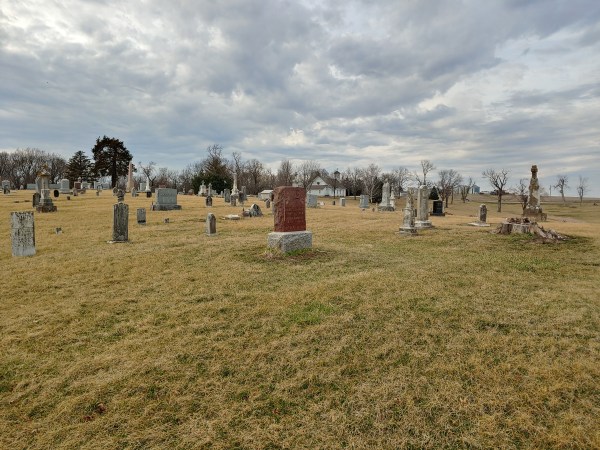
St Patrick’s Cemetery, Irish Settlement

In 1863 a diptheria epidemic came through St. Patrick’s Irish Settlement. Diphtheria is an airborne disease, transmitted by coughs, sneezes, and saliva. Eventually a thick gray matter covers the back of the throat, making breathing difficult. Before a treatment the CDC states that it was fatal in up to 50% of cases. Today, it is prevented by a vaccine.

Often it was referred to in some variation of “The Strangler.” This may trace back to a breakout in 1613 in Spain. The Spanish would come to refer to this period as El Ano de los Garrotillos (The Year of Strangulations). In the centuries that followed, it was a leading cause of death among children.

In 1895 production and testing of a diptheria antitoxin began in the United States. This antitoxin was commonly in short supply, and it is reported that sometimes parents had to choose which child it was administered to. An outbreak in Nome, Alaska lead to the 1925 “Great Race of Mercy,” which brought antitoxin to the community covering 674 miles in five and a half days. This event is annually commemorated in a race now known as the Iditarod.

No sled dogs would come to the Irish Settlement.

20200317_175201-1.jpg

The Weil Stone

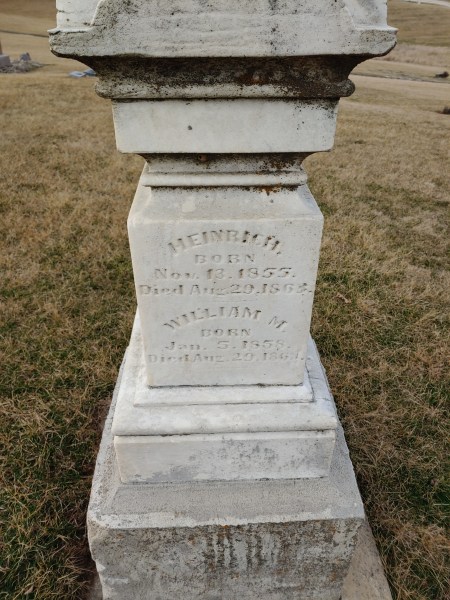
I became acquainted with the story as a kid, hearing John Connor tell of the family of Casper Weil.  In the midst of the epidemic, families dug their own graves, to save someone else from bringing it back to their families.  Heinrich Weil, age 8, died August 29, 1963.  His parents left to bury him at St Patrick’s Cemetery.  When they returned, another son ,William, 5, had died as well.   They had to go back.

Their son Thomas, age four, and daughter Mary M., age one and a half both died September 11th of that year.  The McDonnells would lose three children.  Roseanne, 8, died on April 14th.  Catherine, 16, and Ellen, 6, both died on April 25th.  Other families lost one or two children.   The Butler and McCusker families are also mentioned in experiencing great loss, but those graves are unidentified.

20200317_175402_HDR.jpg

The Harrington Stone

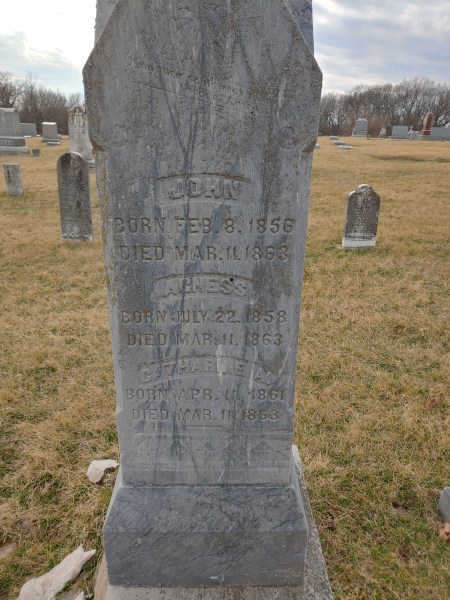
Not far from the Weil stone is one for the Harrington family.  J. and B. Harrington would lose three children on March 11th that year, John, 7, Agnes, 5, and Catherine, 2.  September 22nd, 1863 saw the birth of their son, Thomas.  The worry and fret that must have caused them would be difficult to imagine.  Thomas would survive the year and die in August of 1871.

Merriam-Webster says an epidemic “spreads over a wide are and many individuals are taken ill at the same time…,” and that a pandemic “affects an even wider geographical area and a significant portion of the population becomes affected.”

I suppose they mean ‘significant’ as in number, as though you were lofted above until people and places and times all looked the same.  Closer to the ground, the world is a little more personal than that.  Even if it isn’t the one you now know.


Some Things to Think About in Anxious Times

We are living in a remarkable time.  If you are anxious about it, one thing to remember is that everyone else is too, in their own way.  It’s a normal response.

We all  have our own things to work on.  There are a few things I think about when I know anxiety is heightened.  I would share them with you.  Perhaps some will be helpful.

How you feel isn’t necessarily a good indicator of how you are functioning.  You might feel like a mess.  At the same time, folks could see you as a source of stability and direction.

If you took a look around I’m sure you will see examples of how feeling good can provide a temporary solution while creating long term problems.  Perhaps that’s a consolation; perhaps it isn’t.  Regardless of how we feel, there are things we can try to keep our focus on.

“Gathering Information”  I often repeat this mantra to myself.  Can I begin to start gathering good, reliable information about the situation at hand?  Can I distinguish my thoughts from my feelings?  Can I separate what I know from what I assume?  Can I look critically at my own assumptions?

Intensity can get in the way of that.  I know.  I’m a passionate guy.  It has its pluses and minuses.

Let’s say you and I were looking at the world through our own telescopes, which we are.  Pick one thing.  Focus in on it.  What just happened to the rest of the picture we saw?

We tend to think passion is superior to disinterest.  When we are upset, we tend to see the world in a way which justifies the upset.  Unchecked anxiety complicates solving a problem as much as indifference does.

“Curious Interest”  This is a principle that serves me well, if I can remember where I put it.  Can we approach things more from a point of curiosity?  Can we discuss them from that place?

Intensity in our conversation often keeps our conversations from reaching the full audience.  I like people who can get to a place of observation.  It has a calming effect and helps me think.

“Connecting with Family”  In the line of thinking I have chosen to follow, staying connected to, and working on our functioning in our family of origin is the best long term way to help process anxiety.  In anxious times I touch base with my parents and sisters.  I focus on keeping the conversation balanced.  I may or may not talk about what is bothering me.

Anxiety is like nuclear fusion.  Once started it feeds itself.  Talking about being anxious is self-replicating.

“Energy.”  A more benign way to think about anxiety would simply be in terms of energy.  It’s the energy that gets us out of bed in the morning, drives towards our goals, through the adversity that befalls us, and drives us to create.  If we are overcharged, it can keep us from those things.

I once heard anxiety described like a cow getting zapped by an electric fence.  Energy is transmitted to the cow, who lifts her head and bawls, and the rest of the herd is instinctively anxious though they weren’t zapped at all.  One thing we can chose to focus on then, is the anxiety we transmit to others.

“Managing Myself”  Do I need to bawl every time I get zapped?  What’s my typical reaction been in this situation?  Can I hang in there a little longer without reacting?  Can I lower my volume?  Can I redirect that energy?  Can I do a better job of not getting zapped?

Pick one goal, a little one, and work on it.  It could be less use of the f-word.  Personally, I like the word, so I generally pick to work on something else.

In all likelihood when we are upset, we probably phone the friend or family member most likely to feel our pain.  We’re right.  They do, just like the herdmates of the zapped cow.  What do you think we ought to do about that?

Is that conversation productive?  Are we simply the reinforcing whatever we are feeling and passing anxiety to someone who has enough of their own?  Reinforcing an emotion is like being lost in the woods and discovering we used the day’s energy to wind up back at the same tree we were at yesterday.

Can we move from talking to someone who “will feel our pain” to someone that will stay objective and help us think?

“Being Present and Accounted For.”  Shannon and I maintain two different houses.  We’ve talked about where she wants to be if we are stuck in them for awhile.  We’ve talked about how we would handle being without a job.  I ask her how she is doing.  I tell her where I am at.

We find plenty of time to still drop in a rut or two and plenty of time to get our asses back out.  It has led to some good thinking.  She was the driving force that got my ass off the farm to stock my notoriously empty fridge.

So how do I keep staying present and accounted for?   How do I want to manage myself?  Can I use the energy of the situation to move forward?  Am I connected to my family and working on my functioning?  Can I look at the scene ahead of me a different way or from another point of view?  Have I made assumptions that were in error?  Is there more information I could get?

None of it will feel easy.  It won’t feel that comfortable.  It shouldn’t.  We are in a remarkable time.  How it feels won’t always be a good indicator of how we are doing.

Manaus

The first thing I noticed in Manaus, besides the fences that were topped with razor wire and broken only by security gates, was a shop along our way selling bananas. It was 2 am, and an old man was asleep on a plastic lawn chair. A boy lingered near a counter. The shop was all open air and well lit by a couple of bright fluorescents. The lights, the old man, and the boy provided services, that a fence’s absence did not.

We awoke to meet our guide for the next two days in the city. He was small in stature, and rail thin. Under his clear, blue eyes his cheeks were deeply tan and glistened already that early morning in a mixture of humidity and sweat. His jeans fit snuggly, but he wore a simple cloth belt anyway and it hung loosely around his waist.  I would find him to be something of a philosopher, despite the occasional tourist trap accustomed to his trade.

On a small bus we would be introduced to the rest of the city which sat on the left bank of the Rio Negro, and our guide referred to as ‘The Capitol of the Jungle.’ Street side were more open air shops, speckled in pastels faded by time or besmirched in grime. These same colors, off hue, made their way back in the houses and shacks beyond. The brightest colors came from the occasional well tended flower and fresh graffiti.

In these shops were an arrangement of mattresses, cars on old stands in repair, various plumbing pieces hanging from ceilings in diameters too large for most to use, and more plastic lawn chairs. In one was a half pallet of brick and a few scant bags of mortar. On top of them were apartments augmented with shoddy wooden balconies lined in laundry.  Connecting it all were an array of wires and old satellite dishes.

From the streets out front the old gathered, the young played, and more entrepreneurs emerged selling unpackaged but assorted car chargers, waxed paper wrapped tamales with trapped moisture thrown in, and bottles of water which may have been filled for the second time. Near the man selling car chargers was a young woman with children holding a sign in Portuguese. It was hard not to believe they were all of the same family.

Down the alleys radiating from our street was a hodgepodge of deconstruction and building.  Both seemed to take place over such an extensive period of time it was possible to differentiate the going up from the coming down.  There were clusters of lumber shacks in places that looked like little more than tinderboxes.  In other areas they were made of brick, in a slapshod construction method which left seems only partially filled with mortar, which brought to mine the earthquake devastation one sees on the news. There were also church towers and domes and apartment high rises, anchoring all of it to a psuedo-stability in regards to time.

There was a bleakness to it. A claustrophobic feeling that comes when you follow an alley to its end. It wasn’t beyond the realm of possibility that the people here could be happier than our own. It did seem beyond the realm that they had more opportunity.

But this was all in old Manaus. On its west side were fancy gated communities, now topped with electric fencing and carpeted in green yards meticulously cared for. There were signs attracting buyers to the developments yet to come. Elsewhere in the city was a mix, with western infringement nearly always fenced like it was the night we arrived.

Before we left the blue eyed Socrates of Manaus, our bus had asked him to speak of his own time growing up there. Taking the mic, he spoke only of the ancient history of the place, going all the way back to clashing continental shelves. It was as though there were no distinction between the place and him, or he only a more recent manifestation of it.

“We are square,” he concluded; “the world is round.” As true in a gated community as it is in the alleys of old Manaus.

Swimming Lessons

They sold headstones directly in front of the place where I took swimming lessons as a child.  We drove past them to get into the driveway.  Some youth learn to swim in playful eagerness.  This wasn’t the case for me.

Oh I could doggie paddle, fetch a ring on the shallow end, and pee in the water unnoticeably with the best of them.  I just wasn’t much for crossing the rope where one could feel the bottom slant away.  Leaving the pool made my legs feel like they were wearing concrete galoshes, a feeling that lingered all the way out to the end of the diving board.

There was a bikini clad college girl that instructed us.  She’d tread water in front of the board, and point to the spot she wanted you to jump to.  Seeing I was nervous, she pointed to a spot right next to her.

Seeing as how I was nervous, I tried to jump into her lap.  My hand got a hold of the center of her top, and my momentum and those concrete galoshes took the top to her waist.  I managed to survive as the neighbor kid behind me enjoyed the highlight of his young life.

I have no idea what test certifies you as a swimming instructor, but saving a young boy, while treading water as you put a top on, is unlikely to be a bad substitute.

Yes, being worried can obscure the opportunities life presents us with.  It’s hardly as effective, though, as being comfortable.

At 43 I’m still wont to feel as though life is supposed to be easier and more comfortable.  Yet at 43 I’m continually reminded that if what I wanted was ease and comfort, there is an off ramp of some kind or another every mile, thanks to modern technology and affordable booze.  But if we want to get what we want, difficulty and discomfort is what the way looks like most of the time.

Times that don’t delight us, may serve to delight others.

That instructor, pointing in the water, was entirely comfortable.  After me, she learned something she could have learned no other way.  She probably wasn’t quite as comfortable after that, and I bet that turned out to be a good thing for everyone except the neighbor kid.

I have no idea how you get certified as a life coach, but letting people know most of life is trying to do your job while treading water and keeping your top on probably has surely got to be part of it.

But what do I know?  I still can’t swim.

Japan and Agricultural Policy

Early last fall I had the opportunity to travel to Japan as part of the United States Meat Export Federation’s (USMEF) Heartland Trade Mission.  We were a group of thirty or so.  A few weeks after doing so, I sent a brief report on the trip to Iowa Farm Bureau.  In the months that have passed, I still think about the experience, and it still shapes my thoughts on ag related policy.  I’d share some of those with you.

The Foreign Service Officers attached to the US Embassy in Tokyo, highlighted the high subsidy rate of Japanese agriculture and underscored the difficulty Japan is having in attracting the next generation back to their farms. Subsidy rates and the willingness of people to participate in farming has come up on most of the trips I’ve take overseas.

It was mentioned during the Ukraine Market Study Tour by a Dutch farmer telling us why he left his home. It was mentioned by his fellow Danes whom I shared lunch with during their tour of Iowa.  It was mentioned in Austria on a trip down the Danube valley.

Subsidies sometimes meant to help farmers be “sustainable” are actually undercutting the sustainability of those very farmers in places.

We saw beef carcasses auctioned at a packing plant in the middle of downtown Tokyo. On the cattle side it left me thinking about all the discussion on market structure and pricing that is taking place here. There, the Japanese grading system offers value well beyond prime.

It does so in a country with a birth rate so low the population isn’t replacing itself.  There is a high number of single person households.  From beef to produce, their grocery market is more differentiated, and each variation seems to offer different elasticities of demand.

Beef is no longer just beef.

The demographics aren’t just particular to Japan.  The US birth rate is dropping.  A generation is emerging that places a great deal of value on experiences.  In comparing the Japan and US markets, our current level of differentiation has a ways to go and have a lot of value yet to be discovered.

It isn’t just the characteristics of the product that determined value.  It was also the characteristics of the brand.  The most common theme on the trip, be it in talking with an importer, a processor, or a retailer, was the continued evolution of branding.

Is furthering the development of a brand any different than furthering the development of a story?  Doesn’t it equate to developing value as much as the development of our product does?

USMEF’s role in matching the right product, at the right quality level, with the right story can’t be understated.  I wish everyone that raises beef back home got a chance to see USMEF’s work with their product overseas.  Critics will point out we only export 13.5 percent of our beef, and this is true.

But I’d like to point out that 95% of the world’s population lives outside the United States.  In the next 10 years the Asian middle class will swell to be 10 times population of the US.  They’ve demonstrated a desire to emulate Japan’s appetite for US beef.

Some critics back home also say the value of these export efforts aren’t reaching the producers raising the animals.  This in spite of the fact that the export market added $320 per head in market value last year.  They argue the promotion of our product should be outsourced more to others in the industry.

It is as though the other segments of the industry aren’t going to pass the cost of their having done so back down to us.  The real fallacy, however, lies in the turning over of our story to someone else.  Letting someone else tell your story usually makes you a character in their story.  Once you’re a character in their story, you lost control of it.

In my third time to Japan, I still haven’t heard much about individual animal traceability.  What they seem to want is traceability of a brand.  What I want is that story coming back not to characters, but the real people that raise the product.  It comes back to them because they are the ones telling the story for themselves.

Here we are abuzz with talk about alternative proteins.  They weren’t something Japan was talking about. It surprised me, particularly because of their low self-sufficiency in meat products, but then again, they have a stable government, relatively high income, and a consumer focus on quality.

When you look at the greater region, however, you see other countries with the same low self-sufficiency, but with less of the other attributes. If animal health issues continue to be a concern, alternative proteins might look to be a pretty stable way to keep a people fed.

Speaking of stability, I would mention one story on trade. Ground season pork used to be a big driver for the US in the Japan market. The tariff situation complicated it. Even with a new trade deal on the horizon, that complication won’t go away. The Japanese found another source for their product in the purchase of a Canadian plant. They put some skin in the game, and invested in solutions that didn’t include us.

I think about this in light of the trade deal with China.  In the midst of the discussion of how many soybeans China will now buy, I think about the skin they may have put in the game with Brazil.  It would be hard for them to walk away from that.

If you think about it, they are part of that story now.  That’s a valuable thing.

Resolutions Revisited

Here we are, two weeks into January. Behind us, strewn along the short path of a few days, lie resolutions which have already separated themselves from our resolve. If they happen to be your resolutions separated from your resolve, perhaps it’s not too late to go back for them.

Not that you should listen to me. I’m not a New Year’s Resolution kind of guy. I never have been. But I’m writing because I did make a few resolutions for 2019, and they and my resolve have stayed together.

Why? I don’t know. I know I’ve had a little help. I also know I didn’t get too hung up on the word, “new.”

Sometimes we are so quick to leave the past behind, we refuse to realize the simplest of truths. The turning of a new year does nothing to discard the past. The past is present, like a school kid in the front row waiting to be accounted for.

Including it in the day’s roll call, gives us a better shot at seeing the present moment for what it is. My resolutions going into 2019 centered around the loss of Chasen Stevenson. A friend I’ve managed to think of every day.

In doing so I try to be a little more charitable in my humor, a little more business minded in my work, a little more informed on the issues of the day, a little more sensitive to the needs of others, and believe it or not, I try to talk a little less.

In trying to do these things, I try to bring the future a little into today. Altogether, I suppose that is what a resolution is. It’s an effort to bring both the past and the future a little more into the present.

When I’ve been able to do that this past year in my private life, in my time with Shannon, in my times with friends who didn’t know Chasen, and in a few times with those who knew him much better than I, I’ve stumbled surprised into the joy of the continued presence of a friend.

Perhaps to make a resolution work, we need to resign ourselves to being in three places, now.

A Couple Minutes, a Few Seconds, and You and the News

Last Sunday 60 Minutes ran a piece concerning livestock use in the pork industry. During the segment, which I haven’t seen, they interviewed a veterinarian. It’s been reported since that the actual interview spanned 80 minutes. 60 Minutes used less than two.

However you consume the news, you might wonder which two minutes 60 Minutes were likely to pick. Most would probably assume that they would pick two minutes that were representative of the rest. I would call that an interesting theory.

I have worked with reporters who have picked two minutes that way. I’d be lying to you, however, if that were how I summed up all my experiences. Sometimes the nuance of a story is boring.

As part of a leadership program, I was part of a group that got some advice from former Iowa reporter, Laurie Johns: the interview is always on, and sometimes, what people are looking for is a little spice.

When the Des Moines Waterworks announced their intent to sue three drainage districts in northwest Iowa, I attended the public meeting they held. A local television station wanted reaction from farmers about the decision and myself and another farmer were interviewed. We both served on our local Soil and Water Conservation Boards.

The other farmer went first, gave a great interview, and became the one who had his clip broadcast on the evening news. I had a chance. I suppose I squandered it. I’m thankful for that.

The reporter was a friendly guy, making small talk as we both stood turns to stand in front of the bright light of the camera. The camera guy, for his part, said nothing. He would have blended perfectly into the background, were it not for his assistance in getting the microphones hidden beneath our shirts.

When I had concluded my interview, the reporter said, “Okay. I think we got it.” The cameraman switched off the bright, blinding light that was atop the camera mounted on its tripod. He stepped out from behind it and walked my way to again help me with the mic. This time, he finally spoke.

“Just between the two of us, this is really about that crazy Bill Stowe guy, isn’t it?”

The late Bill Stowe of the Des Moines Waterworks was a popular figure for many in Iowa. He remains so. Still he wasn’t without controversy for some. The light was off, but I’m willing to bet the camera was on, just as the mic still on my collar.

I didn’t make a smart-ass joke, and I didn’t go along to get along. I simply told the truth. “I think people are concerned about water quality, and they want to know it is important to us as well.”

That tends to be a boring enough fact to kill any interview. I handed him my mic. I thanked him for his time, and I walked away knowing he would have gutted me to give that story a spin that would sell.

Amidst the complexity of our own life, we turn on the news in the belief that what’s going on in the world can be summed up in a 20 second sound bite, scarcely giving those of our tribe a second thought, or those of another the benefit of a doubt.

Laurie pulled back the curtain and gave some free advice that experience would have charged me for.