Old I Know it Older Still

20171123_0746051635612142.jpg
Beneath the leaves that lounge today,
lay a dirt road yesterday
that dead ended at the bottom of the hill
at a pasture that lies there still.

It used to be a full fledged road,
No recollection, just what I was told,
As kids we had only known it old.

The trees arched to hem its bald dirt crown in.
The county graded the furrows from its brow.
There was no Botox then like there is now.

Down it once came crashing the tomboy neighbor girl,
her bare feet off the pedals coming down.
“I can’t stop, I can’t stop,” she yelled.
She hit the gate so hard it made her brother cry.

The traffic of youth,
the farmer’s old pickup,
once kept the grass at bay
but trees sprout now
beneath leaves October dripped.

You Have to Live for It

The old man always asked his graduate students, “What is one thing you would die for?” I smiled when I first heard about it. I could imagine being a grad student of his.

Some would try for the answer they thought their teacher wanted. Some would look for the one that would set them apart from the rest. Some would just try to come up with an answer at all.

Today he would be pegged as an idealist. Why shouldn’t he be? There seems to be no shortage of those ready to be a martyr in these anxious times. Any old hill looks like a fine one to die on, and the only thing better than finding a hill is finding a crowd to witness it.

We all want to be part of something bigger than ourselves, and bleeding for such seems to offer us the prospect of fulfilment. Perhaps we adopt the principles of our groups as our own.  Perhaps we confuse our membership with our identity.

What if you and I are bigger than our causes? What if we are making ourselves less and not more? Why is fulfillment still so elusive? What if we are nothing more than crusaders?

The funny thing is that the old man wasn’t an idealist. He believed a theory was only as good as its most recent test. That fulfills the definition of a pragmatist. And what is a pragmatist but someone who can let go of a principle without letting go of themselves?

There are causes surely worth our martyrdom, but the trick seems to be that once we find what we would die for, we have to live for it.


The Butterfly Effect

From time to time on my blog you will see posts about the collaborative effort set forth for conservation in our state by the Iowa Nutrient Reduction Strategy.  I bet you have also read about the hope I and many have that in working to fund and advance the strategy, we’re working to not only address the concerns of today, but we’re building a better framework for the concerns that will arise tomorrow.    A framework that can take another step beyond an out-dated, inefficient, ubiquitous regulatory approach towards conservation concerns.  A framework that can be modernized to include a more collaborative effort, more flexible and more targeted, customized from a menu of options to more closely align with that which is in all of our best interests.

One can already look at conservations issues beyond water quality where that sentiment is taking hold.

If you are like me, you’ve probably noticed quite a few large, monarch butterflies roaming about in the heat of the last few days.  I seem to notice more this fall than I have in years past.  If so that’s great news, and keeping that trend going is the work of the Iowa Monarch Conservation Consortium.  It is made up of 40 members working to help with the recovery of the eastern monarch butterfly population.  It officially began back in 2015, though the desire to bring it about goes back farther.  Members include conservation groups, state agencies, farm groups, universities and agricultural business partners.  Earlier this year, the consortium put forth a 135 page document outlining their strategy to keep the eastern monarch off the national endangered species list.

Monarch Butterfly Video

The eastern monarch butterfly overwinters in Mexico on a specific tree known as the oyamel fir.  The fact that they return each year to the same trees is remarkable not only due to their completion of a 2500 mile journey,  but also in that the monarch that returns is the fourth generation of the one that left.  Along their way north then south again, the monarch caterpillar will only feed on milkweed.  As crop production techniques have advanced, milkweed, traditionally seen as its name implies, has suffered.

Part of the consortium’s work here in Iowa is to come to a greater understanding of the butterfly and all the factors that come into play affecting its population numbers.  Part of the consortium’s work is also to reintroduce milkweed into the landscape.  At one time, the previous federal administration felt 7 million acres were needed for such a purpose.

Iowa plays a pivotal role in these efforts.  An estimated 40% of the monarch’s that overwinter in Mexico come through Iowa and its surrounding midwest states.  Focus has been placed on using “pollinator habitat” in existing Conservation Reserve Program tracts, buffer strips along streams or livestock buildings, borders along field edges, roadways and other local initiatives in Iowa communities.

According to Stephen Bradbury, an Iowa State University ecology and entomology professor who works with the consortium, these small patches here and there will actually do more good than large scale plantings.  It’s in keeping with the monarchs natural tendency to congregate on field edges, and it may have an added benefit in helping fight herbicide resistant weeds.  According to a Des Moines Register article, Iowa leads the way with 623,000 acres in pollinator habitat, and the Register reports that last year another 1.9 million acres were in the process of being created, with farmers kicking in $55.3 million to do that.

You can find out where the butterflies are along the route using the consortium’s website located here.  Populations are kept track of in a couple of different ways.  Surveys are conducted along the migratory route as an estimate, and when they return, the area the monarch cover is measured.  In 2013 the monarch covered a record low 1.66 acres.  In 2014 it was 2.8.  In 2016 they covered 10 acres.  This year winter storms dropped the number to 7.2.  While unfortunate, it along with the illegal logging of monarch habitat in Mexico show there are other factors affecting monarch numbers beyond milkweed.  While there is a long way to go on the road to recovery, people across the monarchs route are coming together in the effort.  Visiting the consortium’s website, you can find out how you can become involved to.

 The Gatekeepers 

A few blocks away, behind an array of buildings, stood the stainless shine of the Arch along the mighty Mississippi.  Often referred to by the name of the city it is in, it’s formally known as The Gateway Arch.  A gateway with no gate.

We were in town to see a Cardinals game, and a mere two blocks separated us from Busch Stadium.  On the sidewalk along South Broadway, just outside of the Hilton, we were joined by a St. Louis Police officer in a blue athletic polo.   Crosing Walnut Street a Missouri State Policeman joined in.

The two had a singular focus.  It seemed to lie up ahead and just off to the left.  Soon we came upon a squad car.  The female officer who drove it had the passenger door open towards the sidewalk we were on.  Her feet were set in a wide stance, and she crouched slightly behind the V that was formed between the door and the car.  Seeing our companions, she rose briefly to speak in the ear of the metro cop and then turned back to where she had stood before.

Looking with her, I finally saw what the hubbub was about.

On the far side of the street and half a block ahead, a sign emerged from the crowd of people making their way to the ballpark.  It was light green with a hint of purple splashed across its top.  Standing in dark letters were the words “God Hates Fags.”  Instinctively I looked away.  Then I forced myself to look back.

Other signs were with it, and beneath them stood half a dozen members of the Topeka, Kansas based Westboro Baptist Church.  Across from them stood the stadium.  In it the Cardinals were about to hold their inaugural Pride Night.

A steel barricade had been put around the handful of members that stood in front of a parking garage.  15 to 20 officers in blue polos stood beside them, many with bicycles.  Around them stood a crowd.  I again looked away.  This time for good.

Among the other signs Westboro is known to sport are:  God Hates Jews.  Priests Rape Boys.  Thank God for Dead Soldiers.  I didn’t happen to see any of those signs that night, only the sentiment, I guess.

They boast they protest six events a day, ranging from ballgames and concerts to deployed soldiers’ funerals and the funerals of LGBT victims of violence.  They have been frequently sued, and while lower courts and state legislatures have tried to take action against the group, the United States Supreme Court, in an 8-1 ruling in Snyder v. Phelps, decided with the group on protected free speech.  The sole dissenter with Justice Samuel Alito, perhaps the most conservative justice on the bench today.

The Church’s most famous leader, the late Fred Phelps, knew his way around a courtroom.  Besides being a preacher, he was a civil rights attorney, and his daughter maintains that his law firm once made up 1/3 of Kansas’ federal docket of civil rights cases.  Twice he was recognized for his work on behalf of black clients.

He never seemed to have made any profit from it, selling vacuum cleaners at one time on the side.  He would eventually go on to run three times as a Democratic candidate in the primary for Governor of the State of Kansas and once ran in the Democratic primary for US Senator.  In the 1992 Gubnatorial Primary he garnered 30% of the vote.

By nearly all accounts, Phelps was known as an asshole of epic proportion.  The church, which claims a mere 40 members today, most of whom are Phelps’ extended family, seems pleased to continue on that tradition.  In the opinion of the author, they do a fine job.

Across from the Westboro Church in Topeka, Aaron Jackson, who founded a nonprofit organization called “Planting Peace,” purchased a residence in 2013 that was then painted in rainbow colors and dubbed the “Equality House.”  It has been reported that in September of 2013 Phelps offered support for those behind the house.  He was promptly excommunicated by Westboro.  Two family members maintain in the aftermath he quit taking care of himself and neglected his own nourishment until his death six months later.

A granddaughter emphasizes Phelps story is a real life example of how even the most hard hearts can change.  Perhaps she’s right, but it is hard to tell if Phelps’ main affliction was a hardness of heart or simply being an asshole.  In the end, he appears to be a victim of who most are a victim of:  himself.

Photo credit: KMOV, St Louis

There on Broadway the counter protesters confronting Westboro hoisted signs of their own, some rather ingenious.  In the park we settled in to watch the game.  Our hotdogs were heaped with pastrami, and our glasses were full of alcohol.  My mind was still full of what I had seen outside.

I thought of those persecuted for who they are, but I really didn’t think of those that stood up to Westboro, facing what I could not.  Nor did I think of the idiots from Topeka.  As I looked at the Arch, what I thought of were the cops.

LGBT, Catholic, Jewish, veteran, standing there beside those they might not want to.  They couldn’t look away, and they couldn’t respond.  They weren’t there to protest hate.  They were there to serve and protect.  Perhaps it is hate’s best antidote.

In the end they laced their bicycle tires together, gating the protesters from the crowd so they could get to their cars and go home.  Home is a place where many along the sidewalk probably slept with a clear conscience that night.  I wonder how the cops slept?

The Cardinals lost.  The crowd went home.  The Arch stood in the dark still open.  Perhaps it is the counter protestors that keep it that way.  Maybe it is the Supreme Court.  Maybe it is just the willingness of some to do that which they don’t want to.

Tomochichi

20170222_164431

The Gordon Monument

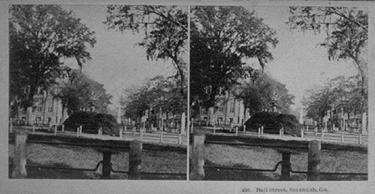
I have no idea if the gray squirrel let loose with a rebel yell when he stepped off the curb and charged onto Bull Street in front of Wright Square in Savannah, Georgia. Two feet in a car tire had struck him down, rendering the question largely moot. He said nothing now.

More tires had come, as if to drive the point home, and it was now nearly impossible to tell where the deceased ended and the road of progress began. I had wondered about his rebel yell only because his tail still stood erect, springing from the concrete. Was a final act of defiance or simply what happened once you were dead?

People walked by on the sidewalk, cars still rounded the street, and as near as I can tell the world went by without notice.

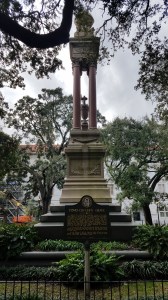
Had he crossed Bull Street and made the square he would have been in the shadow of the William Washington Gordon Monument. It rises 47 feet, and near its top four twelve-foot columns support four winged Atlantes hold a globe. It commemorates the life of the aptly named William Washington Gordon I, who presided over the state’s first railroad. It was to that distinction that the monument was built, albeit if it stands out of proportion to his current fame.

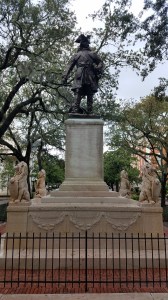
It wasn’t the first monument to be in Wright Square. To build it in 1883 they had to clear a pyramid of stones which dated back to 1739, when the square had been known as Percival. That was the year James Oglethorpe, the founder of the colony of Georgia, buried his Indian friend, Tomochichi.

Oglethorpe had personally carried him to the second of the four Savannah squares he had designed. He buried him there and ordered the grave marked with a pyramid of stones. In the process he created Savannah’s first monument.

Oglethorpe had planned for Savannah to sit on a 40 foot bluff that was home to a small group of natives, known as the Yamacraw, who were exiles from two local tribes. It is thought they numbered around 50, and beneath them, on the ship Anne, sat the 120 passengers Oglethorpe had brought with him. The English had no right to settle on the west side of the Savannah River, and Oglethorpe had no reason to think the natives would be amicable.

Historians place Tomochichi around 90 at the time of the meeting. He greeted Oglethorpe, expressed no offense, and stated a desire to have his tribe educated. Oglethorpe was 36.

He had crossed the ocean to found a new colony to buffer the existing English colonies in the north from the Spanish in the south. He had brought with him those from London’s debtor prisons. He was convinced what separated them from everyone else was that no one had afforded them a chance yet.

20170222_164007

James Oglethorpe

The leaders of the two bands of outcasts hit it off. Tribes never did think much of pragmatists. Fortunately, from time to time, they hold sway in a world beset with indifference to anything practical.

Oglethorpe settled, and in Georgia protected the Indians from the traders that had taken advantage of them elsewhere in the colonies. In turn Tomochichi convinced the neighboring tribes that Oglethorpe was a man they could trust. In time they did. Oglethorpe would go on to meet chiefs from much larger and more powerful tribes, but he never let any of them displace Tomochichi.

Some accounts suggest that in building the Gordon Monument remains were found. Some accounts say Gordon’s daughter had them transferred over 15 years later to a large stone she placed in Wright Square to re-remember the dead Chief. Some accounts suggest that the remains found were strewn all about the square. Others suggest no one even took the time to look.

Today in Savannah’s green and open squares, which now number 22, Spanish moss fancifully drapes itself over the live oak, indifferent to it all. Around many of those squares stand stately mansions, harkening to a different time, colored in earthy tones. Sometimes one thinks it is the bitterness of the passing years that have ate them to their marrow. Sometimes I think iy was the moss, sitting on high, belly full with its meal half ate, lazily waiting to come down and feast again.

A Hundredth Birthday

Tonight, in Winterset at the Jackson Building, the Madison County Farm Bureau will host its Annual Membership Appreciation Dinner.  In doing so we will mark 100 years of existence.  This morning the county caught a widespread drink, and I can’t think of a more fitting birthday present.

The organization began with the idea that strength was to be found in our coming together, which we could use to advocate for the way of life we have been blessed with and share in.  Along the way they built stronger relationships with those around them.  Some of those relationships pulled them away from their former selves and closer to the people we are all called to be.  As it was then, so it is now.

In going down the list of individuals who served as presidents of the organization, one sees the years that correspond to wars, droughts, a depression, and a farm crisis.  It calls to mind the anxiety of those present moments, which now belong to the past.  It does so as many of us today wait on pins and needles for our next rain.

Just as far back go the issues of conservation, regulation, property rights, and taxes.  As we have moved from farming with horses to global positioning systems to big data, we have picked up some new ones.  Ahead lie questions, just as they always have.

Will the state take the lead in developing a dedicated source of water quality funding?  Can we move from a regulatory to a collaborative approach on the fundamental concerns we all share?  How do we best navigate with the inherent risk associated with farming?  How do we connect with a consumer increasingly removed from agriculture?  How do we keep our members informed?

Many groups seem based on the idea that the solution is something to be provided by someone, somewhere.  The grassroots nature of Farm Bureau has maintained that to find solutions we need to bring people together to talk about their concerns, to share their thoughts and ideas, and make use of the best information available to collectively chart a course forward.  In marking our 100th birthday, we celebrate 100 years of being able to keep that perspective, and 100 years of bringing in folks from across the county to do that.

I am a poor predictor of the future.  I will predict, however, that strength will continue to be found in our coming together.  In doing so we will continue charting the course forward.  In doing so we will continue to enrich our lives.

The Pole Bender

Sometimes a man don’t know
When he’s supposed to walk away.

Heath

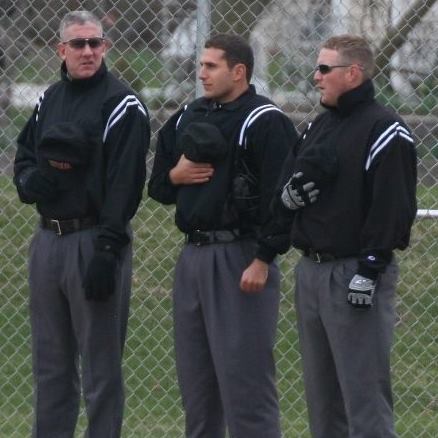
“Mad Dog” Joe Nelson, Pat Hoberg, Heath “Wild Man” Banks, back when they were fat.

“Hi, Terry,” said the MLB umpire leading us back to the elevator that would take us back to the seats of Kaufman.

“Hi, Pat.  How are you doing today?” said the coach with a fifth grader’s enthusiasm.

The umpire was Pat Hoberg.  The coach was Terry Francona of the Cleveland Indians.  We were on our way back from the field, where we had just been shoulder to shoulder with their All Star Lindor as he signed autographs for the kids at Kaufman.  It was neat to be close to a player of his caliber.  It was neat to find that caliber coupled with that humility.  But brushing shoulders with Francona, the coach who just been in the World Series without his two top starters and had managed his ass off only to lose in 7 anyway, was more than neat.  It was something a man could get swept up in.

“I enjoy getting a chance to get people down on the field if I can,” Hoberg had explained earlier as he stood along the fence of a press dugout.  His eyes turned from the field, as though he wanted to emphasize the point.  “It always impresses me how they look at it, wide-eyed and all that.  It reminds me to appreciate what it is I do.  I tend to just look at it as my job.  Sometimes I forget just where it is I work.”

The Indian taking BP crushed a ball just then.  By sound alone, Hoberg’s eyes jolted back and found it mid-flight, like he knew exactly where to expect it.  It sailed to center and was gone.

It’s a strange thing.  You know the ball will come down, yet the mid-flight feeling taps in to something eternal.  The presence of all things in a brief instant.

His eyes never strayed from the field of play again.  It was hardly some super-human quality.  It was simply his job.  His job was not to get swept up in it.

A couple of buddies had umped high school and college baseball games with Hoberg.  It was that connection that had brought me along.

“How did you come to ump with Hoberg?”

“We were umping a game, Joe and I, and the third ump hadn’t showed up.  We were needing to get going.  Joe had called Pat’s games when Pat was in high school.  He spotted him in the crowd and told him he was needed on the field.

‘I don’t know what the hell I’m doing,’ he said.

‘Sure you do.  Will cover you.  We just need the body.’

Turned out, he was pretty fucking good.”

“Do you have a favorite story?”

“Yea.  The three of us were calling a Carroll game.  They’re always good, and going into the bottom of the fifth they were up 8-0.  Two more and they would ten run it and end it early.

The catcher from the other team was a whale of a kid.  I could hardly see around him.  It was a bitch trying to call the plate.

This kid from Carroll was batting with a man on.   All of the sudden I heard that crack, and I knew he had gotten around on one.  Smoked it.  Problem was I had never seen the ball come off the bat.

I looked up and I couldn’t find it.  I had no idea where it had went.  ‘Fuck,’ I thought.

I glanced at Hoberg, and I could tell he hadn’t seen it either.  I looked over at the third base coach, and he had his arm out, pointing fair.  It was all I had to go on.  I put my finger in the air, ran them home, and Hoberg and I trotted off for the locker room.

We were talking about where we were going to get beer on the way home.  I was pulling off my shin guards.  That’s when he asked me where the hell Nelson was.  On cue the door bust open, and Nelson came in, face beet red and his eyes bulging out of his head.

‘What the hell just happened out there, guys?’ he asked, running his fingers through his scalp, exasperated.

Two run homer.  Walk-off.  10 after 5.

‘Walk off, huh?  Did either of you see the fucking ball?’

No.  All I had to go on was the third base coach.

‘Do you know why you didn’t see that ball?  You didn’t see that ball, because it was so far foul it’s sitting in a cornfield in Nebraska right now.  It’s a shit-storm out there.  Where the hell do you think I’ve been for the last twenty minutes?’

The shit storm outside wasn’t the worst part.  The worst part is that we periodically get reviewed, and there was a guy from the state in the stands that night.  Of all the damn nights…I spent the next few days waiting on a phone call.  It never came.

I ran into the guy a few weeks later.  I asked him, ‘Hey uh, did uh, did you hear anything on that Carroll game?’

He smiled.  ‘Yeah, I got a phone call wondering what the hell had happened over there.’

‘What did you say?’

‘I told him the truth.  Don’t really know what to tell you.  Damnest pole bender I ever saw.'”

The guy umping the umps hadn’t got swept up in it either.

“How did it end with you guys?”

“Joe had been to umpire school.  He mentored me.  When he thought I was ready, he encouraged me to go.  I didn’t make it.  When Pat came along, he followed our same footsteps, and then he just kept going.

The guy that taught Pat had went through school with me.  At night my phone would ring.

‘Man, I just don’t know.  I don’t know if I have what they are looking for.  I can’t tell how I’m doing down here.’

‘Oh my God.  This kid…he’s like no one else down here.’

I’d just listen, never able to tell the other where the other was at.”

“I used to think people knew how good they were.  Maybe everybody wonders.  Do you suppose Francona wonders?”

“I suppose he wonders how he is getting back to The Series again.”

“Maybe that’s the trick.”

“What is?”

“The trick is to keep going, home run or pole bender.  The ball will come down on its own.”

How in the World?

I suppose some think that to tell a story you need to invent it first.  It simply isn’t true.  Life will do it for you.  In a pinch, the life of others will work too.

“Where in the world did this idea of providing unconditional love come from?  Can anyone tell me?  This is how parents think they are to raise their children of late.  How has it become so widespread?

Has anyone ever asked themselves if this is something we, as human beings, can even provide in the first place?  Have we asked ourselves if it is really in our best interest to tell those we care about, ‘You can do whatever you want.  I will still love you.’?

When I think of a generation being raised with this mindset, I’ll be honest.  It scares the hell out of me.  I worry that despite everyone’s best intentions, it can be crippling.

There was a teen girl hospitalized in a mental health unit.  She refused to communicate with anyone.  A team of doctors oversaw her treatment, and each day, at the appointed time, they would go in and try to make her talk.  It was as though they could make a bean grow by pulling on it.

This approach yielded the predicted results.  The more they tried to make her talk, the more she resisted.  Eventually a new team became involved.  The woman heading this one up knew something about systems thinking.

She decided no one was to try and make the girl talk at all.  Instead someone would go in, an hour each day, and simply be present with her.  If the girl wanted to sit there in silence, they would sit there in silence, but they would remain present.

They persisted in this line of action for several weeks.  The mental health professional would sit attentively in a chair.  The girl would sit with her head down, arms crossed, and closed off.

Finally one day the girl rose her head, looked across the table, and exasperatedly asked ‘What?’

With little reaction came a simple response.  ‘What are your goals?’

‘Pfffft,’ with a roll of the eyes.  Head went down, arms crossed, and the session ended.  A week later she again asked, ‘What?’  Same exchange.

By asking the question, they began an internal dialog within the patient.  What are my goals?  What do I need to do?  What am I trying to accomplish?

They didn’t provide those answers.  We never help by doing for someone what they could do for themselves.  They also didn’t wash their hands of her.

Some therapy today is awash in delving into and swimming around in emotion.  It is as though a good therapy session is one in which we cry in.  It may feel wonderful at the time.  The question is does it help?

Focusing on goals introduces the idea that the best way to sail through life’s rocky seas is to chart our own life course.  We can do this by using and gathering the best information we can get our hands on.  We can do this by trying our best to recognize the anxiety life and our relationships generate for what it truly is:  energy.  Energy we can use to get there.

This is the path that teen girl was able to take.  No one wrote her off.  No one promised unconditional love.  In not telling her what to do, which includes telling her she didn’t need to do anything, they respected the dignity of the person.

In our own lives it must take a lifetime to make sense of it all.  I guess it is up to each of you.

A Game of Inches (and Partial Ones)

Towards the end of June I awoke one morning to an 80 percent chance of 1 to 2 inches of rain.  We really needed it.  Our last, significant precipitation had been a half inch a few weeks earlier.  It came on oats I had seeded down for cover in our cattle lots.  It was dry enough the half inch soaked right past them and never got them to sprout.

By 3 pm the chances for the day had dropped to 20 percent.  By the end of the day, they would be reduced to zero.  It had become depressing.

The Fourth of July brought inch and a half amounts within just a few miles of the farm.  For us, it brought a sprinkle.  The brown yard crunched.  The corn rolled.  Late soybeans remained the same height they were a month ago.

Now the extended forecast showed 7 days of 90+ degrees and no rain in sight.  I thought about the neighbors’ crops I drove past.  I thought about the neighbors.  I wondered how much more grass remained for our cows.  I wondered what it was we were going to do for hay.

It’s such a funny thing this day and age to be in a profession still held on pins and needles by the uncontrollable, and still unpredictable, weather.  A little like financial markets, I guess, minus much of a reason why emerging from the aftermath.

Last night, with the same 20 percent chance, we got half an inch.  It is nice to know it can do it again.

Parts of the state are much drier than us, and parts of the country are drier than them.  Perhaps we will have no more than a whiff of a drought.  A whiff is plenty.  Perhaps this half inch of rain will be short-lived.  This morning it is enough.

A Fifth of Plochman’s on the Fourth

Another figure looming large in the ability to properly tell a story is a cousin of mine.  He’s the most talented storyteller I’ve ever come across.  He especially shines when it comes to humor.

Most stories involve a cast of his friends, and mostly he refers to them by their last name alone.  It gives the audience a sense familiarity to those they may have never met, and supports a belief that were they to someday, they would be their friends too.  Nearly all tales include an incidental character whom will loom large in the story to come.  Whenever possible he somehow pulls out from the recesses of his mind this character’s full name, reinforcing the thought that whatever it is you are about to hear actually happened.

Employed in the story’s telling are phrases like “remember how it was…,” “you know how it used to be…,” or “it was a day not unlike today…,” and they serve like stitches, connecting the audience in the present day to the setting of the story and offers a sense of mutual recollection about an event the listener can’t recollect at all.  In some places, words are dropped altogether, replaced by replicated looks and gestures that ask that the listener supplying his or her own words, and permeated by the pauses that give them the time to do just that.  Soon, one is no longer listening at all.  They are there, in the story, as an active participant.

“It was the Fourth of July and Baker’s parents were having a party.  We were just out of high school, and the whole gang was there, waiting until it got a little darker and the adults got a little more intoxicated so we could make our own way to the keg.  A pack of vultures really.  Baker’s Mom’s Boss was there, and so was Baker’s Mom’s Boss’ Husband.  Guy’s name was Randy Peterson.”

“It was about this time of day,” he said, looking out on the day behind him.  “Everyone had been nursing a beer, except Randy Peterson.  He had his own tumbler, with a gold bracelet around one wrist, and a shirt unbuttoned a third of the way down, exposing a chest which already that summer had got too much sun.  He’d been mixing his own drinks.  He’s toasted.

He comes staggering over our way, and singles Baker out of the crowd.  He steps up to him and says, ‘(inaudible mumbling) I hear you (inaudible mumbling) like to wrestle,’ as his head bobbed to and fro.  ‘(inaudible mumbling)  Think (inaudible) you can take me (inaudible)?’

Baker said yes, he used to wrestle in high school, but ignores the rest of it.  Peterson continues to stand in front of him, and gives Baker a push on the shoulder.  His wife sees what’s going on and embarrassingly begs him to stop, ‘Oh, Randy.  Why don’t you leave those boys alone?’  Randy won’t be denied, though, and steps up closer to Baker and really sets in to pushing him around.

All of the sudden Baker grabs ahold of his shoulders and takes him down right there in the yard.  Everyone laughs, but by this point Baker is pissed off.  You see him for a split second gets his hand on the back of Peterson’s head, bite his lower lip, and really shove his face in the dirt, letting him know he’s about tired of fucking around and trying to get the guy to back off.  Then he lets them up.

Peterson is belligerent.  Comes at him again, and again starts shoving Baker around.  Down they go a second time.  This time he eats some dirt a little longer.  His wife comes over and pulls him away.

After awhile it is dark.  We’d all found an empty milk jug, which someone would haul over to the keg and bring back to divide among us.  We all drink way to much.

At some point Minella and I step in Baker’s house.  There on the sofa lays Randy Peterson.  He’s got his wallet hanging out of his back pocket, and with it is a patch of sod from the yard, like he was trying to stow away a memento of having come so close to getting his ass kicked.  I was making my way to the kitchen to raid the fridge and sober up.  On the bottom shelf I find a bottle of Plochman’s Mustard.

The little ones, the ones most people got, sat chest high on the shelf at Fareway.  But beneath them, if you remember, down at your feet was where they kept the big ones.  It was one of them.  I grabbed it and made my way over to Peterson, twisting the red tip open as I went.

Minella started giggling as I inserted the tip next to his wallet and squeezed.  I filled his pocket full and was giggling myself about how funny it was going to be when he reached for his billfold.  All of the sudden he moved.

We froze for a second, realized he was out cold, and I found my eyes drawn to the 3 or 4 inches of plumbers crack now exposed from the waist of his jeans.  I looked at Minella, smile, and then shoved the red tip of the Plochmans as far past his belt as I could get it.  I straddled his legs, and with both hands around the bottle I laughed out loud and squeezed for all I was worth.  I wanted to get every drop, and I continued till all I heard was the unproductive wheezing of the empty bottle.  I screwed the red tip back down, and placed the jug back in the refrigerator.

An hour later the remains of the party was moving inside.  With them was Randy’s wife.  Finding him passed out on the sofa, she shook Randy’s shoulders, woke him into a stupor, and told him it was time to go home.

‘Sure, Honey.  (inaudible)  Just a sec (inaudible),’ his voice trailed down the hallway as he staggered like a sailor to the bathroom door to relieve his bladder of the whiskey and Coke.  Minella and my eyes never left the door once he closed it.  The anticipation was killing us.  He lingered in there forever.  Finally, it opened.

If he staggered like a sailor going in, he was as sober as a judge coming out.  His eyes were so big around I had to bite my tongue to keep from laughing out loud.  He scanned the crowd, who hadn’t noticed him, and moved around the room like a kid afraid of heights on a balcony, shuffling along with his back to the wall.

‘Time to go, Diane,’ he says, clear as bell, adding a wave to everyone as he continued to work his way around the room.  Poor guy had to have thought his liver had gave up the ghost in his pants.

I often think about that car ride home must have been like.  Did he tell his wife?  Was he praying a silent litany vowing to God that he would never drink again?  Did he make a doctor’s appointment?

Mostly I wonder if he ever came to appreciate the humor of what it was that had just happened.

Minella and I woke the next day sprawled out in the living room, with Baker’s Dad fishing a left over brat of the fridge.  In his hand was that same jar of Plochman’s.  He hoisted it above the brat, and all it produced was the same wheezing sound it had ended the night before with.

‘Sumbitch.  Who the hell used all the goddamn mustard?’ he shouted.  He tossed it in the trash can, and I breathed a sigh of relief that the little red tip had never touch his breakfast.”

I had become uncertain whether or not I would wet myself.  I wasn’t sure when I would breathe again.  Taking in the present company, in the throes of laughter, what I was certain of was that I had witnessed nothing short of magic.  It was like lightning in a bottle.