Getting Out of the Box

On her wall was a butterfly collection, boxed in a simple frame with a black backing.  Pinned there, each was varied, beautiful in their own right.  They were also all dead.  That was the thing that separated them from us.

“So how does it feel to be vigorously dating?” she asked.

I smiled.  “That’s quite a combination of words.”

“It’s true isn’t it?  You said you’ve been out on more dates the last several months than you have in the rest of your life combined.”

I shrugged.  “Vigorous just makes it sound so action-packed.”  She smiled too.

“What have you learned out there?”

I thought for a moment.

“I hear people tell me repeatedly that they are looking for something different.  They also seem to be generally looking for something easy and comfortable.  I wonder if anyone appreciates the role the latter plays in not getting the former done.”

“That’s an excellent observation.”

“You get the credit.”

“How’s that?”

“Last time we spoke you asked about the gals I meet and find great respect for but don’t pursue.  I told you that for some it had to do with a lack of spark.  You asked how that spark thing had been working out for me.  I laughed.”

“I remember that.”

“Anyway, I think you were right.  Things feel comfortable and easy when they are familiar, and I think that familiarity has a lot to do with that “spark” everyone is talking about.  Some act surprised about how things turn out in their relationships, how the same situations repeat themselves, but should we be surprised that our emotions lead us to familiar turf?

We argue that the feeling in the beginning is different this time, yet our repetitiveness in which we fall for it makes it the same.”

“I think you are learning a lot.”

“If I’m learning, it will be reflected in my choices, right?  And to find out, we need to get out there.  I might have learned something else.”

“What’s that?”

“Hope is a comfortable feeling.  It lets us believe if we keep choosing the same thing, somehow it is going to be different.”

“Maybe that’s a good topic for future thinking.”

“I’ll never have kids, you know.  If I did, though, I’d want them to learn how to get used to being uncomfortable.”

“Why?”

“It’s the only way out of the corner we all paint ourselves into.  It’s how we are rewarded for discovering something more new about ourselves, what we believe, and about others.”

“Do you think you can do it?”

“I think that is something worth hoping for.”

“So what are you going to do now?”

“I reached out to someone I dated in the past.  I told her I’d be curious what would happen if we continue to hang out.  I think she knew then all the things I’m talking to you about now.”

“And you didn’t realize it then?”

“No.  How would I?  It’s impossible to tell anyone something their ears aren’t ready for.”

“Did you hear back?”

“Yes.  She’s happily seeing someone.”

“I’m sorry.”

“I’m not.  She’s a great gal.  She said something curious, though.”

“What was that?”

“She told me I should write a blog about men dating.”

“Sounds like a fantastic idea.”

“Action-packed, I’m sure.”

Nostalgia and the Boogey Man of Industrial Agriculture

I was in Madison County.  Katie Olthoff was speaking.  While she works for the Iowa Cattlemen’s Association, she and her husband raise turkeys.

( Katie’s own blog:  http://www.onthebanksofsquawcreek.com/ )

“We got the opportunity to put up a couple of turkey barns.  This was huge for us.  My husband would be able to leave his job with benefits and farm full time.  We would be able to create something the boys would have the chance to continue.  It was exciting.  I was proud of what we were doing.

I would share the story with the people I knew.   Some asked me how many we would raise.  I told them 120,000 birds a year.  That’s when I heard it.  ‘Oh, it’s a factory farm then.’

I didn’t understand what they were talking about.  It’s not a factory.  It’s our family.

Factory farms are like the monster under the bed my boys are afraid of.  You grab the cover, pull it back, and show them he’s not there.  He doesn’t exist.  We show people our farm, and then they understand that it’s not a factory. But they still believe factory farms are out there somewhere, just like my sons believe the boogey man is going to get them as soon as I leave the room.”

 A month later I was sitting in a waiting room.  I picked up DSM Magazine and began to read their article on Bill Stowe, general manager and CEO of Des Moines Water Works.  I thought of Katie.

The article begins immersed in the nostalgia of Norman Rockwell’s America.  Nostalgia is simply the boogey man’s more attractive sister.  We do the present no favors in remembering the past better than it was.

In Norman Rockwell’s actual America, many of today’s conservation practices were non-existent.  Fields were plowed and worked repeatedly and laid bare over the winter.  Terraces were rare, and so were farm ponds.  A wetland was the piece of ground your Grandfather just hadn’t drained yet.  Buffers and no-till were unknown.

The technology revolution some abhor brought all of that to agriculture.  Farm families have been figuring out how to adopt them ever since.  Living and working in the Badger Creek Watershed, a farmer-initiated watershed going back to the 1950s, I get a chance to see that evolution everyday.  Everyday I’m reminded of the work left to be done.

Stowe maintains modern agriculture is the problem.  I’ll maintain modern agriculture, much more so than that of Rockwell’s, is part of the solution.  Modern agriculture has changed not just how we farm.  It invests continually in making scientific assessments about the impact we are having, in finding flexible, non-bureaucratic solutions, and the funding needed to bring them to fruition.

It seems that the smart, affable man at the Des Moines Water Works, who admittedly looks back in nostalgia to Norman Rockwell, also looks back with nostalgia to the environmental policy of the 1970’s.  He can look as he chooses.  It is a policy, however, both the regional administrator of the EPA and the current US Secretary of Agriculture seem eager to move beyond.  Farm families are too.

At the end, Stowe speaks of social justice.  It is an interesting term to throw out by a man repeatedly using the term “industrial agriculture,” a term which serves to dehumanize those engaged in agriculture today.  His own Des Moines Water Works Lawsuit seeks damages from 10 drainage districts which make up a very small part of the Raccoon River Watershed.  These districts have no way to raise funds, save from the few farm families that make them up.  Where is the social justice in that?

Among their few numbers, we will not find the boogey man that is industrial agriculture.  I know he’s not under my bed.  If you pull the covers back, you’ll find he isn’t under yours either.  Mr. Stowe seems convinced he’s at least under his.

The Last One (The Virgin of Cobre)

Why did they make birds so delicate and fine as those sea swallows when the ocean can be so cruel? She is kind and very beautiful. But she can be so cruel and it comes so suddenly and such birds that fly, dipping and hunting, with their small sad voices are made too delicately for the sea.

The Virgin of Cobre is a statue of the Virgin Mary, found floating in the sea by two Indians and a slave in 1608 off the coast of El Cobre, Cuba.  She has nothing to do with baseball, save for the fact that the two seemingly makeup the background in Hemingway’s The Old Man and the Sea.  We often assume the background to be of less relevance.  Perhaps we shouldn’t with Ernest.

In his book, some critics point to an absence of women, believing it underscores the lack of regard the author had for them.  There are actually several.  There is the old man’s deceased wife, whose former possessions are described as relics and whose image is shrouded in the cleanest thing the old man owns.  One of those possessions is an image of one of the other women in the book, the Virgin of Cobre.

The statue was found perfectly dry, floating on a board on which was inscribed, “I am the Virgin of Charity.”  Charity meant something different then.  It was the virtue by which we love God above all things for his own sake.  The King James Bible translated the famous passage in 1 Corinthians 13:13 as, “And now abideth faith, hope, and charity, these three; but the greatest of these is charity.”  King James opted not to use “love,” knowing perhaps the slew of things we all mean by that.

Hemingway’s old man, Santiago, has faith.  He has hope.  Perhaps his most admirable quality, however, is the charity he endures with.

In 1630, the statue would replace the patron saint of Spain, St. James, or as he is known in Spanish, Santiago, atop the altar in the church at El Cobre.  In 1928, she would get an entirely new house altogether.  Beneath the display of the Virgin of Charity in today’s El Cobre Basillica, is a room housing the gifts left for the Virgin’s intercession to the Almighty.  Some of them were given as part of request.  Some were a token of thanks.  Among them is a 1954 medal for the Nobel Prize in Literature.

You are killing me, fish, the old man thought.  But you have a right to.  Never have I seen a greater, or more beautiful, or a calmer or more noble thing than you, brother.  Come on and kill me.  I do not care who kills who.

Fideli Certa Merces (Part III)

In 1951 Ernest Hemingway might have been considered to be something of a has-been when he sat down to write The Old Man and the Sea.  He wrote it in eight weeks, about a washed-up fisherman who idolize a great baseball player who was at the end of his career.  It was also about faith.  When published in 1952 it would take his fame beyond anything he had known.  It would be his last major work published in his lifetime.

The exploits of Joe DiMaggio and his New York Yankees make up the background of Hemingway’s book like white noise, though there is much that’s missed in the intricate details Hemingway wove in.  Because of the box scores, it seems you can pinpoint the time of the book to a particular season, and with that you can estimate the age of the character the old man refers to as a “boy.”

Books are like people.  You can read all kinds, but it will take a lifetime to know one.

Resized_20160817_192813

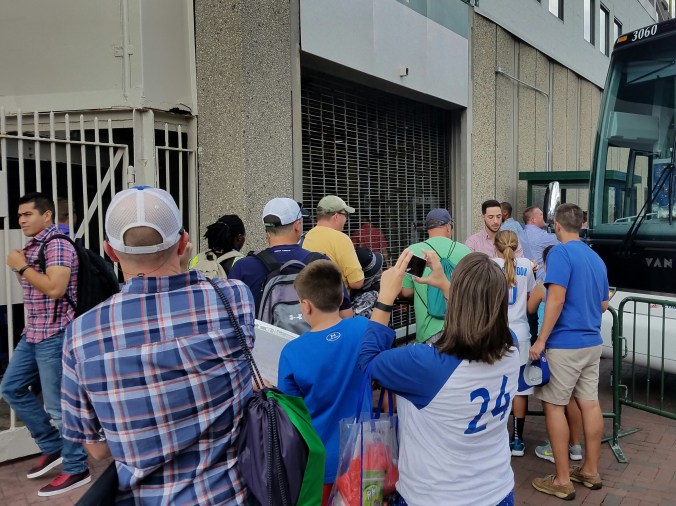
The Brewers bus had come and gone, and we walked over to the opposite side of Wrigley so the girls could try for an autograph from a Cub or two.  I was with a high school friend.  The girls were his, and despite how much they hoped, no players would sign.

Their father and I nearly rubbed shoulders with Theo Epstein.  The girls wouldn’t have known who he was.  We did, but he looked busy.

It was getting late in the afternoon.  In a half hour the gates would open.  The diehards were already in line for the bleachers.

“I bet they have tickets available,” I said.

“God, I’d love to go again,” said he.

“They do.  I just looked it up.  My treat.”

“I afraid the youngest might revolt.  She has her heart set on deep dish Chicago pizza.  Why don’t I take her, and you take my oldest in.”

“Are you sure?”

“Are you kidding me?  You’ve seen how she’s been the last hour.  Do it.”

At the ticket window I bought two tickets just off the end of the Cubs dugout, ten rows back.

“You still got that ball Braun signed?”  I asked.

“Right here in my pocket,” she said.

“Let’s see if we can get a few more on it.”

“I’m going to get one from Ben Zobrist.”

“How do you know that?”

“Because he’ll come out by the dugout again, right after the game, just like he did last night.  This time I’ll be there when he is.  I just know it.”

When the gates opened we found our seats, and she headed down by the infield to get autographs from the pitchers.  Aroldis Chapman dwarfed her and the ball his hand engulfed.  I worked on a bag of peanuts, sipped a beer, and talked to the man occupying the only seat to our right.

“Your daughter?” he asked.

“No.  My friend’s.  Her younger sister opted for pizza.  She opted for autographs.”

He smiled.  “I see she’s getting a few.”

“She’s not bashful about it is she?”  I observed.

An hour before game time they scattered the kids from the wall.

“What do you want to eat, Boss?”

“I can’t eat another hot dog.  I had one last night and one for lunch today,” she said.

“One more wouldn’t hurt anything,” I smiled.  “I saw burgers, though, and chicken tenders.”

“Chicken tenders sound good.  I’ll get some.”

“I’ll go with you.”

“I know where they are.”

“Need money?”

“I got some.”

I let her go, as though she were on her own, and then lazily followed behind to get an Italian Beef.  My Cardinals have a great item with the Killer Pastrami Dogs you can get at Kohn’s Kosher Corner right behind home plate.  But they are only second to the Italian Beef found at Wrigley.   Together the chicken and the beef would be joined by super rope licorice, ice cream in a Cubs helmet, a Bud Light (also mine), two souvenir cups of pop, and a bottle of water.  In between we talked baseball, the day behind, and her belief in Zobrist ahead.

When the game ended, she made a bee line for the other end of the dugout with me in tow.

“I’ll wait for you here,” I said.  The day before was a double header.  It was getting late.  I had my doubts on Zobrist, but she was happy and I didn’t figure she needed to know how the world worked yet.

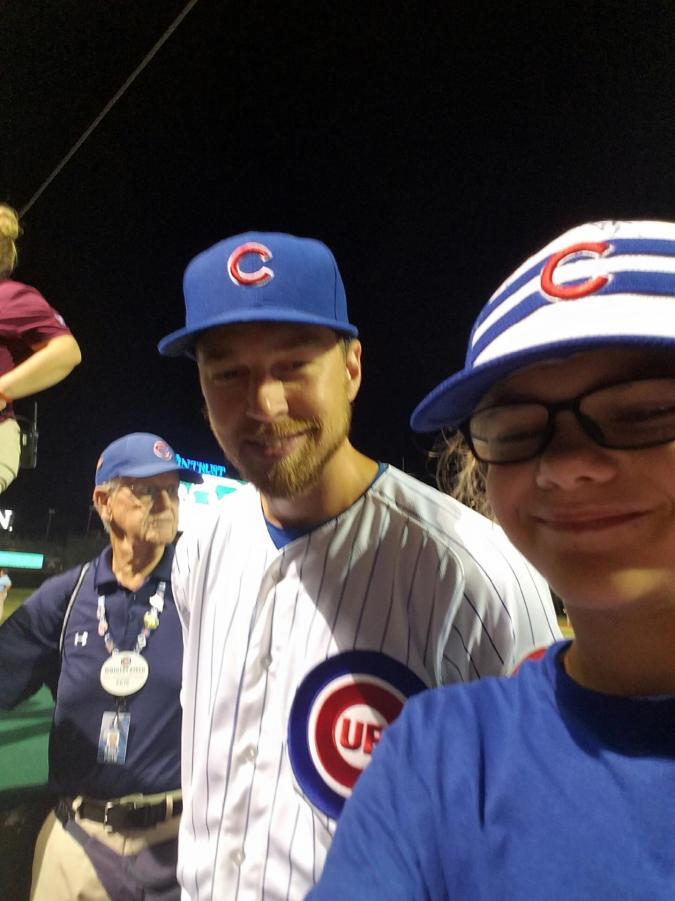
Losing her in the crowd, I spotted her blue and white Cubs hat all the way down in the front row.  She looked back at me and smiled for some reason.  And then in front of her, just like that, came the second baseman out of the dugout.

He was the only Cub that showed, signing balls and caps and taking selfies with the kids.  She was there, and she hit for the cycle.  I couldn’t have been more happy if she were my own.

I thought of the cynic I had been, while she beamed with a youthful joy.  I felt like an old man myself.  A drunk one row down stood on his seat, chanting, “Thank you, Ben Zobrist.  Thank you, Ben Zobrist,” over and over again.  The intoxication that comes, from finding those who get it.

Sometimes we nearly lose all faith.  If we are lucky, we remember or are reminded:  To the faithful, reward is certain.

Resized_20160817_220750

Fideli Certa Merces:  To the faithful, reward is certain.


The Ball Boy (Part Two)

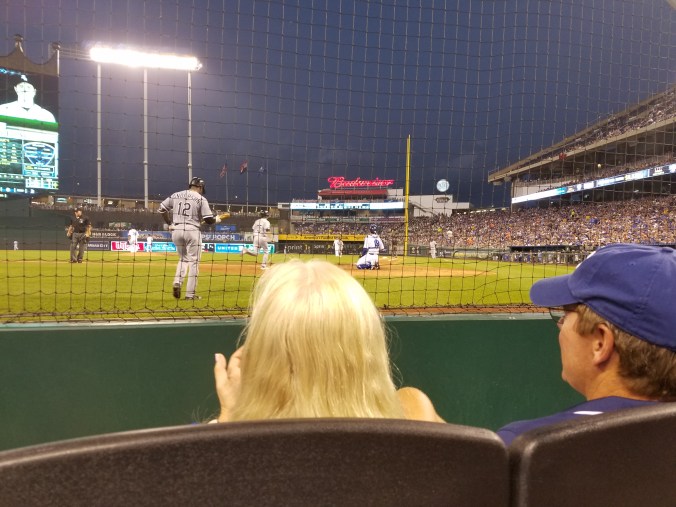
Ten days before Wrigley, I had been part of a group of guys who had splurged on Crown Club tickets in Kansas City.  The ticket gives you access to the rows directly behind home plate.  It also gives you access to an all you can eat and drink buffet in Kauffman’s basement.  We tried to make sure they lost money.

As we got ready to head outside, one of our group didn’t get up. So him and I remained, across from each other.

“You know I always thought if I had a son, I’d like to treat him to something like this.  I wouldn’t want to spoil him, but when I was a kid we always sat up in the cheap seats.  My folk’s busted their ass.  I’m just in a position where I could do better.  It’d be fun, you know, to share a mutual appreciation with your kid.”

Like a lot of men, we were talking baseball…baseball and other things.  Unlike most, we understood each other.

When I grabbed my seat, I could look into the dugout of the visiting White Sox.  They had all headed in, but bullpen catcher Mark Salas remained.  He stood at the top of the steps that headed down into the stadium and looked above at the kids vying for a ball from batting practice.  A muscle-bound and over-tanned dad in a tank top was pointing to his daughter, a shy girl of about 10.

“I thought I already gave you one, Miss,” said Salas.  The girl put her head down, but her father kept pointing.  Finally Salas pointed too, so there was no mistake who the ball was intended for, tossed the last one up to her, and disappeared into Kauffman.

The rest of the kids left, but the girl, a boy I assume was her older brother, and her dad gathered together in a row of seats just over the rail behind us.  The boy had on a backpack, and slipping it gave some indication of just how heavy it was.  His father unzipped it and pulled out an oversized Ziploc bag 2/3rds full of baseballs.

The girl placed hers into the bag and looked down as her father fished another out of the pocket of his running pants.  He returned the bag to the backpack, put the backpack on his son’s shoulders, and up the stairs they went:  the shy girl, the encumbered boy, and their orange meathead of an old man.

If they don’t appreciate it, I suppose you can always force them to do it anyway.  We can tell ourselves its for them, but we know its for us.  Salas had left, but he was already familiar with the script.

Anderson

Anderson comes up the top of the 5th

In the top of the 5th, the Royals were enjoying a 3 to 1 lead with two quick outs.  A recently called up kid, named Tim Anderson was coming up to bat.  A man in his 60s ahead of us, pencil necked and sitting with his wife, decided it was a perfect time to talk shit.  Being on the other side of a backstop is pretty empowering I guess.

“You haven’t hit anything today, Anderson.  0 for 2.  How you liking Kauffman?”

Anderson watched a 94 mph fastball go by for a strike.  Then he took an 81 mph curveball and drove it, beginning a two out rally the Royals would not recover from.  Whether a kid is appreciated or not, they grow up all the same.  Hopefully some of them get around on it.

Wrigley (Part One)

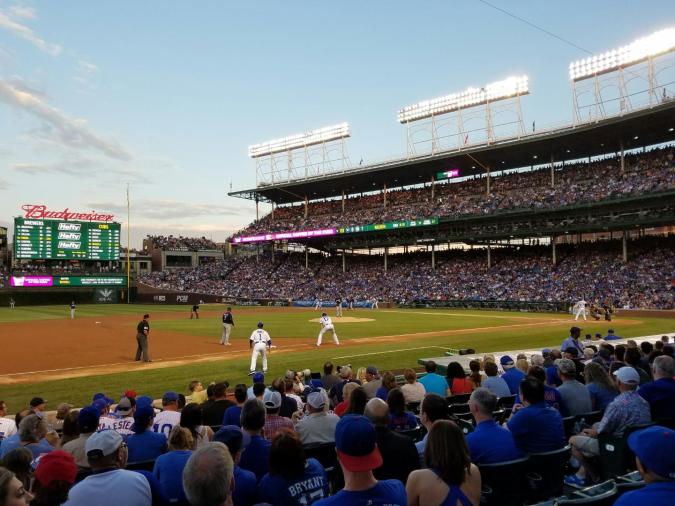
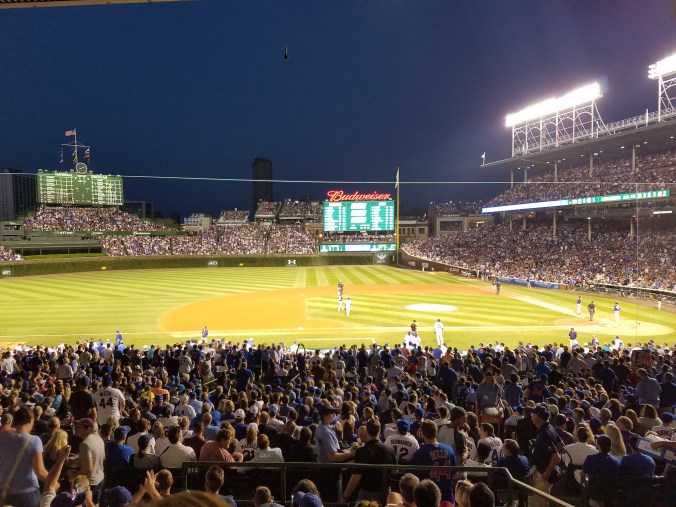
20160816_201130Wrigley Field is like a dilapidated, old hotel on the north side of town, which owes most of its existence to the fact that anyone who’s anybody still goes there.  Folks like me go there too.  We sit down on a late summer evening to the smell of beer, and yesterday’s beer, and body sweat.
You’ll find men wearing salmon shorts with their long sleeves rolled up and their sunglasses on top of their heads, women wearing salmon shorts with their long sleeves rolled up and their sunglasses on top of their heads, and those trying to get a few more days out of their white pants before Labor Day.  Occasionally you’d catch the glimpse of a whisper that mauve is the new salmon.  One is as poor to look at drinking beer as the other.

There are men trying to look important, and those unashamed to have come up from their parents’ basement to see the Cubs play.  The late day sun makes them squint.  There are 65 year old women trying to look 30, and those that have aged gracefully, young at heart, and comfortable being at the game alone.  There are mothers and fathers bringing their kids to the park with different partners than they began summer with, and there are the families you’d hoped you’d have someday.

Just which is which can be tricky.  Life does a poor job of separating out the genuine from the bullshit.  Stuck, I suppose, in a revolving door, round and round, confusing motion for movement.  Our eternal hope is that the divine will separate it someday, but for today we have baseball, which has attempted to separate the genuine from the bullshit since the days of Abner Doubleday.

Wrigley is uniquely situated in that regard:  a ballpark atop an old Lutheran seminary.

A friend and I and his two girls caught the nightcap of a doubleheader, and the next morning we all headed downtown.  The youngest insisted on visiting the American Girl store on Michigan Avenue.  I insisted on letting the family of three have at it.  While I was elsewhere, their father looked back to a discover a familiar face behind them waiting in line at the cash register.

“Excuse me.  Are you Ryan Braun?”

Ryan Braun is a Milwaukee Brewer, who was the 2007 National League Rookie of the Year.  He was named to five straight All Star Games from 2008-2012, was the National League MVP in 2011, and led them in homeruns in 2012.  He also sat for 65 games at the end of 2013, suspended for violating league policy on performance enhancing drugs.  For that, even in The Friendly Confines, he was booed the night before.

“I am.”

“I know you are with your family, and I don’t want to bother you, but could I introduce you to my girls.”

“Absolutely.”

Ten minutes later, he was filling me in.  “Think I did the right thing in not asking for an autograph?”

“I do.  I think it showed the girls some class.  What do you think?”

We had a tour that afternoon of Wrigley.  We spent time afterward in Wrigleyville, grabbing a late lunch, letting the girls find some last minute Cubs gear, and getting ready to find a cab back.  On the backside of Wrigley stood a boy with a three ring binder and his Dad.

“Is this where the Brewers come in?”

“That’s what we were told.  My boy is hoping to get an autograph or two.  The girls, their Dad, and I spent the next 30 minutes waiting as well.  When the bus pulled up, only one Brewer would sign.  It was the girls’ old friend, Ryan Braun.  Perhaps in stopping, he taught them something about movement and the work of trying to sort it all out for our self.

20160818_215623

Ryan Braun, just off the bus, wearing salmon.

Elie the Farmer

“What do you do?”

The question was posed to Elie Wiesel.  He was 15, and he was at Auschwitz.  It had been posed by Dr. Mengele himself.  Elie, who had already lied to an SS guard about his age, lied once more.

“A farmer.”

It is stated that anywhere from 75% to 90% of those that arrived at Auschwitz were killed on arrival, that is to say within 30 to 35 minutes.  Just minutes before his family had come to a sign which read, “Men Left, Women Right.”  They followed it.  It was the last time he saw his mother and youngest sister.

He and his father would have died as well, but a worker instructed them to lie about their age.    Elie lived to be 87 and died the 2nd of July this year.  In his time, he authored nearly 60 books and won a Nobel Peace Prize.  Perhaps his most famous work is “Night,” a memoir of his time in the Auschwitz and Buchenwald concentration camps.

A couple of days after his death, I discovered a copy of that book in my office.  It had been a gift several years ago from one of my sisters.  I peeled off the label that proudly heralded it’s selection into Oprah’s Book Club, and I set in on the thin, 115 pages, passing the time before fireworks that evening.

It is amazing how quick a read an eternity can be.

In the book are passages that will never leave you.  If you chose to hear them, then you must put down the affluent-laced ideas that everything happens for a reason and that it is all going to work out in the end.  You’ll get a sense of the urgency that seemed to guide the active engagement Wiesel pursued life with.  If we give it time, I suppose it will mostly pass.

Elie Wiesel was a farmer.  From a barren field, devoid of life, he harvested something not to be found in our abundance.  From it he took seeds, and he planted them on paper. Harvesting what he grew is up to us.

The Ump

20160729_200715

It was a 70s’ themed bar and offered the beer that had been trendy then but no longer.  Still, the place was not without its popularity.  At the bar sat a well-fit man sporting what appeared to be cowboy boots but of a delicate, soft leather.  Designer jeans hung from his slim waist, and tucked into them was a button down shirt that gave the appearance of being tailored.  His face was a smooth as a baby’s ass.

He was our age, and I fancied to think a few years back when he would have wore the coarser leather of an unscuffed workboot, tucked underneath the upturned cuff of a heavier denim, below an unwrinkled flannel, which gave way to a immaculately trimmed beard topped by black, horn-rimmed glasses, and an oversized wrist watch above his hand.  Either outfit fancied a little ruggedness, but there was nothing rugged about it.  Perhaps there never is about a trend.

With me at a table, was one who wore a beard trimmed just enough to keep from being confused with a biblical prophet.  It lay over a simple t-shirt above shorts as he drank his beer from a can.  He looked to me the same he always had.

“Did you guys catch the first one?”

“Caught the last couple of innings.  Got to see you behind the plate.”

He winced.  “There were two strikes that game I called balls.  That shit haunts you.”

“How’s that?”

“You never worry about the balls you call strikes,” as he took a drink.  “Earlier this year, I had a kid up at bat, and the pitcher was just painting the corners with what he was brining in there.  He threw one right up and in, the batter turned away from it, but it came back and hung over the inside corner.  ‘Stike,’ I called.

The batter turned and shot me this look.  Next pitch the pitcher goes away and loops one in right across the outside edge.  ‘Strike,’ I called again, and I got the same look from the batter.

The third pitch got away from the kid on the mound, hung way outside, and came into the catcher’s mitt a good foot off the plate.  ‘Strike three,’ I barked, and I rung him up.  He looked at me in total disgust but silently went to the dugout.  The next batter was settling in when I heard his coach bust out, ‘What the hell did you think was going to happen looking at that man like that?’

The balls you call strikes don’t matter.  It always the strikes you call balls that get you.”

A fellow umpire reminisced.  “Martensdale-St. Marys used to pay $67.50 to call a game.  You’d take that check over to that bar in town…what’s the name of that place?”

“Northside.”

“Yeah, that’s right, Northside.  You’d take your check over there, ask, ‘Could you cash this for me, Darlin,’ order a cheese burger and fries, have a few beers, and have to stop on the way home and put gas in your car.  Nobody is here for the money.”

Why trends pay better, I don’t know, but sorting out strikes and balls never goes out of style.  The world is always in need of it.  And god damn, it’s a rugged place.

Tokyo

In Tokyo you would go to bed tired, sleep soundly for a few hours, and be wide awake at 4.  It was light by 4:30.  You’d give up going back to bed, you’d shower, pull your boots on, and walk out to the shore of Tokyo bay on the man made island of Odaiba.

Generally you met fellow Iowa Farm Bureau members who couldn’t sleep either.  Rarely did you see any local running around aimlessly.  I thought it a sign of cultural advancement, until I noticed the large logo of a local Starbucks.  Pluses and minuses, I suppose.

20160707_055805

The Rainbow Bridge and some of the original Odaiba Batteries

Back at the hotel, breakfast was very American.  There was bacon and sausages, orange juice and coffee, and pasta and Caesar salad.  (I’m sure someone read about the latter combo in a book somewhere.)

After we would board the busses in front of the Grand Nikko Hotel and take the Rainbow Bridge into Tokyo.  In the bay beneath us was an old island.  It was the sixth of the six original man made islands that bore the name Odaiba in 1853.  They were batteries to keep out Commodore Mathew Perry, his Black Ships, and the Americans they represented.

Japan had been closed to the West for 200 years prior.  It would be closed no longer.  Today hotels and western shopping centers stand nearly on top of them.  So much for isolationism.

Coco

Coco and her admirers

“What did you know about Tokyo prior to coming here?”

“I knew it was clean.  When people would  describe it, nearly all would say, ‘You don’t even see a cigarette butt lying on the ground.'”

“Did that surprise you?”

“Not until I realized how much the Japanese still smoke.”  I smiled.  She laughed.

“My boyfriend smokes, but I usually make him do it under the range hood of the oven.”

20160709_051631

View from the Oregon with the Skytree in the background

The attractiveness of a woman telling a man what to do is universal.

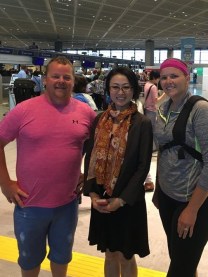
Her name was Coco.  Part of our group was enamored with her.  I had just met her as we sat down for dinner.  We were on the 42nd floor in an American-style restaurant called The Oregon Bar and Grill.  Beneath us was part of the heart of Tokyo.

Down there, among the neon lights, were the androgynous looking youth that had packed our train at each stop from our hotel.  They were headed out.  We were headed up.  Tokyo is big enough to head anywhere.

FB_IMG_1468851933609

Tokyo from Skytree

In 2015 Tokyo had a population of over 13.5 million people.  Chicago, in comparison, had a population just under 3.  If we were to include the Chicago metro, we could boost the number to 10.  If we were to do the same for Tokyo, we would jump it to 37 million, housing more than 25% of Japan’s entire population.

It’s the largest metropolitan area in the world.  On those morning busses, you couldn’t help but stare out the window and marvel at the 20-story apartment buildings which sprouted out of the ground feet apart and stretched to the horizon without end.

Tokyo’s population is like its humidity.  You swam in it.  It stuck to you.

It was a clean stickiness, with a Western feel, on a belly full of pasta, OJ, coffee, and croutons.  If only I had a cigarette.

Farmers: The Accidental Diplomats

20160707_162203

Rainbow Bridge Tokyo

Sitting in the US Embassy in Tokyo, we were getting briefed on the current political climate in Japan.  A door at the back of the room opened, and making her way to the front was US Ambassador Caroline Kennedy.  Her slight build and soft voice gave one the impression of a certain amount of shyness.  There was also something about her quietness that made an impression of her resolve.

Agriculture must look the same way at times.

Ambassador Kennedy looked out on a crowd of over 120 people, there as part of Iowa Farm Bureau and making up farm families from across the state.  For many this was just the first or second time they had stepped over the US border and dipped a toe in the rest of the world.  At the same time, as Iowa farmers, we’re on the world stage every day.

20160707_203716

The Marketplace

“I hope you understand the tremendous value your presence has here in Japan, and the value the Japanese place on personal relationships,” the Ambassador said.  She subsequently underscored this by repeatedly coming back to it.  She did this by stretching it out over the framework of Iowa’s involvement with the Prefecture (State) of Yamanashi.

A typhoon hit Yamanashi in 1959, devastating the area.  An Iowa Sargent, Richard Thomas, would frequently visit the area while he was stationed in Japan post World War II.  Having returned back to Iowa, he asked fellow Iowans to help come to the aid of  the region.

He received 36 hogs and 60,000 bushels of corn.  The hogs, 8 boars and 28 gilts would have 500 descendants in 3 years time.  By the end of 9, they would have 500,000.  In the aftermath of World War II, Thomas’ simple effort underscored the powerful but quiet diplomacy agriculture brings in making peace.  It’s power lies in the quiet resolve of bringing food to those who need it.  It’s brought by the relatively sedentary life of farming, as long as governments stay out of their way.

20160707_203254

Old and New in Japan

That morning Iowa Farm Bureau President Craig Hill spoke to the fact that 2/3 of the world’s middle class will be located on the Pacific Rim.  Potential for Iowa agriculture abounds, if those in our government will simply remove the barriers to trade.  The protectionist or isolationist push against doing such is as productive as trying to hold the waters of the Pacific back with a fork.  All the commotion created is an opportunity for someone else, just across the way, to slip in.

At dinner that evening, I wound up sitting across a large table from the Vice Governor of Yamanashi.  She’s a woman who seems to have held every position one could hold in agriculture, similar in build and manner to Ambassador Kennedy, and a similar sense of resolve.  The words that kept appearing in her remarks when she addressed the group were in thanking our state for its kindness over 50 years ago.

Kindness and agriculture can get by without a translator.  Just look at how well those Iowa hogs did.

20160708_041756

Small but Mighty:  The bonsai tree on the left is over 500 years old.