Tomochichi

20170222_164431

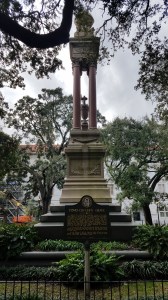
The Gordon Monument

I have no idea if the gray squirrel let loose with a rebel yell when he stepped off the curb and charged onto Bull Street in front of Wright Square in Savannah, Georgia. Two feet in a car tire had struck him down, rendering the question largely moot. He said nothing now.

More tires had come, as if to drive the point home, and it was now nearly impossible to tell where the deceased ended and the road of progress began. I had wondered about his rebel yell only because his tail still stood erect, springing from the concrete. Was a final act of defiance or simply what happened once you were dead?

People walked by on the sidewalk, cars still rounded the street, and as near as I can tell the world went by without notice.

Had he crossed Bull Street and made the square he would have been in the shadow of the William Washington Gordon Monument. It rises 47 feet, and near its top four twelve-foot columns support four winged Atlantes hold a globe. It commemorates the life of the aptly named William Washington Gordon I, who presided over the state’s first railroad. It was to that distinction that the monument was built, albeit if it stands out of proportion to his current fame.

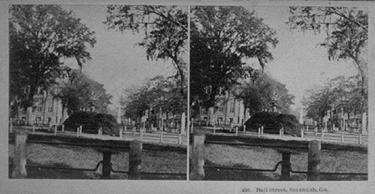
It wasn’t the first monument to be in Wright Square. To build it in 1883 they had to clear a pyramid of stones which dated back to 1739, when the square had been known as Percival. That was the year James Oglethorpe, the founder of the colony of Georgia, buried his Indian friend, Tomochichi.

Oglethorpe had personally carried him to the second of the four Savannah squares he had designed. He buried him there and ordered the grave marked with a pyramid of stones. In the process he created Savannah’s first monument.

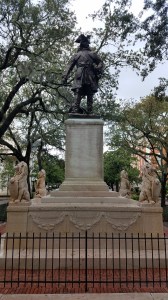
Oglethorpe had planned for Savannah to sit on a 40 foot bluff that was home to a small group of natives, known as the Yamacraw, who were exiles from two local tribes. It is thought they numbered around 50, and beneath them, on the ship Anne, sat the 120 passengers Oglethorpe had brought with him. The English had no right to settle on the west side of the Savannah River, and Oglethorpe had no reason to think the natives would be amicable.

Historians place Tomochichi around 90 at the time of the meeting. He greeted Oglethorpe, expressed no offense, and stated a desire to have his tribe educated. Oglethorpe was 36.

He had crossed the ocean to found a new colony to buffer the existing English colonies in the north from the Spanish in the south. He had brought with him those from London’s debtor prisons. He was convinced what separated them from everyone else was that no one had afforded them a chance yet.

20170222_164007

James Oglethorpe

The leaders of the two bands of outcasts hit it off. Tribes never did think much of pragmatists. Fortunately, from time to time, they hold sway in a world beset with indifference to anything practical.

Oglethorpe settled, and in Georgia protected the Indians from the traders that had taken advantage of them elsewhere in the colonies. In turn Tomochichi convinced the neighboring tribes that Oglethorpe was a man they could trust. In time they did. Oglethorpe would go on to meet chiefs from much larger and more powerful tribes, but he never let any of them displace Tomochichi.

Some accounts suggest that in building the Gordon Monument remains were found. Some accounts say Gordon’s daughter had them transferred over 15 years later to a large stone she placed in Wright Square to re-remember the dead Chief. Some accounts suggest that the remains found were strewn all about the square. Others suggest no one even took the time to look.

Today in Savannah’s green and open squares, which now number 22, Spanish moss fancifully drapes itself over the live oak, indifferent to it all. Around many of those squares stand stately mansions, harkening to a different time, colored in earthy tones. Sometimes one thinks it is the bitterness of the passing years that have ate them to their marrow. Sometimes I think iy was the moss, sitting on high, belly full with its meal half ate, lazily waiting to come down and feast again.

How in the World?

I suppose some think that to tell a story you need to invent it first.  It simply isn’t true.  Life will do it for you.  In a pinch, the life of others will work too.

“Where in the world did this idea of providing unconditional love come from?  Can anyone tell me?  This is how parents think they are to raise their children of late.  How has it become so widespread?

Has anyone ever asked themselves if this is something we, as human beings, can even provide in the first place?  Have we asked ourselves if it is really in our best interest to tell those we care about, ‘You can do whatever you want.  I will still love you.’?

When I think of a generation being raised with this mindset, I’ll be honest.  It scares the hell out of me.  I worry that despite everyone’s best intentions, it can be crippling.

There was a teen girl hospitalized in a mental health unit.  She refused to communicate with anyone.  A team of doctors oversaw her treatment, and each day, at the appointed time, they would go in and try to make her talk.  It was as though they could make a bean grow by pulling on it.

This approach yielded the predicted results.  The more they tried to make her talk, the more she resisted.  Eventually a new team became involved.  The woman heading this one up knew something about systems thinking.

She decided no one was to try and make the girl talk at all.  Instead someone would go in, an hour each day, and simply be present with her.  If the girl wanted to sit there in silence, they would sit there in silence, but they would remain present.

They persisted in this line of action for several weeks.  The mental health professional would sit attentively in a chair.  The girl would sit with her head down, arms crossed, and closed off.

Finally one day the girl rose her head, looked across the table, and exasperatedly asked ‘What?’

With little reaction came a simple response.  ‘What are your goals?’

‘Pfffft,’ with a roll of the eyes.  Head went down, arms crossed, and the session ended.  A week later she again asked, ‘What?’  Same exchange.

By asking the question, they began an internal dialog within the patient.  What are my goals?  What do I need to do?  What am I trying to accomplish?

They didn’t provide those answers.  We never help by doing for someone what they could do for themselves.  They also didn’t wash their hands of her.

Some therapy today is awash in delving into and swimming around in emotion.  It is as though a good therapy session is one in which we cry in.  It may feel wonderful at the time.  The question is does it help?

Focusing on goals introduces the idea that the best way to sail through life’s rocky seas is to chart our own life course.  We can do this by using and gathering the best information we can get our hands on.  We can do this by trying our best to recognize the anxiety life and our relationships generate for what it truly is:  energy.  Energy we can use to get there.

This is the path that teen girl was able to take.  No one wrote her off.  No one promised unconditional love.  In not telling her what to do, which includes telling her she didn’t need to do anything, they respected the dignity of the person.

In our own lives it must take a lifetime to make sense of it all.  I guess it is up to each of you.

A Fifth of Plochman’s on the Fourth

Another figure looming large in the ability to properly tell a story is a cousin of mine.  He’s the most talented storyteller I’ve ever come across.  He especially shines when it comes to humor.

Most stories involve a cast of his friends, and mostly he refers to them by their last name alone.  It gives the audience a sense familiarity to those they may have never met, and supports a belief that were they to someday, they would be their friends too.  Nearly all tales include an incidental character whom will loom large in the story to come.  Whenever possible he somehow pulls out from the recesses of his mind this character’s full name, reinforcing the thought that whatever it is you are about to hear actually happened.

Employed in the story’s telling are phrases like “remember how it was…,” “you know how it used to be…,” or “it was a day not unlike today…,” and they serve like stitches, connecting the audience in the present day to the setting of the story and offers a sense of mutual recollection about an event the listener can’t recollect at all.  In some places, words are dropped altogether, replaced by replicated looks and gestures that ask that the listener supplying his or her own words, and permeated by the pauses that give them the time to do just that.  Soon, one is no longer listening at all.  They are there, in the story, as an active participant.

“It was the Fourth of July and Baker’s parents were having a party.  We were just out of high school, and the whole gang was there, waiting until it got a little darker and the adults got a little more intoxicated so we could make our own way to the keg.  A pack of vultures really.  Baker’s Mom’s Boss was there, and so was Baker’s Mom’s Boss’ Husband.  Guy’s name was Randy Peterson.”

“It was about this time of day,” he said, looking out on the day behind him.  “Everyone had been nursing a beer, except Randy Peterson.  He had his own tumbler, with a gold bracelet around one wrist, and a shirt unbuttoned a third of the way down, exposing a chest which already that summer had got too much sun.  He’d been mixing his own drinks.  He’s toasted.

He comes staggering over our way, and singles Baker out of the crowd.  He steps up to him and says, ‘(inaudible mumbling) I hear you (inaudible mumbling) like to wrestle,’ as his head bobbed to and fro.  ‘(inaudible mumbling)  Think (inaudible) you can take me (inaudible)?’

Baker said yes, he used to wrestle in high school, but ignores the rest of it.  Peterson continues to stand in front of him, and gives Baker a push on the shoulder.  His wife sees what’s going on and embarrassingly begs him to stop, ‘Oh, Randy.  Why don’t you leave those boys alone?’  Randy won’t be denied, though, and steps up closer to Baker and really sets in to pushing him around.

All of the sudden Baker grabs ahold of his shoulders and takes him down right there in the yard.  Everyone laughs, but by this point Baker is pissed off.  You see him for a split second gets his hand on the back of Peterson’s head, bite his lower lip, and really shove his face in the dirt, letting him know he’s about tired of fucking around and trying to get the guy to back off.  Then he lets them up.

Peterson is belligerent.  Comes at him again, and again starts shoving Baker around.  Down they go a second time.  This time he eats some dirt a little longer.  His wife comes over and pulls him away.

After awhile it is dark.  We’d all found an empty milk jug, which someone would haul over to the keg and bring back to divide among us.  We all drink way to much.

At some point Minella and I step in Baker’s house.  There on the sofa lays Randy Peterson.  He’s got his wallet hanging out of his back pocket, and with it is a patch of sod from the yard, like he was trying to stow away a memento of having come so close to getting his ass kicked.  I was making my way to the kitchen to raid the fridge and sober up.  On the bottom shelf I find a bottle of Plochman’s Mustard.

The little ones, the ones most people got, sat chest high on the shelf at Fareway.  But beneath them, if you remember, down at your feet was where they kept the big ones.  It was one of them.  I grabbed it and made my way over to Peterson, twisting the red tip open as I went.

Minella started giggling as I inserted the tip next to his wallet and squeezed.  I filled his pocket full and was giggling myself about how funny it was going to be when he reached for his billfold.  All of the sudden he moved.

We froze for a second, realized he was out cold, and I found my eyes drawn to the 3 or 4 inches of plumbers crack now exposed from the waist of his jeans.  I looked at Minella, smile, and then shoved the red tip of the Plochmans as far past his belt as I could get it.  I straddled his legs, and with both hands around the bottle I laughed out loud and squeezed for all I was worth.  I wanted to get every drop, and I continued till all I heard was the unproductive wheezing of the empty bottle.  I screwed the red tip back down, and placed the jug back in the refrigerator.

An hour later the remains of the party was moving inside.  With them was Randy’s wife.  Finding him passed out on the sofa, she shook Randy’s shoulders, woke him into a stupor, and told him it was time to go home.

‘Sure, Honey.  (inaudible)  Just a sec (inaudible),’ his voice trailed down the hallway as he staggered like a sailor to the bathroom door to relieve his bladder of the whiskey and Coke.  Minella and my eyes never left the door once he closed it.  The anticipation was killing us.  He lingered in there forever.  Finally, it opened.

If he staggered like a sailor going in, he was as sober as a judge coming out.  His eyes were so big around I had to bite my tongue to keep from laughing out loud.  He scanned the crowd, who hadn’t noticed him, and moved around the room like a kid afraid of heights on a balcony, shuffling along with his back to the wall.

‘Time to go, Diane,’ he says, clear as bell, adding a wave to everyone as he continued to work his way around the room.  Poor guy had to have thought his liver had gave up the ghost in his pants.

I often think about that car ride home must have been like.  Did he tell his wife?  Was he praying a silent litany vowing to God that he would never drink again?  Did he make a doctor’s appointment?

Mostly I wonder if he ever came to appreciate the humor of what it was that had just happened.

Minella and I woke the next day sprawled out in the living room, with Baker’s Dad fishing a left over brat of the fridge.  In his hand was that same jar of Plochman’s.  He hoisted it above the brat, and all it produced was the same wheezing sound it had ended the night before with.

‘Sumbitch.  Who the hell used all the goddamn mustard?’ he shouted.  He tossed it in the trash can, and I breathed a sigh of relief that the little red tip had never touch his breakfast.”

I had become uncertain whether or not I would wet myself.  I wasn’t sure when I would breathe again.  Taking in the present company, in the throes of laughter, what I was certain of was that I had witnessed nothing short of magic.  It was like lightning in a bottle.

The Irishman

John

I once heard we should refrain from making other people saints. The idea was that in doing so, we bring about at least two, rather destructive, outcomes. First, the sainthood we bestow gets in the way of knowing the individual for who they truly are, warts and all. Second, it creates an impossible standard for everyone else in our life to live up to.

I suppose a lot depends on how you define a “saint.” Conventional wisdom takes it to mean “he or she that can do no wrong.” I feel differently. So did an old friend of mine.

“What are we to do, when we feel differently than the group we are part of? Is it better to move to a group that thinks like we do? Or is it better to stay and fight for the identity that has laid its claim on you?”

“That’s a good question. You’ve obviously been thinking about it. What are your thoughts?”

“I think I favor blooming where we are planted.”

A few years ago, John Connor had a heart attack.  I went in to see him in the hospital.  He was already in his 80’s, and they were talking a potential surgery.  The thought crossed my mind that I might not see him again.

Outside of my family I had known no one longer.  He was something of a pseudo-grandfather in my youth.  He was now my oldest friend, and an ever present part of the place that I came from and still reside in today.

I entered the door of a large room with light wood paneling.  His wife, Marilyn, was seated by the windows that made up the wall across from me, letting the daylight in and quieting the din from the streets below.  John sat upright in bed reading the Des Moines Register. He looked largely unconcerned. He wore his hospital gown like silk pajamas, as though the two had just wrapped up a late breakfast over a casual morning at home.

At any moment he would rise and don a business suit or the lapel pin of some high ranking public servant.  In real life, John had donned none of those things.  Instead he chose the denim and occasional dirt of a farmer, and beneath them he reminded me there was no less dignity.

He folded the corner of the paper back and revealed his high forehead, and his large, round nose and the large ears that accompanied them.  The latter two had begun to be bandaged as they were occasionally trimmed for the skin cancer that was his reward for a lifetime spent in the sun.

“Well, look who stepped in the door.  We would have spruced the place up a little if we had known to be expecting company.”

The Irish have at least two distinct ways with which they handle life’s anxiety.  The ladies will generally heap food upon you after you have already eaten. Their irrefutable insistence masquerades as an over-the-top hospitality, and I suspect that it comes from a place which knows the presumptiveness of all the things we take for granted. Leftovers, I suppose, from a starved people.

The Irish can also pride themselves in the ability to find humor when most cannot.  For me it was a hallmark of John’s. Had he and I been on the Titanic together, the outlook would have been cold.  The outlook would have been wet. Yet in the time before our final plunge, I have no doubt that the conversation would have been first class. What makes us human is a chance to have a word more final than that of our basic instincts. Leftovers too, I imagine.

They skipped the surgery, and John would live his remaining years full of life without his eyes ever having grown dim. He died the Monday before Easter in midst both of his life’s pursuit and the Irish community he had long been the goodwill ambassador for.

For 59 years he and Marilyn seemingly enjoyed the partnership all aspire to, and I suppose, on the days they weren’t enjoying it as much, they found each other the worthy adversary a life of growth requires.  During that time they raised a family. They had a Pope land in their backyard. Neighbors joked he blessed their crops as he flew over. The crop he blessed were the adults they raised.

During the day, John generally selected the companionship of a faithful dog.  In their succession each seemed to bear part of the stately nature of their owner. His last dog, Riley, a noble Collie, was content to lay on the seat of John’s pickup ruminating on the world outside, just as the driver did. Occasionally, he would raise objection with the more conservative dogs at our place, just like the driver did. Once in a while, when John was offering his thoughts from the driver’s seat, Riley would raise his head from the red cloth and turn and look him in the eye, as if to say, “I couldn’t have said it better myself.”

John sharing his thoughts was instrumental in cultivating my love of stories.  A stop by either party could wind up lasting an hour or two.  In the past few years I became more bogged down, and I stopped less.

He was a proud Democrat. I had known him to be a good one, and when we talked we always talked politics. I can’t recall an argument. We tired, I think, the best we were able to talk about the things that were true. In the end what argument could be against that?

He advocated for his ideas on justice in the world without losing the ability to reflect on the ways his own party might keep it from fruition. In doing so, he taught me how to be a good conservative. He taught me what it meant to be a good citizen.

Once he even encouraged his kid conservative neighbor to get into politics. Last year, when the kid ran for a little county office, it was John that eagerly drove his ballot forms around. In a few hours he brought the forms back completed. “Let me know when you are ready for something bigger,” he said.

Politically that fall the national scene escalated to a fever pitch. At times it would leave me stunned. I felt on the brink of losing trusted acquaintances as much for where I came from as what I believed. But back where I came from was John.

I will often here people list the things important to them. Often the list will start: “faith, family, and…” Some will be particular enough to tell you that it isn’t just a list; it’s ordered. It never fails to give me pause.

Some will use their faith to justify isolation of themselves from the difficult who would stand to teach them the most about the subject to begin with. The same, then, can be said for people and their politics. They pursue their dogma with such zeal they miss the ends they aim for, and so we too become a starved people in the midst of our abundance.

John had his faith. With it he seemed to have faith in his neighbors. He even seemed to have faith in me. None of us were without flaws, but generally, for most people, what’s wrong with them is what’s right with them. Perhaps he knew that.  Perhaps someday people will find some faith in their neighbors again too.

John taught me more than a thing or two about faith, and I suspect he’ll teach me more than a thing or two yet.

His last stop at our place came after spending St. Patrick’s Day 2017 with Marilyn and his daughter, Theresa, in Haiti.  His cousin, Archbishop Eugene Nugent, is the Apostolic Nuncio to Haiti, or in other words: he’s the Pope’s man there. At 86, few would have made the trip, and having made it, John was exposed to a poverty whose depth and breadth shook him.

It was a rainy day.  I finally had a chance to do some mechanic work, and I had two tractors to work on.  John pulled into the machine shed while I was working on the first.  John stayed in the pickup.  My father sat outside his door.  I kept working on the tractor with the cab door open.  While I worked, he began to talk about the slums of Haiti.

I would ask him questions from the cab.  The last words I remember him saying were, “None of us realize just how damn fortunate we are.”  I certainly didn’t realize it at the time. Maybe the ladies who have heaped food upon me would have. John found no humor in it.

I think it is unique that John died with a true appreciation of it.

They had asked the pallbearers to walk ahead of the casket, down the church aisle, and wait outside the door of the bell tower beside the hearse. I walked down the aisle with my eyes directed to the choir loft, only to lower them to greet the priests who had come to celebrate Mass. I stopped to say hello to each and began to get emotional with the first. I quickly stepped outside.
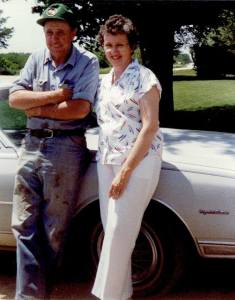
John and MarilynOutside, on the concrete below the bell tower, where John would preside over stories after church, I cried. At a time when everyone is certain someone else doesn’t understand their privilege, I fully understood mine: engaged in a calling, living in this setting, surrounded by the people John and Marilyn recognized for who they were: a blessing.

“Why do you suppose we tell stories?” I asked.

“Why do you think we do?”

“I think some tell stories to lose themselves in the cathartic, emotional abyss of a past they can’t escape from, some out of the anxiety that they or their story will be forgotten, and I suppose some try to escape personal experience altogether in order to tap into something larger about the human one.”

“Do you think its just a bunch of personal stories then?”

I suppose not.  A few are given the perspective that in the end it’s not a collection of little individual stories at all.  It’s one big one, which can repeat itself and often does, lest we try and find a way to nudge the needle. For me, John set his big shoulder against it and pushed.