Spring

20160229_095639

Our first calf of the year was out of a bull called Woodhill Gusto.  The calf, also being a bull, I dubbed Gus.  His mother has raised a couple of calves by now, and given the two she raised and the calf before me, I expected Gus to be a good one.

He was a thick rascal, had good, heavy bone, and his rear legs looked like springs still trying to uncoil.  He was particularly quiet, and his mother was particularly cautious.  I was particularly pleased.

“We had a calf this morning,” I told my father, as I hurriedly changed direction to get on with the rest of the work of the day.

“What was it?”

“A bull,” I said, keeping my expectations to myself.

My father, about to be 70, checked the group Gus was in the next day.

“That little shit is running and hopping now,” he said with a smile.  I partially acknowledged it.  Something new had no doubt come up, and I was once again in a hurry.

The next morning was my turn again, and I found Gus on a pile of cornstalks.  Secretly wanting to see the same performance Dad had, I went to get him up.  He was lethargic, as new calves can often be, and his mother wasn’t around.  Sometimes, when they become fully alert, they panic and take off in any direction, so I was content to let him be.

That evening, making the rounds, I found him in a different spot on the same pile, dead.  I had a veterinarian do a necropsy on the calf, and we found his abdomen pooled with blood.  On his liver was a two inch laceration, barely more than a scratch.

“I think this calf got stepped on,” was the pronouncement.

Spring was here.  New life brought into the same old one.

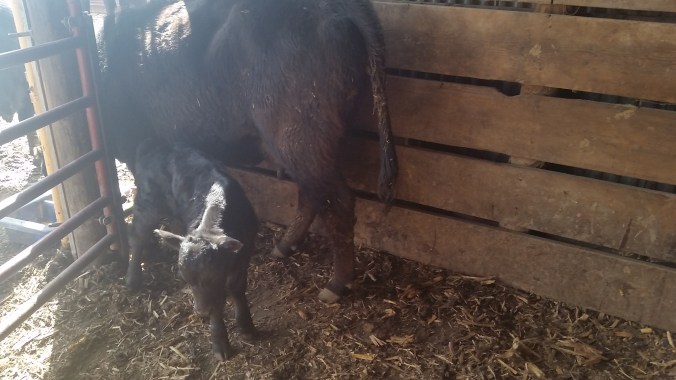
A few days later, with more calves on the ground, I came home to find a heifer needing help.  I had to pull the calf, a big, bulky thing.  While the mother had no trouble mothering him, he couldn’t seem to get the whole nursing thing figured out.

Twice a day I’d latch her in a headgate, get the calf’s mouth in the right vicinity, and wait.  An index finger in the corner of his mouth would try to entice him to get the party started.  If it didn’t work, you’d milk her out and try it with a bottle.

One morning you walk out and finding a standing calf and cow.  The cow has a teat that’s wet.  The calf is looking at you like, “What the hell are you doing here?”  And they are off and running.

This is spring, too.  From the old one, new life.  It’s no wonder they placed Easter here.
20160316_152146

Namaste


20160306_073708

I once listened to a man speak about how to make it through life while keeping our head above water.  Someone asked him about meditation.

“I tend to view meditation as an escape from the world, a form of distance.  We all have our escapes.  I find the world is always waiting for us when we get back.”

“Isn’t the point of meditation:  to escape the world in order to come back refocused?”

“That’s always been the idea, I think.  I’m just not sure I’ve ever seen it work.  It feels good, but distance usually does, and we tend to make whatever form we chose an end in itself.  What I’m interested in is how we might deal with the world by remaining and  becoming more present in it.”

For some men, to meditate is to fish, and it has been that way since ancient times.  Even Christ called a few of them from their boats.

20160305_065059

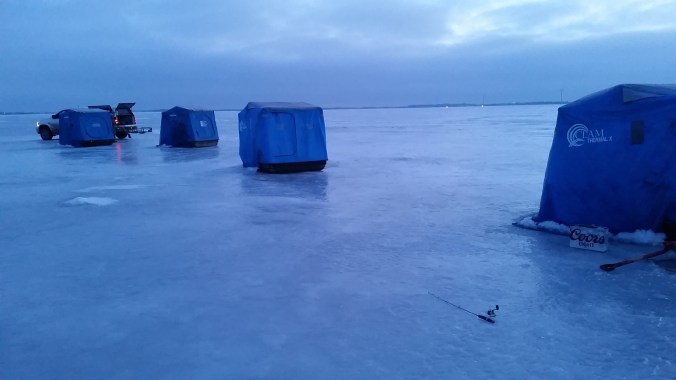
For me, on the ice of Devil’s Lake, North Dakota, in a shack with a partner, over the low roar of the propane heater and staring at the lights of the Vexilar, I wasn’t aware of any distance.  In the stillness of waiting for a fish to bite, I thought it was all present.  The past, the dead, present worries, and the future.

A fish would bite, and they were gone.  Then things would get still, and they would come back.  Perhaps I never was much of a fisherman.

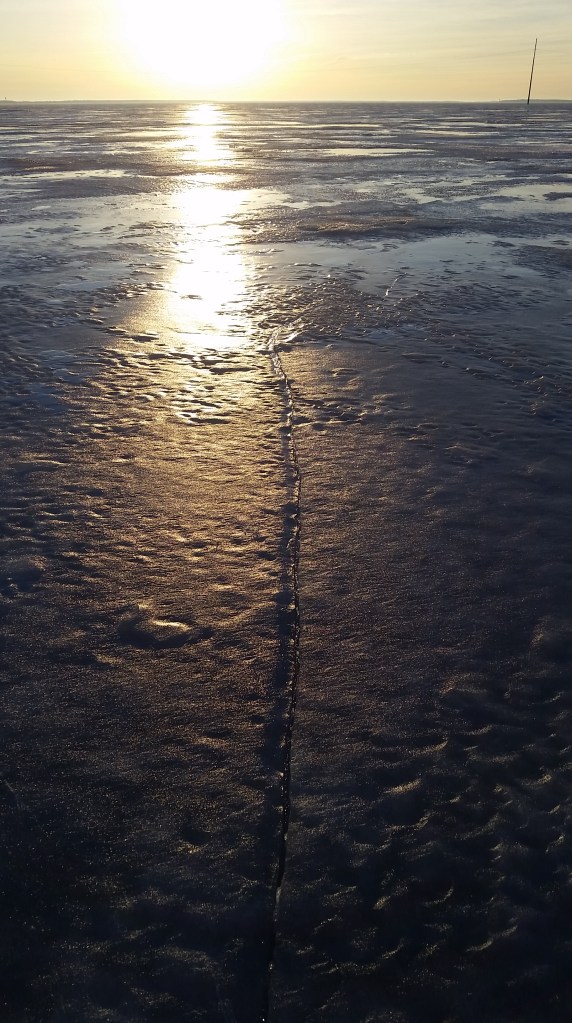
Sunday morning was the start of the third and final day.  At 6 am it was already starting to get slushy on the ice, as we drove down a boat ramp and out onto 90 miles of water in a Chevy Tahoe.

“You know I was nervous enough on Friday, when it was cold,” I commented to our 19-year-old guide.

“Don’t worry about the water.  It means the ice is still strong beneath it.  I don’t start to get nervous until the water disappears.  That means it is soaking through.

After it soaks through long enough, it leaves the ice honeycombed and gives it a hollow, crunchy sound.  When you hear that, you panic.  You’re about ready to fall through.

Today will be the last day we drive trucks out here.”

“Have you ever went in?”

“Last year was the first time.  The ice was getting thin and I was on a four-wheeler with my father.  He tried to blow over a crack in the ice, but the shelf he crossed over on was broke as well.  As he drove onto it, it stood up.  Dad jumped, but I was backwards on the rear rack and daydreaming.  When I hit the water, it was so cold I clenched my fists, and rode the four wheeler all the way to the bottom.  It felt like it took five minutes to get to the surface again.”

“What did you think of that?”

“That will wake you right up.”

I had no doubt.

20160305_150803

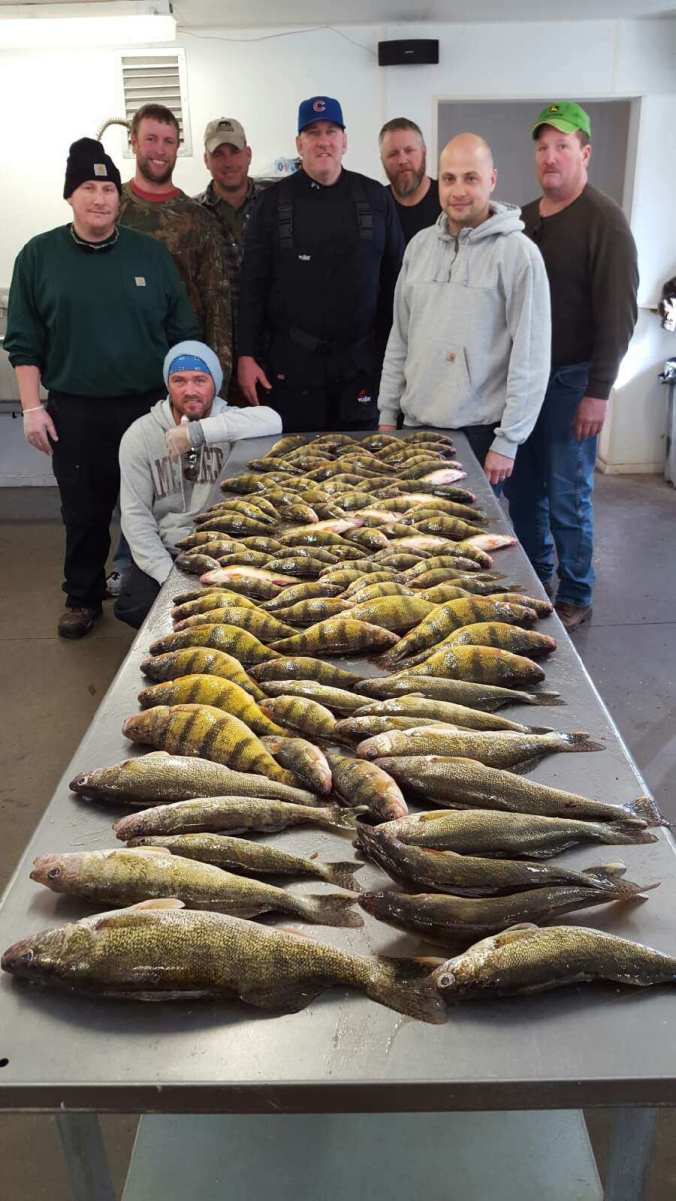
Friday was cold and blustery, and I spent most of the day with my foot holding the frame of our shack down so it didn’t flip over.  Saturday was the big day catching fish.  Sunday we caught walleye before the sun came up, but after that, moving to deeper water for perch, all most of us caught was a buzz.

We wouldn’t mind it none.  The temperature climbed into the mid 50’s.  The sun above us beckoned.  One by one we flipped back the tarps which had been keeping the cold out and our thoughts in, and we sat on the ice in the sun.

Looking out at the expanse we sat on, I thought of our guide.  Someday we will all make the plunge beneath the cracked and shrinking ice.  Today wasn’t the day, though.

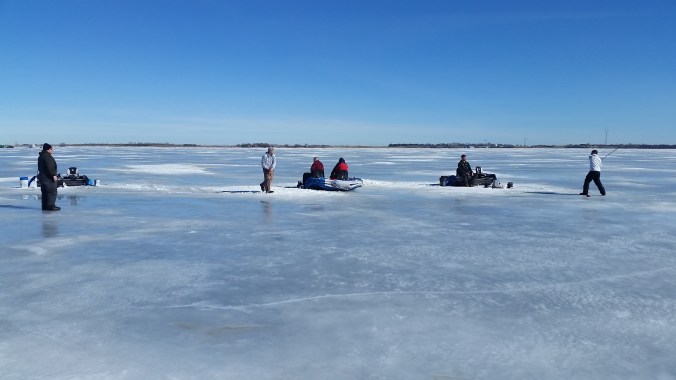
We set our poles down, and on the winter ice, in the springtime sun, the boys of summer played ball.  On Friday we caught the wind.  On Saturday we caught fish.  On Sunday we caught a good time, with the whole world beneath our feet.  Namaste.

20160306_114406

Dignity

Out of the pocket of her robe she produced a cell phone, and with the press of a couple of buttons she placed a call.

“They got the tests done, I’m just waiting for someone to take me back to my room.”

Her voice fit who it came from.  The person on the other end asked no questions.

“I just wanted to let you know how it went.  I’ll talk to you later.”

The business with the phone had startled me.  I had been watching her, and up till then she seemed largely unanimated.  When the call was over, she returned to her previous state.

Earlier, when I had sat down, my attention was drawn to the wall-mount television on my right.  I was trying to make sense of both the words and the volume, as I looked over to see Donald Trump speaking about how he wished someone would punch someone else in the mouth.  I lost interest, and my eyes would come to rest on her.

She sat in a wheelchair ahead of me at roughly the same distance I sat from the TV.  Of all those in the room, she seemed the least likely to look back.  There was safety in that.

Hunched over in her hospital gown, she wore a robe over her shoulders for extra warmth.  He hair, still mostly brown, spilled down over the robe, as her head followed the curve of her back and tilted forward, leaving her mouth open and her eyes staring down blankly at her lap.  One leg protruded at a 45 degree angle and at its end it produced a pale-white foot, wrapped in a snow-white bandage.  Her mouth had no teeth, and beneath the bandage were no toes.

As she hung up the phone, it appeared that she was going to look out over the rest of us.  I looked away.  Eventually, an orderly showed up, and I looked up to find the person that had briefly appeared before me was gone again.

“All right, are you ready to get back to your room?”

There was a nod.  The orderly reached down, released the brakes, and they were on their way.  Finally, she had some company.

In greeting friends and family in the hospital, we use flowers and a smile, but in greeting the sick we don’t know the preferred method seems to be looking down at our own shoes.  Our mothers told us not to stare, and so we put it into practice by not even daring to look.  I think one is the same as the other.

Lazarus

Presiding over mass that Sunday was a rather nondescript, retired priest, who had sat quietly beside the altar, and when he rose to deliver the Gospel, he approached the lectern slightly bent with age. With a slow and steady voice, he read the following passage from Luke:

There was a rich man who dressed in purple garments and fine linen and dined sumptuously each day. And lying at his door was a poor man named Lazarus, covered with sores, who would gladly have eaten his fill of the scraps that fell from the rich man’s table. Dogs even used to come and lick his sores.

When the poor man died, he was carried away by angels to the bosom of Abraham. The rich man also died and was buried, and from the netherworld, where he was in torment, he raised his eyes and saw Abraham far off and Lazarus at his side. And he cried out, ‘Father Abraham, have pity on me. Send Lazarus to dip the tip of his finger in water and cool my tongue, for I am suffering torment in these flames.’

Abraham replied, ‘My child, remember that you received what was good during your lifetime while Lazarus likewise received what was bad; but now he is comforted here, whereas you are tormented. Moreover, between us and you a great chasm is established to prevent anyone from crossing who might wish to go from our side to yours or from your side to ours.’

He said, ‘Then I beg you, father, send him to my father’s house, for I have five brothers, so that he may warn them, lest they too come to this place of torment.’

But Abraham replied, ‘They have Moses and the prophets. Let them listen to them.’

He said, ‘Oh no, father Abraham, but if someone from the dead goes to them, they will repent.’

Then Abraham said, ‘If they will not listen to Moses and the prophets, neither will they be persuaded if someone should rise from the dead.’

Fr. Pfeffer paused a moment and stretched out both hands on either side of the lectern, wrapping his fingers around its edge. He looked down once more at the text and then scanned those assembled. When his eyes reached the far wall, they followed it upwards as he drew a deep breath. Finally, he spoke.

“You know, I often wonder what the rich man did to earn an eternity in Hell. He never beat Lazarus. He wasn’t verbally abusive to him. He didn’t spit on him, nor mock him, nor go out on the street and try to shoo him away.

Instead, it appears the rich man didn’t even notice him. I suppose that, my friends, is enough.”

And with a final look at the text, he unwrapped his fingers from the lectern, walked back to his chair, and sat in the simple silence of the place.

The Lovers’ Lock

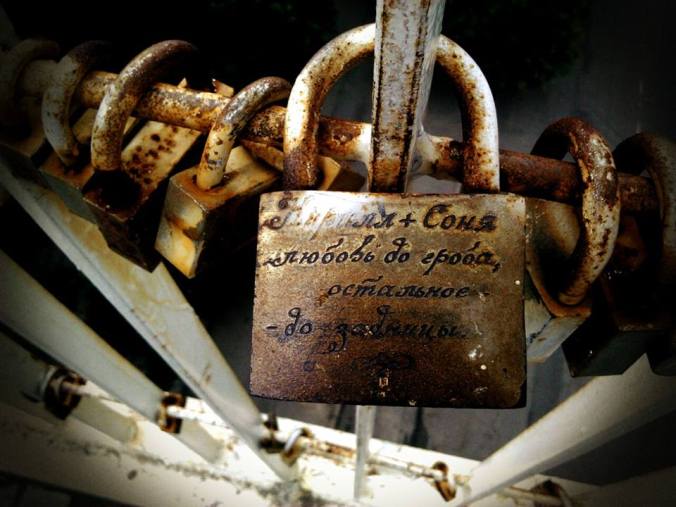
Lover's Lock

Lovers have placed padlocks on the Teschin Bridge in Odessa for decades, often on their wedding day.  After clasping the lock, they walk down to the shore of the Black Sea and toss their key into its waters.  Then they go home and do their best.  The locks remain, though, and are viewed by some as a testament to the permanence of the one feeling they hope won’t fade:  true love.

Being from Madison County, an area prone to linking unrealistic romance with bridges, I felt for the Ukrainians.

We rarely know where our feelings come from, we have little control over them while they are here, and all too often we wake up with no idea where they’ve gone.  We spend our breath, we cover the miles, and we devote our dollars to chase the unattainable.  Perhaps we damage love most by forcing on it our own definition of what it is supposed to look like.

In doing so, it’s not the lock that is symbolic.  It is the key.

Several stories exist concerning why the Teschin Bridge was constructed.  One of them states that a high ranking party leader lived on one side, and his mother in law lived on the other.  Every morning she would cook him pancakes, and every morning he would trek down the side of his ridge and up the side of hers to breakfast.

Some will reason he loved pancakes.  Some will reason hers were exceptional.  If reason is the goal, however, then I suspect neither he nor his wife could cook, and the price was right.

Even more realistic yet, I bet pancakes got old after awhile.  I bet burnt ones became more and more common.  Yet the husband continued for the same reason every husband does what he does not want to do:  his wife.

He chose it.  He chose it every day.  He chose it in spite of the pancakes her mother burnt.  Perhaps she threatened him every morning with a rolling pin, or perhaps he knew love was something more than a feeling.  It’s a choice, and every time he made it he clasped the lock again.

The Cattle Sale

20160101_112805

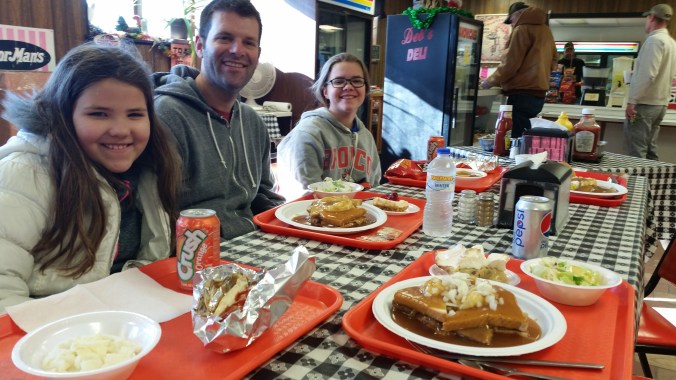
We had lunch at the barn and were now heading in to see our calves sell.  Joining us was a high school buddy of mine and his two daughters.  Lily, 10, was beside me.

“Have you been to a sale barn before?”

“No.  This is my first time.”

“Well, I’m sure your father told you, but try not to look the auctioneer in the eye.”

“Why?”

“If you do and make the slightest movement, he’ll call it a bid.”

“But…I can’t buy anything…I’m just a kid.”

“Happens all the time, Lily.  Some kid sneezes and BAM!  He bought a pen load of cattle.  I’m really surprised your dad didn’t warn you.”

The joke has been around as long as there have been auctions.  I heard it when I was 7 or 8.  I now have friends who are auctioneers.  I still don’t trust them.

Lily sat on her hands for the next hour and a half.

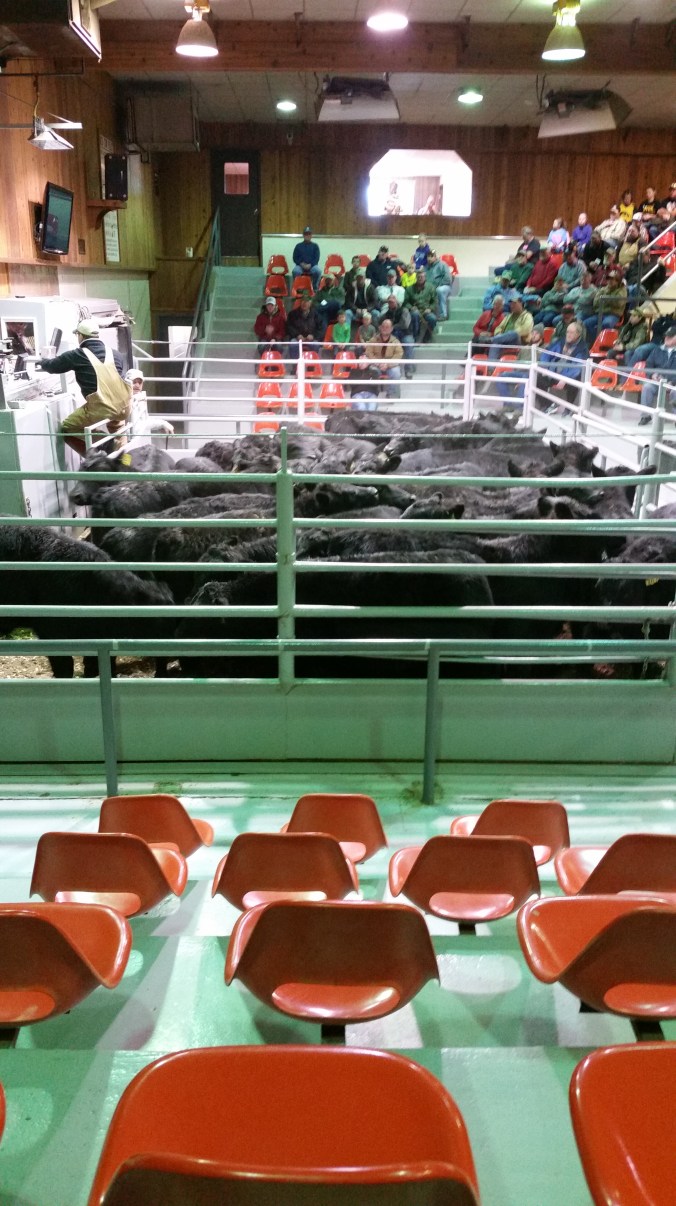
20160101_115618

“That guy in the window is buying almost all of them,” observed Abby, 8.

“He’s what they call an order buyer.  He’s buying cattle for several different places, likely in several different states.  This guy over here by that phone is one too.”

“What are they going to do with them?”

“Well, right now they’re about half-grown.  The buyers will raise them the rest of the way.”

“Will they all be beef?”

“No.  The steers will, but some of the heifers will go back to be cows someday.”

“What if we wanted to buy some calves?”

“We would have to bid against people like the man in the window, and get your sister’s hands out from under her.”  They both smiled.

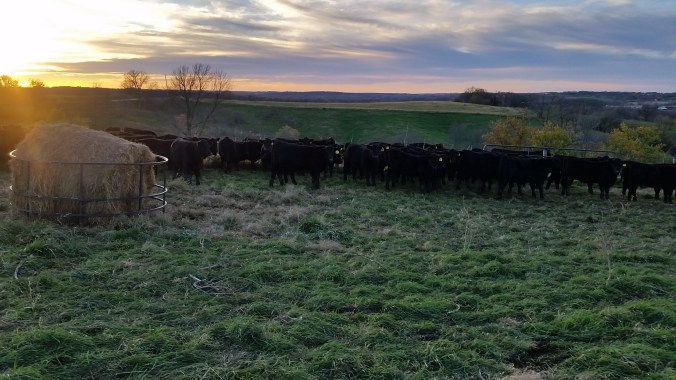
20151101_165553

The calves were weaned the first of November.  They were weighing around 600 pounds then.  Here, on New Year’s Day, they were weighing just under 800.  They had been healthy, beat the mud, and looked good.  They sold well.

“Are you happy with what they brought?” their dad asked.

“I think so.  It’s just over $600 a head less than they did last year, though.”

“Did you say $600 less per head?”  I nodded.  “Wow.  That dollars up in a hurry.”

“Yea, but we are lucky.  The market had a little bounce the last ten days.  Some saw well over a $700/head difference.  Last year was exceptional.  This year is fairly similar to where they sold two years ago.”

“Were people expecting last year’s prices to stick around?”

“Almost everyone was predicting they would.  Some took those predictions with a grain of salt, but I don’t think anyone was expecting this swift of a correction.  It is putting a ding in quite a few pocketbooks.”

“What will people do?”

“Same thing they always do.  Try and make it.”

As we made our way out, Lily was beside me again.

“That was neat,” she said grinning ear to ear.

“It looks to me you’ve found out who the happiest person after an auction is.”

“Who is that?”

“The one that still has all their money.”

The Memorial

“So what’s your process?  What do we need to do to get the magic to happen?  Crown and Coke?”

I smiled.  The thing about the Hawks is their hospitality.  Their kitchen alone is the size of a home.

I was offered a seat in the middle of the kitchen table, in front of a laptop with two Word documents.  The first was the prepared obituary that had already ran in the paper.  The second was the notes from the night before, made as each shared their stories.  Whoever typed them had done well.  Each condensed a story into single line.

Surrounding me was the family of Jim Bussanmas, now deceased.  I was nervous.  A little Crown and Coke should help with that, I thought.

A little is key.  In writing one searches for what we all search for:  redemption.  It’s best not to get sloppy going after it.

“What’s this line,” I asked, taking the first one off the screen:  “‘I never thought I would live so long and have this much fun?'”

“He said that when he went into the VA for the last time.  He was always trying to reassure us.  He did a good job at that.”  As stories continued about his final stay, I placed the line at the top of the obituary.

“It’s quite a quote.  It also says he tried to enlist at 16?”

“He sure did, but they made him wait.  He went in at 18 and became a Seabee.”  Adding that detail to the account of his military service, I looked up to find a picture held in front of me of Jim when he enlisted.  He looked more man than boy.  “Look at how trim he is.  Ladies must have went crazy for him.”

“Dad had a great appreciation for women.  It started with his devotion to Mary, and he would call all of us his ‘dollies.’  He loved my mother, and after she died he would come to love Rozella.  They were quite a pair.”

As this was being said, another picture was selected and held in front of me.  “When the two of them got to laughing the room shook until you thought the walls would come down.”  And as the stories continued, I found the sentences that mentioned both women and added another:  “In their company he was happy.”

The story of an old RV, “Holy Moses,” became a vehicle itself, conveying his love of faith, family, conversation, and travel.  Another paragraph would catch other lines that made his family’s eyes glisten.  One final sentence would capture the story that made eyes more than glisten and would mention the man that called him “Dad.”

A couple of hours, and it was done.  A few more sentences to sum up the years.  I was thanked for writing them, but I hadn’t of course.  Jim had, and a lifetime, and a family, and redemption.  And what were those but all the ingredients necessary for the magic to happen?

Snow and Cows

Reports of a potential blizzard began a week ago.  They always seem to set in motion basic human instincts that remain intact no matter how many generations we might be  removed from the farm.  Last night in the milk or bread aisle of any Des Moines grocery store one could find the proof.

The instincts are just as alive on the farm.  Cows fan out over the corn stalk fields they’ve wintered on to dine on the leaves and husks they’ve passed over many times.  Choice alfalfa hay awaits them in a ring, but they lose interest to devote themselves to finding whatever goodies the snow might cover up.

20160201_125845

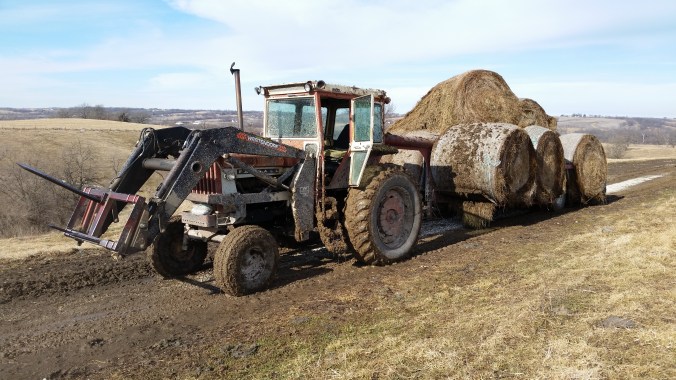
We were gathering too, making sure we had plenty of feed on hand.  Since this storm was coming a month and a half prior to calving season, we took Saturday to sort our way through the various groups of cattle and regroup them according to age and need.

20160202_091317

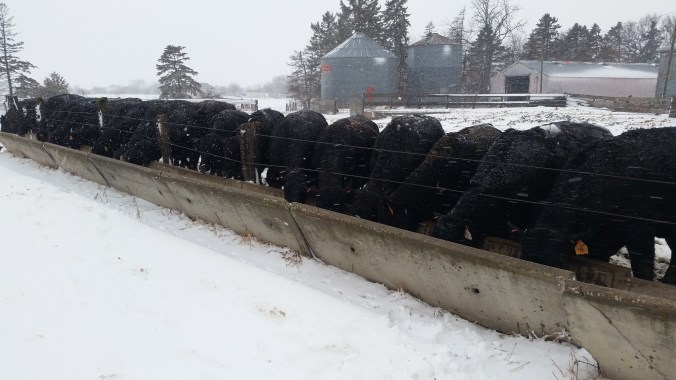
First were the 2 year old bred heifers above.  They will begin to have their first calves after the beginning of March.  They are faced with the nutritional demands of continuing to grow, carrying a calf to term, and successfully getting bred back this summer.  Current nutrition will impact all of that, and right now they are enjoying an extra 3 pounds of corn each.

20151228_100416

We sorted through our largest group of cows, made up of those that have had two calves or more.  We looked for any that could use a little more “condition” or fat cover.  While all of them were adequate, we like to send them into calving 80-100 pounds above their average weight of 1350.  We feel it aids them in raising healthier calves, helps to ensure healthier mamas, and sets the foundation for a successful breeding season.

We moved 5 head of older cows off this group and placed them with the 3 year old cows getting ready to have their second calves.  Like the 2 year olds, the 3 year olds are still continuing to grow.  Often raising their first calf left them with less condition than their mature counterparts.

The forecast called for a mix of rain and snow coupled with heavy winds.  A cow’s hide will loose most of its insulation value when it is wet, and this places a great nutritional demand on the cow to burn enough calories for heat.  During these conditions or periods of extremely cold temperatures, we will put out a week’s worth of a self-fed supplement, helping to cover any caloric deficit.

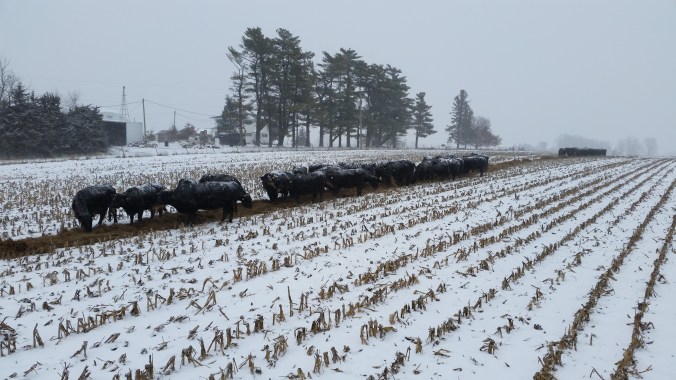
Finally, the cattle will naturally seek out cover provided by the environment.  On the left, our heifer calf crop takes advantage of the windbreak behind the farmstead, while on the right, our mature cow herd takes advantage of one across the road.  I don’t know what amazes me more, some of the places they pick, or how consistently they pick the same places year after year.

In the end, the blizzard was a bust.  The cows and I didn’t mind.  Here’s a link to a year old Des Moines Register video with yours truly talking about taking care of cows in winter and setting the ground work for the topic of this blog next week:  http://www.desmoinesregister.com/videos/money/agriculture/2014/11/30/19700233/

Online Dating

Fifteen minutes in, the gal across from me asked if I had ever considered being a priest.  We had just met.  I figured I had a couple of options.  Either she was telling me she felt comfortable sharing her story, or she was kindly suggesting that I should consider a life of celibacy.  Just then, her phone went off.

We had met at 10:30 on a Sunday night, just after the first of the year. She thrown it out as a possibility because it would be another two weeks before she had a free night. As I drove to the west side, I wondered who would want to meet me for a beer at this hour.  I was pleasantly surprised.

“Do you need to answer that?”

“No, I’ll just text her.  Sorry.  It’s a friend of mine checking in.  I got to wondering who I might meet at 10:30 on a Sunday night.”

I smiled.  “I wondered that too. Do I pass?”

“Barely.”

In some ways dating is different at 39, and in some it remains the same.  The classroom of my youth has been replaced by an online dating site, and notes are now passed electronically and without check boxes.  It’s for the best.  Grownups don’t feel the need to take time saying they aren’t interested.

At some point numbers get exchanged.  When I was young, this was done to call.  Now it is done to text.  The young have no idea what the real world actually looks like and are eager to find out.  Grownups do, however, and seem content to keep it at bay a little while longer.

“What’s been your experience on Match?”

“I haven’t been on it long.  I feel I’ve met good people. It always amazes me what two strangers wind up talking about.  It’s like the profiles, though.  No one wants to put themselves out there until the other goes first.  You?”

“I was only on for a few days.  It was so overwhelming I got off.  I haven’t dated in a long time, and I’m still trying to figure out if I’m ready yet.  All I have to offer right now is a friendship.  Most guys aren’t interested in that.”

“I think I’ve got room. Why did you reach out to me?”

“You put yourself out there.  I liked that.  What else have you learned online?”

“Seems like everyone is looking for whatever they were missing in their last relationship.  The problem was the last guy, and the answer will be in the next.  It’s hard for people to look at the fact that the most common denominator in our failed relationships is ourselves.”

When it is two strangers, the tendency is to lay it all out there, at least for me.  That night I was reminded that I tend to overdo it.  I looked up to find her large, deep eyes damp.

“I know I’m the common denominator. I look at my past and struggle with what that says about me.”

“I wasn’t directing anything at you.  I’m sorry. For what it is worth, I am a common denominator too.”

“I think you are right about people. I’ve spent the last few years trying to become the person I want to meet.  I have no idea how I’m doing.  It is hard. How do we know when we are ready?”

“Well I’m enjoying meeting you.  I don’t know how we know when we were ready. Maybe we don’t until we are in it.”

“What are you looking for?”

“Mutual respect, I think.  If one can keep that intact, maybe however things turn out doesn’t matter.” Even at 10:30 on a Sunday night.

Just Around the Corner

He was older than how he spoke.  I suppose it was the way God had left him here to share his time with us.  Once I had spent part of an afternoon with him, and finding him now, standing up against the corner of a wall, I made my way over to say hello.

“Do you remember me?  We worked together last fall.”

“Yea.  You’re that nice guy that’s easy to talk to.”

Unprepared for that, I rolled out the standard, self-deprecating humor.  “You must have me confused with someone else.” I smiled and look up in time to see him lose his.  He thought he did.

As his eyes turn down to his feet, I understood the dignity I had denied him by refusing the kindness he offered.  It felt shameful.  I tried again.

“It was a poor joke.  I meant that I don’t think most people would describe me that way.”  And his face lit up again, and we were off in conversation, from trains to baby calves and any place he wanted to venture between.  Before long it was time for him to go.

“You are welcomed to help us anytime, you know?”

In him I could find no malice, no reservation to share what made him happy with others, nor any inkling of fear about the dark recesses of our hearts.  It was easy.  As he left, I suppose a little shame lingered at how I, like most of us perhaps, work against myself to make it hard.

Maybe someday we will round the corner.