The Anxiety You Bring Yourself

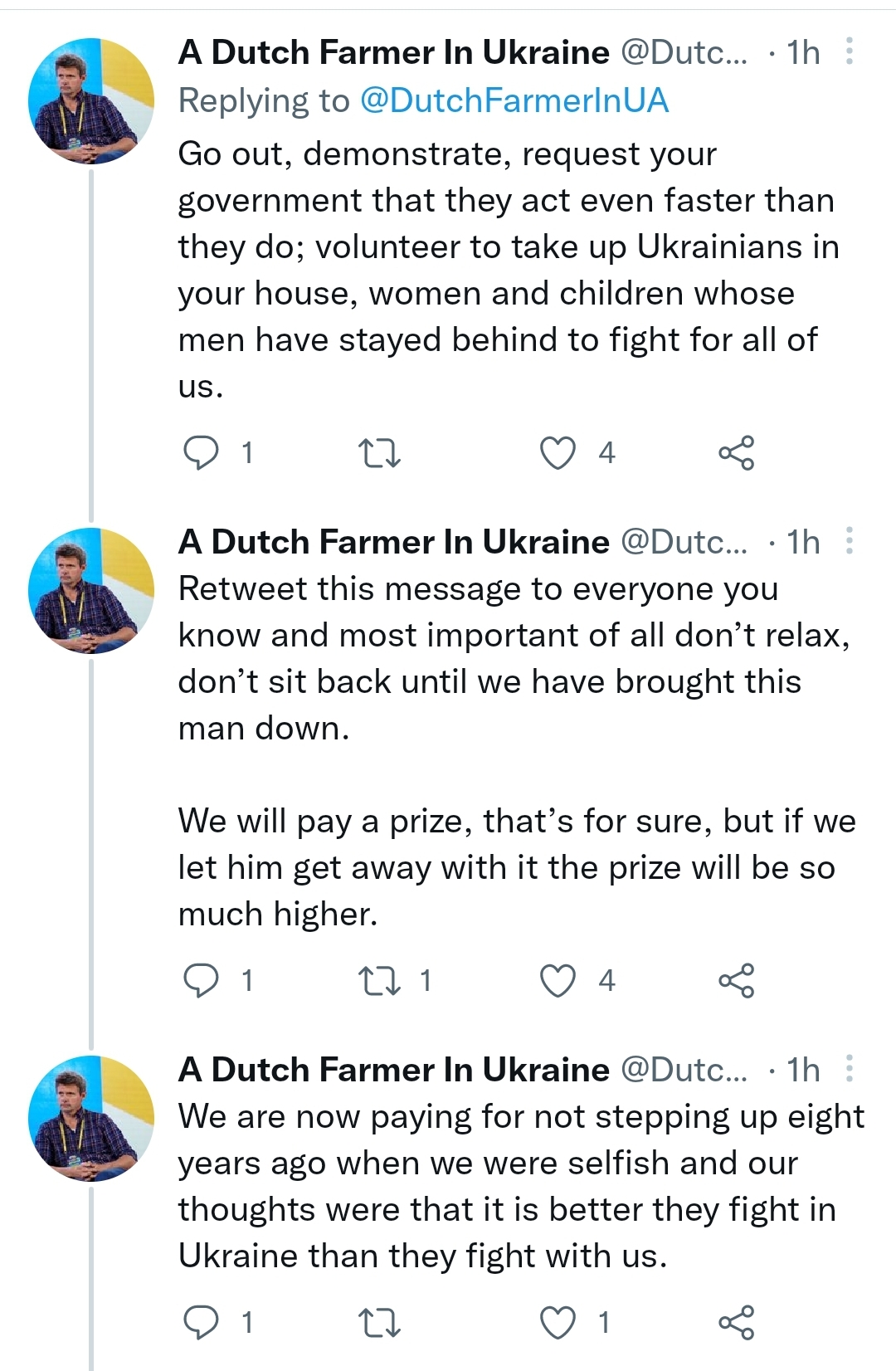
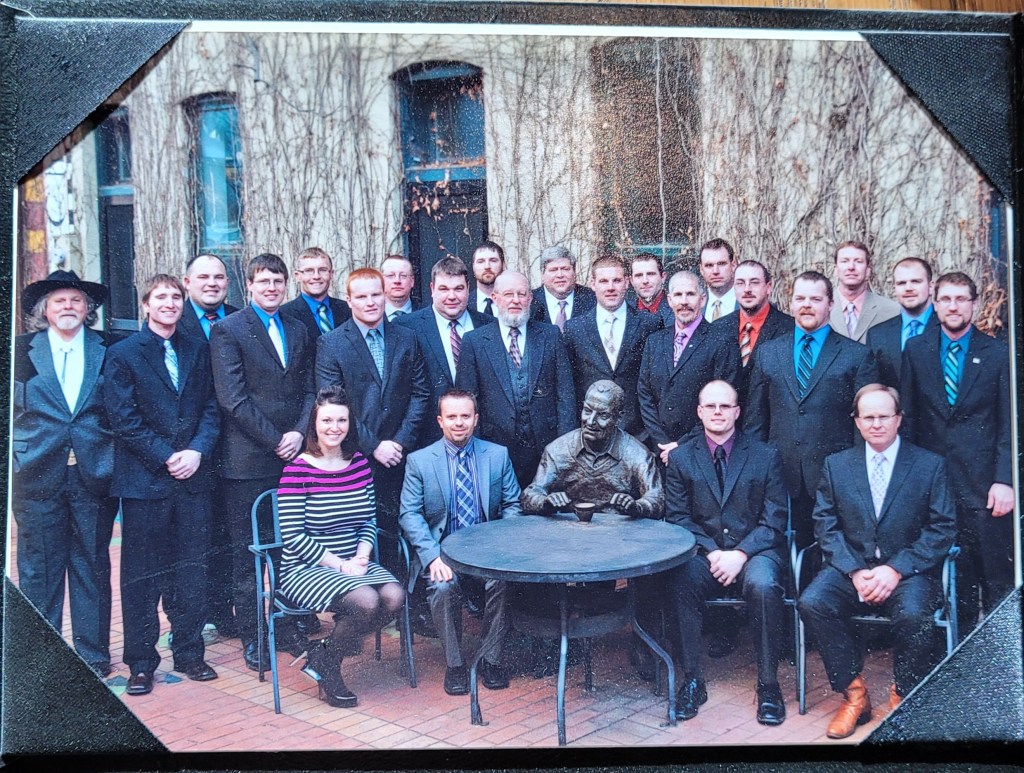
2013 Iowa Farm Bureau Ag Leaders

In 2013, I participated in the Iowa Farm Bureau’s Ag Leaders Institute. I credit a lot to that experience. This morning, as I write, I’ve been trying to figure out why.

I had participated in other leadership programs before. Most of them had left me trying to figure out how to fit in with the group. Ag Leaders began to teach me how to more better develop myself. This was due to the program, headed by Mary Foley Balvanz, and it was due to the people I found myself surrounded with.

At some point, Mary gave us a creative writing assignment. For some reason I didn’t phone it in, but rather tried to string a few sentences together in a way I had hardly done since college. Reading it before the group, I could feel my face getting flush, and thought about how stupid it must sound, and wondered why I ever thought it was a good idea to attempt it in the first place. I quietly took my seat and sat there until we took a break, at which time Chris Prizler came over before I could get up and said, “Man, that was amzaing.”

I’d go on to write a little about my experience that summer, during an Iowa Farm Bureau Market Study Tour of Ukraine. Eventually I began a blog, and later I’d mostly give it up as I became part of the Des Moines Writers Workshop, which helped me get feedback from other writers and challenged me to try to make myself a better one. Occasionally, I’ll still post, most of which has been to celebrate the life of a late friend or advocate on the topic of mental health.

In the workshop, I’d cross paths with the late Mike Beecher. I began to write so that I might hear a particular comment from Mike, “I think that took a great deal of courage.” I supposed he helped me realize those were the only topics worth writing about.

At some point, I also began to realize there was safety in writing for me. I could do it as I felt motivated. I could edit endlessly, always going back and recrafting until I was saying just the right thing, exactly how I wanted.

I used to think life was about learning to say the right thing. I realize now saying the right thing is but a small part of it. People say the right thing all the time, but they say it in a way that doesn’t let it be heard. They confuse the fact that they aren’t heard for some type of martyrdom, when in all reality they are a step short, refusing to self sacrifice the last bit that gets in the way.

Beginning a new year, I decided I wanted to leave the safety of writing behind. I had mostly fallen out of practice anyway. I want to focus on being better at speaking, talking about a thing that took some courage. I reached out to Mary, and I asked to speak on the topic of mental health in agriculture to her current Ag Leaders Class. She was receptive, and in August granted me a part of the day’s program to give it a go.

It was a topic I had talked a lot about before in one on one conversations with folks I knew. I had written about it, and I think the fact that I had written about it made the topic more approachable for people I knew to bring up. That and I guess the fact that folks often feel comfortable sharing where they are at with me.

This would be to a group of relative strangers. I’d be giving it cold, without an exchange on niceties, and our families, crop prices, and the weather. I knew what I didn’t want it to be. I didn’t want a powerpoint presentation. I wanted to try to make it conversational so I scribbled a couple pages of handwritten notes, and in the days leading up to the event, I’d practice as I drove around in how I might deliver them.

I was terribly nervous, which was to be expected. People want an anxiety-free life. People also want to feel like the have lived a life well lived. I have never found them to be particularly suited to each other.

I started talking about my old Ag Leaders group. I knew that would make me comfortable. And then I transitioned qucikly in the following way:

It’s a funny thing getting to know new people. The things you share. The things you don’t. That group that year wouldn’t have known that I was recenlty divorced, or that I was trying to manage a new business, or that my father had been diagnosed with a terminal illness, or that I was consumed about what that meant for him or the farm. I certainly wouldn’t have told them that I was talking to a therapist, or if you prefer, a coach. Yet here I am today, still talking to them every month and telling a group of strangers about it.”

I suppose it was a group of 25 people or so, and while I typically maintain good eye contact while I speak, I had taken a brief break from it to deliver the lines above. When I looked back up, I felt I had every set of eyes in the room squarely on me. Then I did feel nervous.

I’m no stranger to the idea that establishing an emotional connection with you audience helps them connect to what you are trying to say. I just didn’t anticipate the connection I felt at that moment, and what followed for me was the most I had struggled in delivering remarks to a group in a long time.

Amid the nerves, I tried to continue on.

Mental health is health. Talking to someone on a regular basis is someting I do. For a long time, there hasn’t been the feeling of something chronic. You look at life, and try to figure out how to be more present and accounted for to yourself in your relationship with others. For me mental health is professional development. It is about becoming better at self management, more resilient, and more effective in how you communicate.

There’s a stigma surrouding it and it cuts both ways. People worry if they talk to someone, folks will think they have “problems,” whatever that means. But the reality is when I speak to folks about why they don’t seek help, they usually say they don’t think their “problems” are big enough. I don’t know what your problems pile up to, but I do know you and the people you care about are worth it, 100%

I told them I was talking to them about it because I figured I was a lot like them. The more you do, the more people give you. “I bet a lot of you don’t say “no” very often.” There’s nothing wrong with that, but things can really stack up. The ability to withstand one storm is often tested by an even larger one, or ones in quick succession.

It’s further complicated in agriculture. Your friends see their family on holidays. We work with them every day. Along with it comes huge generational pressure. The pressure to keep it going, admist markets and weather that we aren’t in control of. Not to mention that the distinction between life and work is difficult to find most times.

“A story I often go back to is that at the end of the day, we are all dealt a hand of cards. Many we don’t have much control over. Where we are born at, for example. If it rains this year, for another. You’re going to find folks that you feel have been dealt great hands, but won’t make the effort to learn how to play their cards. You’re going to find folks that have been dealt extremely tough hands, and play the hell out of them. You’re going to find yourself hoping for better cards. We can’t deal those to ourselves, but in playing our own hands better, perhaps we can deal them to others.”

It writes much better than I spoke it. I havent struggled that much in a long, long time. The group was kind enough to ask questions, and with a face flushed I answered them. It felt remarkably similar to a spot I had found myself nearly 10 years before.

When they were done, I made my way back to a friendly face at the back of the room. I heard Mary say, “He writes this wonderful blog “True Stories and Tall Tales.” He used to write it regularly. I wish he would again.”

“This would make a good blog post,” I thought, and I wondered if I had ever told her how impactful she’d been in all of it. “Maybe that would make a nice blog post too.”

Sometimes I hear someone say what they think leadership looks like. Most of what I hear is bullshit. Folks will tell you leadership is the offspring of courage and confidence. I think we mostly say it because we want to believe it. This in spite of the fact that personal experience will tell you most folks with confidence would be better off if they had a little less courage.

When I see leadership around me it’s usually a product of courage and anxiety. Either someone dipping a toe into something new, or someone having done so once sharing what they learned. Mary Foley Balvanz taught me that. She and the Ag Leaders Class of 2013 gave me a little courage. The anxiety I brought myself.
Privilege

Flying hime from Reno a week ago involved a three hour flight to Dallas/Ft Worth.  Upon boarding the plane, and finding my seat just one row from the back, a noise came behind me from the last row and the people I had overlooked.  It was the shrill yell of a small child, seated against the window as I was.

Its nothing, I thought.  They just need to settle in.  Besides, it wasn’t like I was the only one that could hear it.  I figured nearly the whole damn plane could.

On takeoff the roar of the engine muffled the yells a bit.  The turbulence after, muffled it further.  The plane felt like it was dropping hundreds of feet at a time.  The first few I rode out without reacting, eventually I pushed my hand ahead and clutched the side of the seat in front of me.

At any moment I expected that shrill scream to give way to cries of terror.  It did not.  It just kept marching on, enthralled with its own sound.  It continued to do so over the next three hours, the first ten of which were spent afraid that I might die.  The next two hours and fifty minutes left me regretting that I had not.

I resigned to watch a documentary close captioned on my phone, and as the shrieks continued, I followed more and more intently the tiny words on my screen.  At one point a stewardess intervene and attempted what his mother hadn’t and offered him a popsicle to quiet down.  It did not work.

An hour in and his older sister started flipping the latch of her seat belt.  It only took a minute of that coupled with the shrieking to cause a woman a few rows up to loose her shit.

“Would whoever is clicking that seat belt please quit it?” exclaimed the woman, in a voice about to break.

The clicking stopped.  Her younger brother went on.  The beverage cart had gotten close enough that in between shrieks I could hear what the folks ahead of me were ordering.  If there was ever a time when a beer was worth ten dollars, I thought, this is it.

I ordered a diet coke anyway.  On my screen i kept progressing through the lives of the boxers, Sugar Ray Leonard, Thomas Hearns, Marvin Hagler, and Roberto Duran.

Maybe he has a disability I reasoned.  Maybe they are just too young, still I couldn’t help but wonder how for two hours his mother didn’t try.

When we finally made the gate a mother with two young children of her own, neither of which had made a peep, moved back a row to sit directly across from the mother and two kids behind me.

“Hi,” she said, “What are your guys’ names?”

It was their mother that finally spoke.  “You can have them if you want them.  I’m done with them.  I tried to get my tubes tied after the first one, but they wouldn’t let me.”

At that I turned, finding two kids older than I imagined, with seemingly nothing wrong but their mother, whose eyes lay deep in a moist haze and the filthy white skin of her face.

“Do you want them?” she asked, turning her dead gaze to me speaking in a way that made it difficult to tell if she were joking.

All I wanted was the shrieks of her son to make her ears bleed and stop the words I heard from coming out.  For the first time in three hours he was silent.

I let them exit the plane ahead of me, so I might finally create some space between myself and them.  Getting my bag, a young black stewardess spoke to me.  “Thank you,” she said.  “I’m so sorry.”  Before I could say anything, she turned to her coworker, “Did you hear that?” with a look of pure astonishment and shock.  She mouthed the word ‘unbelievable’ as I walked away.

Just two weeks before, I was sitting with my mother in an ER room watching my father battle a sepsis infection.  His heart had been racing and now they were struggling to keep his blood pressure up.  He was awake for the first time in awhile.

A nurse came in and seemed secretly alarmed my father’s blood pressure had dropped even further.  She tried to nonchalantly move his blood pressure band over to the other arm.  I waited for it to reappear on the monitor.  It read the same.  She removed it and read it by hand.

“Any different?” I asked her.

“No,” she said.  Then for the third time in 20 minutes she asked, “Richard, can you tell me where you are right now?”

“In bed,” he cooly replied.

It broke the tension and the nurse’s shoulders convulsed in laughter. “You got me there.  Where is this bed at?”

“Same place it was five minutes ago, Mercy Hospital, downtown Des Moines.”

“Who’s the President?” she asked.

“We don’t have one,” he said.

“Sounds like he’s fine,” said my mother.  The nurse laughed again.

“We need to get your blood pressure up,” she told him.

When she left, from the seat of a hard plastic chair I told my father, “I’m sorry you are going through all this.”

“It’s all right.  I’ve lived a good life.  I’m old.  Things wear out.”

Some things sooner than others I think.

The day after I returned, we got my father back home. The infection behind him.

Working Cattle

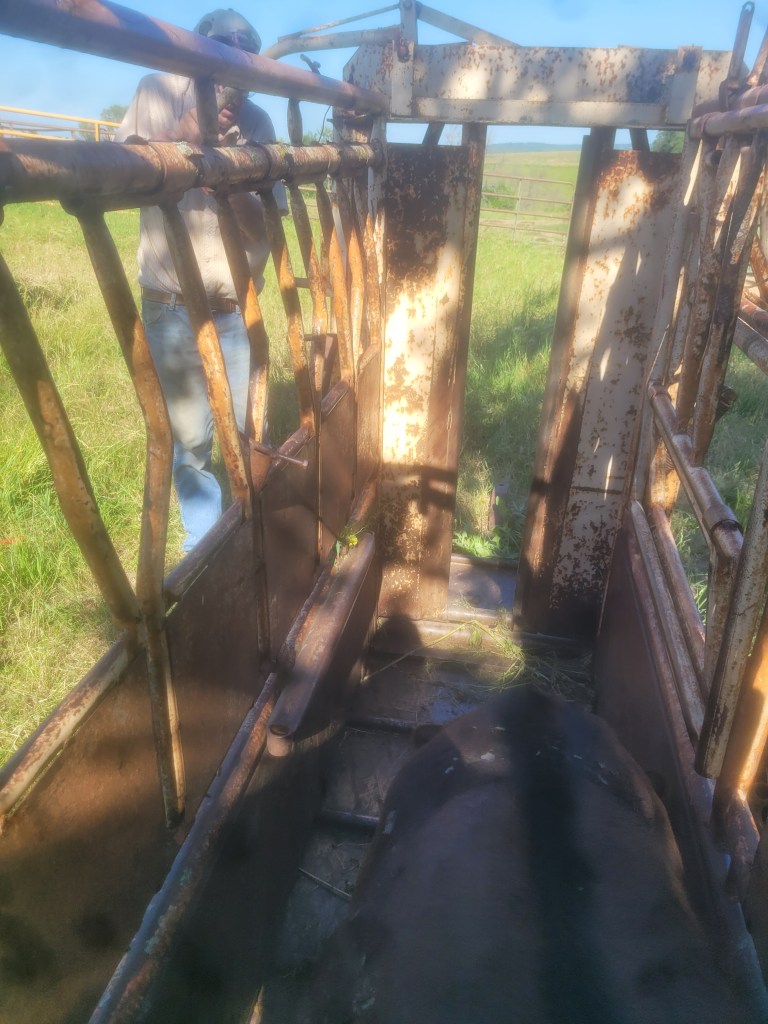
On a Sunday in mid-June I discovered pinkeye was doing a number in 60 head of calves in the commercial cow herd. It was mid-morning of what was to be a hot day, and the window to work them had closed. I set my sights, then, on the next one.

My sisters, between work and baseball camps, couldn’t make the next day work. I couldn’t ask my friends in good conscience. They had work, and the short notice couldn’t be excused by the fact that I am family.

“I could do it,” said my father.

In the morning I was certain I could get them a quarter mile to the corral fine on my own. Beyond that some help would be nice with the sorting and the catching.

“I don’t know, Dad,” I replied.

My father has idiopathic pulmonary fibrosis, a gradual hardening of the lung. This spring he went on oxygen. We’d all complain, but he was diagnosed in 2012. They wanted to put him on oxygen, then. He was stubborn.

He got into a drug trial in an effort to help others. Prior to the trial, the only treatment was an antacid, a multivitamin, and trading for someone else’s lungs. That is if someone wasn’t using them at the point you got poor enough to need them, and had stabilized enough for a surgeon and a transplant specialist to say, “What the hell.”

In the trial, Dad would later find out he got the drug. It was meant to slow the progression of the disease. It was approved after it had done so for most participants. For Dad it did something for him it did for no one else. He got better.

Eight years later I was with him at a doctor’s appointment. She asked him if he remembered when he first came in. He told her he did. “I was just trying to buy you another year,” she told him. “We passed that a long time ago.”

Last year she congratulated him on being her longest lived patient. My father wondered if that congratulation came with an improved hospital parking spot. This was the same guy wanting to work calves now.

He always wants to help. Sometimes I’d like him to have plans other than that.”

“Like what?

“I don’t know. To go places and do things. All the things I’ve got to do because of him.”

“Have you told him that?”

“I have.”

“What did he say?”

I tell him I want him to spend time doing what he enjoys. He says he is doing what he enjoys.”

“Do you think you can accept that, then?”

“It’s hard.”

“Why?

“Because I know I’m not worth all of that.”

Back at the ranch, we started getting the cows in at 6:30 the next morning. It was cool and they moved easy without wanting to bunch in the heat. Into the corral and then the sort pen with my father after them like his faithful border collie, Rusty.

My father was on the gate as always, and a portable tank of oxygen was in his truck. They sorted well, and Dad took a break. I moved the calves up closer to the catch chute and began sorting the haves from the have nots.

At some point I notice a collapsible Coleman camping chair being positioned between the pickup and the chute. The portable oxygen was deployed as well. One by one we made our way through the calves.

Occasionally we took a few extra minutes.

Ten days later, trying to bat cleanup on any infections still lingering, my father piloted a Kawasaki Mule bringing them up, while I flanked them in a Chevy truck. This time we were trying to fit it in at the end of the day, thinking the heat Ihad abided enough.

The air was in the low 80’s, but the cows were still too hot. The front ones wanted to stop and bunch, while the bulls covering them wanted to stop and fight. It was all too much for my six year old nephew, Easton, tagging along with Grandpa in the mule with his Mom.

“I’m scared, Mom.”

“About what, Easton?”

The bulls were fighting right outside the Mule, and he and the rest of its occupants were not protected by the doors and windows of a full cab.

“I love Grandpa, and I don’t want anything to happen to him.”

Meanwhile, Grandpa let out a war whoop that would have made old Rusty proud.

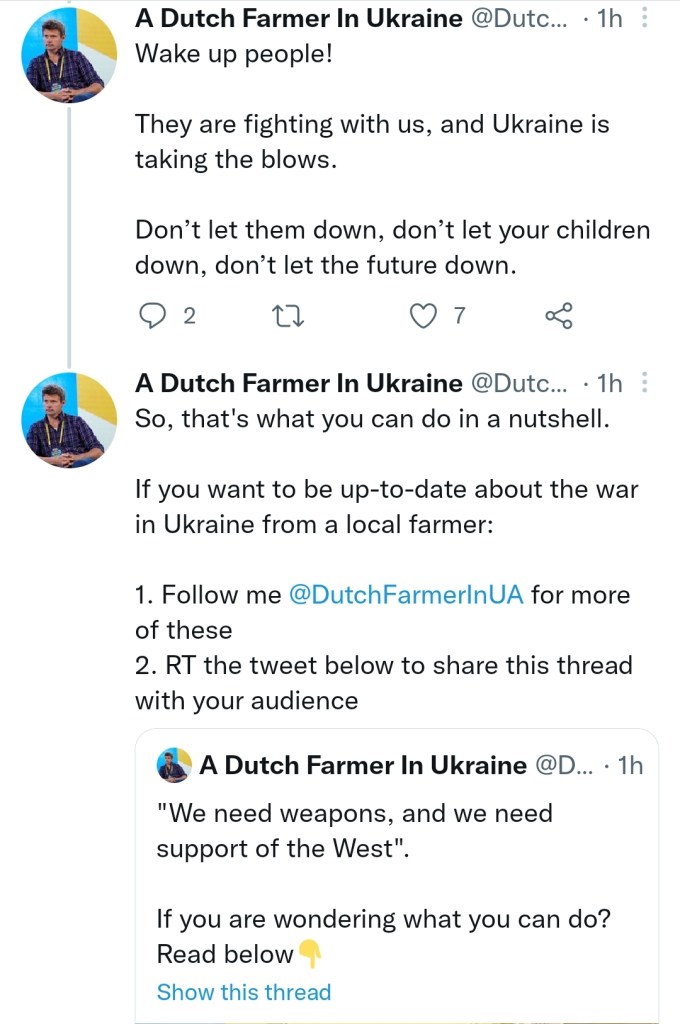
A Dutch Farmer in Ukraine

In 2013 we visited this farmer in Ukraine.  Sometimes what I write gets summed up in fewer words than what were spoken.  Sometimes it’s several different conversations merged into one.  In my blog, this particular farmer, Kees Huizinga, is the one who makes the comment on Ukrainian villagers and what they read.

Kees is immediately likeable. He talks with a passion and energy that is infectious. If there was any momentary barrier in language, it didn’t matter. Who he is translated perfectly.

His respect for the Ukrainians shone through.  He talked about what a pleasure it was to share homemade vodka in their homes. How they made him feel welcomed, and what a rush it was to have a conversation with a people so engaged on the really big questions of life.

Watching these people fight for their country. I think of how our own must have been once, before it is like it is now.

The village near him was remote. Livestock roamed in people’s yards. A huge community garden was just outside. We would think of them as poor. At the time some were survining on a little more than $600 a year.

Were you or I passing by, we wouldn’t have said two words to the people we found there, but the conversations Kees was having were changing his life.

Today we have this western notion, that everything is going to work out, because usually it does, I guess. We find comfort in the hope that maybe everything is happening for a reason yet to be revealed. Maybe were we in their shoes, because of those thoughts, we would rise to the occasion and fight.

I don’t think the folks you are seeing on TV have those thoughts, however. In the last hundred years alone, Ukraine has no doubt witnessed millions of people killed worse than cattle. From the Holomador, to their Jews in the Holocaust, their soldiers in WWII, and Stalins whims and Nazi incursions. I don’t know if that’s much of a departure from the rest of their history.

I don’t believe the Ukrainians are comforted by the belief it’s all going to work out. At this point, I don’t suppose they think someday there’s going to be a reason big enough to soak up all the blood thats be spilled in the last century. I would guess many do know God is with them, and they probably feel like He’s the only one at times.

I lost count the number of times I heard people express, ‘God’s in control’ during the last two years. I don’t know how I feel about that. If He’s in control, He’s letting a lot of shitty stuff happen. Maybe He’s just expecting you and I to do a little of His work.

There are some Ukrainians and Dutch working their asses off. They might not expect a thing, but they do know you sure as hell better try. It’s hard not to notice that, thanks to Kees.

Ring Them Bells

Towards the end of our journey through Ukraine, we finally settled down into the port of Odessa.  Gone now were the rough and winding roads that occasionally ended in dead ends not yet mapped.  Gone as well were the mass of people traveling with us along them, by horse cart or motorcycle, in old communist cars or over-crowded city buses, or on foot in high heels in areas so remote there only purpose could have been to garner interest for a ride out.

Gone were the rural villages with their houses guarded by concrete walls, which held livestock in and the West seemingly out. Gone were the crumbling concrete edifices of old communist apartment buildings, with walls covered in air conditiong units, latticed with random wires, and balcaconies enclosed in plywood. Gone were abandoned factories.

It seemed the only rural fingers which made their way into this port town were grain and stray dogs.

Here in Odessa, there were tree-lined streets and mowed grass and even lovers on occasion.  Communist party members had vacationed here, one of us observed, and they were wise enough not to shit where they slept. This they had in common with the stray dogs, but commonality ended here.  The dogs were indifferent about where they vacationed.

At the port we found the Black Sea, and it lay open ahead of us.  At its shore were tied up cruise ships, barges, dinghies and yachts with names like “Lady Luck.”  Towering above them in the nearby shipyards and were massive cranes, yet even at the great sea’s shore they could not reach its bottom and busied themselves instead with what floated on top of it.

Above the boats and below the cranes, at the furthest point of our pier, was an Orthodox church. From its far end against the sea, rose a bell tower.  It was Sunday morning.  At this tower every 15 minutes or so, a boy appeared, darkly tanned, dressed in jean shorts and a t-shirt.  Among the collection of bells within the tower he would hammer.  He hammered well.  Were Odessa silent, the bells would ring as far inland as they did out to sea.  This boy straddled the coast, and with his ringing I began to reflect on what I had seen.

We had seen American farmers in Ukraine. We had seen the Dutch. We also saw the Russians. After viewing the Dutch run farms it was difficult to sleep at night, thinking about all the low hanging fruit, and how quickly they would become competitors to us. After viewing the Russian farms, with modern tractors abandoned and varying modern implements being raided for parts, we slept better.

At the beginning of the journey one farmer gave us his take on the Ukrainian condition.  “Years and years of communist rule has left the average Ukrainian unable to think for themselves.  They don’t want responsibility.  They can’t handle it.”  His long time Ukrainian right hand man was present for this.  So may have been our Ukrainian guide.  I don’t recall where the bus driver was, but he spoke no English so it didn’t matter.

He fed us a large lunch of traditional Ukrainian staples, as well as beer and vodka.  I ate to my heart’s content, as his Ukrainian cooks, both markedly attractive, brought out course after course.  In the end I wound up with indigestion, but the cooks were not to blame.  I suspect my conscience had done it.  I plyed my conscience with the booze, and it worked nicely.  Writing about it now cleared it up entirely.

It is easier to go with the flow than take the responsibility of raising an objection; especially when the flow is feeding you.  This is as American as it is Ukrainian.

“If you want to get a handle on what these people have faced, read The Bloodlands by Timothy Snyder,” he said. When the Soviets came to power they sort of laid the law down in each village and moved on. They came back in a month, and if you weren’t doing what they told you, they lined you up against the wall and shot you. After a couple rounds of that, those left understood not to do anything unless someone told you to. It’s still like that today,” he opined.

Another farmer offered a different take. “The Ukrainian villager may not have a satellite dish, we might view them as surviving only on subsistence farming, but they are highly literate, much more so than we are.  I don’t mean a higher percentage of the population can read.  I have no idea about that.  What I mean is that a higher percentage does read.  All the houses have books, and they are not just any books, but Tolstoy and all the other Russian and Ukrainian greats.”

On our way through, passing immense fields worked by fleets of new tractors and harvested by teams of new combines, a lone horse cart sat on one end of a five acre field.  Working here was a solitary man with a pitch fork.  He was turning over a field of hay.  In the countryside there were no fences, and in a day or two we would begin to find 2 or 3 people keeping watch over the village’s cows or sheep for the day.

Since the fall of the Soviet Union, the whole country is held in small 5-10 acre chunks by villagers, and assembled into much larger tracts by their tenants.  There is no open land market in Ukraine. How it is leased is still impacted by the communists rise to power. 

1932-1933 was what some call the Holodomor (Extermination by hunger) in Ukraine.  Stalin had seized the wheat, and by spring 1933 general estimates are that around 3.5 million people had starved to death.  The Soviets did the best they could.  They printed posters warning the peasants to refrain from cannibalism and prosecuted 2500 for doing it.

To this day most villagers take their rent in bags of wheat, not cash.  After a year the crop is sold and a new bag takes its place. If God hates a coward, I should think it harder for Him to find one here than other places.  Perhaps I am sentimental.

What does the future hold in store for Ukraine?  I can’t say.  I can say perhaps our presents, though, aren’t all so different.  We are both trying to do the best we can, but find ourselves only able to do the best we know how.  Perhaps we both might show each other how to do better.

“Ring them bells ye heathen from the city that dreams.  Ring them bells from the sanctuaries across the valleys and streams.  For they’re deep and they’re wide, and the world is on its side, and time is running backward and so is the bride.”

Telling Our Story Through the Beef Checkoff

There’s a story my Dad was fond to repeat when I was growing up. It was about a local guy, taking a load of fat cattle on an old stake bed truck into the packing plant located near downtown Des Moines. It was a nice day. Folks had their windows rolled down, and this would prove to be unfortunate for the poor woman, parked in the lane beside him at a stoplight, when a steer in the back lifted his tail, shot through the slat side, and right into her open window.

She was disgusted. The driver was undeterred. “Don’t worry ma’am,” he is said to have remarked. “It’s only grass and water.”

I suppose the beef community has always had its advocates. In the decades that have passed, the story has become more layered, our connection to consumers has become a little less personal yet more developed, and our advocates have become more skilled in communicating the story behind the product they raise. Still, sometimes all of those things have to face some pretty strong headwinds.

This has become increasingly evident this spring. Robust demand for our product and the good price consumers are willing to pay for it isn’t translating to higher prices on the farm. While this issue commands the most attention, it isn’t alone. Feed and input prices are rapidly climbing, dryness in some areas is expanding, and the forecast for the summer ahead is full of as much uncertainty as I can recall.

On some issues we face and of some remedies proposed there seems to be consensus within our community, and on some we find disagreement. Farmers, ranchers, and feeders want to know what anyone is doing about finding a solution, what efforts are working, and which are not. They are frustrated, and it couldn’t be more understandable.

Against this back drop, one morning on the farm, I found a month old calf with her leg tangled in three strands of a new barbed wire fence and her mother waiting anxiously beside her. The new wire was so tight, I couldn’t release her until I ran back to the farm, grabbed the wire cutters, and cut her free.

The wire had tore to the bone on both sides of her leg. The local veterinarian took care to clearly spell out that her chances were slim. Yet even against the backdrop described above, there was no debate about how we were going to proceed. We gave her the best care we possibly could.

As a producer, I need favorable economics to survive. It seems like a big hill to climb right now. Yet across the valley of this current spring is another peak, I think of equal height, about who we were, and why we do what we do. These two, on our farm, have to work together. Your Beef Checkoff works on both.

That’s hard to remember sometimes, specifically because strong demand and a good price from consumers are things we would like to point to as something enhanced by checkoff efforts. I understand the obvious concern raised when not as much of that price is making its way back to the farm as we would like. An uncomfortable question we might ask ourselves is where we would be without that demand and without that sense of value consumers feel they get from our product.

I’d like to think a remedy can be found in governmental policy or the enforcement of law, but neither are in the arena the checkoff is allowed to operate in. Against this backdrop, we sometimes lose sight of all it can do.

I have a good friend who is a photographer, well known in Iowa agriculture and beyond for his work. He knows how to select the right equipment, catch the right light, and how to position himself at the right angle. He also knows how to capture images that resonate with folks. About the latter, he knows two secrets we as producers too frequently miss. Or if you don’t, I do.

The first secret is about the power of the images he is capturing. It connects folks outside the agricultural community to a story they want to know and be part of. That connection coveys a sense of trust that facts and figures need to be piled tenfold to equal. The value of that trust would be difficult to measure. The second secret he knows is where to find these moments.

He knows that in our everyday work, the images he’s looking for, the ones that resonate with the consumer, abound. To capture them, all he has to do is spend a little time with us as we do the work we often take for granted, because it needs to be done. In our daily work, we are stewards of our cattle, stewards of our land, stewards of our family and our local communities. Nothing offers you a chance to be the steward of your own story as a beef producer like the Beef Checkoff does.

Other industries are envious of the story our community has. They should be. Over their mountains of facts and figures that glaze your eyes over, stands one rancher watching their cattle graze on a beautiful day or pulling a newborn calf out of the mud.

I’m not aware of anything as dedicated to refining and discovering the value of our daily story as the efforts of the checkoff. I know of no venue that brings our story to such a wide audience, nor offers to producers such an opportunity to take part in shaping how that story is told. I know of no vehicle that delivers that story not dependent on characters and scripts, but with our own lips conveying the true essence of who we are and why we do what we do.

As a producer, I don’t want us to take it for granted. We need the ability to tell our story, and we need to keep telling it, in good times and challenging ones, with any effective means at our disposal, save perhaps stake bed trucks and open windows.

Finding God in Troubled Times

Since the beginning of the pandemic, and the upheaval of the last few years, I keep coming across a message often repeated: There is nothing to worry about. God is in charge. For those who find comfort in that, I don’t want to strip anything away. Hope is a thing the world doesn’t need less of.

What I do know, though, is for some the idea that God is in charge falls short. It falls short for me. If He’s in charge of this world we are in, He certainly has some explaining to do.

Elie Wiesel, in his famous book Night, writes about his experience in the Auschwitz and Buchenwald concentration camps. Perhaps the most famous passage in his story pertains to the death of a young boy, executed by the Nazis. Lighter than the two men he was killed alongside, he languishes for half an hour in front of those assembled. Wiesel writes someone behind him kept repeatedly murmuring, “Where is God? Where is God?” while they stood and watched the scene unfold.

Inside him, Wiesel writes of a voice inside him, giving a quiet, personal response. “Where is He? This is where – hanging here from this gallows.”

Often this passage is interpreted to mean that Wiesel is writing about the death of God. The collapse of his idea that God is in control, and the surrender of his thinking that our suffering happens for some greater reason. What purpose could be worth the most difficult death of this boy and the thousands like him?

Once, in trying to find my own way, a parish priest, Fr. Dan Krettek, recommended to me the book Finding God in Troubled Times. The book’s author, Rev. Richard Hauser, SJ, writes about this passage, and saw it differently than most interpreters. For Hauser the passage evokes parallels to the crucifixion of Christ, and reminds us that being on the gallows is the only place God can be.

Where is God? He is with us, even in our suffering.

The thought has often been a comfort to me, and often one I struggle to translate to those I care about.

A lot of the times, when we tell folks that God is in charge, we do so with instruction on not being worried or afraid. I’ve never been sure why this is, though I recognize that sometimes “bucking up” is exactly what we need to do. But there are other times when the folks we love could be reminded that before Christ’s crucifixion He was so anxious He sweated blood and on the cross uttered the words “My God, my God, why have you forsaken me?”

Sometimes, as a poor Catholic, I find consolation in that, and a strange sense of purpose, and a reminder that I am not alone.

Crossing Rivers

I had opened my eyes to a mostly dark hotel room. A sliver of early morning light made its way around the fringe of the curtain and threw its force into the darkness. Though in sharp contrast, from the bed I could not tell where the light ended and the darkness began. Maybe the darkness has no beginning. Maybe the light has no end.

Outside, the light the summer had lavished now came into a world that was beginning to know the value of its scarcity in mid October.

I was not alone. Beside me was another bed, and from that one came a soft noise. It was the slight stirring of a man still embraced by sleep.

Here in the outskirts of Chicago, sleep had come easier for me than it had come for him. It had finally came for him, though, and I was reluctant to drive it back. There was no hurry. There was plenty of time.

In my bed I thought of the conversation from the night before, just before we turned in.

“I’ll toss and turn a lot,” he said. “It takes me a while to get to sleep. Usually it doesn’t come until the early hours of the morning. I kind of worry I’ll keep you up,” said the young man with cancer, apologetically.

“I think we will be just fine, Chasen,” I reassured him.

That evening my blood still had beer in it, and I was happy and warm, and I knew I’d sleep the sleep of a child. For some reason knowing he was worried about me of all things made me smile a little more. In the time ahead, I’d continue to find a kindness about him. In the years ahead, I’d admire how he maintained it, and wonder if I had let less in life keep me from the same.

I usually wake up by 9. Will that work for you?” he asked.

“It sounds good. There’s no hurry. We’ve got all day to get back.”

“I had fun tonight, you know.”

“I did too.”

I was still smiling about that the next morning, in bed with light making its way into our room. A portion of that light had come to rest on the back of my hand, popping out from under a pillow. A jolt turned me from it.

Would he think we came all the way out here because I felt sorry for him? The warmth faded. I quietly found my suitcase and headed for the shower.

I suppose I had felt sorry for him once, but now I admired him. It was about friendship now, looking straight across.

I dressed without waking him, slipped out the door, and headed down to the lobby for coffee. ESPN was on the far wall, about to give a rundown of Game 4 of the NLCS between the Cubs and Dodgers. I didn’t need the rundown. We’d seen it in person.

In September he had told me he was lifelong Cubs fan that had never been to Wrigley. I thought I knew someone who could help with that. They did when the postseason came around.

It was harvest, his family was busy, and even battling cancer he was going to be present and accounted for as the crop came out. So when I first called, he turned me down, and yet I just knew he’d call back.

A half hour later he did. “You still got those tickets?”

“I’ve got two. I can run them over. Do you have someone you want to go with?”

“I figured I’d go with you.”

I hadn’t planned on that. We were just getting to know each other.

He was thirty, tall and strong, although cancer and the treatments had left him thin. There was a pain in his leg that would cause him to shift his hips slightly when he stood, but he did his best to hardly mention it, save needing to get out and stretch his leg from time to time.

On the trip out the day of the game, we took a leisurely pace. Farmers were in the field from Knoxville, Iowa all the way through Illinois. We talked a little about everything we could think of. We came to talk mostly about our lives, though, and twists and turns.

There’s a funny tendency when someone is telling you a story. They get to the meat of it, and if we as a listener sense it is a difficult, we refrain from asking them about it. As though the teller, who had already went through it in actuality, would somehow be unable to talk about it in retrospect.

The teller, meanwhile, invariably senses the silence of the listener and thinks they are making the listener uncomfortable, so they stop. It’s like starting a journey and giving the whole thing up when you come to the first river to cross. For some reason that day, we asked questions and forged ahead.

When we finally to our room north of Chicago, he wanted to try for an hour of sleep. “I won’t of course,” he confided, “but I’ve gotten used to that. It does do me some good sometimes just to lay down and shut my eyes.” The hour came, and the hour went, and the results were as he expected.

An Uber driver began the hour drive that would take us to Wrigley. We quickly left main routes behind to avoid the snarled up traffic, and made our way picking throughthe side streets of suburbs and a city lined with homes and business. We rode most of it quietly, taking in the enormity of it all. Back home there were folks who had never made it in to here. Here there were folks who had never made it out.

Sometimes he closed his eyes and picked up where he had left off in the hotel room, flirting with a desire to get a little rest. His leg was getting tight, and he would let his head drop to his hands. I wanted to ask how he was doing.

For fuck’s sake, I thought, don’t ask him that. He’s got to be tired of people asking him that.

Finally, in the midst of a residential district, the driver stopped. “This is as close as I can get,” he said curtly in an Eastern European accent. “Just walk that way. You’ll see it. It’s just right over there.”

I was apprehensive. Traffic had been slow, and even though people clothed in Cubs blue were now on the sidewalks, I wondered how close we actually were. The hesitation wasn’t lost on our driver.

“This is as close as I can get. Just walk that way. Right over there,” came his steady insistence.

“This will work just fine,” Chasen said as he opened the door and popped out.

I followed him. “I hope it isn’t a long walk,” I said anxiously.

“It’s just a walk. It’ll be nice to stretch.”

The driver drove off into the coming darkness. We crossed the street and followed the rest who were making their way. A block or two later I heard him say, “Well there it is.” I looked up from my anixety about what was to come.

In front of us loomed the left field lights so large I hadn’t realized what I was looking at. You saw them without seeing them at first. Sometimes in life it is the sheer scale of things that make them elusive. Such was Wrigley that night.

Its lights, looking like a glorified erector set, splashed light on the final remnants of the day. Beneath them it was better than daylight. It was as if they stopped time or turned it back.

“I thought that driver was just trying to dump us to avoid the traffic. Turns out he left us at a hell of a spot,” finanlly giving voice to the worry he already knew I had.

“I knew we were close,” he said.

“Why’s that?”

“You didn’t see the city snow plow they were using to block the street he wanted to do down?”

Embarrassed, I chuckled. “No. I guess that was lost on me too.”

He kept steadily marching on. Below the outfield scoreboard were the bleachers where the rowdies sat in the summer time and employees told you to keep your kids away. The whole crowd would be rowdy tonight. The Dodgers were poised to sweep.

Construction had begun on the new shops at Wrigleyville. We hopped in one so he could get a t-shirt for his young son at home. Back outside, the mounted police were in the streets on the far side of the barricades we walked along.

Inside, before the place was full, he had his run of it. The only photograph I have of him is from that night as he peeked out from beneath the upper deck on the first base side of home plate, to look up at the broadcast booth and see the late Harry Carry’s glasses recreated on the windows.

During the game, Wilson Contreras and Javier Baez both homered in the second, whipping the crowd into a frenzy that never let up. Jake Arrieta went six and two thirds, and the Dodgers kept everyone on the edge of their seats in the eighth and ninth.

We had a beer together. He sipped off my second and third. We cheered the homers that shot straightaway to left, and looked in suspense for those that hung above the upper deck in the night sky, only to drop down and clear the fence. That night the Cubs would win their only game of the 2017 National League Championship Series 3-2.

Near the end, I asked him if he was worried about the crowd and wanted to get out early. “No, he said, “let’s stay till the end.” So we did. It ended on a double play.

On the ride back to the hotel, I thought I heard him catch some sleep.

The next day, I got a call in the hotel lobby around 11:00 am.

“Where are you at?”

“Down in the lobby, watching television and reading emails.”

“What time is it? Shit. It’s 11? Why did you let me sleep so long?”

“Because you could. Was it any good?”

“I haven’t slept like that in a long time,” he laughed. “Heck yes it was good.”

On the way home, his wife called.

“I’m sorry I missed you earlier. I was on a call.”

“That’s all right. I figured as much.”

“Where are you guys at?”

“That’s what I was calling you about. We’re back in Chicago,” he said and held the phone away from his mouth, breaking loose with silent laughter that shook his shoulders as he brought his hand down to slap his knee.

There was a pause, “Are you serious?”

“Yes. I had a ton of fun last night. My phone blew up with texts saying that we had to go back for Game 5. They thought I was the lucky charm. Dan and I found a pair of tickets on Stubhub, and we decided to split the cost and find another hotel.

I wanted to talk it over with you first, but those tickets weren’t going to last forever. So we just did it. I figured you’d be okay with it. What do you think?”

“I think your son will be excited to see you tomorrow.”

“I’ll be excited to see you guys. I knew you’d understand.”

When the call ended, he laughed without any reservation.

“You know, I thought I’d feel pretty tough today, but I feel great. It was like all that yesterday stretched my leg out or something. You let me sleep in too long.”

“I was going to have to wake you up. I drank them out of coffee.”

“I better call her back and tell her I was joking.”

“Maybe you should check Stubhub first.”

We stopped to get something to eat at a McDonalds in LeClair, Iowa, perched on a bluff above the Mississippi. Outside were a couple picnic tables, allowing you to sit there and look back over the river that you had just crossed, or were about to, or would someday.

I was convinced he would beat it. He did, I guess, just different than I thought. On the trip, he taught me something. We are all looking for something to die for. I don’t know why. I suppose we figure it makes our life worth more.

You don’t have to scroll far on social media to find us, the would be virtual martyrs, and the just causes we’ve picked out, playing it up for the crowd. In the end, I don’t know what it does to advance a cause, if it advances it at all. Chasen taught me that whenever you find whatever it is you’d die for, you got to figure out how to live for it.

That’s it. That’s the trick.

When we got home, he took the time to show me around the farm. I never told him how much that meant to me. But at the end, I knew he was eager to find his brother and his Dad and see how harvest was getting along, so I gladly let him go.

When I got to Shannon’s place that evening, she poured me a drink as I sat down at her island. She poured vanilla rum into the bottom of a tumbler of ice, and dumped a Diet Pepsi over the top of it. It fizzed and swirled and mixed around, but for all the commotion, at the bottom remained a splash of spirit hardly diluted.

As I drank it, I told her about our trip.

“Is there anything you wished you would have asked him and didn’t?” she asked.

“Yea. He is in the midst of it. I should have asked him if he was afraid.”

Just this year I was back to the farm. His family was hosting a UTV poker run to raise money for the Seeds of Hope Foundation, seeking to help farm families on similar journeys. Just around the first few corners, we came to a county historical marker mentioning an 1853 wagon train.

When I got home, I looked it up. A winter storm had left the wagons stranded on a bluff overlooking Whitebreast Creek. The party decided to camp there and ride the winter out. By the next spring elevn of the party had died. One, a girl named Emily, was nine days old.

I don’t know what the trip had cost them to make it that far. I don’t know where they were headed. But I did think about the rest of the party sitting on that bluff, looking at that river that was still there to cross.

They did. He did. We can too.

Social Distancing

The woman was of slight build, with a few strands of hair that hung down over her forehead. Those strands were a dishwater blonde with a few streaks of grey. I suppose they were a brilliant gold once. Her cheeks were flushed, perhaps with rosacea, and it caught the right corner of her forehead beneath the strands. Her eyes were a plain brown, as brisk and as fleeting as the autumn that was sure to come.

She had both hands planted on a bar that would have come right out of a western saloon. She looked equally capable of pouring you a drink or showing you the door, which ever the situation require. Twain would have said she had sand, and that she did. She had it figuratively in the grit he implied, and literally in miles of the sand’s rolling hills covered in grass in Brewster, Nebraska.

It was late there, and true to her word she had kept the light on for us. It was a dim one. Three other men sported cans of beer at the far end, that spilled into the living room of this woman and her husband.

“You folks will be in Room One. Here’s the key. I have already unlocked the door for you. Can I make you a drink before you go to bed?”

“Thanks,” I said, “but no. We will head on up.”

“Where are you folks coming from?”

“We were supposed to stay in Valentine and go down the Niobrara in the morning. The hotels were booked.”

“That’s extremely odd for Valentine.”

“We were told it was graduation weekend, and the last hurrah for everyone wanting to do something outside before school starts.”

“How did you find us?”

“Lowell Minert brought a group of us here once, on a cattle tour.”

“Oh,” she said and looked down slightly out of the corner of her eye. “What time will you two take breakfast in the morning?”

“I’m afraid we will have to be up early to make it back in time,” I said hiding my surprise that breakfast was included.

“That’s no bother.”

“How about a quarter after 7?”

“That will work fine, you folks have a good evening.”

In the morning, on our way back down, we found the staircase covered with old black and white photos from the heyday of Brewster. There were town panoramas, they were building a new church, there was a minister with a hundred of his faithful gathered in front of a old sod one, and there were seven boys in uniform as the Brewster Coronet Band. As I continued on down, I was calculating the odds of how many of the seven could actually play, or how many that came here could actually ranch.

The bar was now dimly lit by the early morning sun, and the sun seemed to have the place to itself. Beyond the bar, opposite the living room, the ceiling gave way to a large open hall with a view of the North Loup. Game trophies adorned the wall, along with more photographs, and a Christmas tree hid in an upper corner of the room.

Kitchen tables line the floor, each covered in white tablecloths. Display cases hugged the walls. We browsed them all.

In one corner of the room was a black and white photo, and in the corner of that photo was written “Wolf Hunt at Chamberlain Ranch.” In the middle were two young gals on horseback, with black riding dresses hoisting rifles. On the far left, in a derby hat, was a man with a couple of wolves hanging from his saddle and a look as though he was determined to keep one of the ladies or impress them.

On the right side another young woman looked directly up at the camera. Her cheeks bubbled, her eyes were bright, and she smiled as though she had no care for tomorrow.

“It’s unusual,” Shannon said, “to see someone in that old of a photograph smile like that.”

Eventually, across from a wide patio door, we found a table set for two.

“This must be ours,” Shannon said. As if on cue, as soon as we sat our hostess appeared.

“Would either of you care for some coffee?” Two nods. “And I forgot to ask last night how each of you would like your eggs.”

“One scrambled, one sunny side up.”

“You mentioned Lowell last night. You heard he passed away a few years ago.”

“Yes. I had heard that. He was a good host to our group.”

“Do you have cattle as well then?” she continued.

“Yes. We used to come out here for the Summitcrest Bull Sale years ago.”

“Yes. Fred and Betty. What wonderful people. Now is Betty still alive?”

“I afraid she’s passed as well.”

“Oh. You know when we had the restaurant, Fred used to bring me a hat full of mushrooms every year that he wanted me to cook him for dinner. I’d tell him I didn’t know, they aren’t really my specialty, and I wouldn’t want to kill him.

‘Oh,’ he’d assure me, ‘I think you are going to do just fine.’ Such a character.”

Like the night before, she spoke in a softer way, and often her eyes would drift down to the corner of her face. Not in an unfriendly way. Perhaps it was with a touch of sadness, or perhaps it was looking back to a different time.

“How big of a town is Brewster?” I asked, partially knowing the answer. I had told Shannon the night before I thought it was 70 or so.

“Well, I guess it varies by the day, but I think officially they list us at 13.”

“13?” I echoed. “Aren’t you the county seat?”

“Oh yes. Blaine County, Nebraska. Smallest county seat in the United States.”

Small in terms of population, I suppose.

Mental Health and Mental Illness

May is Mental Health Month and at the beginning of it the State of Iowa launched their Make It Ok campaign as an effort to reduce the stigma of mental illness. Thanks in part to an op-ed I wrote for the Des Moines Register a year ago, I was contacted to see if I would take part in the campaign as one of several Iowans telling their personal story. After I was asked, I hesitated. I did so for numerous reasons and at numerous times. Paramount for me was the uncertainty I felt in saying something that would leave someone else feeling marginalized.

I also wondered if I fit. I was hung up on the term “mental illness.” It is not a term I or the therapist I still frequent use.  It’s not talked about in this way at the conferences I attend. I have never been prescribed anything. The difficulty I experienced was mostly confined to a certain period of my life.

We all waste so much time wondering what something is supposed to look like.  It probably equates the same amount of time we wait to be comfortable before we do something.

I also hesitated because I have my own thoughts on stigmas and mental health. My op-ed was in response to a beautiful piece columnist Daniel P Finney wrote detailing his own struggle with depression. I knew people would read it, think that his life isn’t what theirs looked like, and conclude that mental health wasn’t something for them.

So I wrote my own story about a series of life changes and the acute depression and anxiety that came with them. What I wanted to argue was that mental health is for everybody. After it ran, the op-ed brought up even more conversations, so I wrote a follow up blog post. I tried to state the same thing, and suggest the even bigger stigma was how we talk about mental health.

I forwarded the follow up to the state group launching the campaign. I wasn’t sure they had seen it. Perhaps I hoped they would conclude I was no longer a good fit.  They didn’t that way.

I would go on to do a phone interview, from the cab of an excavator, about how I dug into mental health.  The interview became a story, my story.  This month it was included with others from my fellow Iowans.

In the material for the Make It OK campaign, they say 1 in 5 Iowans will experience some form of mental illness. Honestly, if mental illness simply means that our emotional state is severely impairing our ability to function and think clearly at a given time, 1 out of 5 is much too low. Our emotional state impairs our ability to function most days in some way.

What I will always argue is that 5 out of 5 Iowans would benefit from learning about and working on their mental health.

I mentioned above that I don’t typically think in terms of mental illness when it comes to mental health. The terms I more often hear discussed are “symptoms,” and being “symptomatic.”  For some these terms are event oriented and associated with periods of their life.  Perhaps only a period.

For others, it’s a daily part of life.  I suppose they are more neutral terms. Perhaps more neutrality is at the heart of dispelling stigmas.

There was an army physician in World War II named Murray Bowen. During his service, he came to observe differences in how soldiers handled trauma and stress. These observations led him into psychiatry after the war was over.

In his study of psychiatry, his observations led him a different direction than his contemporaries. This direction would come to be known as Bowen Family Systems Theory. I discovered it by wondering where the hell my own therapist was taking me.

Were they going to turn a hot tempered Irish cattleman into a pacifist vegan?

In my own layman terms, where Bowen began to differentiate himself from the work of Freud relates to how many might view mental illness today.  Freud saw problems residing in individuals. To fix them, one needed to treat the individual.

In Bowen’s work, particularly aided by his work with schizophrenia patients and their families at the National Institute of Mental Health, he began to be pulled by the idea that many of our human difficulties went beyond the individual and were part of a product of our family systems.  You could help individuals by helping them achieve more rewarding relationships.

In a old blog post, I once relayed a story about a common way that this might look.  I’ll relay it again here:

Think of a family that has three people in it.  A mother, a father, and their 20 year old son.  The son is making a spring trip home.  He’s rarely been home because be around his parents always raises his anxiety.  Knowing that is coming, he’s anxious.

His mother has been excited for some time to see a son she’d like to see more of.  She wants him to enjoy himself.  She has some realization that he doesn’t seem to have been on previous trips.  She’s going to pay particular attention to him this time, to make sure that doesn’t happen.

The father is anxious that this visit will follow the past, with everyone leaving in disappointment. His already anticipating what might happen, and planning out a course to fix things in case it does.

When they pick their son up from the airport, the mother greets him and says, “Why you don’t have a coat on? You must be cold.”  It is her way of expressing care for her son, and is exactly the type of thing her mother would have said.

The son immediately bristles at the comment. “I’m twenty years old, Mom.”

The father, recognizing anxiety on the rise, decides to show support for both sides. “It’s good to see you, son. Your mother is right. It’s cold out there.”

The son feels as though he is being tag-teamed, and begins to withdraw.  The more he withdraws, the more his parents pursue him in conversation on the way home. The more they do, the farther he goes.

Finally his mother asks, “Are you sure you are all right?  You don’t seem like yourself.”

The father, still trying to fix the problem, proclaims, “He’s just tired. He’ll be fine.”

“There you go again, minimizing my worries,” says his wife.

All I have to do is make it through the next couple of days, thinks the son.

The above is a benign example anyone could relate to. But you get to see it here from the cat bird seat.  From this seat, where does the problem lie?  From this seat, what could any of our three characters do to change the narrative?  Now for the million dollar question:  How do you get to that seat in your own life?

If any of the three were to be less reactive the situation would improve for them.  If any were to dial back the focus on what they perceived the problem to be, the situation would improve for them.  In either case, it wouldn’t improve just for them.  It would improve for everyone else.

In his work with the schizophrenia patients and their families, Bowen found that just making observations about what he was seeing, asking for the observations of those he was talking to, and trying to remain neutral about it all seemed to help get a family thinking again.  Some of the ways he did it were quite subtle.  His contemporaries would ask someone, “How do you feel?”  Bowen came to ask people, “What do you think?”

It isn’t a cure all.  The mother in this case is till going to tend to focus on her concern for her son. The son will still feel a tug to withdraw in certain anxious situations. The father will still want to get in between two people and fix things. I’m still a hot tempered Irish cattleman.  Yet knowing the cards you hold will help you do a better job of playing your hand. It will also likely help those around you holding more or less difficult hands of their own.

Hopefully also, in this benign example, one can also see the complexities that would arise if any of the two decided the third person was the problem and proceeded to heighten their focus on it.  It isn’t a stretch to say it create a situation where the entire family gets stuck. No one in the family is trying to better manage themselves.

Were it another health issue, we might think of it differently.  I think of a parent who has a child with down syndrome. In that case, thousands of families, through a stance of inclusion, are finding a system that benefits themselves. Mental health is health.

Anxiety, depression, and a whole multitude of symptoms are all real. People’s ability to cope with these symptoms vary from person to person and event to event in our lives. Sometimes people are symptomatic.

Stigma about it all is real. Some of it we use to afflict others. Some of it we use to afflict ourselves.

Treatments vary.  They look a lot of different ways.  Working on becoming a more responsible self benefits ourselves. It benefits those in our relationships, whether they are symptomatic or not. It benefits our families now and in the family’s future after us.

May we talk about it in a way that leaves no one feeling marginalized.