Diphtheria and the Irish, 1863

20200317_174925_HDR.jpg

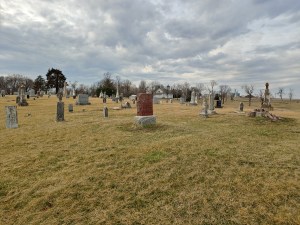
St Patrick’s Cemetery, Irish Settlement

In 1863 a diptheria epidemic came through St. Patrick’s Irish Settlement. Diphtheria is an airborne disease, transmitted by coughs, sneezes, and saliva. Eventually a thick gray matter covers the back of the throat, making breathing difficult. Before a treatment the CDC states that it was fatal in up to 50% of cases. Today, it is prevented by a vaccine.

Often it was referred to in some variation of “The Strangler.” This may trace back to a breakout in 1613 in Spain. The Spanish would come to refer to this period as El Ano de los Garrotillos (The Year of Strangulations). In the centuries that followed, it was a leading cause of death among children.

In 1895 production and testing of a diptheria antitoxin began in the United States. This antitoxin was commonly in short supply, and it is reported that sometimes parents had to choose which child it was administered to. An outbreak in Nome, Alaska lead to the 1925 “Great Race of Mercy,” which brought antitoxin to the community covering 674 miles in five and a half days. This event is annually commemorated in a race now known as the Iditarod.

No sled dogs would come to the Irish Settlement.
20200317_175201-1.jpg

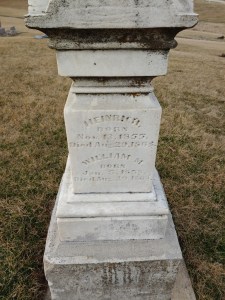
The Weil Stone

I became acquainted with the story as a kid, hearing John Connor tell of the family of Casper Weil.  In the midst of the epidemic, families dug their own graves, to save someone else from bringing it back to their families.  Heinrich Weil, age 8, died August 29, 1963.  His parents left to bury him at St Patrick’s Cemetery.  When they returned, another son ,William, 5, had died as well.   They had to go back.

Their son Thomas, age four, and daughter Mary M., age one and a half both died September 11th of that year.  The McDonnells would lose three children.  Roseanne, 8, died on April 14th.  Catherine, 16, and Ellen, 6, both died on April 25th.  Other families lost one or two children.   The Butler and McCusker families are also mentioned in experiencing great loss, but those graves are unidentified.

20200317_175402_HDR.jpg

The Harrington Stone

Not far from the Weil stone is one for the Harrington family.  J. and B. Harrington would lose three children on March 11th that year, John, 7, Agnes, 5, and Catherine, 2.  September 22nd, 1863 saw the birth of their son, Thomas.  The worry and fret that must have caused them would be difficult to imagine.  Thomas would survive the year and die in August of 1871.

Merriam-Webster says an epidemic “spreads over a wide are and many individuals are taken ill at the same time…,” and that a pandemic “affects an even wider geographical area and a significant portion of the population becomes affected.”

I suppose they mean ‘significant’ as in number, as though you were lofted above until people and places and times all looked the same.  Closer to the ground, the world is a little more personal than that.  Even if it isn’t the one you now know.


Some Things to Think About in Anxious Times

We are living in a remarkable time.  If you are anxious about it, one thing to remember is that everyone else is too, in their own way.  It’s a normal response.

We all  have our own things to work on.  There are a few things I think about when I know anxiety is heightened.  I would share them with you.  Perhaps some will be helpful.

How you feel isn’t necessarily a good indicator of how you are functioning.  You might feel like a mess.  At the same time, folks could see you as a source of stability and direction.

If you took a look around I’m sure you will see examples of how feeling good can provide a temporary solution while creating long term problems.  Perhaps that’s a consolation; perhaps it isn’t.  Regardless of how we feel, there are things we can try to keep our focus on.

“Gathering Information”  I often repeat this mantra to myself.  Can I begin to start gathering good, reliable information about the situation at hand?  Can I distinguish my thoughts from my feelings?  Can I separate what I know from what I assume?  Can I look critically at my own assumptions?

Intensity can get in the way of that.  I know.  I’m a passionate guy.  It has its pluses and minuses.

Let’s say you and I were looking at the world through our own telescopes, which we are.  Pick one thing.  Focus in on it.  What just happened to the rest of the picture we saw?

We tend to think passion is superior to disinterest.  When we are upset, we tend to see the world in a way which justifies the upset.  Unchecked anxiety complicates solving a problem as much as indifference does.

“Curious Interest”  This is a principle that serves me well, if I can remember where I put it.  Can we approach things more from a point of curiosity?  Can we discuss them from that place?

Intensity in our conversation often keeps our conversations from reaching the full audience.  I like people who can get to a place of observation.  It has a calming effect and helps me think.

“Connecting with Family”  In the line of thinking I have chosen to follow, staying connected to, and working on our functioning in our family of origin is the best long term way to help process anxiety.  In anxious times I touch base with my parents and sisters.  I focus on keeping the conversation balanced.  I may or may not talk about what is bothering me.

Anxiety is like nuclear fusion.  Once started it feeds itself.  Talking about being anxious is self-replicating.

“Energy.”  A more benign way to think about anxiety would simply be in terms of energy.  It’s the energy that gets us out of bed in the morning, drives towards our goals, through the adversity that befalls us, and drives us to create.  If we are overcharged, it can keep us from those things.

I once heard anxiety described like a cow getting zapped by an electric fence.  Energy is transmitted to the cow, who lifts her head and bawls, and the rest of the herd is instinctively anxious though they weren’t zapped at all.  One thing we can chose to focus on then, is the anxiety we transmit to others.

“Managing Myself”  Do I need to bawl every time I get zapped?  What’s my typical reaction been in this situation?  Can I hang in there a little longer without reacting?  Can I lower my volume?  Can I redirect that energy?  Can I do a better job of not getting zapped?

Pick one goal, a little one, and work on it.  It could be less use of the f-word.  Personally, I like the word, so I generally pick to work on something else.

In all likelihood when we are upset, we probably phone the friend or family member most likely to feel our pain.  We’re right.  They do, just like the herdmates of the zapped cow.  What do you think we ought to do about that?

Is that conversation productive?  Are we simply the reinforcing whatever we are feeling and passing anxiety to someone who has enough of their own?  Reinforcing an emotion is like being lost in the woods and discovering we used the day’s energy to wind up back at the same tree we were at yesterday.

Can we move from talking to someone who “will feel our pain” to someone that will stay objective and help us think?

“Being Present and Accounted For.”  Shannon and I maintain two different houses.  We’ve talked about where she wants to be if we are stuck in them for awhile.  We’ve talked about how we would handle being without a job.  I ask her how she is doing.  I tell her where I am at.

We find plenty of time to still drop in a rut or two and plenty of time to get our asses back out.  It has led to some good thinking.  She was the driving force that got my ass off the farm to stock my notoriously empty fridge.

So how do I keep staying present and accounted for?   How do I want to manage myself?  Can I use the energy of the situation to move forward?  Am I connected to my family and working on my functioning?  Can I look at the scene ahead of me a different way or from another point of view?  Have I made assumptions that were in error?  Is there more information I could get?

None of it will feel easy.  It won’t feel that comfortable.  It shouldn’t.  We are in a remarkable time.  How it feels won’t always be a good indicator of how we are doing.

Manaus

The first thing I noticed in Manaus, besides the fences that were topped with razor wire and broken only by security gates, was a shop along our way selling bananas. It was 2 am, and an old man was asleep on a plastic lawn chair. A boy lingered near a counter. The shop was all open air and well lit by a couple of bright fluorescents. The lights, the old man, and the boy provided services, that a fence’s absence did not.

We awoke to meet our guide for the next two days in the city. He was small in stature, and rail thin. Under his clear, blue eyes his cheeks were deeply tan and glistened already that early morning in a mixture of humidity and sweat. His jeans fit snuggly, but he wore a simple cloth belt anyway and it hung loosely around his waist.  I would find him to be something of a philosopher, despite the occasional tourist trap accustomed to his trade.

On a small bus we would be introduced to the rest of the city which sat on the left bank of the Rio Negro, and our guide referred to as ‘The Capitol of the Jungle.’ Street side were more open air shops, speckled in pastels faded by time or besmirched in grime. These same colors, off hue, made their way back in the houses and shacks beyond. The brightest colors came from the occasional well tended flower and fresh graffiti.

In these shops were an arrangement of mattresses, cars on old stands in repair, various plumbing pieces hanging from ceilings in diameters too large for most to use, and more plastic lawn chairs. In one was a half pallet of brick and a few scant bags of mortar. On top of them were apartments augmented with shoddy wooden balconies lined in laundry.  Connecting it all were an array of wires and old satellite dishes.

From the streets out front the old gathered, the young played, and more entrepreneurs emerged selling unpackaged but assorted car chargers, waxed paper wrapped tamales with trapped moisture thrown in, and bottles of water which may have been filled for the second time. Near the man selling car chargers was a young woman with children holding a sign in Portuguese. It was hard not to believe they were all of the same family.

Down the alleys radiating from our street was a hodgepodge of deconstruction and building.  Both seemed to take place over such an extensive period of time it was possible to differentiate the going up from the coming down.  There were clusters of lumber shacks in places that looked like little more than tinderboxes.  In other areas they were made of brick, in a slapshod construction method which left seems only partially filled with mortar, which brought to mine the earthquake devastation one sees on the news. There were also church towers and domes and apartment high rises, anchoring all of it to a psuedo-stability in regards to time.

There was a bleakness to it. A claustrophobic feeling that comes when you follow an alley to its end. It wasn’t beyond the realm of possibility that the people here could be happier than our own. It did seem beyond the realm that they had more opportunity.

But this was all in old Manaus. On its west side were fancy gated communities, now topped with electric fencing and carpeted in green yards meticulously cared for. There were signs attracting buyers to the developments yet to come. Elsewhere in the city was a mix, with western infringement nearly always fenced like it was the night we arrived.

Before we left the blue eyed Socrates of Manaus, our bus had asked him to speak of his own time growing up there. Taking the mic, he spoke only of the ancient history of the place, going all the way back to clashing continental shelves. It was as though there were no distinction between the place and him, or he only a more recent manifestation of it.

“We are square,” he concluded; “the world is round.” As true in a gated community as it is in the alleys of old Manaus.

Swimming Lessons

They sold headstones directly in front of the place where I took swimming lessons as a child.  We drove past them to get into the driveway.  Some youth learn to swim in playful eagerness.  This wasn’t the case for me.

Oh I could doggie paddle, fetch a ring on the shallow end, and pee in the water unnoticeably with the best of them.  I just wasn’t much for crossing the rope where one could feel the bottom slant away.  Leaving the pool made my legs feel like they were wearing concrete galoshes, a feeling that lingered all the way out to the end of the diving board.

There was a bikini clad college girl that instructed us.  She’d tread water in front of the board, and point to the spot she wanted you to jump to.  Seeing I was nervous, she pointed to a spot right next to her.

Seeing as how I was nervous, I tried to jump into her lap.  My hand got a hold of the center of her top, and my momentum and those concrete galoshes took the top to her waist.  I managed to survive as the neighbor kid behind me enjoyed the highlight of his young life.

I have no idea what test certifies you as a swimming instructor, but saving a young boy, while treading water as you put a top on, is unlikely to be a bad substitute.

Yes, being worried can obscure the opportunities life presents us with.  It’s hardly as effective, though, as being comfortable.

At 43 I’m still wont to feel as though life is supposed to be easier and more comfortable.  Yet at 43 I’m continually reminded that if what I wanted was ease and comfort, there is an off ramp of some kind or another every mile, thanks to modern technology and affordable booze.  But if we want to get what we want, difficulty and discomfort is what the way looks like most of the time.

Times that don’t delight us, may serve to delight others.

That instructor, pointing in the water, was entirely comfortable.  After me, she learned something she could have learned no other way.  She probably wasn’t quite as comfortable after that, and I bet that turned out to be a good thing for everyone except the neighbor kid.

I have no idea how you get certified as a life coach, but letting people know most of life is trying to do your job while treading water and keeping your top on probably has surely got to be part of it.

But what do I know?  I still can’t swim.

Japan and Agricultural Policy

Early last fall I had the opportunity to travel to Japan as part of the United States Meat Export Federation’s (USMEF) Heartland Trade Mission.  We were a group of thirty or so.  A few weeks after doing so, I sent a brief report on the trip to Iowa Farm Bureau.  In the months that have passed, I still think about the experience, and it still shapes my thoughts on ag related policy.  I’d share some of those with you.

The Foreign Service Officers attached to the US Embassy in Tokyo, highlighted the high subsidy rate of Japanese agriculture and underscored the difficulty Japan is having in attracting the next generation back to their farms. Subsidy rates and the willingness of people to participate in farming has come up on most of the trips I’ve take overseas.

It was mentioned during the Ukraine Market Study Tour by a Dutch farmer telling us why he left his home. It was mentioned by his fellow Danes whom I shared lunch with during their tour of Iowa.  It was mentioned in Austria on a trip down the Danube valley.

Subsidies sometimes meant to help farmers be “sustainable” are actually undercutting the sustainability of those very farmers in places.

We saw beef carcasses auctioned at a packing plant in the middle of downtown Tokyo. On the cattle side it left me thinking about all the discussion on market structure and pricing that is taking place here. There, the Japanese grading system offers value well beyond prime.

It does so in a country with a birth rate so low the population isn’t replacing itself.  There is a high number of single person households.  From beef to produce, their grocery market is more differentiated, and each variation seems to offer different elasticities of demand.

Beef is no longer just beef.

The demographics aren’t just particular to Japan.  The US birth rate is dropping.  A generation is emerging that places a great deal of value on experiences.  In comparing the Japan and US markets, our current level of differentiation has a ways to go and have a lot of value yet to be discovered.

It isn’t just the characteristics of the product that determined value.  It was also the characteristics of the brand.  The most common theme on the trip, be it in talking with an importer, a processor, or a retailer, was the continued evolution of branding.

Is furthering the development of a brand any different than furthering the development of a story?  Doesn’t it equate to developing value as much as the development of our product does?

USMEF’s role in matching the right product, at the right quality level, with the right story can’t be understated.  I wish everyone that raises beef back home got a chance to see USMEF’s work with their product overseas.  Critics will point out we only export 13.5 percent of our beef, and this is true.

But I’d like to point out that 95% of the world’s population lives outside the United States.  In the next 10 years the Asian middle class will swell to be 10 times population of the US.  They’ve demonstrated a desire to emulate Japan’s appetite for US beef.

Some critics back home also say the value of these export efforts aren’t reaching the producers raising the animals.  This in spite of the fact that the export market added $320 per head in market value last year.  They argue the promotion of our product should be outsourced more to others in the industry.

It is as though the other segments of the industry aren’t going to pass the cost of their having done so back down to us.  The real fallacy, however, lies in the turning over of our story to someone else.  Letting someone else tell your story usually makes you a character in their story.  Once you’re a character in their story, you lost control of it.

In my third time to Japan, I still haven’t heard much about individual animal traceability.  What they seem to want is traceability of a brand.  What I want is that story coming back not to characters, but the real people that raise the product.  It comes back to them because they are the ones telling the story for themselves.

Here we are abuzz with talk about alternative proteins.  They weren’t something Japan was talking about. It surprised me, particularly because of their low self-sufficiency in meat products, but then again, they have a stable government, relatively high income, and a consumer focus on quality.

When you look at the greater region, however, you see other countries with the same low self-sufficiency, but with less of the other attributes. If animal health issues continue to be a concern, alternative proteins might look to be a pretty stable way to keep a people fed.

Speaking of stability, I would mention one story on trade. Ground season pork used to be a big driver for the US in the Japan market. The tariff situation complicated it. Even with a new trade deal on the horizon, that complication won’t go away. The Japanese found another source for their product in the purchase of a Canadian plant. They put some skin in the game, and invested in solutions that didn’t include us.

I think about this in light of the trade deal with China.  In the midst of the discussion of how many soybeans China will now buy, I think about the skin they may have put in the game with Brazil.  It would be hard for them to walk away from that.

If you think about it, they are part of that story now.  That’s a valuable thing.

Resolutions Revisited

Here we are, two weeks into January. Behind us, strewn along the short path of a few days, lie resolutions which have already separated themselves from our resolve. If they happen to be your resolutions separated from your resolve, perhaps it’s not too late to go back for them.

Not that you should listen to me. I’m not a New Year’s Resolution kind of guy. I never have been. But I’m writing because I did make a few resolutions for 2019, and they and my resolve have stayed together.

Why? I don’t know. I know I’ve had a little help. I also know I didn’t get too hung up on the word, “new.”

Sometimes we are so quick to leave the past behind, we refuse to realize the simplest of truths. The turning of a new year does nothing to discard the past. The past is present, like a school kid in the front row waiting to be accounted for.

Including it in the day’s roll call, gives us a better shot at seeing the present moment for what it is. My resolutions going into 2019 centered around the loss of Chasen Stevenson. A friend I’ve managed to think of every day.

In doing so I try to be a little more charitable in my humor, a little more business minded in my work, a little more informed on the issues of the day, a little more sensitive to the needs of others, and believe it or not, I try to talk a little less.

In trying to do these things, I try to bring the future a little into today. Altogether, I suppose that is what a resolution is. It’s an effort to bring both the past and the future a little more into the present.

When I’ve been able to do that this past year in my private life, in my time with Shannon, in my times with friends who didn’t know Chasen, and in a few times with those who knew him much better than I, I’ve stumbled surprised into the joy of the continued presence of a friend.

Perhaps to make a resolution work, we need to resign ourselves to being in three places, now.

A Couple Minutes, a Few Seconds, and You and the News

Last Sunday 60 Minutes ran a piece concerning livestock use in the pork industry. During the segment, which I haven’t seen, they interviewed a veterinarian. It’s been reported since that the actual interview spanned 80 minutes. 60 Minutes used less than two.

However you consume the news, you might wonder which two minutes 60 Minutes were likely to pick. Most would probably assume that they would pick two minutes that were representative of the rest. I would call that an interesting theory.

I have worked with reporters who have picked two minutes that way. I’d be lying to you, however, if that were how I summed up all my experiences. Sometimes the nuance of a story is boring.

As part of a leadership program, I was part of a group that got some advice from former Iowa reporter, Laurie Johns: the interview is always on, and sometimes, what people are looking for is a little spice.

When the Des Moines Waterworks announced their intent to sue three drainage districts in northwest Iowa, I attended the public meeting they held. A local television station wanted reaction from farmers about the decision and myself and another farmer were interviewed. We both served on our local Soil and Water Conservation Boards.

The other farmer went first, gave a great interview, and became the one who had his clip broadcast on the evening news. I had a chance. I suppose I squandered it. I’m thankful for that.

The reporter was a friendly guy, making small talk as we both stood turns to stand in front of the bright light of the camera. The camera guy, for his part, said nothing. He would have blended perfectly into the background, were it not for his assistance in getting the microphones hidden beneath our shirts.

When I had concluded my interview, the reporter said, “Okay. I think we got it.” The cameraman switched off the bright, blinding light that was atop the camera mounted on its tripod. He stepped out from behind it and walked my way to again help me with the mic. This time, he finally spoke.

“Just between the two of us, this is really about that crazy Bill Stowe guy, isn’t it?”

The late Bill Stowe of the Des Moines Waterworks was a popular figure for many in Iowa. He remains so. Still he wasn’t without controversy for some. The light was off, but I’m willing to bet the camera was on, just as the mic still on my collar.

I didn’t make a smart-ass joke, and I didn’t go along to get along. I simply told the truth. “I think people are concerned about water quality, and they want to know it is important to us as well.”

That tends to be a boring enough fact to kill any interview. I handed him my mic. I thanked him for his time, and I walked away knowing he would have gutted me to give that story a spin that would sell.

Amidst the complexity of our own life, we turn on the news in the belief that what’s going on in the world can be summed up in a 20 second sound bite, scarcely giving those of our tribe a second thought, or those of another the benefit of a doubt.

Laurie pulled back the curtain and gave some free advice that experience would have charged me for.

Mental Health, Another Round

This year, at the beginning of the summer, I wrote about mental health in a way that shared my own story.  It was a meandering bit, which I eventually pared down to a few hundred words so that it might run in the Des Moines Register.  When they ran, I gave a copy of it to the coach I’ve seen for the last eight years.  She was curious about the feedback I had received.

In the time that has passed, the article found its way into many conversations.  There were people I knew well that talked about experiences they had never shared with me before.  There were those I didn’t know well who reached out to share their story all the same.  And there were those who simply wanted to share they had read it.  I appreciated it all.

Some of those conversations were a little stuttered.  There were people trying to figure out how to talk about a thing for the first time.  I like to think I do well at hearing people in times like that.  Despite being a fairly open book, sometimes the person stuttering was me.

When conversations get uncomfortable, or anxious, there is often a roundabout way to involve a third party.  We do it to diffuse intensity, among other things.  So when it came to the topic of mental health, it wasn’t uncommon to hear about the struggles of someone other than them or me.

If I recall correctly, in the initial version of my own piece I wrote openly about feeling depressed following a divorce.  I referenced an incredibly anxious time in the aftermath, while owning my own business.  Some would view the above as an example of the stigma of mental health.

In this example, I talked about what “was wrong with me.”  Others told me about someone else who “had something wrong with them.”  That is who those people view mental health as being for:  people who have something wrong with them.

It isn’t how I view it.

I think life is a lot more nuanced than we make it out to be.

In all the conversations I had after the article on mental health ran, there is one I revisit most often.  It went something like this:

“I’ve got a great spouse.  I’ve got great kids.  I’ve got a great life.  I don’t know why my mind plays these tricks on me.  I know there are people who don’t have it one tenth as good as I do….I am so lucky….I am so blessed….I am so fortunate.  I need to remember that more.”

In a way it was like having a conversation with myself.  What they were thinking, I had thought myself.

One side of a stigma surrounding mental health is that there a few people out there who view it as something for those that have something wrong with them.  I’d argue, though, that it garners more than its fair share of blog posts, and articles, and online attention.

The bigger side of the stigma is the one that seldom gets talked about.  I think a lot of people fret their worries aren’t important enough to do something about.

In the previous piece I said mental health is health.  In this post I’ll tell you that mental health is for everybody.  In telling you why I feel this way, I’ll share another story.

I have a particular line of thought I subscribe to when it comes to mental health.  Twice a year is a little conference in Des Moines that brings in some of the foremost researchers along this line.  I nearly always go.

At one of those conferences, I heard the presenter make an observation along these lines:

“Sooner or later in life some of us become conscious we are holding a hand of cards.  You realize some around you have been dealt much poorer hands.  Some have been dealt much better.  Sometimes we would like to change our hand, but we can’t quite.

What we can do, though, is learn how to play the cards we got.  We find people in life who got dealt a bum hand and played the hell out of it.  We also find those holding the hands we envy that misplay it all.

In my work with families, I am often hit with a simple observation.  For all practical purposes families are almost immortal.  Few die out, though some have their names change.

Learning to better play your own hand in life has a profound impact on those you care about.  It is like a rising tide.  It lifts your boat and it often lifts theirs as well.  For those in the family that come after you, perhaps it can give them what we want for ourselves:  a better card.

Some think it is too small a thing, learning how you play your hand.  Maybe it is a small thing, but I think it can make a big difference.”

There are all kinds of hands at our table.  I have come to believe learning to better play the one we are holding is the true work of a lifetime.  In spite of whatever cards I might hold, I too am willing to bet it makes a big difference.

And here comes another round.

A Star is Born

Movies.  That’s my secret.  When faced with a long plane ride, what I most depend on to pass the time are movies.

Earlier this month I traveled to Tokyo.  One movie I turned to was A Star is Born, the recent remake staring Lady Gaga and Bradley Cooper.  I gave it a whirl for a couple of reasons.

First, Shannon was talking about it.  Second, it featured the song writing of Jason Isbell, of whom I’m a fan.  Shannon and I had the opportunity to see him headline one evening of Hinterland in the little town of St Charles, Iowa this summer.  It was the best concert I’d ever seen.

The song he wrote for the movie is called, “Maybe It’s Time.”  He played it that night, and I guess it rooted its way into my brain.  At the time I thought it was a song about personal growth.

Somewhere halfway through the flight to Tokyo, just coming off the tip of Alaska, I got to the crux of the movie.  To say I found the moment depressing would be an understatement.  It hung over me overseas, and I find it something I still brush up against today.

I thought the storyline would parallel Isbell’s own experience, himself a recovering alcoholic.  Instead, Cooper’s character seems to end all hope of a future because he doesn’t believe he can escape his past.  Isbell’s song found a much darker meaning.

Now enter Carson King and the Des Moines Register.

King has raise somewhere around $1.5 million dollars for the University of Iowa Stead Family Children’s Hospital.  It’s a remarkable accomplishment for a college student.  Most of us will never do anything like it.

The Register certainly helped promote the story.  Then their efforts to expose offensive social media posts King made when he was 16 got them in the midst of a public relations nightmare.  Many have removed the Register from their social media feeds.  The reporter of the story has now had his own past Twitter posts come to light.

If you must direct your disgust, try and keep it to the Register.  The paper has a staff who are meant to act as an intermediary between a reporter and their story and the public.  Repeating the missteps of the reporter doesn’t absolve us from making the same mistake.  Maybe it’s time to let the old ways die.

I hope you also direct yourselves to something affirming.  You can donate to Stead Family Children’s Hospital.  You can contribute to King’s fund.  If you do so, I’d mention an often untold part of what your dollars will do.

You are going to help give the kids an opportunity to make their own bad decisions.  To end relationships in crappy ways, to be ignorant or insensitive to the people around them, and to spend years convinced of things that simply aren’t so.  That’s part of what it looks like to grow up.

As they grow up, they will hopefully discover what we might someday discover:  our undignified moments can be part of a dignified life.  They shouldn’t keep us from working good in the world, and they shouldn’t let us get in the way of others doing so.  Someday, if we can find that true for ourselves, maybe we can find it true for others too.

Tokyo Bay

“Where the hell is the ocean at?  The lights seem to be all around us.”

“I know,” came the voice of a young, North Dakota corn farmer near me.  “It’s crazy.”

“The channel makes a dog leg.  See that flashing light right there behind us?” a Nebraska hog farmer asked, as he pointed his finger among an array of lights.  “That’s a navigational beacon.  That’s how you find your way.”

With his help I could see them.  Yet when I looked ahead, into the heart of a city of 40 million, I couldn’t pick out one.  Still, I knew they were there.  I had confidence in the hog farmer.

Were on the rear of the upper deck of a small cruise ship.  We been out in the bay for a few hours, and we were headed back.  As we went out, a seminar was going on.  It featured the American farmers who grew things, and the Japanese importers, retailers, and processors who brought those things over.  The end had been celebrated with heavy hors d’oeuvres featuring products new to the Japanese market.

With the festivities over, I made my way for the rail on the far side of the ship.  We were passing a cargo vessel.  It was carrying goods people would spend their lifetime making, and headed to where they would collide with a lifetime of desire.

Planes had been leaving the airport across from us like clockwork, and one barreled over that vessel as it approached us.  It was surreal.  The lives of people and the movement of things seen from a ship preoccupied with the topic of trade.

The theme of the trip for me, what the retailers and processors were all striving for, was branding.  What is a brand, other that the product of a good product meeting a good story?

“It’s amazing isn’t it?” said a former Iowa farm boy behind me, gazing at the same scene that I was.  “What a view.”

I thought of taking a picture, though I knew the picture would look only like a moment I was trying to hold onto and remind me only of the fleeting passage of time.

I was still thinking of that view the next morning, on the way to our first meeting of the day.  We were driving past the Imperial Palace in the heart of downtown Tokyo.  In a city of such density, the green of the Imperial grounds hits you.

Tokyo’s area is half of greater Chicago, yet its population is quadrupled.  Cut Chicago in half.  Stack eight of those halves on top of each other.

“This is Imperial Palace,” the Japanese voice said in English, with the English ‘r’ giving the speaker trouble.  “The Emperor lives here, Naruhito.  The Emperor has no family name, only one name.  His father was Akihito.  His father was Hirohito.  Naruhito is the 126th generation.”

“Hear that? 126th generation.  You guys thought being a 5th generation farmer was something,” joked the man with whom I had admired the view the night before.

At the height of Tokyo property values in the 1980’s, some estimated the half square mile the palace sits on had a real estate value greater than the entire state of California.  The fact that it remains is a testament to the fact that one thing was of greater value:  its story.

Amid the bright lights and pulse of the news today, in sailing our own ships out and in, we produce what others desire.  The quality might be exceptional.  The products may be uncommon.  In and of themselves, though, they aren’t enough.  To navigate the years it needs to tell a good story.

We have one that’s timeless, better than any picture, and capable of bringing us into any port and into places we’ve never dreamed.  Let’s not forget it, and let’s tell it ourselves.