It sounded as though he spoke in English broken by German phrases. In truth, it was the opposite. He was in his late 50’s, and it gave him a high forehead and receding hair line. He stood slightly hunched over, as though he had spent his life down here between the brick walls and low ceilings of the catacombs under Stephansdom (St. Stephen’s Cathedral) in Vienna, Austria.
“And in the next room you will see their bones, Und im nachsten raum wirst du ihre knochen sehen, stacked like firewood, gestapelt wie brennholz.”
His large, balbous eyes, fluent in both languages, bulge even larger when he arrived at “firewood” and shortly thereafter at “brennholz.” Each pulse brought a brief smile across his face, as though his eyes and the corners of his mouth were attached to each other. The former moving out pulled the latter up.
“Often if you try to tell people what you observe in real life they will never believe you,” I confided to one of my travel companions, Allen Burt.
“You know what I think?” he asked. “I think this guy really loves his job.”
A few minutes prior we had been waiting for our tour on the main floor of the church, at the top of a staircase leading down to a heavy wooden door with an arched top and a window with a wrought iron grate. I had been canvasing the crowd, looking for anyone who resembled a guide. Instead we heard a bolt being drawn back, the creak of the door on its hinges, and from behind emerged our guide venturing forth from the land we ventured to.
Back below ground, those further ahead began to move down the narrow, dim, brick hallway to see the next room the guide had spoke of. As they made their way, I took the liberty of stepping back to peak at the iron stair disappearing in the small round hole in the floor behind me. It descended a mere foot or two until it disappeared into a pool of ribs, clavicles, and shoulder blades. The only thing that appeared to have used this particular stair in recent history was mustiness.
It was our turn to move, and we went down the hall, looked to our left, and found the room exactly as he had described it. Through a window were rows of femurs neatly stacked three feet high for a run of twelve feet. Here and there, a bone meticulously extended a few inches, and on this extension sat a skull. These skulls formed a diamond pattern down the length of the pile, and they gazed across at those that looked back from the stack a couple feet over.
All in all, there was something noticeable in how the American reacted in the group. As though in our relative abundance of space and relative shortness of time, we still possess some naiveté about our dead. Her there were 11,000. As the catacombs got full, prisoners were given the task of going down and clearing space for more, stacking the bones into the space saving arrangements seen today.
Waves of emotion had battered those interred here once. Once oceans of delight had washed over them. They are forces even mother nature would be challenged to account for. But here, dry bones bore witness to a delicate precision their earthly bodies were liked to have scarcely known.
A few more steps, and we began to climb the stairs back to the surface. The tour was over before we knew it. Our guide stopped half way up and let us pass.
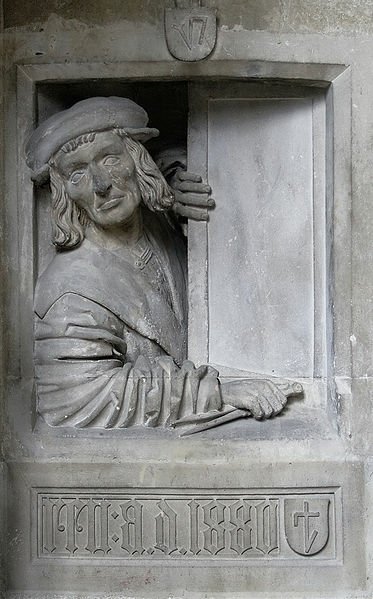
Upstairs, in the second largest of all European cathedrals, stands a large stone pulpit. Elaborately carved in the 1400’s, it contains numerous features of note. One of them is found seemingly out of the way, close to the cathedral floor, beneath the stairs it features. Gawking (German: gucken) out a half open window (German: fenster) is a stone mason. He is known as Fenstergucker. Many believe it is a self-portrait of the sculptor himself.
He holds a chisel, and wears a cap which reveals a high forehead with a receding hairline. He appears to popping up from below. From time to time, he gives tours down there.
Late in the spring, it is always the same. The rush of trying to finish, so the world can grow again. Often, at the conclusion of a day, my old pickup winds up parked in the machine shed of the farm.
It’s dark by then, and the way across my parent’s yard to my place either lies lighted by a moon, or nestled in darkness broken by footsteps too long in knowing the way. This is what people never realize about free will. We see the world dimmly, in a light not our own, and we follow the footsteps we made long ago, back when we were just trying to get from point A to point B and had never considered the possibility of what such a precedent we might set.
It is one thing to have free will. It’s quite another to actually use it. He who hasn’t figured that out yet, doesn’t know shit.
Occasionally, my footsteps will take me into my parent’s home. Checking to see if on the kitchen table lies a note from my mother. “Dan, there’s a sandwich for you in the fridge.”
It’s odd now, past 40, but I will find that sandwich with dirty hands and eat it in the dark that marks the rest of the way to my home. Just inside the front door, I will kick my dirty clothes off, hop in the shower, and collapse into bed. Having been saved, due to the thought of my mother, from having just a beer for dinner.
My mother is the oldest of her siblings. Over the years I’ve come to better appreciate the power that fact works in our relationship. I am an oldest too.
Most of us tend to seek approval from those much older than us. The world we first knew was theirs after all. We have had a lifetime of orienting ourselves to them.
I think it would make being a mother even more challenging. Instead of embarking on that period of your life with friends your own age, finding your own way together, step by step, you are looking for validation from those who have already done it before. If motherhood is like everything else, I suspect those who have done it are nearly as free with their opinion as those who have never attempted it.
If the latter seldom let the fact they haven’t interfere with them giving their opinion, then the former, particularly if they have been successful, seldom properly account for the role mere luck played.
Beyond the opinions of others, lie the expectations. Just a few generations ago we all expected our mothers to attain nothing short of sainthood. Now, in our expectation that they provide unconditional love, we want them to have nothing short of the power of God, Himself.
I expected that of my Mom once, and spared her martyrdom for a kind of crucifixion. In recent years, I’ve come to suspect they have a word for my expectations. They call it “immaturity.” I’ve been working on it. It takes longer to shake it than one might think. Meanwhile, in letting go of expectations, I get a better grip on who it actually is I suppose I’ve been trying to impress all along.
If you want something in life, you general have to plan for it, work at it, and set goals. That is if you want anything other than a family. Most families seem to simply start with little more than good intentions. Neither mother nor child really knowns what they are getting themselves into, especially not the first go around.
It takes a little free will to move past our intentions and expectations. In their place we find a daily reality that surpasses them, the plan one didn’t start out with, goals to strive for, and an education of a lifetime.
Sometimes, in the middle of the night, we might even find a sandwich.
This week marks Soil and Water Conservation Week here in the state of Iowa. It also marks the beginning of May is Beef Month. The fact that these two overlap shouldn’t come as a surprise. It doesn’t for me. Cattle have helped us achieve our conservation goals for some time in the northeast corner of Madison County.
Here beautiful ridges of corn and soybeans break into the rolling hills of grass our cow herd calls home. The transition between the two has long been where our family has focused their conservation efforts. Initially, acres not fully suited to continual crop production would be seeded down in rotation, providing corn or soybeans some years and providing forage for the cows during the rest of them. My father and his brother terraced this farm in the 1980’s, extending the good ridge that ran through it down a series of three steps in the landscape. In doing so, more acres could sustainably be moved into continual crop production.
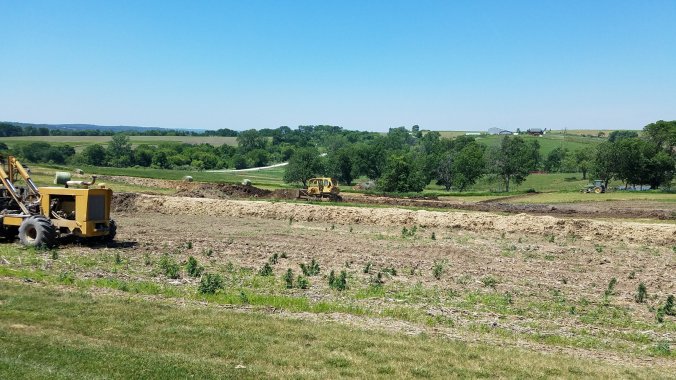
In the years that have passed, we have maintained that trend, and the number of terraces on our farm seem to increase each one. Though the crop ground is now leased to a neighboring family, we all work together to keep advancing conservation practices on our farm. We couldn’t do it without them. In the photo above, we’ve begun to transition some hay ground from side hills now protected by terraces to serving as a buffer along field borders, and in this case, above a neighbor’s pond. Below you can see we have done the same along a large ditch that runs through another.
Instead of just taking the ground out of production for an environmental benefit, having cattle gives us an option of keeping some acres sustainably in production, while still maintaining an environmental benefit. These buffers will now help not just to hold soil in place, but also to filter the water that moves across them before it leaves the field or enters the ditch, catching soil and nutrients as it does.
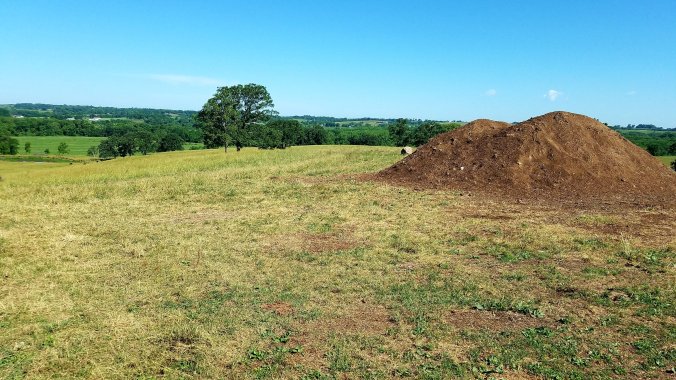
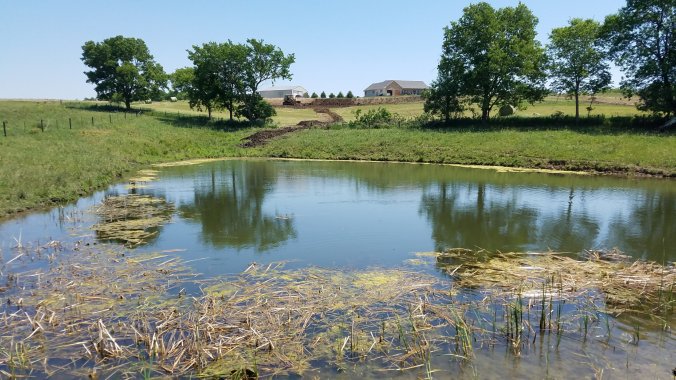
We have built a farm pond a year for the last decade, which help us to better manage the pastures, provide a cleaner source of water for the cows, and act as another filter for the water moving across the fields. Above, a couple of terraces we built late last spring are going to outlet in the pond the next ridge over, the tiny splash of blue on the right of the photo. The additional water will provide more volume to keep the pond full and allow to filter even more water coming off the landscape.
Along with the ponds have came better management of our grazing acres, which has produced more grass of better quality for the herd. Year in and year out, it should all work to translate to more head and more pounds of beef off the same acres, while improving their body condition and pregnancy rates. For the last couple of years we have used poultry litter to help boost soil fertility in order to make the most of our improvements.
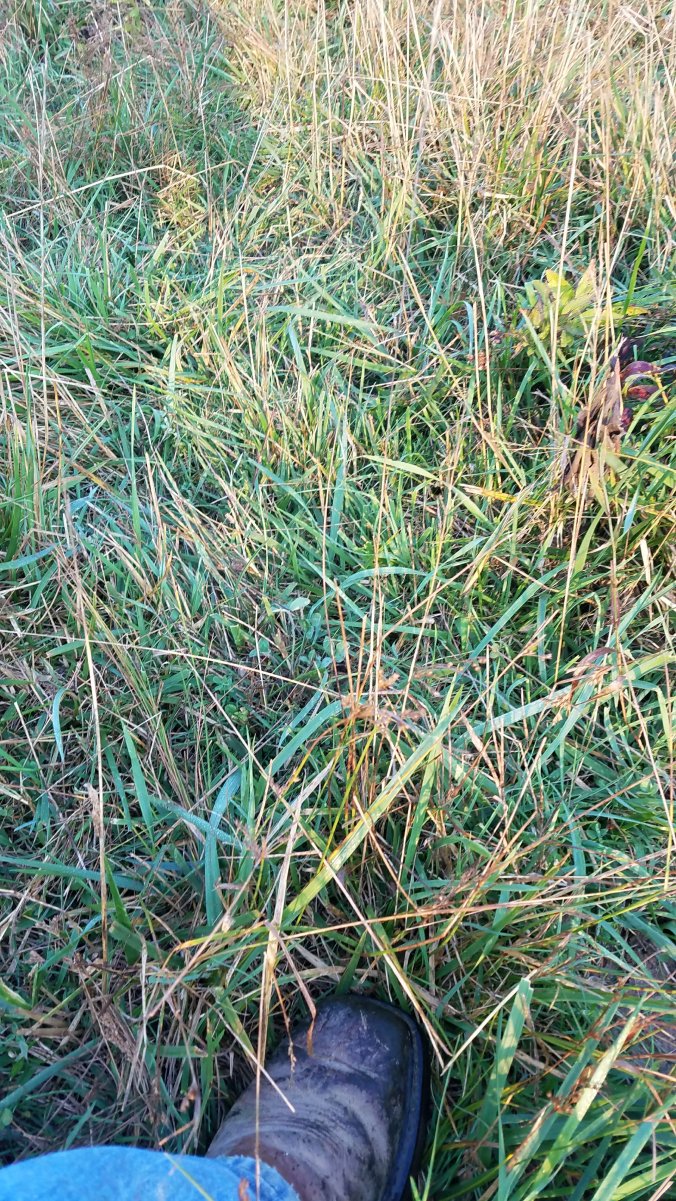
We monitor our progress with regular soil testing. Once the fertility levels are where we want them, the natural nutrient cycling that happens as cattle graze should in large part keep them there. Of particular note has been the boost we’ve been able to make in soil organic matter. In the photo below it is at 6.7%.
This boost allows more carbon into the soil, increasing soil health, dramatically impacting water infiltration thereby reducing runoff in storm events. You can’t go to a conservation meeting now days and not run into a discussion on soil organic matter and soil health. Cattle, due to the role they play in recycling nutrients, seem destined to play an integral role in that.
This year we will begin to soil sample acres that we have rotationally grazed, along with those we have in the Conservation Reserve Program. We expect to notice a difference between the two in soil organic matter, and we expect the acres that have been devoted to cattle production to have the advantage. A few years from now, when those acres come out, we should have the rest of the farm in a position that allows us to bring those acres sustainably back into production.
Smart farming looks differently today than it did when my grandparents watched over the place. It looks differently than it did when my father and his brother started. It looks differently than it did 20 years ago, when I and my siblings were still in school. It is a concept constantly evolving. We simply aim to keep up with it.
In todays water quality efforts, some look at agriculture and point only to the challenges, as though one could slice the issue so thin that it only had one side. It’s a shame. In agriculture today, both in row crops and livestock, also lie the solutions. Conservation and production are not mutually exclusive. They need to go hand in hand.
Back here on the home front, in my case with the cows, there is a lot to be thankful for in the last few years. New faces have come into the beef industry, and many of those are have infused some youth. Some are eager to raise their own cattle in hoop buildings. Some have set out to custom feed cattle for others, or develop someone else’s replacement heifers. Some hope to raise seedstock, and some simply bought a handful of bred females to begin a herd of their own with.
With this infusion beef production in 2018 will see an all-time high. Even allowing for continued growth in exports, however, experts predict beef supply will increase by over one billion pounds. Its as critical as it has ever been, that we keep our product moving.
We exported about 11% of our production in 2017. It was enough to account for $286 of a fed animal’s value. This year in the cow/calf sector estimates range from a few dollars a head profit to just under $100. Either way, profitability can be found in the $286 exports bring to the table.
My last post mainly dealt with agricultural trade to China, and the policies and issues surrounding it. When it comes to Chinese trade and agricultural commodities, the US beef community is towards the back of the line. Last year US beef exports to China amounted to just over 30 million dollars. By contrast, US beef exports to Japan were at 2 billion dollars.
There is more to the story, however. China had been closed to US beef for 14 years until last year. The subsequent excitement generated by China opening the door says a lot about the long term potential our industry sees in the renewed relationship.
Japan has a population of 120 million people. China has 1.4 billion. Japan is number two in beef imports. China is number one. Yes, the socio-economic conditions are vastly different for the two countries’ populations, and yes, China’s growth has certainly slowed, but make no mistake the pace it is on is staggering. From 2011 to 2013 China used as much concrete as America did in the entire 20th century.
New faces here are going to need new faces around the globe to connect with. The idea we should further hinder and delay making inroads in a country where 1.4 billion are located, in a country who leads the world in beef imports, couldn’t be more short-sighted. There are those that argue hindrances and delays will hurt them more. There are those that argue they will hurt us more. There really isn’t an argument at all. It will hurt us both.
Beyond the someday-potential of China, and the current discussion centered on tariffs, is the much more real and tangible trade that happens through agreements like NAFTA, and that which was hoped to have happened through the proposed Trans-Pacific Partnership. After indicating he may be interested in rejoining the TPP efforts a couple of week ago, last week the President tweeted he remained opposed. “Bilateral trade deals,” he wrote “are far more efficient, profitable, and better for OUR workers.”
While to date he has remained in NAFTA despite threats to pull out, the bigger trouble is that there hasn’t been much in the way of bilateral trade deals. In the wake of such, TPP and other trade talks have continued on without US involvement, diminishing our country’s involvement in the world’s discussion on international trade.
The administration has promised US farmers that they will be compensated for any trade losses, at least in regards to China. The administration is investing considerable time and effort in figuring out how it is that they would do just that. One focus in the news of late is using the same act that is responsible for government cheese. I wonder what the current economic conditions are for the US dairy industry?
I suppose some farmers and producers are old-fashioned. Given the choice, they prefer to earn their income through open markets and trade.
Finally, there are those that maintain that when it comes to beef we should raise the gates and eat only what we grow here. They will point to the fact that US beef consumption and US beef production are about equal, around 26 billion pounds. What is sometimes missed is that for it to work the US consumer is going to have to eat a lot of beef cuts they have never ate before in their lives.
Last time I visited a packing plant, for instance, we walked by stacks of boxes on which were the words “bull penises.” Not only am I going to need for you to take a second helping, I’m also going to need you to pay as much as those that wanted them in the first place.
A 2006 survey of American economists found that 87.5% supported eliminating tariffs and barriers to trade. It’s not economists that are most influential on the issue currently, however. It is you and I. What say you?
“In time of war, we blockade enemies. In time of peace, we do to ourselves with tariffs, what enemies do to us in time of war.” Henry George 1886
There is a lot up in the air right now for American farmers in regards to trade. For me it is concerning. The productivity and efficiency of American agriculture is unmatched in the rest of the world. We produce far beyond what the American consumer can consume.
From our relationship with main trading partners to our participation in trade deals with other countries, little appears to be certain. In writing about it, I find it such a large topic that I will break it up over a couple of blog posts. In the first, I’ll try and hit on a few of the larger issues I think about. In the second I will try to talk about how it may impact me, a beef producer.
Dominating the headlines lately is the trade dispute with China. Some are concerned the first may escalate into a trade war. Our administration has threatened tariffs against China for China’s unfair trade advantages. China has responded in kind by threatening retaliatory tariffs directed to U.S. agriculture.
On one side in agriculture is a group who maintains that most of what the President is doing represents mere posturing in order to negotiate a better trade deal with the Chinese. They give him the benefit of the doubt on using these protectionist trade policies to do so. I know many who have this view. In fact, some I respect.
Alongside them, living in the same place and generally sharing the same politics, is another side who continues to support what they have historically supported, free trade. They are steadfastly against the concept of tariffs. This happens to be the camp I am in.
Of those in the first group are some more queasy about it than others, and at the other end of the spectrum are some, in full-throated confidence, urging the POTUS, “to bring it on,” and telling the rest of us “to shut the hell up and support the president.” In fact, that latter was exactly with the Iowa Cattlemen’s Association’s CEO Matt Deppe heard on a recent appearance on the Simon Conway Show.
Some of them criticize those of us in the second group as simply being “anxious.”
I happen to be interested in how anxiety impacts the decisions we make in life. I devote a considerable amount of time to learning about it, and I could offer my own testament on the counter-productivity of letting our anxiety rule the day. The fact is, though, sometimes anxious is the proper state of mind.
As humans we certainly have the ability to get worked up to a point where anxiety overshadows our thinking, but we are also capable of not letting it properly inform our thinking at all. Researchers would call this the “normalcy bias.” Our minds can view any situation as normal, whether it is or not.
Let’s say we are in a high-rise apartment building. A moderate fire has broke out below us. Some of us, at the first whiff of smoke, are going to be consumed with the desire to “get out,” and they are going to begin to make their way down the stairs to try and find a way. Others will pacify themselves with the thought that “there is no need to worry” and opt to stay in place. They may be correct, but have they been in a high-rise fire before? What do they know of the fire below them?
With one in every three rows of Iowa soybeans going to China, with the export market putting $300 a head on cattle prices, I’d argue a little anxiety is the proper state of mind concerning China and our trade agreements.
As I think about them, I try to keep if focused on a few ideas and principles to help guide my thinking. One of the first is: should the prior administration had found itself in the exact same situation the Trump administration is in, what would the agricultural conversation sound like? I keep arriving at one answer: much differently.
Second, I belong to two, policy-based agricultural groups. Between those two, and the assortment of others that are out there for varying commodities, there has been historically strong support for open markets, greater trade access, and lower tariffs. All of these policies were arrived at by these groups beginning with a basic question, “What’s best for our members and their families?” Then they ask politicians to support the policies that are in their members’ best interest.
As members we are not the groups themselves. We do the groups a service by telling our individual stories, by debating varying opinions, and by becoming informed on them. Where would we be if we asked what our politicians or President supported first, and then try to get our members to support it? I’d argue we are doing ourselves a disservice.
There are those that argue we should wait and see how things play out. If that is to mean our policy organizations should wait and see if what they oppose goes into effect before they offer opposition, when have we ever proceeded like that?
Third, in my involvement with policy-based agricultural groups, I’ve wrote countless letters to and had countless conversations with my legislators. From WOTUS to the estate tax and beyond, one well I consistently draw on is the detrimental effect of legislation that creates uncertainty for agricultural producers. Is it in our best interest to court uncertainty now in our trade policy, and light a fire in the high-rise in which we dwell?
Finally, it concerns me that in our current debate where are those holding up an example of when protectionist trade policies worked out? Where are those arguing that this is the only option we have to address our concerns?
I’ve heard the statement countless times that “all you really need to do is read the Art of the Deal to understand what it is the President is doing.” I should read it, I guess, but I haven’t. What I’ve been able to gather, though, is that the book seems to make the case for the power of escalating anxiety in negotiations.
I don’t dispute there are times where that might be a tactic we employ, but when it comes to relationships we are in it for the long haul with, is that really in anyone’s best interest? Tonight, while you are at home, escalate anxiety with your spouse during whatever it is you find yourself in negotiations over. Let me know how that works out for you. Tell me if whatever short term gain it secured was worth it.
Doesn’t the very idea that we should bring escalating anxiety into trade negotiations go against how our trade policy has been geared for decades? Hasn’t it been geared towards deescalating the anxiety of an unstable world in order to create a more stable one in its place? Hasn’t the United States reaped the advantages of being the dependable partner the world can count on in this regard? What will happen if we change sides?
In World War I and World War II, we entered the global stage and only asked for enough ground to bury our dead in the aftermath. In fact, after the second we worked to actively protect our adversaries in Germany and Japan. Perhaps the President would say, “We got screwed.” Perhaps we knew the value of peace. Maybe that is why that generation was so great.
“We are reminding our trading partners that preserving individual freedom and restoring prosperity also requires free and fair trade in the marketplace. The United States took the lead after World War II in creating an international trading and financial system that limited governments’ ability to disrupt free trade across borders. We did this because history had taught us an important lesson: Free trade serves the cause of economic progress, and it serves the cause of world peace.
When governments get too involved in trade, economic costs increase and political disputes multiply. Peace is threatened. In the 1930’s, the world experienced an ugly specter—protectionism and trade wars and, eventually, real wars and unprecedented suffering and loss of life.
There are some who seem to believe that we should run up the American flag in defense of our markets. They would embrace protectionism again and insulate our markets from world competition. Well, the last time the United States tried that, there was enormous economic distress in the world. World trade fell by 60 percent, and young Americans soon followed the American flag into World War II.
I’m old enough and, hopefully, wise enough not to forget the lessons of those unhappy years. The world must never live through such a nightmare again. We’re in the same boat with our trading partners. If one partner shoots a hole in the boat, does it make sense for the other one to shoot another hole in the boat? Some say, yes, and call that getting tough. Well, I call it stupid. We shouldn’t be shooting holes; we should be working together to plug them up. We must strengthen the boat of free markets and fair trade so it can lead the world to economic recovery and greater political stability.”
I spent the morning in Des Moines. On the way home, about lunch time, getting on the freeway, I spotted a man standing along the side of the road, holding a cardboard sign. Up ahead, the light was green, and I about to coast right on by.
I gave him a once-over. Did he look a guy driven by life circumstances to be standing along the side of the road holding a cardboard sign, or did he look like a guy that merely dressed the part and had a Lexus SUV around the corner? Did he look like a veteran? Did he look stable? Did he look like a guy the police knew by his first name?
His face did not appear used to a life of comfort. His eyes looked too serious for that. A black mustache sat above lips as straight as it was. His clothes were certainly nothing fancy nor nothing tattered. His hands appeared to know what work was, and the boots he wore were for working in.
Almost passed him now, I looked at his sign. “Trying to get home,” it simply read. Perhaps, I am a sucker, but it has stayed with me all day.
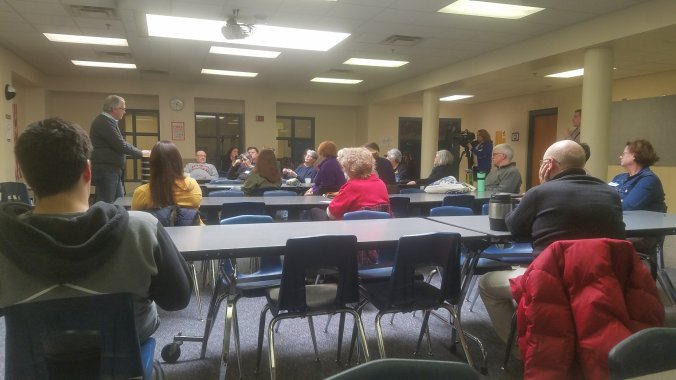
Late this winter, on a Saturday, I found myself in Winterset for a Town Hall held by Congressman David Young, who represents Iowa’s 3rd Congressional District. There were around 20 of us in the room. The prior election I had voted for him. By my unofficial count, I would guess four or five of my companions at the Winterset school had also.
The news was there with a camera. Congressman Young had a staffer there with a camera. There was a lady on the far side of the room who also insisted on holding a camera. All that was missing was a drone. I suppose the ceiling was too low.
We had placed our questions into a metal can, and when the meeting was to begin, Young pulled a question out. It was pointed, written with an edge that came through even though he had given it a smooth and rather monotone delivery.
“Whose question is this, if you don’t mind my asking?” After a pause he added, “It’s all right. You don’t have to say. I’m just curious who it is that I should address.”
“It’s my question,” came a voice with a tone different than the hand that wrote it.
“Great. Well first off, thanks for asking about this issue.”
The meeting continued topic by topic, one piece of paper at a time. Discussion would break out, others would join in, questions were asked from our seats. Young, for his part, went along with it. He struck the tone he nearly always strikes, a moderate one, and then he would reach in and pull out another slip.
When mine was pulled, he read a question I had asked about trade. I didn’t dwell on how concerned I was about it, though I’m still concerned a lot about it. I had taken time on a Saturday to come in and ask. I guess I figured he knew.
The guy beside me, in the midst of the questions, simply made a comment to Young: “I’ve heard from my party, the Democrats, that you’re voting record is the 3rd or 4th in Congress in terms of voting with the President…”
“Yeah, well that’s interesting considering the president doesn’t vote.”
“I understand, and maybe it is unfair,” he side, quietly acknowledging the possibility of what everyone in the room, regardless of party, knew to be true, “but what do you have to say to that, because you know that is what they are going to come after you with.”
“I say the President isn’t my boss. The party isn’t my boss. I look at the issues. I think about my constituents. That’s how I vote. That’s what my record reflects.”
A woman joined the conversation, “Why don’t we have middle ground anymore? Why don’t we see it? Why isn’t there more bipartisanship,” it was an interesting question for a group trying to vote out a moderate Republican.
“I think it depends on where you look. Sure, there are a lot of divisive issues out there taking news headlines, but there is also a lot of work we do that enjoys broad-based support.”
A third participant joined in. “I keep going back to silence being consent Congressman. We need strong voices to stand up. We need people to find their voice. Then you will be our heroes. We’re looking for some heroes.”
“Well I’m not trying to be a hero.”
From my perspective, at the far wall. His deliverance of the line caught the group off guard. While he went on to speak, you could see those who heard it pondering whether or not they had just heard him say that. After they had reconciled with themselves that they had in fact heard him say that, they went on to silently look at each other, or lean over to their neighbor’s ear. A candidate for the Statehouse passed a note over to another. I’m not sure how many heard what followed.
“When you are listening at home, what you hear is strong rhetoric on both sides of the aisle. That’s not me. I don’t call people names. I don’t judge others. How do I know what is in their hearts? Those out there shouting at both fringes, folks they’re ostracized. They aren’t there. They aren’t in the room when the solutions are found. If they aren’t in the room, guess what? The thousands of people back home they represent aren’t in the room either. If I’m going to be a good Congressman for the 3rd District, I need to be representing you there.”
The morning after found us in the Art Institute of Chicago. Towards the end of our time, I caught the woman who had brought me standing before a portrait. It was a portrait everyone looked at, and I was trying to find some hidden gem, among works that were all gems who had mostly lost part of their luster and most of the appreciation of their rarity since they were all gathered here under one place.
“I suppose you’ve seen this one too.”
“No, I haven’t.”
“You’re kidding me? American Gothic, Nighthawks, the picture on the shore with the little girl that stares at you, and you never taken the time to look at this? This one is amazing.”
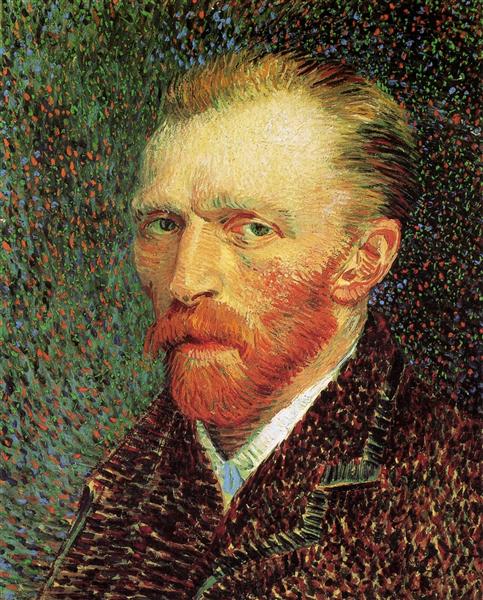
It was amazing. The paint was layered so thick it hung like flesh on the bone. There was a texture, a human texture to it, and it stood out from the stair-stepped frame that had brought you down to its surface. His cheek alone looked to rise half an inch from the canvass.
“I’m not even sure how long I’ve been looking at it. It’s got this background of colors that contradict one another, but somehow his image ties them all together. You can pick a hue from the background and look at him and find it every time. I can’t decide what it means.”
“What do you think it means?”
“I thought it meant we are all made up of all kinds of contradictions, but I wonder if he wasn’t trying to say that in our bringing them together we make some sort of sense of them.
Standing here, it’s like he’s going to come out of that wall or something. I think that’s the quality I most admire. I like the ones that make you forget it’s a painting.”
The past is present. People say you should “move on” or “let the past be the past,” but the past is present. Maybe all “moving on” is, is getting to a place where you can look at ourselves with nothing more than curiosity with which we look at them, divorced from all the intensity that was then.
We think forever is a series of nows without end; the present followed by an endless supply of the present. It’s so linear. What if forever is simply viewing past, present, and future, all at once?
Vincent van Gogh painted over 30 self-portraits. The Art Institute of Chicago lays claim to a self-portrait he did in the spring of 1887. Penniless, he could not afford to hire anyone to pose. Struggling, there was no one who would pay him to paint their own. To perfect his technique he scraped up enough to buy a mirror and use himself as a model.
He painted the image as he saw it, his right is actually his left. Surely he knew what he was looking at, but he did not seem to correct for it. Most of us stumble out of the shower, face the mirror, and never even consider that the right of our reflection is our left. Even in that most perfect reflection, we are not who we seem, and those around us stake a claim to seeing us better than we can see ourselves.
In his self-portraits, we see the artist as the artist sees himself and as he sees us.
“I strongly urge you to study portrait painting, do as many portraits as you can… We must win the public over later on by means of the portrait; in my opinion it is the thing of the future.”
“I tell you, this road is an awful partner Got me so strung out I know you think that it’s just one big party But that’s not what it’s all about.”
Earlier that night, inside Park West, the lights were hiply dim. Looming blue curtains against the far wall gave the anticipation that something big was about to be revealed. Nothing would come from behind them, however. Instead the show would take place in front of them. On the cusp of my 41st birthday, I had been a few years coming into the realization that was how life worked. It takes place right in front of you while you, mostly while you’re waiting for something else. The top tier of the venue hosted a swanky bar, adorned with mirrors and cut glass that served to play with the limited light that did abide. A multitude of liquor bottles with their clear glass tops exposed looked more for decoration than they did for sale. The bartender and his dapper hair looked for show also, though they worked in unison to complete an order. The middle tier held a series of trendy booths where the patrons could sit cozily, as though around a small, invisible fire which boasted just enough visible light to dab a little on the face of your companions. One more tier down and closest to the stage, were long tables which ran perpendicular to the stage’s curved front like spokes from an axis. We chose to sit at one of them.
The interior of a dome sat above it all and absorbed any renegade light which made it that high. A mirror ball hung unemployed in its center, though the top of it, due simply to it’s proximity, gleaned a little light with which to play. It sat above like a thought attempting to rise from the anxiety of the day. It seemed uncertain as to whether it would go on and break free or simply burst in effervescence. In this city of 2.7 million people, a scant 500 might have been in the place. Most were probably there for the headliner, the son of a well-known country music star. We weren’t. Neither was the man across from us. He too was here for the opening act, a female artist named Nikki Lane. His cuff was unbuttoned on his shirt and pulled up above his forearm, exposing the American muscle that fixed things and made them work. His brown hair spilled onto his denim blue shoulders, and deep creases marked his high cheek bones. His palm cupped a Coors Light bottle, his fingers wrapped around it, and his thumbnail traced the edge of the label it wore around its neck. As Nikki took the stage with the rest of her band, she saw him and offered something of a girlish, southern grin and wave. He swallowed hard and nodded to acknowledge it, almost embarrassed, as though he was unaccustomed to something so gentle.
“Do you think that’s her Dad across from us?”
“It might be.” He seemed to beam with a certain look of pride. It was as though the two of them, there in the semi-darkness in front of the blue, knew some secret everyone else in the place was merely guessing at. Quickly she turned and brought a hand up to furiously rub the side of her nose. The band settled into their places and she spoke to them only to fidget with her nose again.
When she sang, he sang too, in a voice so soft it was inaudible, which knew every word to come, as though he knew them long before she had wrote them down. On the streets outside, the same 2.7 million would give me the man little notice, but we did. We thought he was cool as fuck.
I come from Greenville, South Carolina. Not sure if you all know where that is or not. My father works road construction. I was a flag girl once, but I graduated to that machine that packs the asphalt in. My Dad always thought he was a song writer. In fact sometimes when I get in, he’s called me and left a message of him singing a new song he’s convinced will someday be a hit. Mostly I suspect he’s drunk. When I was in ninth grade a teacher wrote on the board, “Complacency Kills,” and I guess those words just kind of bored their way into me and I sort of got carried away with that. The voice she spoke with was a departure from the southern voice with which she sang and carried something of that southern sadness that has a tone just deep enough to know your secrets. The voice she spoke with was higher, sweeter, and bore a bit of pride in having come all the way from South Carolina. I don’t not know who the guy across from us was, but we decided it doubtful that it was actually her Dad. My grandfather had promised me the car of my dreams when I got out of high school, but I dropped out early, and that car of my dreams went to his girlfriend instead, which left me with her old, busted-down Chevy Lumina. So I took it, put a trailer hitch on it, got a U Haul trailer, and drove the damn thing to California to make it big as a fashion designer.I’m still not sure who got the better end of that deal. It’s all right. I don’t have the best luck with cars anyway. A matter of fact, I just wrecked my boyfriend’s, so he’s driving mine. Which, it turns out, really is the car of my dreams. It’s a beautiful, black Dodge Charger, and I think he’d really enjoy driving it except that I opted for the personalized plates and they say HWYQUEEN, and you know I think it’s really starting to piss him off.
When her set had ended, the headliner eventually came out to claim the stage. Nikki had previously sang a refrain about how, “forever last forever, until forever becomes never again.” With his bass player jumping around like Steven Van Zandt, the headliner condensed it to a refrain of his own “forever is just a four-letter word.” After a few songs we had all had enough. The mysterious stranger left, we left, and the dome above decided to fizzle after all.
On the way out, we passed the man in blue at the merchandise table, waiting to say “Hi,” looking as if he would patiently wait forever.
I had been trying to figure out just where that soft light was coming from. I suppose it was coming from a South Carolina girl who had grown up and had the courage to go out in front of a different crowd each night and lay her life on the line about the way things are instead of the charade of how we want them to be. Mostly it was for little more than the entertainment of strangers. Yet for some, for a brief while, Nikki Lane brought the sun.
The Uber driver ducked his car beneath the track of the El, which ran one block off Grant Park and right above South Wabash Avenue in downtown Chicago. It was midnight when we stepped out into a light and cold November rain and tucked ourselves into the warm confines of Miller’s Pub.
She had never been, so I retraced my footsteps to a place I had been before. I used to think places haunted us. It was a silly thought. They can’t. We haunt them.
The long bar against the back wall was full. Those who sat were interlaced with those that stood, all bound together in celebrating the accomplishments of the day, or the simple fact that the day was over, or simply because they knew not where else to go on a night that needed a little warmth.
“Can I find you a seat?” asked the hostess.
“Sure.”
“Two?”
“Yes.”
The next aisle back from the bar, which bowed around those it adjoined, hosted a series of booths. “Will these work for you?”
“These will work fine.”
On one side of the aisle, closest to the bar, were a series of booths which sat two. Across from them were ones that sat four. She seated us in the latter. Above our booth and those across the way rose a short partition decorated with stained glass in something of an argyle pattern that hemmed them in.
All the four person booths on our side were populated by couples, and each two person booths on the other side contained but a sole occupant. On our side the couples drank. On the other the individuals slowly ate the meals that had come from the late night kitchen, and sipped whatever the waitress brang them. On our side was fast-paced chattering, loud laughter, or the quiet spoken words of concern. On the other they took their time eating and seemed content.
“Oh my God, I love this place. Have you been here before?” she asked.
“I don’t remember. Parts might have been, and parts were probably shit.”
“It’s got such a warm feel about it. It’s like it gives you a sense of…I don’t know…”
“Belonging?”
“Yeah. Belonging,” she smiled. Then she laughed. “Look at this cocktail menu.”
“What do you think you’ll have?”
The excited eyes which scanned the menu came to a quick conclusion. “I think I’ll try the P&P Daiquiri. You?”
“The Blood and Sand.”
“Why?”
“It sounds both romantic and doomed at the same time.”
“Well, you’re certainly full of it tonight. Should we get something to eat?”
The man across from us enjoyed his meal one bite at a time. He had no phone he was looking at. There were no televisions. The meal and the noise around him was stimulation enough.
“I’m fine if you are. I enjoyed the concert tonight and the trip here today. I don’t know if anyone had ever done something like that for me on my birthday. I do have a question though…”
“Shoot.”
“I didn’t think you cared for her when we heard her at Hinterland. What made you get these tickets?”
She laughed. “I knew you liked her, and we’ve talked for awhile about coming here. It seems you enjoy this town. It’s been twenty years since I’ve been here.”
“What did you think of the show?”
“I really liked it. I think I understand why you like her. She really is a good writer, isn’t she? Between her and the act that headlined, there’s just no comparison.”
At Hinterland she had led right out with Highway Queen. I thought it was a song about how she didn’t need anybody. I just don’t buy that. Everybody needs somebody, don’t they?”
“I think so, but people find that in all types of ways. Sometimes just proximity will do, and sometimes, I guess, people find a having in the not having.”
“I realized tonight that so many of her songs are about trying to make a relationship work, that maybe I was hard on her. Still, I’m not sure of what to make about Highway Queen. What do you think it is about?”
“I don’t know. Perhaps it’s about how we wind up taking too much credit for chosing the life we’ve been mostly left with by default.
I knew a gal in college, and she was in a BMG Music Club. Remember that? You bought once CD, and then you got ten more for a penny each. They messed her order up, and she got a CD ‘The Very Best of Elvis Costello and the Attractions.’ She didn’t want it. She didn’t want to send it back. So I gave her a penny and I took it.
I fell in love with it. He kind of had his own sound, like Nikki does. On the album he had this song, ‘Alison.'”
“You played it for me once, remember? It’s the song about the guy that is going to kill the woman he loves.”
I laughed. “That’s right. You picked up on it right off the bat. I listened to that song a hundred times before I ever realized what he was singing about. He sings, ‘My aim is true’ in a sort of sweet way, and I just thought he meant he had good intentions.
So you go on for awhile, thinking you’ve discovered the big secret behind the song. Funny thing is twenty years pass, and you realize the song isn’t about that guy who is going to kill the woman he loves either. It’s about how sometimes, if we aren’t careful, our pursuit of our best intentions kill what we love.
That’s good writing to me. Hiding what it is about in plain sight, and rewarding us for sticking with it.”
“Well, you know what they say about the road to Hell…”
 This week marks Soil and Water Conservation Week here in the state of Iowa. It also marks the beginning of May is Beef Month. The fact that these two overlap shouldn’t come as a surprise. It doesn’t for me. Cattle have helped us achieve our conservation goals for some time in the northeast corner of Madison County.
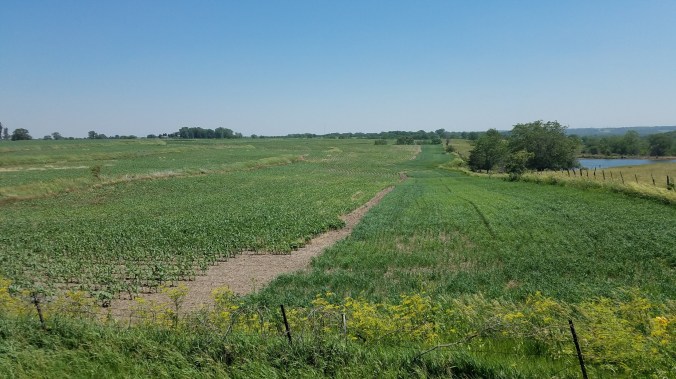 Here beautiful ridges of corn and soybeans break into the rolling hills of grass our cow herd calls home. The transition between the two has long been where our family has focused their conservation efforts. Initially, acres not fully suited to continual crop production would be seeded down in rotation, providing corn or soybeans some years and providing forage for the cows during the rest of them. My father and his brother terraced this farm in the 1980’s, extending the good ridge that ran through it down a series of three steps in the landscape. In doing so, more acres could sustainably be moved into continual crop production.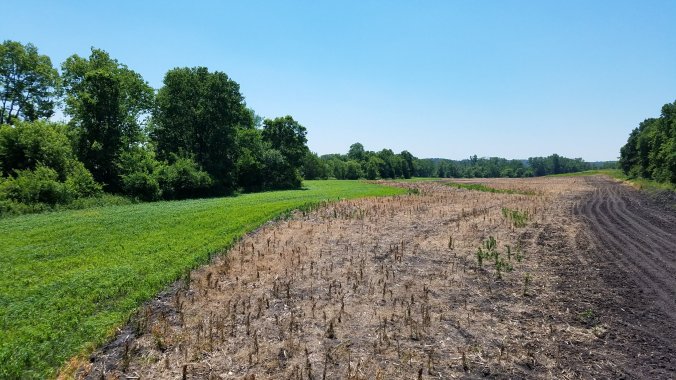



 True Stories and Tall Tales