Old I Know it Older Still

20171123_0746051635612142.jpg
Beneath the leaves that lounge today,
lay a dirt road yesterday
that dead ended at the bottom of the hill
at a pasture that lies there still.

It used to be a full fledged road,
No recollection, just what I was told,
As kids we had only known it old.

The trees arched to hem its bald dirt crown in.
The county graded the furrows from its brow.
There was no Botox then like there is now.

Down it once came crashing the tomboy neighbor girl,
her bare feet off the pedals coming down.
“I can’t stop, I can’t stop,” she yelled.
She hit the gate so hard it made her brother cry.

The traffic of youth,
the farmer’s old pickup,
once kept the grass at bay
but trees sprout now
beneath leaves October dripped.

You Have to Live for It

The old man always asked his graduate students, “What is one thing you would die for?” I smiled when I first heard about it. I could imagine being a grad student of his.

Some would try for the answer they thought their teacher wanted. Some would look for the one that would set them apart from the rest. Some would just try to come up with an answer at all.

Today he would be pegged as an idealist. Why shouldn’t he be? There seems to be no shortage of those ready to be a martyr in these anxious times. Any old hill looks like a fine one to die on, and the only thing better than finding a hill is finding a crowd to witness it.

We all want to be part of something bigger than ourselves, and bleeding for such seems to offer us the prospect of fulfilment. Perhaps we adopt the principles of our groups as our own.  Perhaps we confuse our membership with our identity.

What if you and I are bigger than our causes? What if we are making ourselves less and not more? Why is fulfillment still so elusive? What if we are nothing more than crusaders?

The funny thing is that the old man wasn’t an idealist. He believed a theory was only as good as its most recent test. That fulfills the definition of a pragmatist. And what is a pragmatist but someone who can let go of a principle without letting go of themselves?

There are causes surely worth our martyrdom, but the trick seems to be that once we find what we would die for, we have to live for it.


The Butterfly Effect

From time to time on my blog you will see posts about the collaborative effort set forth for conservation in our state by the Iowa Nutrient Reduction Strategy.  I bet you have also read about the hope I and many have that in working to fund and advance the strategy, we’re working to not only address the concerns of today, but we’re building a better framework for the concerns that will arise tomorrow.    A framework that can take another step beyond an out-dated, inefficient, ubiquitous regulatory approach towards conservation concerns.  A framework that can be modernized to include a more collaborative effort, more flexible and more targeted, customized from a menu of options to more closely align with that which is in all of our best interests.

One can already look at conservations issues beyond water quality where that sentiment is taking hold.

If you are like me, you’ve probably noticed quite a few large, monarch butterflies roaming about in the heat of the last few days.  I seem to notice more this fall than I have in years past.  If so that’s great news, and keeping that trend going is the work of the Iowa Monarch Conservation Consortium.  It is made up of 40 members working to help with the recovery of the eastern monarch butterfly population.  It officially began back in 2015, though the desire to bring it about goes back farther.  Members include conservation groups, state agencies, farm groups, universities and agricultural business partners.  Earlier this year, the consortium put forth a 135 page document outlining their strategy to keep the eastern monarch off the national endangered species list.

Monarch Butterfly Video

The eastern monarch butterfly overwinters in Mexico on a specific tree known as the oyamel fir.  The fact that they return each year to the same trees is remarkable not only due to their completion of a 2500 mile journey,  but also in that the monarch that returns is the fourth generation of the one that left.  Along their way north then south again, the monarch caterpillar will only feed on milkweed.  As crop production techniques have advanced, milkweed, traditionally seen as its name implies, has suffered.

Part of the consortium’s work here in Iowa is to come to a greater understanding of the butterfly and all the factors that come into play affecting its population numbers.  Part of the consortium’s work is also to reintroduce milkweed into the landscape.  At one time, the previous federal administration felt 7 million acres were needed for such a purpose.

Iowa plays a pivotal role in these efforts.  An estimated 40% of the monarch’s that overwinter in Mexico come through Iowa and its surrounding midwest states.  Focus has been placed on using “pollinator habitat” in existing Conservation Reserve Program tracts, buffer strips along streams or livestock buildings, borders along field edges, roadways and other local initiatives in Iowa communities.

According to Stephen Bradbury, an Iowa State University ecology and entomology professor who works with the consortium, these small patches here and there will actually do more good than large scale plantings.  It’s in keeping with the monarchs natural tendency to congregate on field edges, and it may have an added benefit in helping fight herbicide resistant weeds.  According to a Des Moines Register article, Iowa leads the way with 623,000 acres in pollinator habitat, and the Register reports that last year another 1.9 million acres were in the process of being created, with farmers kicking in $55.3 million to do that.

You can find out where the butterflies are along the route using the consortium’s website located here.  Populations are kept track of in a couple of different ways.  Surveys are conducted along the migratory route as an estimate, and when they return, the area the monarch cover is measured.  In 2013 the monarch covered a record low 1.66 acres.  In 2014 it was 2.8.  In 2016 they covered 10 acres.  This year winter storms dropped the number to 7.2.  While unfortunate, it along with the illegal logging of monarch habitat in Mexico show there are other factors affecting monarch numbers beyond milkweed.  While there is a long way to go on the road to recovery, people across the monarchs route are coming together in the effort.  Visiting the consortium’s website, you can find out how you can become involved to.

 The Gatekeepers 

A few blocks away, behind an array of buildings, stood the stainless shine of the Arch along the mighty Mississippi.  Often referred to by the name of the city it is in, it’s formally known as The Gateway Arch.  A gateway with no gate.

We were in town to see a Cardinals game, and a mere two blocks separated us from Busch Stadium.  On the sidewalk along South Broadway, just outside of the Hilton, we were joined by a St. Louis Police officer in a blue athletic polo.   Crosing Walnut Street a Missouri State Policeman joined in.

The two had a singular focus.  It seemed to lie up ahead and just off to the left.  Soon we came upon a squad car.  The female officer who drove it had the passenger door open towards the sidewalk we were on.  Her feet were set in a wide stance, and she crouched slightly behind the V that was formed between the door and the car.  Seeing our companions, she rose briefly to speak in the ear of the metro cop and then turned back to where she had stood before.

Looking with her, I finally saw what the hubbub was about.

On the far side of the street and half a block ahead, a sign emerged from the crowd of people making their way to the ballpark.  It was light green with a hint of purple splashed across its top.  Standing in dark letters were the words “God Hates Fags.”  Instinctively I looked away.  Then I forced myself to look back.

Other signs were with it, and beneath them stood half a dozen members of the Topeka, Kansas based Westboro Baptist Church.  Across from them stood the stadium.  In it the Cardinals were about to hold their inaugural Pride Night.

A steel barricade had been put around the handful of members that stood in front of a parking garage.  15 to 20 officers in blue polos stood beside them, many with bicycles.  Around them stood a crowd.  I again looked away.  This time for good.

Among the other signs Westboro is known to sport are:  God Hates Jews.  Priests Rape Boys.  Thank God for Dead Soldiers.  I didn’t happen to see any of those signs that night, only the sentiment, I guess.

They boast they protest six events a day, ranging from ballgames and concerts to deployed soldiers’ funerals and the funerals of LGBT victims of violence.  They have been frequently sued, and while lower courts and state legislatures have tried to take action against the group, the United States Supreme Court, in an 8-1 ruling in Snyder v. Phelps, decided with the group on protected free speech.  The sole dissenter with Justice Samuel Alito, perhaps the most conservative justice on the bench today.

The Church’s most famous leader, the late Fred Phelps, knew his way around a courtroom.  Besides being a preacher, he was a civil rights attorney, and his daughter maintains that his law firm once made up 1/3 of Kansas’ federal docket of civil rights cases.  Twice he was recognized for his work on behalf of black clients.

He never seemed to have made any profit from it, selling vacuum cleaners at one time on the side.  He would eventually go on to run three times as a Democratic candidate in the primary for Governor of the State of Kansas and once ran in the Democratic primary for US Senator.  In the 1992 Gubnatorial Primary he garnered 30% of the vote.

By nearly all accounts, Phelps was known as an asshole of epic proportion.  The church, which claims a mere 40 members today, most of whom are Phelps’ extended family, seems pleased to continue on that tradition.  In the opinion of the author, they do a fine job.

Across from the Westboro Church in Topeka, Aaron Jackson, who founded a nonprofit organization called “Planting Peace,” purchased a residence in 2013 that was then painted in rainbow colors and dubbed the “Equality House.”  It has been reported that in September of 2013 Phelps offered support for those behind the house.  He was promptly excommunicated by Westboro.  Two family members maintain in the aftermath he quit taking care of himself and neglected his own nourishment until his death six months later.

A granddaughter emphasizes Phelps story is a real life example of how even the most hard hearts can change.  Perhaps she’s right, but it is hard to tell if Phelps’ main affliction was a hardness of heart or simply being an asshole.  In the end, he appears to be a victim of who most are a victim of:  himself.

Photo credit: KMOV, St Louis

There on Broadway the counter protesters confronting Westboro hoisted signs of their own, some rather ingenious.  In the park we settled in to watch the game.  Our hotdogs were heaped with pastrami, and our glasses were full of alcohol.  My mind was still full of what I had seen outside.

I thought of those persecuted for who they are, but I really didn’t think of those that stood up to Westboro, facing what I could not.  Nor did I think of the idiots from Topeka.  As I looked at the Arch, what I thought of were the cops.

LGBT, Catholic, Jewish, veteran, standing there beside those they might not want to.  They couldn’t look away, and they couldn’t respond.  They weren’t there to protest hate.  They were there to serve and protect.  Perhaps it is hate’s best antidote.

In the end they laced their bicycle tires together, gating the protesters from the crowd so they could get to their cars and go home.  Home is a place where many along the sidewalk probably slept with a clear conscience that night.  I wonder how the cops slept?

The Cardinals lost.  The crowd went home.  The Arch stood in the dark still open.  Perhaps it is the counter protestors that keep it that way.  Maybe it is the Supreme Court.  Maybe it is just the willingness of some to do that which they don’t want to.

A Hundredth Birthday

Tonight, in Winterset at the Jackson Building, the Madison County Farm Bureau will host its Annual Membership Appreciation Dinner.  In doing so we will mark 100 years of existence.  This morning the county caught a widespread drink, and I can’t think of a more fitting birthday present.

The organization began with the idea that strength was to be found in our coming together, which we could use to advocate for the way of life we have been blessed with and share in.  Along the way they built stronger relationships with those around them.  Some of those relationships pulled them away from their former selves and closer to the people we are all called to be.  As it was then, so it is now.

In going down the list of individuals who served as presidents of the organization, one sees the years that correspond to wars, droughts, a depression, and a farm crisis.  It calls to mind the anxiety of those present moments, which now belong to the past.  It does so as many of us today wait on pins and needles for our next rain.

Just as far back go the issues of conservation, regulation, property rights, and taxes.  As we have moved from farming with horses to global positioning systems to big data, we have picked up some new ones.  Ahead lie questions, just as they always have.

Will the state take the lead in developing a dedicated source of water quality funding?  Can we move from a regulatory to a collaborative approach on the fundamental concerns we all share?  How do we best navigate with the inherent risk associated with farming?  How do we connect with a consumer increasingly removed from agriculture?  How do we keep our members informed?

Many groups seem based on the idea that the solution is something to be provided by someone, somewhere.  The grassroots nature of Farm Bureau has maintained that to find solutions we need to bring people together to talk about their concerns, to share their thoughts and ideas, and make use of the best information available to collectively chart a course forward.  In marking our 100th birthday, we celebrate 100 years of being able to keep that perspective, and 100 years of bringing in folks from across the county to do that.

I am a poor predictor of the future.  I will predict, however, that strength will continue to be found in our coming together.  In doing so we will continue charting the course forward.  In doing so we will continue to enrich our lives.

The Pole Bender

Sometimes a man don’t know
When he’s supposed to walk away.
Heath

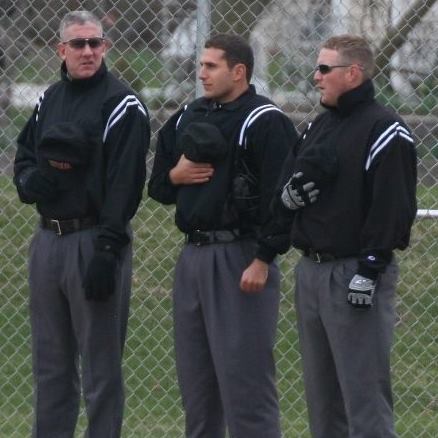
“Mad Dog” Joe Nelson, Pat Hoberg, Heath “Wild Man” Banks, back when they were fat.

“Hi, Terry,” said the MLB umpire leading us back to the elevator that would take us back to the seats of Kaufman.

“Hi, Pat.  How are you doing today?” said the coach with a fifth grader’s enthusiasm.

The umpire was Pat Hoberg.  The coach was Terry Francona of the Cleveland Indians.  We were on our way back from the field, where we had just been shoulder to shoulder with their All Star Lindor as he signed autographs for the kids at Kaufman.  It was neat to be close to a player of his caliber.  It was neat to find that caliber coupled with that humility.  But brushing shoulders with Francona, the coach who just been in the World Series without his two top starters and had managed his ass off only to lose in 7 anyway, was more than neat.  It was something a man could get swept up in.

“I enjoy getting a chance to get people down on the field if I can,” Hoberg had explained earlier as he stood along the fence of a press dugout.  His eyes turned from the field, as though he wanted to emphasize the point.  “It always impresses me how they look at it, wide-eyed and all that.  It reminds me to appreciate what it is I do.  I tend to just look at it as my job.  Sometimes I forget just where it is I work.”

The Indian taking BP crushed a ball just then.  By sound alone, Hoberg’s eyes jolted back and found it mid-flight, like he knew exactly where to expect it.  It sailed to center and was gone.

It’s a strange thing.  You know the ball will come down, yet the mid-flight feeling taps in to something eternal.  The presence of all things in a brief instant.

His eyes never strayed from the field of play again.  It was hardly some super-human quality.  It was simply his job.  His job was not to get swept up in it.

A couple of buddies had umped high school and college baseball games with Hoberg.  It was that connection that had brought me along.

“How did you come to ump with Hoberg?”

“We were umping a game, Joe and I, and the third ump hadn’t showed up.  We were needing to get going.  Joe had called Pat’s games when Pat was in high school.  He spotted him in the crowd and told him he was needed on the field.

‘I don’t know what the hell I’m doing,’ he said.

‘Sure you do.  Will cover you.  We just need the body.’

Turned out, he was pretty fucking good.”

“Do you have a favorite story?”

“Yea.  The three of us were calling a Carroll game.  They’re always good, and going into the bottom of the fifth they were up 8-0.  Two more and they would ten run it and end it early.

The catcher from the other team was a whale of a kid.  I could hardly see around him.  It was a bitch trying to call the plate.

This kid from Carroll was batting with a man on.   All of the sudden I heard that crack, and I knew he had gotten around on one.  Smoked it.  Problem was I had never seen the ball come off the bat.

I looked up and I couldn’t find it.  I had no idea where it had went.  ‘Fuck,’ I thought.

I glanced at Hoberg, and I could tell he hadn’t seen it either.  I looked over at the third base coach, and he had his arm out, pointing fair.  It was all I had to go on.  I put my finger in the air, ran them home, and Hoberg and I trotted off for the locker room.

We were talking about where we were going to get beer on the way home.  I was pulling off my shin guards.  That’s when he asked me where the hell Nelson was.  On cue the door bust open, and Nelson came in, face beet red and his eyes bulging out of his head.

‘What the hell just happened out there, guys?’ he asked, running his fingers through his scalp, exasperated.

Two run homer.  Walk-off.  10 after 5.

‘Walk off, huh?  Did either of you see the fucking ball?’

No.  All I had to go on was the third base coach.

‘Do you know why you didn’t see that ball?  You didn’t see that ball, because it was so far foul it’s sitting in a cornfield in Nebraska right now.  It’s a shit-storm out there.  Where the hell do you think I’ve been for the last twenty minutes?’

The shit storm outside wasn’t the worst part.  The worst part is that we periodically get reviewed, and there was a guy from the state in the stands that night.  Of all the damn nights…I spent the next few days waiting on a phone call.  It never came.

I ran into the guy a few weeks later.  I asked him, ‘Hey uh, did uh, did you hear anything on that Carroll game?’

He smiled.  ‘Yeah, I got a phone call wondering what the hell had happened over there.’

‘What did you say?’

‘I told him the truth.  Don’t really know what to tell you.  Damnest pole bender I ever saw.'”

The guy umping the umps hadn’t got swept up in it either.

“How did it end with you guys?”

“Joe had been to umpire school.  He mentored me.  When he thought I was ready, he encouraged me to go.  I didn’t make it.  When Pat came along, he followed our same footsteps, and then he just kept going.

The guy that taught Pat had went through school with me.  At night my phone would ring.

‘Man, I just don’t know.  I don’t know if I have what they are looking for.  I can’t tell how I’m doing down here.’

‘Oh my God.  This kid…he’s like no one else down here.’

I’d just listen, never able to tell the other where the other was at.”

“I used to think people knew how good they were.  Maybe everybody wonders.  Do you suppose Francona wonders?”

“I suppose he wonders how he is getting back to The Series again.”

“Maybe that’s the trick.”

“What is?”

“The trick is to keep going, home run or pole bender.  The ball will come down on its own.”

Chevron Deference

If you have followed the confirmation hearings of Supreme Court Nominee Neil Gorsuch, chances are you’ve heard the concept of Chevron Deference once or twice.  Over lunch today, I took the time to tune in for a brief while.  Of note to me was a comment Senator Amy Klobuchar, an attorney from Minnesota, made on Judge Gorsuch’s desire to overturn Chevron Deference, a legal concept established in the Supreme Court case of Chevron U.S.A., Inc. v. Natural Resources Defense Council, Inc. from 1984.

“This 33-year-old case guarantees that the most complex regulatory decisions are made by experts who are best equipped to handle them. Overturning Chevron would have titanic real-world implications, jeopardizing rules that protect public safety, requirements against lead‐based paint, and clean water protections for our Great Lakes.”

As I had mentioned in my previous blog post, part of my trip a month ago to D.C. actually educated me on the topic of Chevron Deference.  Senator Klobuchar’s comments sent me scrambling.  I thought I had learned wrong.  It turns out that I hadn’t.  Whatever your view of the confirmation of Gorsuch, you might be interested in knowing what Chevron Deference is really about.

What Chevron Deference states is that if you or I are caught in a lawsuit with any agency of the United States Government, and you or I and our experts have a reasonable interpretation of the law, and the agency and their employees have a reasonable interpretation of the law, the courts must side with the government agency.  It was a fine thing to have heard that Senator Klobuchar feels that the government employs “experts who are best equipped to handle” regulatory decisions, but I think most of us would have our doubts.  I know farmers for the last eight years that have had them, and I can bet on the environmental groups that will have them with the new EPA.

It has an ironic feel that liberal leaning legislators would mention the repeal of Chevron as a concern for Gorsuch, when a repeal of Chevron might actually be one of their better friends.  But then filibustering a nominee who would restore the court to its former balance and as a consequence invoke a Senate rule change that will clear the way for nominees much more from the fringe feels ironic as well.  Then again, I don’t suppose anyone has ever accused D.C. of being overly-farsighted.

I’m a poor guesser of the future, but I would guess that the fight to overturn Chevron Deference will someday have new, leftward-leaning allies.

The Lobbyists

The basement cafeteria of the Longworth House Office Building in Washington, D.C. is a bustling place to be.  Officials come and go, and their constituents do the same.  Tables are at a premium, lines are long, yet somehow everyone gets enough to go on with.  The most dedicated are able to carve out some little place for themselves, at least for a brief while, until someone else carves one of their own.  It’s a microcosm, I guess.

It was day three, and by now I was starting to get to know the group of Iowans I was in DC with.  All of us were involved in agriculture, and we had all come to give input on a particular segment of agricultural policy.  Some were making their third such trip.  Some, like me, were making our first.

Each segment was represented by a committee.  The committees had met on our first day.  I had spent my meeting trying to learn more.  I did.  I learned about Chevron and Auer deference in legal proceedings, the Endangered Species Act, air quality standards, and how it all impacted members of my committee who stretched from New Mexico to Montana and from Pennsylvania to Arizona.

Day two had been devoted to educational breakout sessions on various points of agricultural interest,  Day three, the day which had the delegation from Iowa entering the cafeteria, had us visiting our national legislators and their staff to speak about existing ag policy.

Here in the cafeteria one of our group was able to summit and place a flag on the only available table, a table for four.  There were 15 of us, but having a toe hold gave us a base to mount subsequent campaigns from.  My detachment raided a nearby table when it lost all of its occupants save one.

“Would it be all right if we joined you?” we asked the young woman.

“Absolutely,” she said.  So a farm couple, a veterinarian, a hog producer, and myself did.

“Do you work here, or are you in town for a visit?” I asked.

“Well I used to work here, but now I live in Colorado.  I’m here advocating for women’s healthcare on behalf of Planned Parenthood.  Where are you guys from?”

“Iowa.”

“What brings all of you here?”

“Farm policy.”

We went on continuing to share lunch together.  It was a fine thing.  Alongside Chevron and Auer deference and the rest, I now stored tidbits about living in Denver, working in D.C., and the answers she provided to the inquiries we made about Colorado’s marijuana laws.  If such a conversation can happen in DC, I suspect it can happen in other places.

At that table and in the subsequent visits with our Representatives and Senators, I frequently had time to reflect on the group I had stumbled into being a part of, and I began to realize my appreciation for them.  No one spoke about abstract, philosophical arguments on agricultural policy.  Instead they spoke about their real-life, real-time view of agriculture, revealing some of the things they were passionate about and a little of the hope we all have in being able to make a difference.

Those who didn’t have to catch a flight that night were finally able to gather for an informal dinner.  They spoke of their families back home.  By now we had learned something about each other’s sense of humor, and laughter was plentiful and came freely without costing anyone a dime.  Back at the hotel, headed to my room, I smiled the same way an eight year old boy would.

“It was a good day.”

“It was with good people.”

I don’t know what will come of all our discussions on free trade, the new Farm Bill, regulatory and tax reform, and renewable fuels.  I don’t know what impression of Iowa the Coloradoan had left lunch with.  What I do know is that occasionally we all get the opportunity to try to make a difference on the issues that mater to us.  Perhaps the way to make the biggest difference is in how we live our lives.  I’ve been fortunate in agriculture to continue to get to know those who live their lives in ways which make a difference to me.

Other People’s Children

Originally the school had a herd of 100 cows and 100 hogs to go with them.  The kids did the work, most of them were orphaned after a yellow fever epidemic.  That was what the place used to look like.

Today it boasts a herd of dwarf Nigerian goats.  Ten perhaps.  They milk them to make soap.  They sell the soap at farmer’s markets.  The garden was unkempt.

“If I have a kid that likes to draw, I tell them that’s okay.  You come out here and draw while we work.”  I bet they would draw it even better, if they had to do it, but even to make soap the school looked outside to source volunteers.

Where they were today was complicated.  Long ago they had to quit being self sufficient.  Government regulation forbid eating much of their own food.  Regulation also posed challenges with the school’s religious foundation.  By now the conversation had turned to a whole myriad of buzz words:  non-profit partners, socially-conscious, aesthetic value, increased awareness, pollinator seeds.

I make no claim I understand the complications they face.

In the background, through the nearby trees, I could catch a glimpse of the boys at the school playing ball.  They were dressed in the school’s olive t-shirts with khaki shorts, white and black, and still playing the way the boys that preceded had:  for keeps.  I suspect they used to farm that way too.

The kids still understood what it was about.  Even if farming had now become little more than a curiosity.  Even if the use of the term “farming” was questionable.

“We also have chickens here.  Our goal is that soon we will no longer have to source any chicken feed at all, generating it instead from our leftovers.  We are teaching them about the larger cycle, that nothing gets wasted, and that we shouldn’t consume needlessly.”

I suppose it’s a fine cycle.  Agriculture teaches us an even larger one, though.  To survive we have to find a way to make it work.  If we try hard enough, and the rain comes just right, sometimes we can make it just a little bit longer before that cycle gets the better of us.

Still, they were doing good for those boys.  Waiting in the hallway for the boy’s room just before we boarded the bus, the bell rang, classes began changing, and I was in the midst of them.  Today they are at-risk kids, encompassing anything from ADHD to having been kicked out of schools in the past.

Many knew more about trying to survive than most their age.  Many probably knew it better than me.  It was a shame their glimpse of agriculture didn’t give them a better chance to put those skills to use.  It would have made some of them fine farmers.

“House of Mercy” was the translation for the place.  I had it for the teachers.  For other people’s children, I had what the teacher’s had:  faith.  They had it in them from the beginning.  There was no sense in doing something different now.

Preaching to the Choir

He had a friendly southern draw, conveying a sense of southern hospitality, while producing words in the quick paced way of a man that is busy.  Sunglasses dangled from his neck as he spoke after lunch in the little town of Lyon, Georgia.  While one hand held the podium in place, the other would work to make his point.  Visually he would have fit right in with the group of Iowa farmers listening, but we were listening because he was a Georgia one, growing among other things, the Vidalia Onions Toombs County was known for.  He was 38.

“Now who of y’all wants to ask the first question?”

“A lot of our crops in Iowa use biotechnology.  It’s something some express concerns about.  You guys have huge urban centers in Georgia.  How does agriculture interact with those consumers?”

“At least two of your all busses have visited Pittman’s right?  They’re the produce farm with the country store.  Any of you all know what Silver Queen Sweetcorn is?  Down here it’s the sweet corn all the supermarkets carry.  They have for years.  It’s all most people have ever known.

Folks will drive out to Pittman’s, who sell sweetcorn, and they’ll ask Mr. Pittman, ‘You, uh, you got any of that Silver Queen Sweetcorn?’

‘No, sir.  I sure don’t.’

‘Why, uh, why don’t you have any of that Silver Queen?’

And he’ll answer ’em, ‘Well y’all didn’t drive out here in no Model T Ford did ya?’

Up north you have BT Corn.  Down here we have BT Cotton.  You have it for your friend, Mr. Corn Borer.  We have it for ours, Mr. Boll Weevil.  In 1996 I could have used 14 different pesticides to keep him at bay.  I don’t have to use any today.  I know which one I prefer.

Some consumers are using bad information.  That’s on them.  Sometimes we aren’t doing a good putting information out there.  That’s on us.  We’ve never had to do it before.  It’s important to understand how to do it without driving wedges.”

As a spokesman for agriculture, he was bona fide, in every sense of the word.

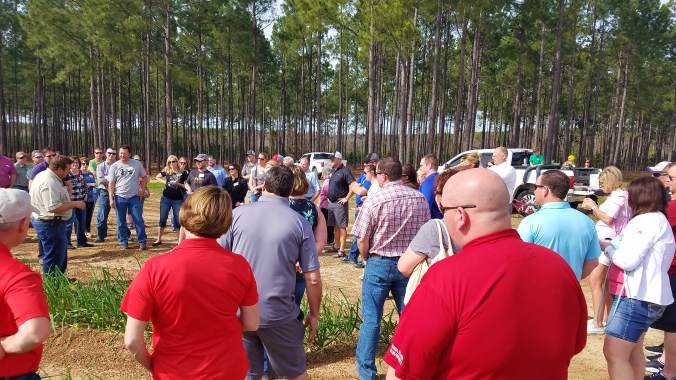
20170220_144208

Visiting the farm after lunch.

After lunch, our bus came to a stop in 20 acres of Vidalia Onions.  There we met the rest of his family, in the back of a pickup, serving up boiled peanuts to their third bus load of guests.  Their two sons, 7 and 3, danged their feet over the side of the box and took it all in.

“I’m sure you’ve noticed in your other stops how pebbly our soil is.  When my grandfather was looking for land, he’d look at them stones.  What he wanted to see is what y’all are seeing here today, good red rock.  If he saw quartz, then that land was of no value to him.  It is red rock that takes in the heat from the sun, keeps our ground warm even in the winter time, and allows us to do what we are doing here.  By April these onions will be harvested, and peanuts will be growing in their place.”

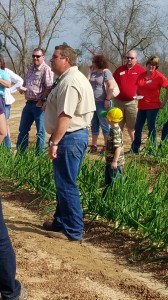
20170220_150204

Taking it in

Two Georgia boys were getting their own chance to soak it up, in order to keep it going.  Meanwhile their father preached to the choir; looking, I suppose, for a few more preachers.  We need ’em.