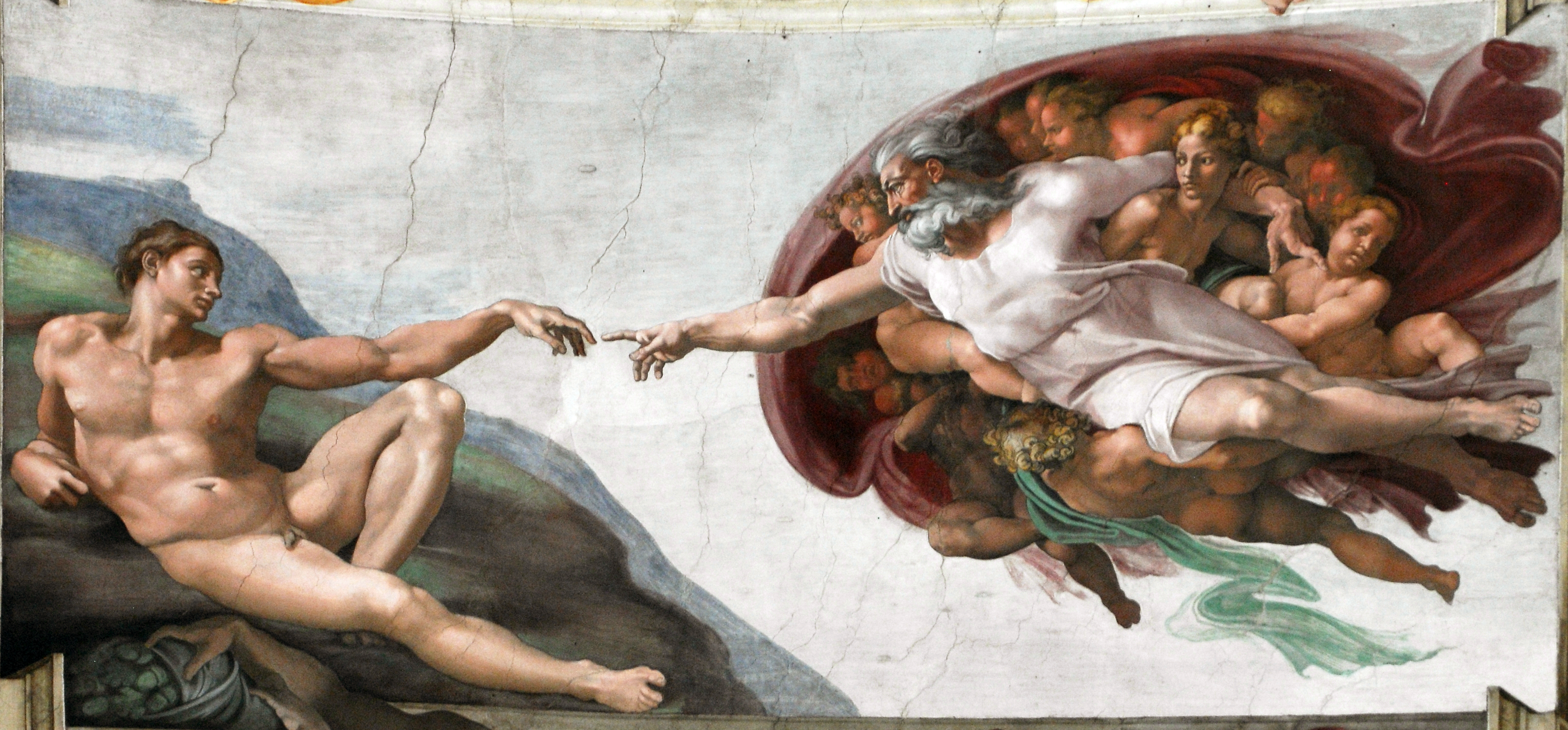
Wikipedia tells us that Michelangelo’s Creation of Adam, found in the center panel of the ceiling of the Sistine Chapel, is rivaled only by the Mona Lisa as a famed piece of art. Michelangelo completed it in just three weeks in October of 1511, and since that time numerous theories on its meaning have been put forth. I would only mention a few of the most common here.
Frequently noted are the mirrored images of Adam and God, which seem to underscore the biblical line of Adam being created in God’s image. Noted as well is Adam’s relaxed state, juxtaposed to the purpose driven God and the strain of the accompanying wingless angels bearing him along. Nearly every discussion will also mention the feminine figure in God’s embrace. Some, given her longing look to Adam, view her as Eve who hasn’t got down to the ground just yet. Others view her as the Virgin Mary, with the child beside her, on whom God’s hand is resting, being her son, the Christ.
Considerable thought has went into the velvet backdrop God and his traveling band are arriving in. One interpretation sees the backdrop as nothing short of an actual womb, with the green dangling scarf being the umbilical cord which gave our newly created, ideal, and idle man his navel. A second interpretation sees in the backdrop an anatomically correct representation of the human brain. In this interpretation we find two main camps. One sees this as suggesting we can find God via our intellect. The other sees it as a subtle suggestion that God is the product of our own mind.
At the time of the writing of this blog, Michelangelo seems to have no further comment on the subject, which would be notable, I suppose, if not for the fact that he is dead. Should he comment, the blog will make an appropriate note of it, though the reader would have likely heard about it elsewhere first.
I became curious on the painting several years ago, when I was in a Des Moines office, and across from me, above the coffee table housing Newsweek, Time, and Sports Illustrated, was what I assumed to be an actual size reproduction of the painting, focusing solely on the two hands at its center.
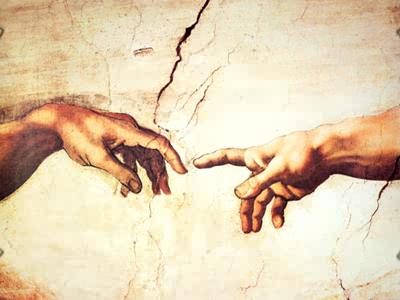 I was already well aware that many felt this image from the larger panel had captured the intimate closeness of the human and divine, close but not quite touching. In that office, however, being occupied by this image instead of the magazines, I realized for the first time that the painting also suggests it doesn’t have to be that way. It doesn’t appear to be God’s intent. All our ancient ancestor had to do was snap out of his leisure for a moment and straighten out his finger. Instead, Adam, relaxed and taking it day by day, is about to miss taking advantage of the moment.
The common interpretation of the painting says that God is reaching out, about to give Adam the spark of life. I am hardly an expert, but it appears to me Adam is already alive. I wonder who the first one was to suggest that, all those centuries ago? Someone should have told him to stick a sock in it, assuming they had socks in Michelangelo’s time.
Michelangelo seems to be representing the purpose driven fullness of the divine, and man not acquiring it because he prefers instead to lounge around on his ass. Today we have many things to make this experience more enjoyable. Michelangelo didn’t. Poor guy painted the Sistine Chapel on his ass just trying to pass the time.
Perhaps in 1511, Michelangelo noticed Adam’s progeny had not fallen far from the tree. This would leave his commentary at the very least as much about man as God. It’s likely we fell no further in the centuries since, though all the centuries from Adam on have at least introduced the concept of decency. Today I lounge around on my ass watching football fully clothed mostly, laying there as the pinnacle of human breeding.
In another couple of weeks, Christmas will be here. Another of the noted days when God again extended himself to man. I suppose he probably does it every day. Maybe we ought to try to poke a finger back sometime; when there isn’t a football game on of course.
 True Stories and Tall Tales