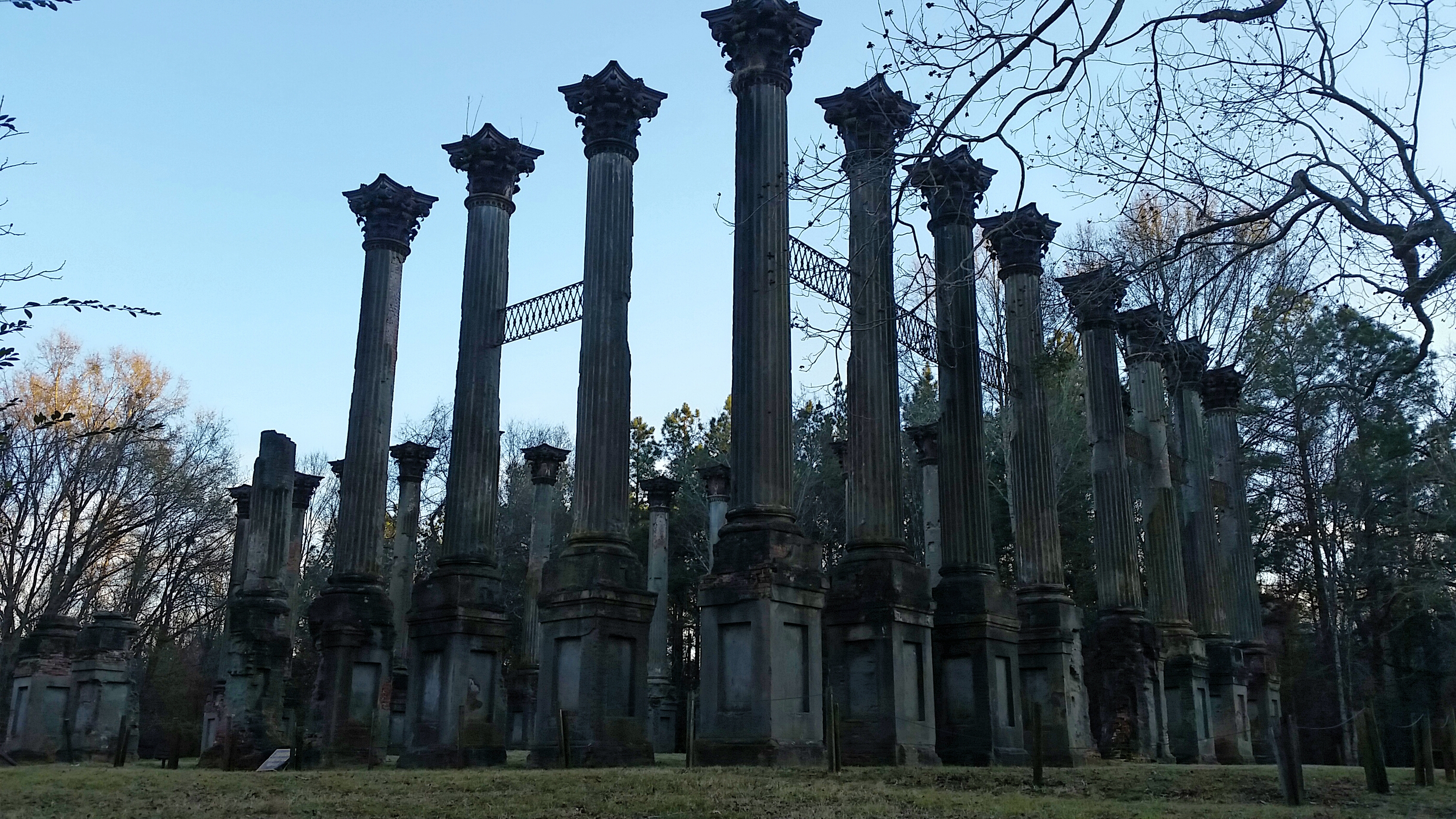
The Windsor Ruins near Port Gibson, Mississippi
Last month found Dad and I in Vicksburg, Mississippi on a Sunday.
“Suppose there is a Catholic Church here?” Dad asked.
There was one. The Gospel that Sunday was John’s and featured the Apostle Andrew. Only in this Gospel do we find Andrew as a disciple of John the Baptist and the first to follow Christ. John tells us Andrew recognizes Jesus as the Messiah and seeks out his brother, Simon Peter, to come follow Him as well.
“This morning we get one of the few mentionings of Andrew which takes place in the New Testament. The New Testament only references Andrew a dozen times, and half those times it goes on to mention that he was the brother of Simon Peter. It is as though Andrew’s name doesn’t carry any weight unless his famous brother is thrown in.
You see folks the Apostle Andrew was just like you and I: He was an ordinary man. He never makes a great speech that gets recorded. There is no mention of some great act Andrew performs. He simply recognizes Christ and follows Him, and brothers and sisters that is all that is asked of us.
The other three which join after him, his brother, James, and John, all get called on by Christ to be present in some of His finest and most trying hours. Time and time again Andrew, the first, is left out. Do we ever hear about Andrew being bitter about this, of his throwing a temper tantrum, or being jealous with the others? No. We don’t. What is remarkable about this ordinary man is how easy Andrew makes it look, but Christ knows how hard it was for Andrew, and Christ loves him for it.
You and I know how hard it is to be ordinary too. You and I know how hard it is to follow Christ. You and I know how hard it is to be Catholic in the state of Mississippi.”
The priest’s name was Malcom O’Leary, though I wouldn’t have guessed him for an Irishman. He had walked up the aisle humbly, with graying hair, a bowed head, and a decided limp hardly concealed by his vestments. His homily, only partly caught here, was as skillfully worded as any I had ever heard and was delivered to a parish no larger than one which might exist in a small, rural Iowa town.
Ninety percent of this congregation was black, and some of them, along with some of Mississippi’s whites, were part of an expanse of poverty like I had never seen in this country before. I wouldn’t have faulted Fr. O’Leary for saying how hard it was to be poor in Mississippi, nor would I have faulted him for saying how hard it may have been to be black. He had said neither of those things, however. Instead he talked about how hard it was to be Catholic.
Perhaps if it hasn’t been hard for us to be Catholic, or whatever faith it is we choose, we haven’t been doing it right. Maybe the same applies for being ordinary. It is the Gospel of John that uses the ambiguous phrase “the disciple whom Jesus loved.” This unnamed disciple is almost always in the company of Simon Peter. He’s in his company so much, it wouldn’t be a stretch to think they might be related.
The traditional interpretation is that the disciple whom Jesus loved was John. If we lay tradition aside, and sometimes it is the best thing to do, perhaps Christ saw in an ordinary man, whose name was hardly worth mentioning, exactly what Fr. Malcom O’Leary saw. Perhaps in embracing the difficulty of the ordinary, Andrew was anything but.
 True Stories and Tall Tales
Dan – To be Catholic in Mississippi. What a great line. Thanks for this and the JI song. Every time I hear him I am so moved and I am one part inspired and 9 parts “I’m never writing again!” He is so good. I want to reverse that ratio. Love these thoughts about being ordinary. At times it seems like there could be no worse fate and yet I am beginning to see that is probably the only way to find our uniqueness: to embrace our ordinariness. Be well
I grew up in Bayard, Iowa. Went to Iowa State and left Iowa for Pennsylvania and then Massachusetts – back in 1974. Still have a brother near Bayard and some good friends around Des Moines.