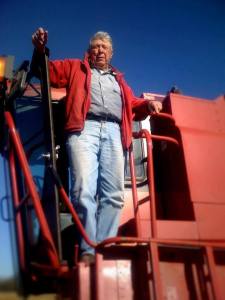
I once heard we should refrain from making other people saints. The idea was that in doing so, we bring about at least two, rather destructive, outcomes. First, the sainthood we bestow gets in the way of knowing the individual for who they truly are, warts and all. Second, it creates an impossible standard for everyone else in our life to live up to.
I suppose a lot depends on how you define a “saint.” Conventional wisdom takes it to mean “he or she that can do no wrong.” I feel differently. So did an old friend of mine.
“What are we to do, when we feel differently than the group we are part of? Is it better to move to a group that thinks like we do? Or is it better to stay and fight for the identity that has laid its claim on you?”
“That’s a good question. You’ve obviously been thinking about it. What are your thoughts?”
“I think I favor blooming where we are planted.”
A few years ago, John Connor had a heart attack. I went in to see him in the hospital. He was already in his 80’s, and they were talking a potential surgery. The thought crossed my mind that I might not see him again.
Outside of my family I had known no one longer. He was something of a pseudo-grandfather in my youth. He was now my oldest friend, and an ever present part of the place that I came from and still reside in today.
I entered the door of a large room with light wood paneling. His wife, Marilyn, was seated by the windows that made up the wall across from me, letting the daylight in and quieting the din from the streets below. John sat upright in bed reading the Des Moines Register. He looked largely unconcerned. He wore his hospital gown like silk pajamas, as though the two had just wrapped up a late breakfast over a casual morning at home.
At any moment he would rise and don a business suit or the lapel pin of some high ranking public servant. In real life, John had donned none of those things. Instead he chose the denim and occasional dirt of a farmer, and beneath them he reminded me there was no less dignity.
He folded the corner of the paper back and revealed his high forehead, and his large, round nose and the large ears that accompanied them. The latter two had begun to be bandaged as they were occasionally trimmed for the skin cancer that was his reward for a lifetime spent in the sun.
“Well, look who stepped in the door. We would have spruced the place up a little if we had known to be expecting company.”
The Irish have at least two distinct ways with which they handle life’s anxiety. The ladies will generally heap food upon you after you have already eaten. Their irrefutable insistence masquerades as an over-the-top hospitality, and I suspect that it comes from a place which knows the presumptiveness of all the things we take for granted. Leftovers, I suppose, from a starved people.
The Irish can also pride themselves in the ability to find humor when most cannot. For me it was a hallmark of John’s. Had he and I been on the Titanic together, the outlook would have been cold. The outlook would have been wet. Yet in the time before our final plunge, I have no doubt that the conversation would have been first class. What makes us human is a chance to have a word more final than that of our basic instincts. Leftovers too, I imagine.
They skipped the surgery, and John would live his remaining years full of life without his eyes ever having grown dim. He died the Monday before Easter in midst both of his life’s pursuit and the Irish community he had long been the goodwill ambassador for.
For 59 years he and Marilyn seemingly enjoyed the partnership all aspire to, and I suppose, on the days they weren’t enjoying it as much, they found each other the worthy adversary a life of growth requires. During that time they raised a family. They had a Pope land in their backyard. Neighbors joked he blessed their crops as he flew over. The crop he blessed were the adults they raised.
During the day, John generally selected the companionship of a faithful dog. In their succession each seemed to bear part of the stately nature of their owner. His last dog, Riley, a noble Collie, was content to lay on the seat of John’s pickup ruminating on the world outside, just as the driver did. Occasionally, he would raise objection with the more conservative dogs at our place, just like the driver did. Once in a while, when John was offering his thoughts from the driver’s seat, Riley would raise his head from the red cloth and turn and look him in the eye, as if to say, “I couldn’t have said it better myself.”
John sharing his thoughts was instrumental in cultivating my love of stories. A stop by either party could wind up lasting an hour or two. In the past few years I became more bogged down, and I stopped less.
He was a proud Democrat. I had known him to be a good one, and when we talked we always talked politics. I can’t recall an argument. We tired, I think, the best we were able to talk about the things that were true. In the end what argument could be against that?
He advocated for his ideas on justice in the world without losing the ability to reflect on the ways his own party might keep it from fruition. In doing so, he taught me how to be a good conservative. He taught me what it meant to be a good citizen.
Once he even encouraged his kid conservative neighbor to get into politics. Last year, when the kid ran for a little county office, it was John that eagerly drove his ballot forms around. In a few hours he brought the forms back completed. “Let me know when you are ready for something bigger,” he said.
Politically that fall the national scene escalated to a fever pitch. At times it would leave me stunned. I felt on the brink of losing trusted acquaintances as much for where I came from as what I believed. But back where I came from was John.
I will often here people list the things important to them. Often the list will start: “faith, family, and…” Some will be particular enough to tell you that it isn’t just a list; it’s ordered. It never fails to give me pause.
Some will use their faith to justify isolation of themselves from the difficult who would stand to teach them the most about the subject to begin with. The same, then, can be said for people and their politics. They pursue their dogma with such zeal they miss the ends they aim for, and so we too become a starved people in the midst of our abundance.
John had his faith. With it he seemed to have faith in his neighbors. He even seemed to have faith in me. None of us were without flaws, but generally, for most people, what’s wrong with them is what’s right with them. Perhaps he knew that. Perhaps someday people will find some faith in their neighbors again too.
John taught me more than a thing or two about faith, and I suspect he’ll teach me more than a thing or two yet.
His last stop at our place came after spending St. Patrick’s Day 2017 with Marilyn and his daughter, Theresa, in Haiti. His cousin, Archbishop Eugene Nugent, is the Apostolic Nuncio to Haiti, or in other words: he’s the Pope’s man there. At 86, few would have made the trip, and having made it, John was exposed to a poverty whose depth and breadth shook him.
It was a rainy day. I finally had a chance to do some mechanic work, and I had two tractors to work on. John pulled into the machine shed while I was working on the first. John stayed in the pickup. My father sat outside his door. I kept working on the tractor with the cab door open. While I worked, he began to talk about the slums of Haiti.
I would ask him questions from the cab. The last words I remember him saying were, “None of us realize just how damn fortunate we are.” I certainly didn’t realize it at the time. Maybe the ladies who have heaped food upon me would have. John found no humor in it.
I think it is unique that John died with a true appreciation of it.
They had asked the pallbearers to walk ahead of the casket, down the church aisle, and wait outside the door of the bell tower beside the hearse. I walked down the aisle with my eyes directed to the choir loft, only to lower them to greet the priests who had come to celebrate Mass. I stopped to say hello to each and began to get emotional with the first. I quickly stepped outside.
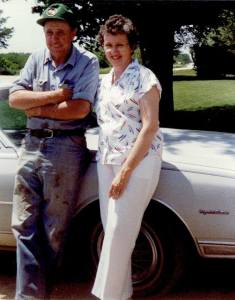 Outside, on the concrete below the bell tower, where John would preside over stories after church, I cried. At a time when everyone is certain someone else doesn’t understand their privilege, I fully understood mine: engaged in a calling, living in this setting, surrounded by the people John and Marilyn recognized for who they were: a blessing.
“Why do you suppose we tell stories?” I asked.
“Why do you think we do?”
“I think some tell stories to lose themselves in the cathartic, emotional abyss of a past they can’t escape from, some out of the anxiety that they or their story will be forgotten, and I suppose some try to escape personal experience altogether in order to tap into something larger about the human one.”
“Do you think its just a bunch of personal stories then?”
I suppose not. A few are given the perspective that in the end it’s not a collection of little individual stories at all. It’s one big one, which can repeat itself and often does, lest we try and find a way to nudge the needle. For me, John set his big shoulder against it and pushed.
 True Stories and Tall Tales
Good job Danny. John smiled.
I look forward to your true stories and tall tales. Each is a delight to read and maybe even ponder. You are a very talented writer. The teacher in me says never stop writing and giving your insite on your chosen topic. This article is especially wonderful written about a wonderful man. Thank you.
Beautiful story Dan!
As I recall the story, my (very young) dad and a group of his cronies were up to mischief late one night in Martensdale. They thought it was hilarious to sneak into back yards and tip over outhouses (and we think that WE are bored during this quarantine).
While trying to escape from an angry homeowner with a 12 gauge loaded with rock salt, they fled the scene in a big hurry. Dad said that he made it into the back seat of the car, someone else was hanging on the running board, and someone else was draped over the front fender. As they sped down the street to make their getaway, John, with his long legs flailing like a windmill, PASSED THE CAR!