The Farmer at the Farmers’ Market

IFFP 2

A few weeks ago I got a call from Nancy Degner of the Iowa Beef Industry Council.  A group called The Iowa Food and Family Project was partnering with the Mills Civic Hy-Vee, and they had invited six people and their friends to spend an evening making a week’s worth of meals for their families.

The meals were designed to be taken home, froze, and ready to use when needed.  Since May was Beef Month, they decided on a “beef” theme and wanted a local cow/calf producer to come in and address the group.  Being close to Des Moines, Nancy contacted me.  I was happy to go.  Our local Madison County Cattlemen Association has always been on the lookout to find ways to have a greater footprint with our urban neighbors.

This happens to be the mission of the Iowa Food and Family Project:  Connecting families, farmers, and food.

The evening went well.  I burnt nothing.  The guests had a good time.  Nancy even treated me to supper at Hy-Vee’s in store Chinese Express afterwards.  The only wrinkle was that they were about to close, and their beef options were exhausted.  Later, as the 12 participants filed past us, half of them took time to comment on my choice of Sesame Chicken.

There are at least 10,000 comedians out of work in this country.

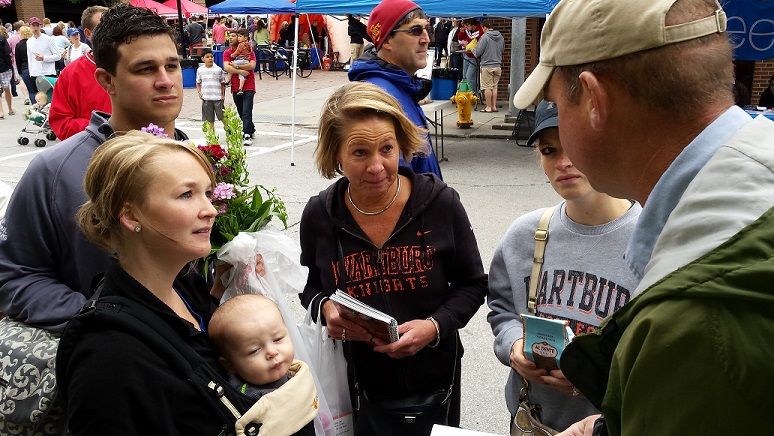
I volunteered additional time if the Iowa Food and Family Project ever needed it, and last Saturday they took me up on my offer.  They had a booth at Des Moines Downtown Farmers’ Market and wanted help staffing it.  I navigated through a parade of runners participating in the annual Dam to Dam race and made my way to Court Avenue.

IFFP features the work of two bloggers, Kristin Porter from Iowa Girl Eats, and Cristen Clark from Food & Swine.  Last Saturday Cristen was on hand, signing copies of the Iowa Food and Family Cookbook we were giving away.  The book contained recipes from both bloggers, as well as additional ones from farm families across the state.  I provided relief for her husband, who had been in charge of spinning a wheel where guests were asked random questions on agriculture in exchange for a free Subway sandwich.

In no time flat my mouth was in gear, and in no time flat, with never a down moment, three hours passed. Somewhere in the process I got a bottle of water.  I never had time to open it.  Cristen had signed so many cookbooks, they gave away 700 that day, I was surprised her hand hadn’t fell off.

They estimated a couple of thousand people went through the booth.  I would call that conservative.

Conversations ranged from the Des Moines Water Works lawsuit, GMOs, organic foods, support of Iowa’s agriculture, animal care, and Fred Hoiberg coaching the Bulls.  For my part, I learned it took 48 hours to get milk from the farm to the grocery store shelf, that Jethro’s restaurants purchase over one million pounds of pork annually (making them the largest independent purchaser of pork in the state), and that 11 million turkeys are raised in Iowa (making us the largest supplier for Subway and Jimmy Johns restaurants).

There were two questions I used particularly for their advocacy.  The first was in detailing what a bioreactor is and it’s role in removing nitrates from agricultural drainage water.  The second was about the inability to find a nutritional difference between organically raised and conventionally raised produce.

In regards to the first question, I got to witness one guest accurately describe to another the Des Moines Water Works lawsuit in 30 seconds.  I was impressed.  With regards the second, I had one boisterous guest take issue on it.  With regards to the cookbooks, I had one turn it down because it didn’t look very vegan.  I think it was the pot roast that gave it away.

Make that 10,001 out of work comedians in this country.

IFFP 1

The cookbook was free. The information about agriculture was free. Putting babies to sleep was a bonus.

 Iowa Food and Family Project:  http://iowafoodandfamily.com/

Food & Swine:  http://foodandswine.com/

Iowa Girl Eats: http://iowagirleats.com/

It Doesn’t Take a Village. It Just Takes a Few.

Youth Beef Team

May is the time of graduations, and graduations are an annual event where the old feel free to give unsolicited advice to the young.  Generally we select the advice we have never taken ourselves.  If we are unaware of this fact, the young are free to look at us and judge us hypocrites. If we are aware of it, however, then may the young look at us and realize we see in them a chance to get it right in the ways we haven’t been able to yet.

May is also Beef Month, and cattle producers celebrate it in the coming of green grass, the growth of this year’s calf crop, and the onset of breeding season.  They hope you celebrate it with the grill on the deck. For the Madison County Cattlemen, however, we are blessed with something more.  We get to celebrate the Madison County Youth Beef Team.

The team has been headed for many years by John LaFratte and his wife Shirley.  As an association we try to help cover expenses, but the vast majority of the expenses are covered by John and Shirley themselves.  The two have an ice cream stand at the county fair, and for most it would turn a good profit.  John and Shirley use it as an engine to propel the county’s youth, either through the purchase of trophies that help to fund local scholarships, their support of the 4-H auction at the fair’s conclusion, or their monthly commitment to the Youth Beef Team.

The team itself boasts 30 youth, which spend time learning about cattle, how they are raised, all things beef, communication and presentation skills, and how to advocate for it all.  Somewhere in the process, the youth also learn about becoming adults.  I suspect they don’t learn about it via John and Shirley’s advice, rather it is by their example.

At Tuesday’s cattlemen’s meeting over 20 directors got a chance to see a small part of what that looks like.  John and four of the youth joined us and gave the same presentation they had recently given to over 270 fifth grade students from around the county.  You might be able to go a day without eating beef, but you cannot go a day without benefiting from it and those who raise it.

In the midst of it all, it was hard not to think about what the future might hold, as the youth from years ago are now returning and putting the skills which John and Shirley worked to give them to use.  May tomorrow’s promise become today’s realization.  They have a much better chance of getting it right.

The Infant Running the Show

Upset people tend to see the world in a way which justifies the continuation of the upset.  At least that is what a guy told me once, and he seemed believable enough.  I was thinking about this as I looked over at Raylan, somewhere in the vicinity of age 3, currently knee deep in a man made creek in the middle of Reiman Gardens in Ames, Iowa.  He had tried to jump on a rock.  He had missed.

I laughed.  Raylan chose a different direction.  I still laughed.  He wasn’t mine after all.

My mother, God bless her, had decided we should celebrate Mother’s Day on Saturday, giving my four younger sisters the chance to spend Sunday with their families.  My mother thought she had done a great thing.  I suspect what she’d really done was give my four brother-in-laws heartburn.

She had picked Reiman Gardens in Ames as part of the way to spend the Saturday.  They were hosting a butterfly and a treehouse exhibit, and she assumed the kids would find both enjoyable.  Two sisters and an assortment of nieces and nephews went with my parents and I.

To get to the butterfly exhibit, you walk into a short hallway.  Either end has a door.  Both can’t be open at the same time.  This is to keep the butterflies from escaping they say, but I would guess it also ensured the lady laying down the law had a captive audience.  She spoke to the kids in the voice most adults use to read to fairytales to them in.  Among the instructions she laid out was, “Don’t touch the butterflies.”

There were three boys in the group, ranging in age from 3-5.  Evidently she thought the boys would try to pet them.  Evidently she hadn’t raised any boys.

I haven’t either, but I knew my own kind well enough to know they were looking to make grease spots of them.  This is exactly what one nephew, Bowen, was intending to do.  I caught him by the arm as he was bending his knees to jump on what was probably a Duke of Burgundy on the sidewalk before him.

“You can’t touch them, Bowen,” his mother said.  Hmmm.  Maybe that woman had raised boys after all.  Mothers view their children in a way which justifies the continued belief of their good motherhood, I suppose, and I am sure it is the same with fathers.

We ventured out into the gardens.  It was similar to a pasture walk without any anxiety that I would find cows out.  Free of such worries, my mind was left to think of how much its stocking rate could be improved with an application of 2 4-D.  I should tell the little old lady about it, I thought.  I’ll try to corner her in the butterfly hallway first.

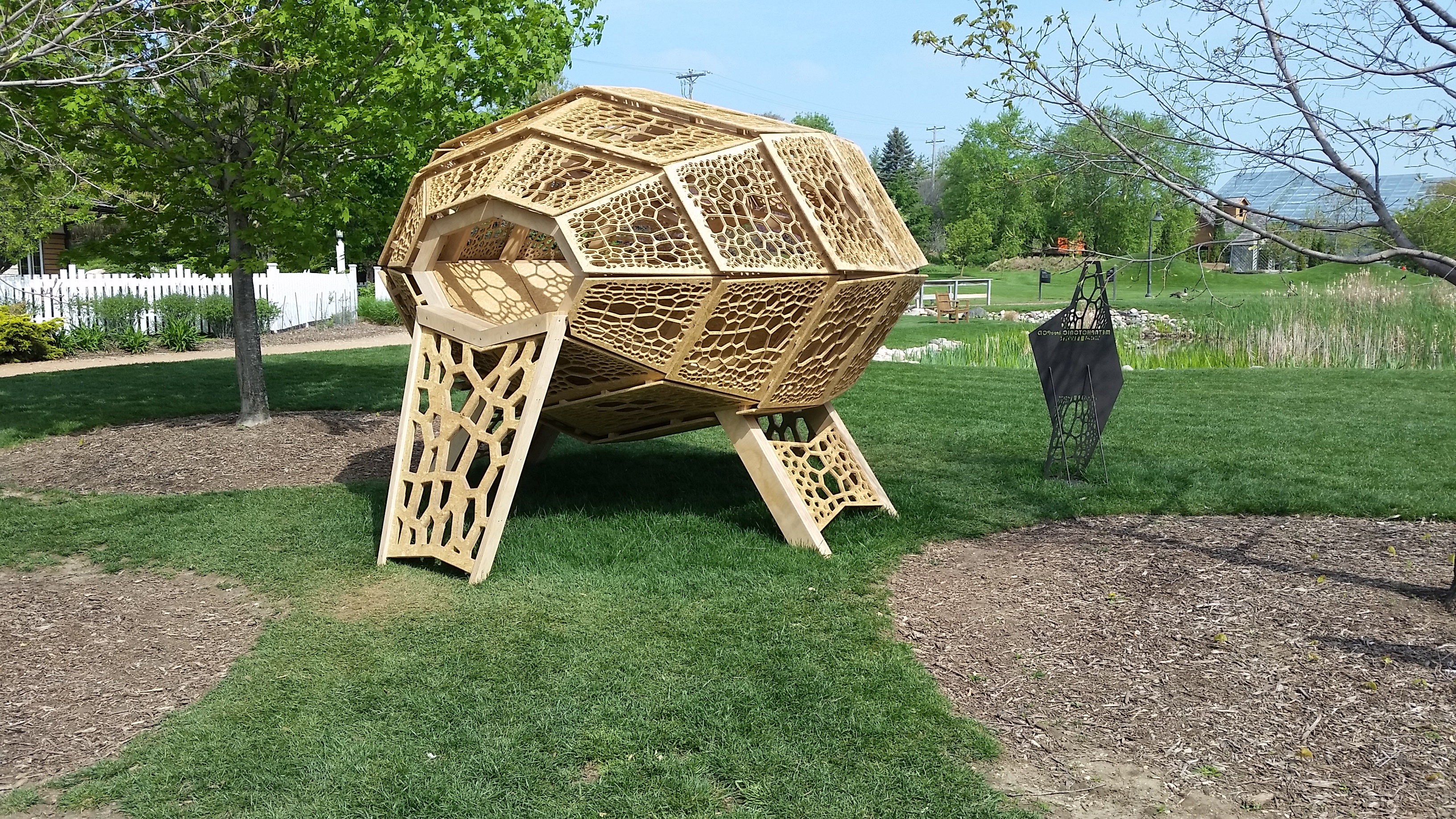
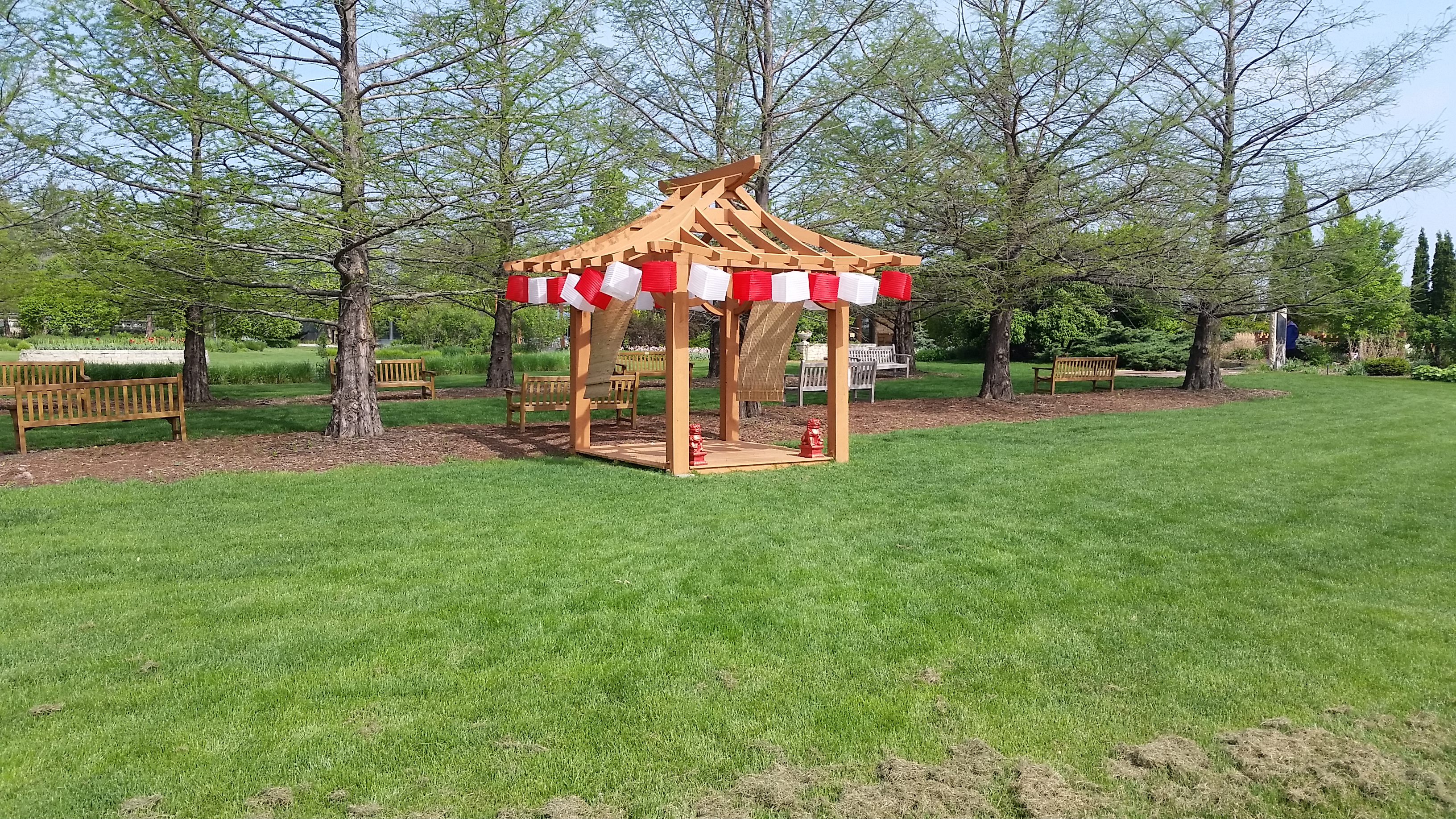
As far as the treehouse exhibit, there were two main problems.  First, not a single one was in a tree.  Second, hardly any of them resembled a house.  Below are some examples.

Egg

The incredible, inhabitable egg

My Dad is a crappy carpenter.

My Dad is a crappy carpenter.

Carptenter2

My dad is a better carpenter than your dad and an engineer.

An outhouse with a view.

An outhouse with a view

I’m sure the adults responsible are quite proud of their contraptions, but they held little enticement for the kids.  Instead they found a green, grassy knob that they could roll themselves down, and here spent more time than with the butterflies and treehouses combined.  A mother brought her daughter over.  I would guess the daughter was 2.  The mother threw herself down the hill.  I would guess she was trying to show her daughter how to do it…or she had been drinking.

Reiman Beer Gardens, now there is an idea for a college town.  Just need to get the bug zapper installed by the butterfly display.

The say we all have an infant inside us, but that infant needn’t run the show.  Raylan was trying hard not to let him, but eventually the infant won out.  They probably do most of the time.

We grow older and think we grow up.  We take pride in that.  Instead our infant has only got more sophisticated.  We still want our mothers, our pant legs dry, someone to listen, to squash any bug we come across, real tree houses, and to be blissfully ignorant of all of it.

If we could grow up, perhaps we would lose our mothers, but might actually know them for the people they really are.  Hell though, now you’ve heard it in my voice too.

The Stone Masons

“Duane Honnold died this morning.”

This is how I was greeted the 7th of March, arriving at the Madison County Livestock Auction to look over a set of yearling bulls.  We were in the midst of an unusually mild string of March days.  The bulls looked nice on display.  Either of these would have been normal starters for conversation, but on that day they were just too common to do.

Duane was 90, and I had only really gotten to know him over the last few years as I became more active in the Madison County Cattlemen’s Association.  A cattleman is how I will remember Duane, but like most cattlemen, he was a lot more than that.

He was a stone mason, a teacher, drove a truck, drove a school bus, was building inspector, the past president of the county pork producers, the county cattlemen, a county Farm Bureau member, a commissioner on the Madison County Soil and Water Conservation Board, a 4-H leader, a Lion’s Club member, an elder of his church, and the list goes on.  Longer than he had done any of those things, however, he had been a husband to his wife, Edna, for 71 years.  They enjoyed the type of collaborative partnership nearly all hope for in getting married, but plainly speaking, most find elusive.

Duane struck me as a man who was very particular about what he wanted.  What he wanted was the best, and naturally those who were affiliated with him benefited from the results.  The results live on in Madison County and beyond, from the stonework of the north shelter house at the Winterset City Park to county fairs around the country and their peddle tractor pulls which he’s given credit for establishing.

Edna is every bit his equal, and I always wondered how that worked.  How could two people, equally particular on what they wanted, form such a strong bond with nary a quarrel?  I finally figured it out a couple of county fairs ago.  Outside the fair booth was Duane’s domain.  Inside was Edna’s.  Duane never forgot that, and Edna never had to remind him.

Together they were a power couple long before anyone had ever coined the term “power couple.”  They remained so always.

Attending his funeral, I thought I would see Duane one final time, yet when I got there I realized I was mistaken.  What was before me was just his body.  I thought of all the people in my own life that were still living, and I had failed to see any deeper than that.  Duane seemed to see beyond it, and even as a church elder, saw something more in an individual smoking with the sulfuric smell of brimstone like me.  Because of that, he will live on for some time, especially for us fire eaters.

A week later, at yet another Madison county bull sale, Edna, along with her son, Dwight, and his wife, Lynn, came into the sale barn.  They sat up in the rafters, and after awhile I went up and took a seat beside Edna.

I hadn’t visited with her since Duane died, and before I left, she lightly grabbed my arm, looked me in the eye, and said she didn’t want the Madison County Cattlemen to forget about her.  She wanted to stay active.  I was moved.  Edna and Duane had been part of the Cattlemen since the Cattlemen began.

I was also moved by her strength.  Most of us will live our lives convinced if we can only become harder, life won’t touch us.  We will, and it won’t.  Edna reminded me that true strength isn’t shown by us getting harder, but by the ability to be vulnerable to whatever life throws at us.  Our hardness is a crutch for what was already broken.  Vulnerability is nothing more than having the strength to bend.

I suppose understanding that is what made her and Duane so capable in working with us stones.

“And one more thing,” Edna added, “I don’t want to see the Cattlemen go downhill.”

Neither do I.  Judging by the masons, the roof might leak, but the walls are sound.  And God knows, if Edna is willing, there’s nothing going to be headed downhill in the Cattlemen’s booth when fair times rolls around.

Duane

Duane. If I’m not mistaken, in front of some of his handiwork. Photo stolen from the Winterset Citizen webpage.

Tomorrow is a Foolish Thing to Do

At 6 this evening I found I had been tided over the whole afternoon with nothing more than a little bottle of Gatorade.  I had one more trench to dig and another intake to set.  It would be dark in a couple of hours.  Still, it seemed as good a time as any to take a break.

The closest town was Churchville.  The closest real town was Martensdale.  “Real” in this case means a group of houses with a gas station and a post office.  Churchville has neither; Prole has one.

Martensdale also sports a school, and twenty years ago this spring I left it.  I was happy to go; they were happy I went.  I never looked to make sure the diploma was signed; they never looked to make sure it was there.  It was a draw then.

In my day the gas station was known as K&W.  It’s called something different now and is further proof that my day has passed.  Beyond the name I wouldn’t have known the difference until I had either tried to rent a VCR or noticed that John, the man with the curiously long fingernail on his pinky, was no longer manning the register.

Tonight I found the heat lamp trying to culture a science experiment on the jalapeno poppers.  I wagered that the heat of the jalapenos would kill anything that was attempting to grow.  Had I thought it a close bet, I would have hedged it with booze from the cooler in back.

I was in the process of paying for the poppers, a Sprite Zero, and a cheeseburger hardly worth mentioning, when a former classmate walked in.  We caught up, and as we did so my attention wandered down to his son.

“What’s your name?” I asked him.

His son looked surprised that I had spoke to him and bashfully looked up to his father.

“Answer the man,” his father said and pointed in my direction.

“Nolan,” the boy said quietly.

I judged him to be in fourth grade, but I asked to make sure.

“Well Nolan, I’m Dan.  Your Dad and I went to school together.  What grade are you in?”

“Kindergarten.”  And just like that the bashfulness fell away, and Nolan began to talk.  “But nobody believes that, though, because I am so tall.  I’m the tallest one in my class.”

“Have you started playing basketball yet?” I asked with a touch of sarcasm hardly above his head but evidently beyond his grade.

“No,” he said in an honest and puzzled way with the same clear eyes I remember his father having when he and I were boys.

His Dad was there to pick up a taco pizza, and Nolan was excited about it.  I suspected time would cure him of this, and I thought that a shame.  Adults are never satisfied with the right moment unless it comes at the right time.  A taco pizza is nothing to get excited about if the bills are piling up, work is a mess, and the neighbor’s dog is still fertilizing your yard.  To the young, however, the time is always right if the moment is.

No junior high boy worth his keep worries where the girl he’s attempting to steal a kiss from is going to be five years down the road.  He only knows she’s worth the attempt, and that the moment currently presenting itself might not come again.

“Well, Nolan, you pay attention in school.  If you don’t, you’ll wind up like me, digging a ditch someday.” It was my standard joke.

“Don’t let him fool you, Nolan.  He was one of the smartest kids in our class,” said his Dad.

I was trying to instill in young Nolan a certain sense of work ethic.  Work hard, and good things will happen.  His Dad comment, however, might give him the idea it’s mostly for naught anyway.  I suppose it’s best to have the boy see the world for what it is, instead of forcing on him what we hope it to be.  Maybe that’s what being a man is, after all.

Still, when he gets older he should try to steal that kiss when the moment presents itself, even if it is for naught.  Tomorrow might be a foolish thing to do, but today usually ain’t half bad.

https://www.youtube.com/watch?t=24&v=I5j6fcCAF-Q

The Unreported Art of Questions and Trends

“Recently, the Des Moines Water Works announced it would pursue a lawsuit against three northwestern Iowa drainage districts because of record high levels of nitrates in the water flowing from those districts, leaving the job of removing the nitrates to Des Moines Water Works. Do you think the Des Moines Water Works is right or wrong to pursue this lawsuit?”

This is the question that was asked by the Des Moines Register for an Iowa Poll featured in last Friday’s paper.  63% of the respondents were in favor of the Des Moines Water Works intended action.  23% were opposed.  14% were unsure.  Donnelle Eller, whom covers both the agricultural and environmental beats at the Register, wrote the story.

On the same day the story ran, I was taking part in a group that brought together everyday people telling the story of agriculture and rural Iowa so they might share how they do it and what they have learned with each other.  Donnelle had been asked to speak to us.  My impression of her was that of a ‘straight shooter’ and someone striving towards unbiased reporting.  She had a good sense of humor, spoke directly, and was very approachable.  This was all well because a few of us thought the question above was off the mark, and we didn’t miss the opportunity to say so.

“I think it is pretty fair and straight forward.  What do you take exception to about it?” asked Donnelle.

“Why did you need the first sentence before you asked the question?” asked someone.

“It’s accurate isn’t it?”

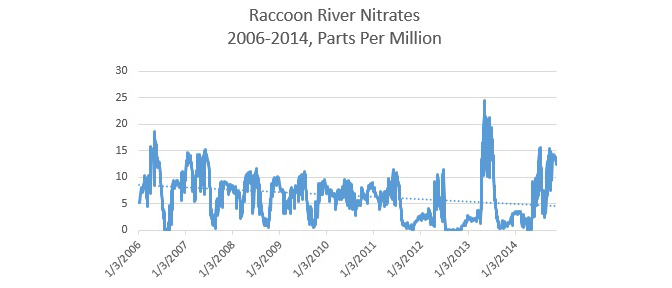
“Actually, I think the Iowa Department of Natural Resources and the U.S. Geologic Survey say it’s been trending lower over the last eight to fifteen years.  I think Des Moines Water Works own data supports this claim.  What would have happened to the poll results had you mentioned that trend?”

Someone else added, “I’ve never read an article in the Des Moines Register which actually examines the trend of nitrates in the Raccoon River.  Did I miss it?  I read Bill Stowe saying it keeps trending higher and higher, and that there is no evidence we are having an impact.  At least two other government agencies and a former governor, the current U.S Secretary of Agriculture, say otherwise.  Which is it?”

“That’s on the top of our list to cover next.”  I think it was supposed to be reassuring.  The fact that it had went unexamined this far wasn’t, however.  “I think Bill Stowe would say that he’s not in the business of dealing in trends, though,” she added.  For not dealing in them, he certainly seems to be selling the hell out of a particular one.

It is frustrating for me.  As an assistant Soil and Water Conservation Commissioner in Madison County, I get to see first hand the waiting list of farmers wanting cost share assistance for large scale conservation projects.  This assistance isn’t just in terms of dollars, but also design and engineering.  As a commissioner and a contractor, I got to witness a staff laying these projects out as fast as they can, but hardly keeping up with contractors also facing the same workload.  As a farmer I know firsthand how these new practices will compliment existing ones already in place and are part of a long term plan for the future.

In terms of the trends involved, one can do a Bing image search of “nitrate levels in the Raccoon River.”  The two graphs below will pop up.  One can see how both trends can be argued at the same time.  What do they look like to you?  Does it impact how you would answer the poll?

I would like to be able to tell you how all the stakeholders involved collaboratively view the below, but unfortunately I can’t.  One of them has not been in a collaborative relationship with the rest for some time.  For my part, as a farmer, contractor, and assistant commissioner, you get up every morning, try to do the best you can, and try to figure out how it is you can do better.  In this effort I get assistance from all groups but one.  It is harder because of their absence and will likely be harder if attorneys get involved.

RaccoonRiverNitrates2006-2014

Basic RGB

The Difficulty in Being Ordinary

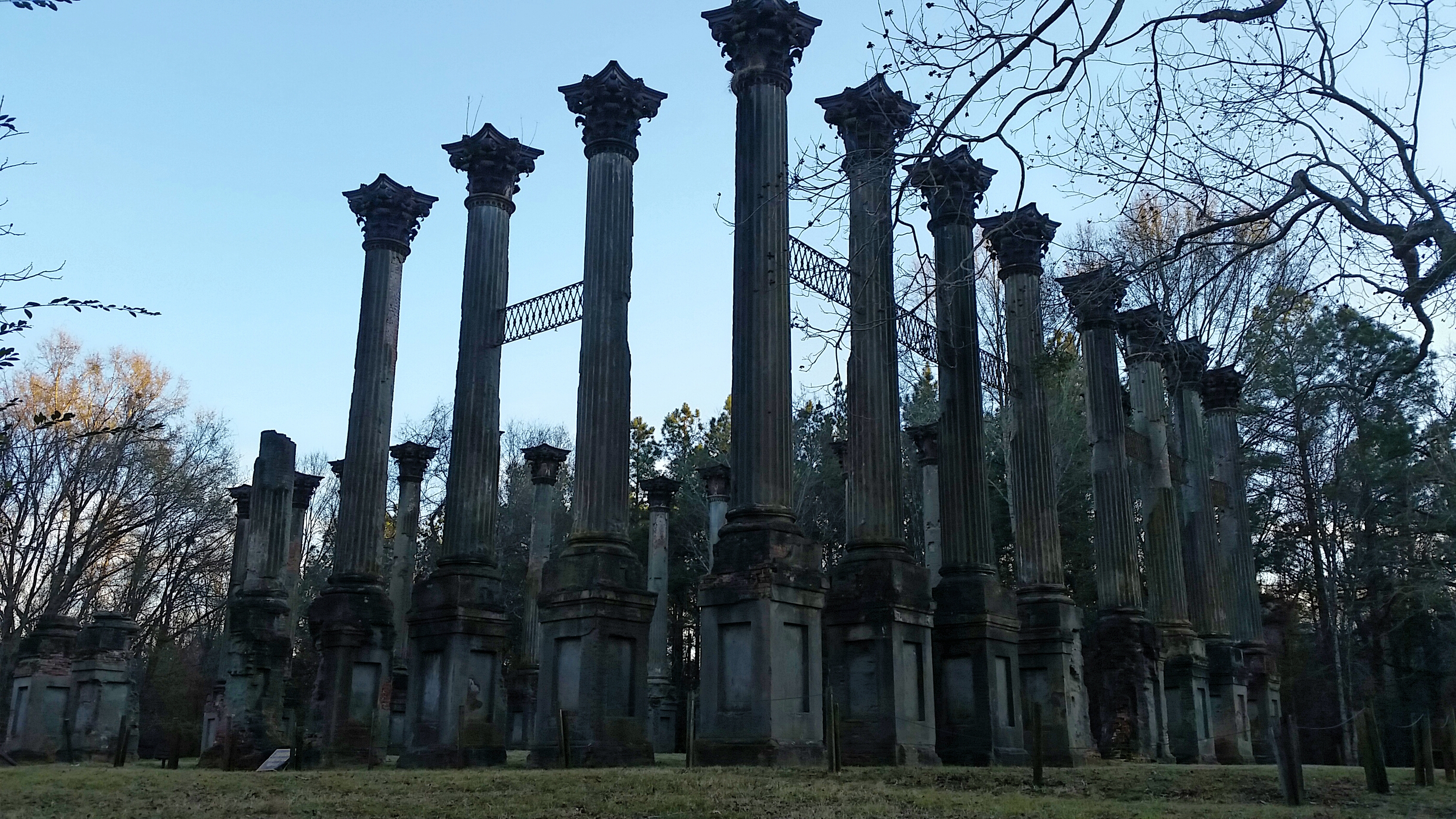
Windsor Columns

The Windsor Ruins near Port Gibson, Mississippi

Last month found Dad and I in Vicksburg, Mississippi on a Sunday.

“Suppose there is a Catholic Church here?”  Dad asked.

There was one.  The Gospel that Sunday was John’s and featured the Apostle Andrew.  Only in this Gospel do we find Andrew as a disciple of John the Baptist and the first to follow Christ.  John tells us Andrew recognizes Jesus as the Messiah and seeks out his brother, Simon Peter, to come follow Him as well.

“This morning we get one of the few mentionings of Andrew which takes place in the New Testament.  The New Testament only references Andrew a dozen times, and half those times it goes on to mention that he was the brother of Simon Peter.  It is as though Andrew’s name doesn’t carry any weight unless his famous brother is thrown in.

You see folks the Apostle Andrew was just like you and I:  He was an ordinary man.  He never makes a great speech that gets recorded.  There is no mention of some great act Andrew performs.  He simply recognizes Christ and follows Him, and brothers and sisters that is all that is asked of us.

The other three which join after him, his brother, James, and John, all get called on by Christ to be present in some of His finest and most trying hours.  Time and time again Andrew, the first, is left out.  Do we ever hear about Andrew being bitter about this, of his throwing a temper tantrum, or being jealous with the others?  No.  We don’t.  What is remarkable about this ordinary man is how easy Andrew makes it look, but Christ knows how hard it was for Andrew, and Christ loves him for it.

You and I know how hard it is to be ordinary too.  You and I know how hard it is to follow Christ.  You and I know how hard it is to be Catholic in the state of Mississippi.”

The priest’s name was Malcom O’Leary, though I wouldn’t have guessed him for an Irishman. He had walked up the aisle humbly, with graying hair, a bowed head, and a decided limp hardly concealed by his vestments.  His homily, only partly caught here, was as skillfully worded as any I had ever heard and was delivered to a parish no larger than one which might exist in a small, rural Iowa town.

Ninety percent of this congregation was black, and some of them, along with some of Mississippi’s whites, were part of an expanse of poverty like I had never seen in this country before.  I wouldn’t have faulted Fr. O’Leary for saying how hard it was to be poor in Mississippi, nor would I have faulted him for saying how hard it may have been to be black.  He had said neither of those things, however.  Instead he talked about how hard it was to be Catholic.

Perhaps if it hasn’t been hard for us to be Catholic, or whatever faith it is we choose, we haven’t been doing it right.  Maybe the same applies for being ordinary.  It is the Gospel of John that uses the ambiguous phrase “the disciple whom Jesus loved.”  This unnamed disciple is almost always in the company of Simon Peter.  He’s in his company so much, it wouldn’t be a stretch to think they might be related.

The traditional interpretation is that the disciple whom Jesus loved was John.  If we lay tradition aside, and sometimes it is the best thing to do, perhaps Christ saw in an ordinary man, whose name was hardly worth mentioning, exactly what Fr. Malcom O’Leary saw.  Perhaps in embracing the difficulty of the ordinary, Andrew was anything but.

The Hack

hack noun 1. a writer producing dull, unoriginal work.  2. a dry, unproductive cough

It was the end of a long, cold February day in Iowa City, and I had the pleasure of being in the company of an attractive woman.  The fact that she was a talker made her more so.  There was nothing more I wanted than for her to keep right on talking.  It was hardly the first time I had felt that way.  Winter is the loneliest of times.

“Do you weld?”

“I’m sorry?”

“Are you a welder?” she asked.  “My Dad was a welder.  He had lung trouble.  They finally found out it was because of the fumes.  Do you weld?”

“No.  I’m not a welder.”

“Well, I really hope they find out what is going on with you.  Hopefully this scan will help them do that.”

I imagined we had been moving through that scan like cattle, and the fact that she could hold such a thought for me, a stranger at the end of the day, I found remarkable.  It was no surprise that she would wonder if I was like her Dad.  By now I was used to wondering whether she wanted me to be.

I had never seen anyone wear black scrubs before, and why the gal with the CT scan was wearing them was beyond me.  If she looked like an angel, then it was the Angel of Death.  Surely there were more cheerful colors, for surely there were those getting much worse news than I.

I had lived the previous two years thinking my persistent cough was the omen of something inheritable and, until a few months ago, largely untreatable.  (You might think me a hypochondriac, but I never have been before and am too old to go around picking up new habits now.)  An hour prior to the scan, I had found out it didn’t have anything to do with an inheritance at all.  It might just be heartburn or a calcified lymph node causing a tickle.  This should have been good news, but in some strange way I felt unaffected by it.

Now I even felt disappointed.  Her concern was unwarranted.  Still, she didn’t know that, so I didn’t tell her.

To get to the precautionary CT scan, I had made my way through a series of waiting rooms.  Most in them were older.  One was younger.  For some moving from waiting room to waiting room is like living; for some it is like dying.  While we tend to think the two are different, perhaps the only differences are immediacy and how you want to look at it.

“Your shirt has metal snaps; it will have to come off.”

It did and in the process revealed the extra 15-20 pounds it was probably doing a poor job of hiding anyway.

“I will have you lay right here on this table.  Don’t worry about your boots; they’re fine.  Now if you would just place both your hands above your head…perfect.  All right, the table is going to move through the scan and you will hear a voice telling you how to breathe, until then just breathe normally.”

For the first time in my life, looking at my pale, white belly and my lanky arms devoid of tone, I felt old.  It passed, though.  I then closed my eyes and prayed that they find the harpoon that got me.

When it was over, I snapped the shirt, donned the long black coat, and stood up in the boots which allowed me to reclaim as many of the trappings of youth my receding hairline would allow.  On the way home I stopped in West Des Moines and filled a prescription for an antacid and an inhaler.  I paid the man and handed half of my reclaimed trappings back.

The World Series

World Series Panorama

“Ninety feet between home plate and first base may be the closest man has ever come to perfection.”

-Red Smith

I’ve always associated with interesting people. One would think, if I do so often enough, some of the interesting is bound to rub off on me, but alas, it is not to be. The party ends, the lights go out, and I go home the same boring sonofabitch I’ve always been.

One of the interesting people I know is a friend I first made in elementary school, Heath Banks. Heath is an umpire. He has called high school games beyond count, worked college games, and an occasional one in Triple A. A year ago he even worked a game in St. Louis’ Busch Stadium.

Once he tried to make it to the big leagues. If you are going to do it, you need to do it by the time you are 25. Heath made his run at the age of 24.

He breezed through the first cuts and earned considerable distinction in the process.  He drug that distinction behind him going into the final round.  Now he would be calling big league spring training games, and his performance had earned him not a only place in the main park for his first game, but also behind home plate. “On the stick” as they say.

Heath was nervous beyond all get out, but he was also anxious to get the game started and for the butterflies to disappear. Taking his position behind home, he squatted down in his stance and felt a long rip followed by a breeze blowing up his backside. There, on the biggest stage of his career, before the first pitch had ever crossed the plate, in what he had hoped to be his finest hour, Heath had ripped the seat right out of his pants.  The distinction behind him would do little to hide it.

“It was horrible. All I could think about was that everyone in the stands could see my whitey tighties. I wanted to crawl in a hole and die. There was nothing I could do. I couldn’t stop the game. I had to get on with it.

When the pitches started coming in, I could hardly see straight. I had no idea where they were. My strike zone was all over the place. Around the third inning an instructor came down and asked, ‘What the fuck are you doing out there, Banks? You look like a god damn clown.’

After that I kind of knew it was over. I got sent down to the bottom of the deck at some little, out of the way field. After a game or two I realized no one was coming by to see how we were doing, and they were never going to come. I spent the rest of my time drinking beer with the guys.”

Fifteen years after his tryout, I got a call from Heath mid-October. “Got a few World Series tickets to game 6 in Kansas City. Any interest?”

“Hell yes.”

It would be a stretch to call me a fan of baseball. It’s not because I don’t enjoy it. I enjoy it above all other games. It would be a stretch to call me a fan because I know so little about it, especially when it comes to one of the things which separates it from all other games: its grand mountain of statistics.

Yet here I was, three or four rows up from the outfield and forty feet from the foul pole. Looking up at it, it appeared as though it was a hundred feet high.  I thought of how a ball might be hit down that line and over the wall.  Half the country would hang in suspense on whether it was fair or foul. Perhaps it would be part of a moment that would live forever in baseball lore. I would be among the first handful to know, a few seconds ahead of those watching at home, a few milliseconds before it would be added to the mountain of statistics already mentioned.

Pleasure doesn’t lie in keeping a secret. It is found in knowing first what everyone else will come to know later.
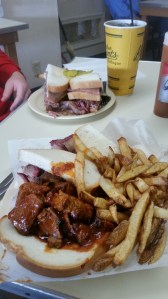
AB's

Lunch at the famous Arthur Bryant’s

T Bones

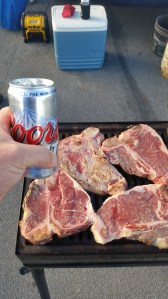
Supper at Kauffman parking lot

All told, three of us had went down to see Heath, who was seeing all the home games that series. We spent the day in good company, eating the best food and having the occasional beer. I suppose it was the latter that had left me thinking I should share my observations on the sport I know so little about with the guy who actually gets paid to observe it. He didn’t seem to mind.

“Heath, I think the thing about baseball is the pauses. No other sport has them like baseball, and that’s too bad. During those pauses baseball places on you the full weight of the moment to come. The deep breath the pitcher takes just before delivery, the flight of the ball to home, all leave you waiting anxiously on the swing of the bat.”

Yes, I thought, whoever invented baseball knew a thing or two about anxiety and had simply built a game around it.

For Royals fans during that game, the potential of the second inning was realized beyond their wildest expectations. They would score 7 runs during it, and we whooped and hollered and drank more beer during the forty five minutes it lasted. Any anxiety drizzled out with the Giants hopes, and for the rest of the game the joy continued unabated.

World Series VIP

At the VIP

“So I was offered some tickets to the VIP party afterwards. What do you all think?” asked Heath.

We were speechless.

Beyond the outfield wall, in the white tents pitched inside a wrought iron fence, everything was complimentary.  We judiciously used the free food and beer to bring our dollar cost average down for the food and beer we purchased during the game. When the dust had settled, we had ate and drank cheaper than any happy hour special Des Moines could boast of, and we had done so with the rich and famous, or at least their second cousins.
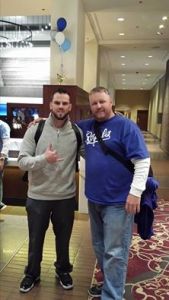
Moose

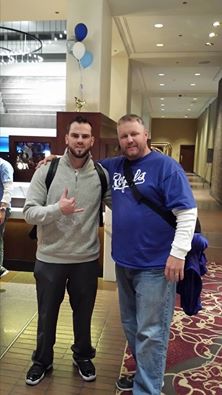
Banks and Moose

We headed back to the hotel, where we happened onto one of KC’s brightest stars, Mike Moustakas. The evening had been full of so many “I can’t believe that just happened moments,” I didn’t doubt that had happened at all. We recharged, and headed for a bar just down the street from where we were staying, called ‘The Quaff.’

“The Quaff is an ‘umpire friendly’ bar. All the towns have them. It’s a place the umps can go after a game where the owners ensure they can enjoy a little peace and quiet,” Heath told us.

As we walked in the door, the bar was a series of three, long, narrow corridors. We were in the first one. Along one wall stretched the bar, down the center was a narrow aisle, and stretching along the backside was a series of booths that would hold two a piece comfortably and four if it had to. We took a booth.

Occupying the rest of them and lining the bar were Royals fans. Light blue hats and light blue jerseys were all oriented to the old, grimy, color televisions, which had probably also broadcast the last World Series the Royals were in.  They were still showing post game coverage on the MLB Network. These fans had watched the entire game from these seats, and we looked at each other, quietly sharing the secret that we had enjoyed the game from better ones.

We all had a dab of light blue ourselves. Most of ours had been purchased only a few hours prior.

Quietly we began to talk the way people always talk after the unbelievable happens. At least three of us, giddy as schoolgirls, did. Heath was already on his third game of the series, and by now was old hat at it. He just sat and smiled the way people always smile when they give the gift that lights up the face of someone else.

All of the sudden he looked up and said, “They’re here.”

Coming through the door into the sea of blue was the World Series umpire crew. There was Des Moines native Eric Cooper, his wife Tara, and their son. Cooper’s shaved head was in a Notre Dame hoodie, and behind it was the flat top of Jeff Nelson. Behind all of them was Ted Barrett, the only major league umpire to have been behind the plate for two perfect games. The Coopers should have been pretty familiar with Barrett. They not only umpire together, but Barrett, an ordained minister, had married them. Jim Reynolds, also umpiring the 2014 World Series, was married by Barrett as well.

As they walked around the sea of blue before them, not a single hat turned, and not a single “Hey, aren’t you….” was heard. Everyone remained oriented to the old color TVs, while we got up to join them and make our way to the back of the bar. We passed through the second corridor, housing pool tables, a dart board, and a jukebox full of Tom Petty albums, and landed, safe at third, in the back one housing the kitchen, the restrooms, and a couple of dim lit lights.

There in seclusion, we spent an hour or two, putting a cap on a hell of a good night. Just before we left, I realized I was all wrong about baseball. It had nothing to do with finding anxiety in its pauses and its base paths. We find that daily in our own lives. Instead it has everything to do with finding peace, even if it had left your ass hanging out in the breeze one day.

All of Us World Series

The Crew: Myself, Justin Banks, Heath Banks, Frank Hawk
A Legacy of Litigation

I thought I had just concluded my first television interview, and while the reporter for a local television station was preoccupied with putting his equipment away, the man behind the camera flipped off the bright light he had been pointing in my face, casually walked around it, and held his hands out for my mic. Having just managed to get it out from under my vest, I set the mic in one hand and the box attached to it in the other.

“Just between you and me, off the record, the whole problem here is Bill Stowe, isn’t it? I mean none of this was an issue before he came on the scene.”

He was referring to the manager of the Des Moines Water Works, whose board was about to file an intent to sue three northwest Iowa counties and their drainage districts over excessive nitrates in the Raccoon River, which is a partial source of the water the utility requires.

He still held his hands out, with the mic in them, right in front of me. The camera was still sitting on its tripod. If I were going to make a friendly wager, for some reason I would bet both of them happened to still be on. It didn’t really matter. The facts were what they were.

“Absolutely not,” I said. “Soil and water quality have always been a concern and a focus of many producers’ efforts. If anything has changed with Stowe’s arrival on the scene, it is Des Moines Water Works’ approach to the problem. I believe you would find LD Mc Mullen (Stowe’s predecessor) was a proponent of the collaborative approach, and built many relationships in that regard with the community upstream. Stowe has ended many of those and seems to be intent on going it alone. At the end of the day the challenge for improved water quality is such a complicated issue, I don’t see how it is going to take anything less than all of us working together to find a solution.”

The cameraman had to be disappointed. I could have made several off the cuff remarks which could have been sensational side bars that would help sell the story and gain viewers. In the end, I said the main focus of concern was actually a collaborative effort to improve  soil and water quality. That’s hardly a sexy thing to sell to viewers, and no one understands that better than Bill Stowe.

In the public meeting which followed the interview, Stowe left the sensational to the public comments of those in attendance. He made an effort to be above the fray, representing a utility facing an ever increasing risk of nitrates affecting its ability to deliver safe, drinkable water to its customers, and whose back was against the wall after having exhausted every opportunity to meet with the agricultural community.

His entire statement was broken into effective 30 or 40 second sound bites, ready to be assimilated by the media in attendance, and demonstrating what makes Stowe so particularly capable. The most glaring problems, however, were that none of it appears to be true, and no one seems particularly motivated to check. Numerous farm groups have tried to meet with Stowe, but to no avail. As just one example, a representative from the Iowa Soybean Association spoke on the relationship the two groups once enjoyed in working in a collaborative partnership.  A relationship which doesn’t exist today.

While Stowe maintains that collaborative effort got his utility nowhere, the Iowa Soybean Association points to their own samples, tested by the Water Works themselves, which show a 25% reduction in nitrate concentrations from 1999-2014 in the Raccoon River. These reductions were due to “refinement in cropping systems.” Their data is backed by the Iowa Department of Natural Resources, and the U.S. Geologic Service.

The next day I had a chance to be interviewed by an NPR reporter. I thought it went rough. At its conclusion I was asked, “This is really an urban vs. rural debate isn’t it?” I stumbled through the following:

“I fear that’s the way it will be portrayed by news outlets, I guess, but no, that is not how I see it. I see us in agriculture working with our local Soil and Water Conservation Boards, our local counties, our state’s Department of Natural Resources and Department of Agriculture, the National Resource Conservation Service, and the Environmental Protection Agency. Personally, I’m proud of these efforts and of this legacy. I’m not the only one.

If we want to start at the tip of the iceberg, the Region 7 administrator of the EPA is on the record as saying that the voluntary, collaborative approach is the role model everyone else should be working off of, and the best way to meet the challenges of today and tomorrow. Agriculture is doing that.  It is doing it right outside my front door, in the little watershed I live in, Badger Creek.

The approach that the Des Moines Water Works is taking is not making it ‘urban vs. rural.’ It is making it the Des Moines Water Works vs. everyone else involved. It is also introducing a new legacy, one of litigation.”

If I didn’t say it exactly like that, I should have.