A Hell Raiser after All

“Why did the old Persians hold the sea holy? Why did the Greeks give it a separate deity, and own brother of Jove? Surely all this is not without meaning. And still deeper the meaning of that story of Narcissus, who because he could not grasp the tormenting, mild image he saw in the fountain, plunged into it and was drowned. But that same image, we ourselves see in all rivers and oceans. It is the image of the ungraspable phantom of life; and this is the key to it all.”

-Herman Melville (opening paragraphs of Moby Dick)

We weren’t water people when I was young. There were no summer trips to the pool, or Sunday rides on the lake. My mother insisted we all take swimming lessons anyway, and so I did for three or four years. I would say the time was wasted on me, but that is not entirely true. While I was not among the kids that left the class with the skills required to avoid drowning altogether; I avoided drowning for its duration, and this suited me just fine. I didn’t plan on having to swim again.

When I got a little older I took informal classes on burning bridges. This was considerably easier for me than swimming had been, and in time I could boast I was good at it. In their smoldering remains, being unable to swim left me but one option: Forward. And forward always seemed like the way to go.

Imagine my surprise then, when I got older still, and realized there was no forward any more, nor was there ever as far as I could tell.

The only way I could re-cross the now de-bridged stream was in my mind. This was well.  In my mind was where all my swimming and sailing had been done anyhow. I could dream about being a pirate as well as any other land-locked son of the Midwest, and I could out-pray most of them that the chance to one day do it on the sea would be a cup that would pass my lips. My mind, then, was familiar both with water and all the ways to keep my ass dry. My ass wouldn’t be dry for always.

One day I met a girl who was a water person. She could not swim either, but this didn’t seem to stop her none. It started out simple enough. There were first boats on lakes, then canoes on rivers, and eventually we got down to kayaks. I tended to find my anxiety grew larger as the size of the vessel and the number aboard dwindled.

My introduction to kayaks was on the occasion of her birthday. I had arranged to rent two kayaks from an outfitter in Boone. We were to float down the Des Moines River and underneath the Kate Shelley High Bridge. The original bridge was completed in 1901 and lies alongside its replacement, which was being finished the year we floated down in 2009. It is the longest spanning double track railroad bridge in the United States.

It is named for the Iowa heroine, Kate Shelley, who on July 6, 1881, was awoken after a thunderstorm by the crash of a locomotive on a small creek near the home of her, her mother, and her younger siblings. Taking a lantern she arrived to find the bridge out and two survivors, one of whom urged her to make her way to the depot in the neighboring town of Moingona, just south of Boone. In an hour, at midnight, a passenger train from Omaha was bound through. If no one warned them, it would be a catastrophe.

She followed the tracks, reaching the trestle bridge that laid over the Des Moines River. As she reached it, her lantern went out, and in the rain of the dark night she was left to crawl on her hands and knees from tie to tie, not knowing for sure when the train from Omaha would happen along wanting to use the bridge too.

She would make it, run another mile to the depot, holler that the bridge was out, and then faint from exhaustion. What she wouldn’t do, however, was see that the oncoming train was sitting there already stopped. It was no matter, everyone gave her an “A” for effort anyway. In 1901, the new bridge was christened the “Boone Viaduct,” but locals soon named it informally after Kate Shelley. “High” was added sometime in the 60s.

My favorite version of the story tells that in approaching the station she was simply too exhausted to speak. She fished in her dress pocket, found a clothespin, and held it high above her head, right before she collapsed. The erudite railroad men recognized the clothespin as the universal sign for “wash out.” The Omaha passenger train was still as stopped as it had been before, she still got the “A” for effort, but now earned additional points for originality.

We set out with a party of 20-30 folks, hauled in three or four vans, a couple of which towed a trailer carrying the vessel of our choosing. Most had chosen canoes; some had chosen inner tubes. Some immediately made their way into the water, and it was my preference to let them all go before we did.

I had no idea how to properly get into or launch a kayak, and I wanted to make sure anyone who might know didn’t see me do it. As a general rule, I will make an ass of myself, but I hate to do it with an audience. As a general rule, an audience usually happens by anyway.

The mop-headed high school kid, remarkably glassy-eyed for having just drove our van, was now in the process of getting our kayaks ready. He seemed an unlikely confidant, but any other contenders I had already let slip into the current. He would have to do.

“So I’ve never actually….driven…err…riden…that is to say got into one of these things before. Any pointers?”

He looked at me and said, “Yea. Don’t tip it over, man.” He offered a laugh, but I didn’t take it. He recovered.

“If you do, dude, you don’t have a thing to worry about. You’ll pop right freaking out of it. It’s completely natural. My buddies and I just went down here last weekend. You will be able to standup and touch bottom anywhere. Between all of that and your lifejacket, you’ll be just fine.” These were the words I floated out into the Des Moines River on.

Being a fairly tall guy, there would be a couple complications. The first had to do with the kayak. To my surprise the seat went far enough back and wasn’t the issue. My feet on the other hand found the quarters on their end kind of cramped. There was not enough room to simply point my toes up nor was there room to angle them in or my heels out. The only thing I could do was point them as far ahead as I could.

It was far from comfortable, and I had no idea how I was going to survive a two or three hour float by doing it. I remember looking ahead and seeing all the other people. The adventurers had already set out to distance themselves from the pack. Those with small children were already in the midst of adventures of their own. Bringing up the rear were me, my wife, and my painfully big feet.

I did what was natural for anyone to do. I was sitting in an area of sufficient size, so I simply brought my knees up to my chest. There I sat comfortably, albeit for a brief while, until I realized why no one sits in a kayak like that. I no longer had any balance. I had little to begin with.

All the sudden I could feel the kayak suddenly pitch to my left. I threw everything I could muster to the right. The kayak flipped over, and I came out just as the glassy eyed kid said I would. What I couldn’t do, however, was touch anything resembling a bottom. I now found the second complication of being a bigger guy on an outfit geared to accommodate the masses.

In the midst of my rapidly flailing arms, I discovered my lower lip’s natural position was just scarcely above the waterline. In fact it was so close to it, it wasn’t unreasonable to assume the rapid flailing of my arms was the only thing keeping my lip above it. It’s a challenge to be in full panic, flail your arms, and breathe all at the same time. While I tried to do the latter, I found I preferred the first two more, and gave up on it. Eventually I tried to get maneuvered somewhere where a bottom could be found.

The stroke I chose was the doggie paddle, beings as how this was the only one I knew that let me keep my head above water. We were on the far side of a bend in the river. The bank closest to me was being actively cut and stood above the water like a wall. A hundred yards away on the inside of the bend was a sandbar. I set my sights on that.

The doggie paddle, or at least how I was practicing it, is as effective for swimming as is shoveling the snow out of my driveway with a fork. I managed to take two or three yards off the distance, but by that time I was exhausted. I tried again to touch bottom, and I couldn’t.

My wife had retrieved my kayak and was beginning to understand that I was in trouble. She placed it just ahead of me, between myself and the sandbar, in the hopes that I would grab hold. I reached out and knocked it out of the way.

She stopped it with her paddle and pushed it back. As I looked over at the sandbar of my salvation, a bright red wall came floating back across my view. I pushed it again. “No,” I managed to get out.

I couldn’t imagine getting my arms far enough out of the water to get around it. There really wasn’t anything I could see to get a grip on. I couldn’t take having the view of that quiet little sandbar taken from me. I guess I had become partial to it.  I began to wonder if they served beer there.

“What do you want me to do? Just tell me what you want me to do.”

I could look down stream and still see most of the party we left with. There was one guy, in a kayak as well, looking back. I remember thinking of hollering for help, but then I thought, For Christ’s sake, don’t make a scene about it. Drown quietly.

There was enough of a current that my wife had to put forth a little effort to keep from leaving me. She’d paddle a little all the time, darting this way and that, and I could see how nervous she was.  I began to forget how nervous I was.

“I’m getting in,” she said.

I managed to get out a “No you are not.”

“Yes. I am.”

“Listen to me.  No.”

I had read somewhere that most of the time there are two drowning victims it is because the first wraps their arms around the second. I was quite certain I would do it too, and I was intent on it not happening. She had a paddle to knock me out with, and if she had done it I would have had no argument. She was too soft hearted, though.

Her nerves had her paddling harder, and instead of keeping even with me she was about to paddle right on by. She had to turn the kayak to keep from doing so, and that is when I saw it. There on the back of her boat, held by a little string, was a red t-handle just above the water line. I latched on to it before she could get in and have me latch on to her.

She paddled for the sandbar I had been dreaming about. On one end of it were barefoot kids whose parents were already needed a break from their river adventure.  On the other end was me, washed ashore like a shipwreck survivor.

The man I had noticed in the kayak had noticed me after all. He nudged the kayak we had left behind up on the bar beside me and placed my paddle back inside.

“There is no way we can go on.  You nearly drowned,” my wife said.

I looked back the short distance to where we had left. The vans and my confidant were gone.

“Well I’m not walking back to Boone. Looks like on down is the only way to go.” I was hoping “on down” would be downstream.

It was, and I went keeping my toes pointed straight ahead the whole time. When we got to Kate Shelley’s bridge, I took it in as well as I could, trying to keep my larger than average head perpendicular to the rest of my body, so as not to cause the kayak to list. I’m sure the view was just as good from the backside, but I never turned my head to take a look.

When I arrived at our destination, I thought I had accomplished a feat no less than the one Kate had.  She hadn’t saved anyone either, after all. But no one single person made a commotion about it. My effort had earned no great notice. Seems like the only thing I could have done to have made the paper was to have not come down it at all. They don’t name a bridge after you for that though. You get a chunk of concrete in a row some place.

For a while I thought it was something to have decided I was going to drown quietly, without making a commotion and all. I thought it separated me from other men. A few years later I was plunged into deep water again, deepest of my life, and this time I was on my own. I would realized drowning quietly is what most men do.  I had been no different.

It was then that I came to an appreciation of bridges that don’t burn, of the humble doggie paddle, of those that see you need help without your asking, and the special ones that help you quietly raise some hell after all.
In the Beginning (Before There was Football)

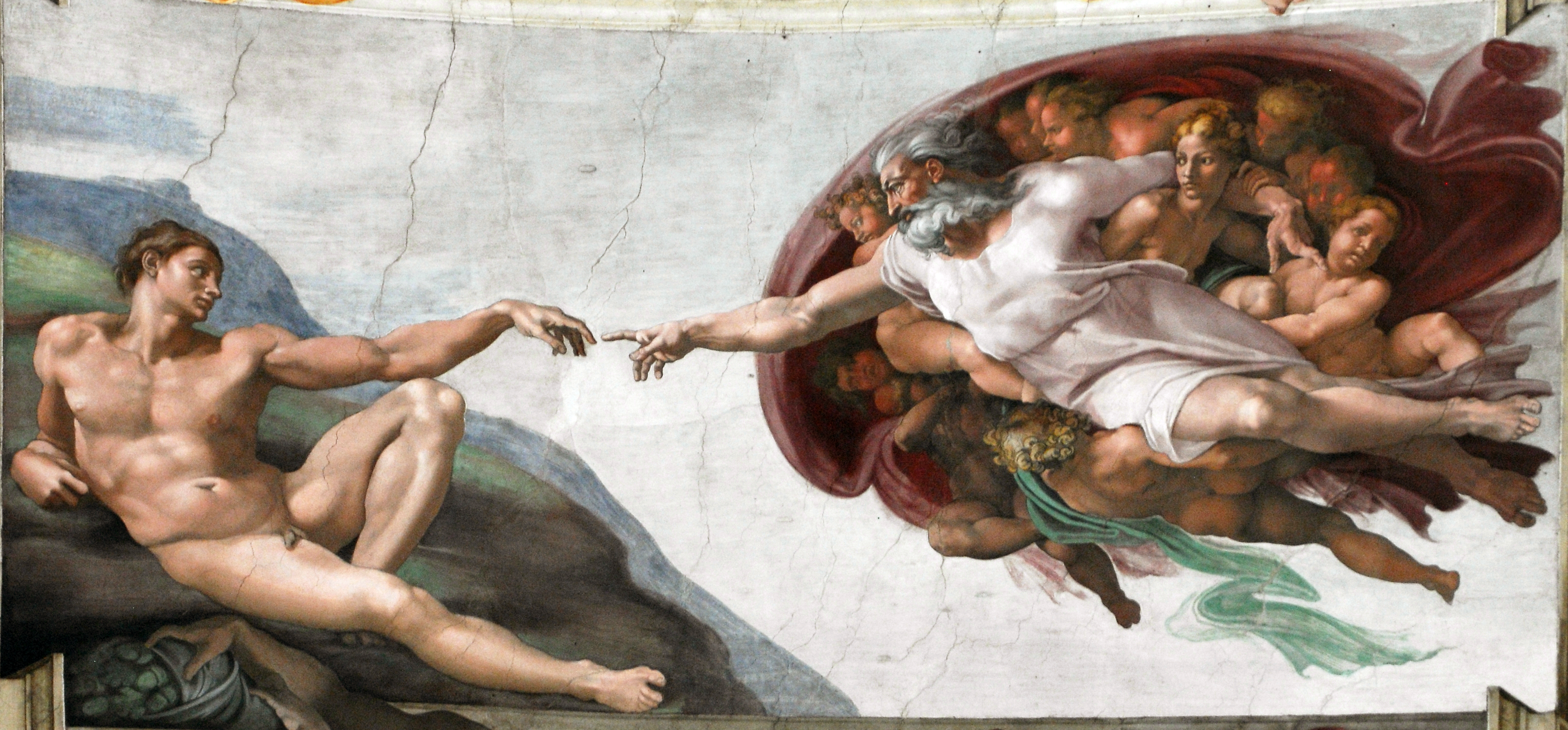
God2-Sistine_Chapel

Wikipedia tells us that Michelangelo’s Creation of Adam, found in the center panel of the ceiling of the Sistine Chapel, is rivaled only by the Mona Lisa as a famed piece of art.  Michelangelo completed it in just three weeks in October of 1511, and since that time numerous theories on its meaning have been put forth.  I would only mention a few of the most common here.

Frequently noted are the mirrored images of Adam and God, which seem to underscore the biblical line of Adam being created in God’s image.  Noted as well is Adam’s relaxed state, juxtaposed to the purpose driven God and the strain of the accompanying wingless angels bearing him along.  Nearly every discussion will also mention the feminine figure in God’s embrace.  Some, given her longing look to Adam, view her as Eve who hasn’t got down to the ground just yet.  Others view her as the Virgin Mary, with the child beside her, on whom God’s hand is resting, being her son, the Christ.

Considerable thought has went into the velvet backdrop God and his traveling band are arriving in.  One interpretation sees the backdrop as nothing short of an actual womb, with the green dangling scarf being the umbilical cord which gave our newly created, ideal, and idle man his navel.  A second interpretation sees in the backdrop an anatomically correct representation of the human brain.  In this interpretation we find two main camps.  One sees this as suggesting we can find God via our intellect.  The other sees it as a subtle suggestion that God is the product of our own mind.

At the time of the writing of this blog, Michelangelo seems to have no further comment on the subject, which would be notable, I suppose, if not for the fact that he is dead.  Should he comment, the blog will make an appropriate note of it, though the reader would have likely heard about it elsewhere first.

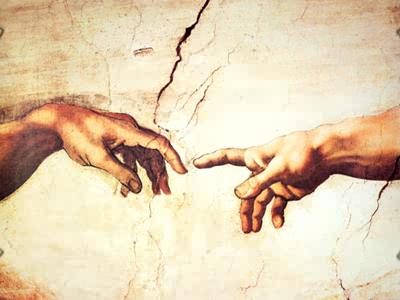
I became curious on the painting several years ago, when I was in a Des Moines office, and across from me, above the coffee table housing Newsweek, Time, and Sports Illustrated, was what I assumed to be an actual size reproduction of the painting, focusing solely on the two hands at its center.

Creation_of_Adam FingerI was already well aware that many felt this image from the larger panel had captured the intimate closeness of the human and divine, close but not quite touching.  In that office, however, being occupied by this image instead of the magazines, I realized for the first time that the painting also suggests it doesn’t have to be that way.  It doesn’t appear to be God’s intent.  All our ancient ancestor had to do was snap out of his leisure for a moment and straighten out his finger.  Instead, Adam, relaxed and taking it day by day, is about to miss taking advantage of the moment.

The common interpretation of the painting says that God is reaching out, about to give Adam the spark of life.  I am hardly an expert, but it appears to me Adam is already alive.  I wonder who the first one was to suggest that, all those centuries ago?  Someone should have told him to stick a sock in it, assuming they had socks in Michelangelo’s time.

Michelangelo seems to be representing the purpose driven fullness of the divine, and man not acquiring it because he prefers instead to lounge around on his ass.  Today we have many things to make this experience more enjoyable.  Michelangelo didn’t.  Poor guy painted the Sistine Chapel on his ass just trying to pass the time.

Perhaps in 1511, Michelangelo noticed Adam’s progeny had not fallen far from the tree.  This would leave his commentary at the very least as much about man as God.  It’s likely we fell no further in the centuries since, though all the centuries from Adam on have at least introduced the concept of decency.  Today I lounge around on my ass watching football fully clothed mostly, laying there as the pinnacle of human breeding.

In another couple of weeks, Christmas will be here.  Another of the noted days when God again extended himself to man.  I suppose he probably does it every day.  Maybe we ought to try to poke a finger back sometime; when there isn’t a football game on of course.

Something Old but New Again

Sometimes we are tempted to think our grandparents knew all the secrets we haven’t figured out yet.  So we bestow on them reverence, as though they had an understanding which surpassed our own.  We neglect to account for the fact that when our grandparents knew it, it wasn’t a secret yet.

This past summer I did something I hadn’t done in a long time.  Truth be told, I may have never done it at all.  I wrote letters, actual letters, letters which bore my own chicken scratches, that were sealed in an envelope, which was plastered with a stamp and then sent to roam half the world and half its people till it found the one I meant it for, in whom I hoped it may find approval.

The technology is centuries old and as amazing now as it was then, if you want to take the time to think about it.

The real marvel, however, the most pertinent thing which escapes us and our technology of today, is what takes place once the letter finds the addressee.  Opening it, they find a little part of whoever it was that sent it.  For the sender this part had aged for several days and had gotten old, but half way around the world this old self becomes new again in the eyes of another.  For a moment, two different versions of ourselves exist in two different places at the exact same time.

Somehow in all the world, a letter found them, and my old self was made new again and got a second chance to do some good.  I hope it did.

This has been replaced by the celebrated technology of today, which gives us instead the remarkable ability to be the same old ass in two different places at the exact same time.

A Church of Sorts

Growing up near a rural town in Iowa, one discovers the only other things more than a couple of stories tall besides the water tower are church steeples and grain elevator legs. When I was married in one of the former, I was working in one of the latter. The elevator is called BB&P, and sits on the north side of Winterset. In planning the slide show for the wedding, my wife to be came across a picture of me at the age of three, donning a seed cap and a bright red jacket, both with a checkerboard logo and the embroidered name of the elevator I would come to work for. “That’s so going in,” she said.

It was at this time that I began to wonder if I had been indoctrinated at an early age into a church of sorts with a grain leg for a bell tower. While some may think that sacrilege, my intent is not to offend.  I can only say upon reflection several similarities have emerged.

My earliest memory of the place was my sisters and I filing in the door to be greeted by one of the owners, Dean Molln. “You guys look thirsty,” he astutely observed and began to fish into his pocket to find the quarter the pop machine required. I might have been five or six at the time, and over the coming years this scene would be played out repeatedly. One would hear the click of the button, then the subsequent hum of the machine, and finally the loud “clunk” as the bottle came home.  Dean would pop the top off, give it to my youngest sister, and we would all pass it around.

The taste was wonderful; the bottle ice cold and dripping in what I now recognize as nostalgia itself. That, I suppose, was my baptism. Not by Holy Water, but instead by an ice cold Coca-Cola from a blue and white Pepsi baptismal font. All of it was much to the pleasure of our smiling parish priest of sorts, a priest could have taught the rest of them a thing or two about telling good jokes and cussing properly.

Inside the door today, as has been for decades, a long countertop nearly spans the length of the room. Across that countertop homilies are frequently offered on our current state of affairs, from political candidates and pending legislation to anything of note form the newspaper, TV, or radio. (Quieter ones are sometimes offered by patrons on more local affairs.) A solution to many of the world’s problems has likely been stumbled upon several times, but seeing how no one is in a position to implement it, it is left to be stumbled upon again.  The dead are eulogized, often more candidly than during the service. The crop is declared damned, then saved, and then damned and saved again, and rain is asked to come or go.

My first communion took place across this counter, just after I had pulled my shaky leg off the clutch pedal, having brought my first load of grain successfully into town. In doing so I crossed the scale, which leveled me with all others.  A couple of years later, at my confirmation, I was able to sell grain and make purchases on my own accord.

Incense was often part of the daily service here, before state law forbid it. On special occasions, like at the end of a long day, the completion of a hard job, or just before the undertaking of something no one wanted to do, it wasn’t uncommon to come in the back door and find Bob Rhodes with his pipe, and Jim Cook, Nick Beck, and Larry Molln (another owner) with their cigarettes. There was so much smoke in the air, it was impossible not to feel a sense of reverence as they were lost deep in the midst of their meditations.

Now off to the right of the main office, across the red and white checkerboard floor, is the mill room. In there one can find Mike Corkrean or Gary Dudney spinning the wheels, pushing the pedals, pulling the cables and turning the chains necessary to bring the hammer mill and mixer whirring to life. Many a boy has stood in there, as much in awe of the factory of motion and sound as though it were a grand pipe organ. I would suppose there are organists to which the whirr of the hammer mill is preferable, but none were ever coated in the residue their notes left behind.

In the back right corner is Paul Bruett’s office, the elevator’s agronomist. He handles seed sales, and does his best to exorcize any blight, deficiency, or petulance that afflicts the crop.

In the back left corner, down the hall, first door on you right is the accountant’s office. In it Pam McCullough sends out the monthly tithing request and takes in whatever offerings the congregation has for the moment.

The first door on your left is Bob and Peggy Casper’s office, also owners. While it is very much the working office, with mail coming in or going out, records kept on file, and situations being handled as they arise, it also has a secondary purpose. It’s where you come to confess your best laid plans did in fact go a rye. Your penance is nearly always another year of trying it again.

Finally, on the left of the counter is a small shop of sorts. There everything broken is mended. I wouldn’t be surprised if Lazarus himself steps out of it someday.

Marriages? Oh there are marriages. Some employees have never known another job, others had, but after finding this one have stuck with it for decades, Yes, over the years there have been a few divorces. Some were amicable, some not. Some quiet, and others filled with all sorts of fireworks.

All that is missing, I suppose, is the altar boys. I’m afraid even I can’t compare the guys at the shop to altar boys. I would admit, though, they could give them one hell of an education.

The door is nearly always open. The families of the men that work here sometime have Thanksgiving in the evening because the day was spent hauling anhydrous to the customers, or unloading grain. Employees work those days because the owners work those days, and you forget about what you’re sacrificing when you see the sacrifice of another. It’s not done to make every last dollar, but in order that customers may not know need. That has allowed the business to know a lot of customers.

One day I was getting lunch in town. The woman ahead of me, with her young son, turned and asked, “You work at BB&P, don’t you?”

“Yes,” I said.

She continued, “This one’s first word was tractor,” pointing towards her son, “and his second word was BB&P. None of my family knew what the hell he was talking about, but my husband’s sure did.”

I smiled and thought of how another one had been brought into the fold.

So is it a religion then? Of course not. But it is something, I suppose.

The Snow

Who was it that said the snow should fall upon the ground,
as it lay barren and lifeless in the winter time?

The ground does not mind the freeze.
It hurts it not, but breaks and heaves it,
so it might be softer in the spring.

Instead, over the tears of a cup of coffee,
Or the unvoiced fears of a friend,
In finding the lonely with all of their company,
And those finished before they start again,

Frozen, I think, we just get harder
and less receptive to the spring,
more unwilling to let establish
whatever might that season bring.

Let the ground lie cold and naked.
Our being hard is not a virtue;
let the snow blanket us instead.

Who was it that said the snow should fall upon the ground,
as it lay barren and lifeless in the winter time?

Getting Your Shit Together

Sometime ago I started with the goal of trying to write once a week.  On occasion I do not, but generally I have been able to adhere to it.  This week I nearly missed.

The goal had a simple premise behind it:  we should spend our lives doing what we enjoy, that if we are not careful we won’t, and we will find it all slipped away.  Surely I could come up with something human to write about once a week, I thought.  Surely being human is a common experience.

It isn’t, though, and that’s the funny thing.  We tend to hide what most makes us human.  None of us hides it perfectly, and an observer sometimes finds a glance, or movement, or word from us which lets them slip in without our knowing.  These are the moments we try to capture in our photographs, and our writing, and our art.

In these instances the creator generally works to cover it back up again, leaving it to find for those with the eyes to see or ears to hear.  They avoid giving it away for nothing, and maintain respect for whatever it was someone was trying to hide in the first place.

When I wrote about fall in Northeast Iowa, for example, it was about my fear of my father’s declining health.  I tried to get death to subtly work its way in and out of the piece in the topics of divorce, and autumn, and the effigy mounds, not being able to get up the hill, etc.  I took the topics I couldn’t touch on with those closest to me and found a way to share them with anybody and their brother.

I never could quite get it right, but it still lays out there, to take up and edit again, and that’s the wonderful thing about writing.  Most of the words I have said failed when they left my mouth, and the ones I should have used always come to me after the moment has passed.  In the ones I write lie the hope that someday I’ll get ones in the right place at the right time.

A couple of days later, Dad was back up on his feet again, and I was off on other topics.  If I don’t watch it, the piece will get away from me, and Dad will too.

Now on occasion we run into people not playing the same game the rest of us are.  They feel no need to make it look like everything is under control.  Or if they feel that need for everyone else, for some strange reason they don’t feel they have to with you.  I ran into one this week.  The subtle hints were gone, and I was hit over the head with what it was like to be human.

In doing so it stripped away my own subtly, my dry wit and confidence and left in their wake the anxious little boy of my youth, naked and knobby kneed.  I was embarrassed and I was certain I’d be abandoned for it.  I wasn’t.  The boy I couldn’t accept, they accepted just fine.  I hope I had done the same for them.

It should be so rare in life, and if it wasn’t, it wouldn’t have felt so remarkable.

Typically I write the words I’ve paid a price for.  But the only price for these was a little embarrassment, and what I got in return was far more valuable.  I had got the better end of the deal, and for that I owe.

It seems the only way to pay the debt is to do it for someone else, and that advice I offer freely to anybody and their brother.

“Life is messy,” they said.  Yes, and sometimes our maintaining it isn’t only makes it worse.  We miss out on all the good things that come from getting caught not having our shit together.

The Tree in Your Yard

Tree at my window, window tree,

My sash is lowered when night comes on;

But let there never be curtain drawn

Between you and me.


Vague dream head lifted out of the ground,

And thing next most diffuse to cloud,

Not all your light tongues talking aloud

Could be profound.


But tree, I have seen you taken and tossed,

And if you have seen me when I slept,

You have seen me when I was taken and swept

And all but lost.


The day should put our heads together,

Fate had her imagination about her,

Your head so much concerned with outer,

Mine with inner, weather.


Tree at my Window  -Robert Frost

At one time, while this place was still being settled, people would plant trees in their yard. They say it was for the shade mostly, but seldom have I ever seen anyone sitting in the shade of the tree in their yard. I suspect it was to make a new home homier, for a tree is nearly as fine a thing to come home to as a house is.

Some people still plant trees, but the country is settled now. The existing ones go along with the houses they are attached too. Whatever dreams were to have taken root with them, whatever hopes and longings, they are now simply included in the purchase price. “Thrown in” as they say, given the fact that they never impact the price in the least. It seems the highest hopes and the highest dreams trade at the same rate as the lowest of them.

All our hopes and dreams appear to be of equal value. If not to us, then to the next ones.

One evening last week I got home in time to take my daily hike to the mail box and see if I got anything of note beyond the political mailings, limited time offers, and bills the day typically offers. I had not. I seldom do. I thought of taking the mailbox down altogether but then thought I might get something of note someday. So I left it up. As I walked back, I glanced at the oak in the corner of my yard.

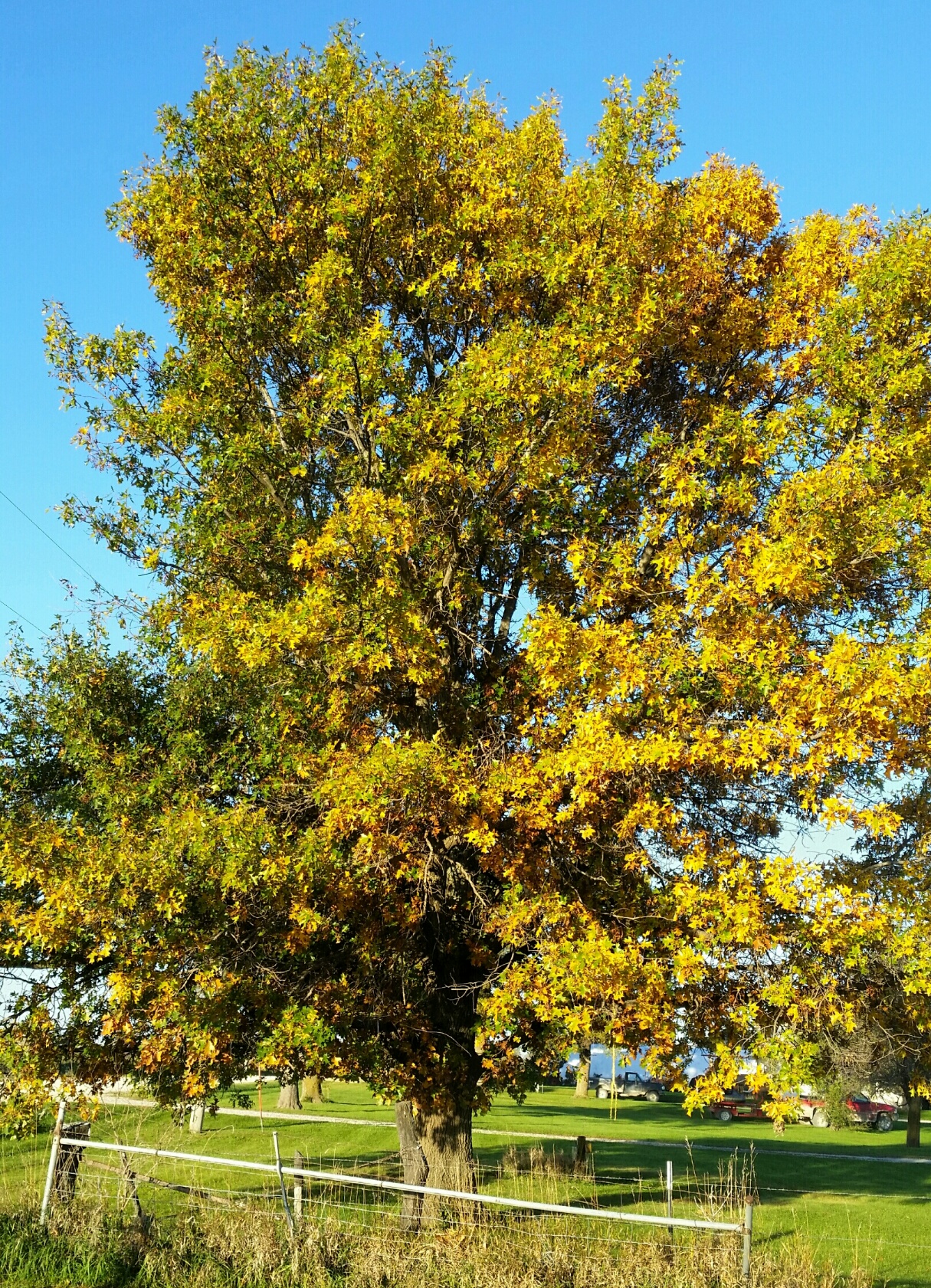
There, in the light of the early evening, I found half the tree a magnificent gold and speckled in green. The other half was a dark, somber green speckled in yellow. It seems the tree was at odds with itself on whether to embrace the current season upon us, or hold on to the summer that had passed. I too get at odds with myself on such matters, and think I might make a fine tree someday. That is if one should someday take me up and relieve me of being part of the plain, ordinary grass.

I wouldn’t help its value none, but I wouldn’t hinder it either, I suppose.

2014-10-23_07.26.21_resized_1

Taken the next morning, and already decidedly more yellow.

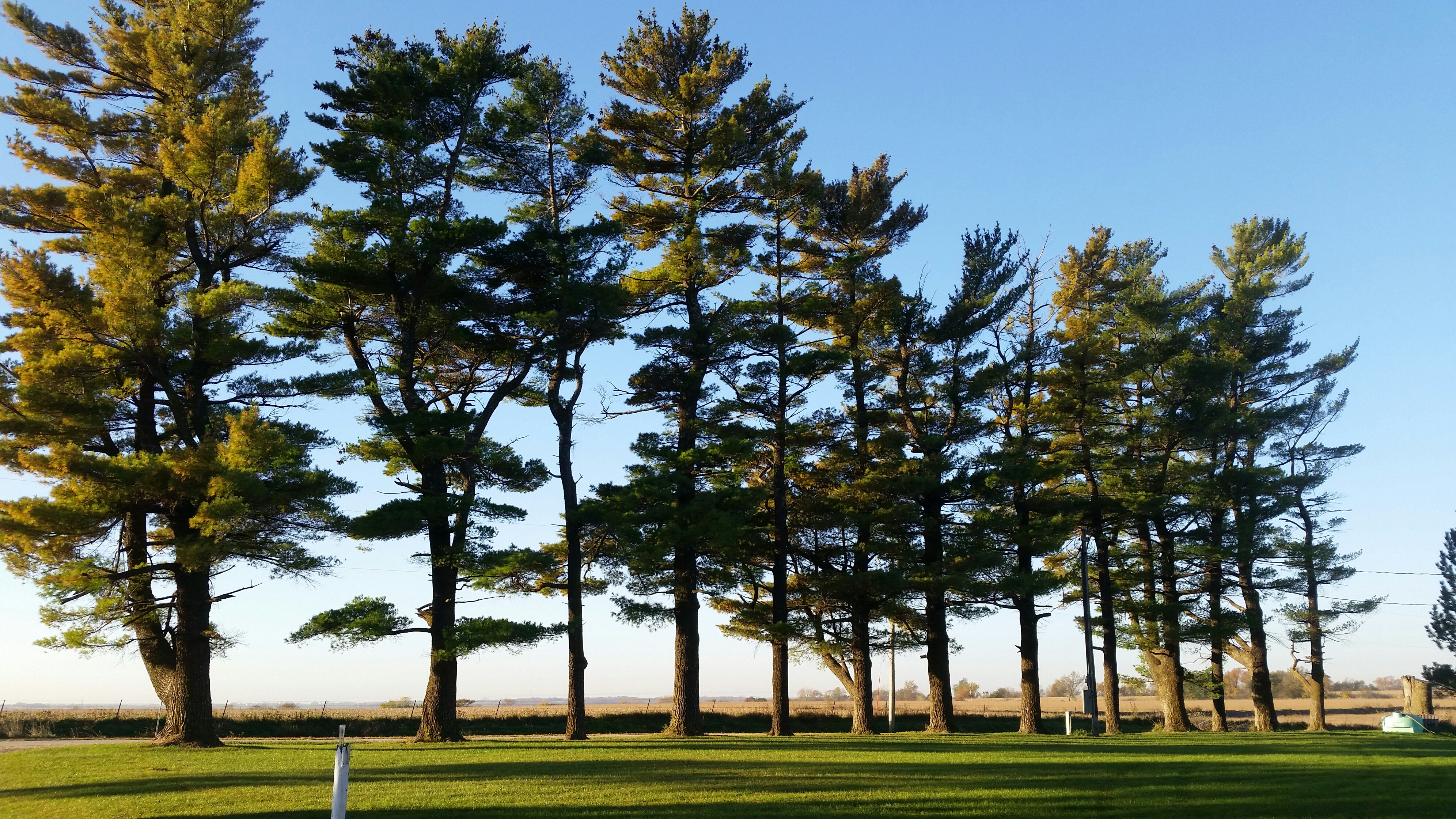
Across the way, at my parent’s home, stand a row of pine which witnessed the rise and fall of the family that planted them, and still hang around, ever green, for whatever it is that will happen next. Not being native, they shed a few needles in the fall and make an attempt to fit in. This is the tree equivalent to crocodile tears, however, and as winter arrives and their neighbors disrobe, revealing the spindly and knotted nature their leaves had been concealing, the pine attempts to keep its dignity.

Planted by the Breen family around 1885.  They were to have had an abundance of potatoes in their cellar, and so they threw a few in the bottom of each hole.

Planted by the Breen family around 1885. They were to have had an abundance of potatoes in their cellar, and so they threw a few in the bottom of each hole.

It keeps so much of it, though, at times it looks down right gaudy. In trying to maintain dignity’s appearance, it forsakes most of it. This not unlike the new neighbor, coming over and partaking in your Busch Light, only for you to visit him one day and find his fridge stocked with various micro brews.

In my yard, though, sat a red oak. This is the tree which keeps its dignity. Its leaves would turn, even if half of them didn’t know it yet, and what will happen when they do gives the oak the dignity denied the pine. Instead of discarding the old, dried out remembrances of what was, the red oak keeps clothed in them until it catches a glimpse of spring. It neither throws what happened to the wind, nor maintain a false green countenance to suggest nothing did.

This particular tree was planted in 1975, when my grandfather and grandmother built a new home, leaving the old to Mom and Dad so they would have a house big enough to raise a family in. During the drought of 1977, it seemed the tree had died, but in three shoots showed up at its base in the spring of 1978. The new shoots became small talk between my Dad and Grandfather as the latter battled cancer.

“You should pick the strongest one,” he told my father, and so my father did.

I suspect the other two’s leaves would have been as much at odds as this one’s was, and I suspect they would linger just as long as this one’s will. What then was it that made this one the strongest? I don’t know, and no one will ever price it.

Noah and Jonah Walk into a Bar (Part One)

Charlie was 12, and while his father waited at the top of the stoop, outside the large, dark door of St. Martins, Charles was content to stand in the grass. The church sat in the middle of downtown. On either side of it were four lanes of traffic, four headed north and four headed south. Together the church campus and the streets served to create an opening among the downtown buildings, allowing the young Charles a view north to an unobstructed sky.

It was a hot July day, and while the sky directly north of him was blue and cloudless, a large line of storms were beginning to fire. He could see thunderheads quickly billowing on either side of the clear patch ahead of him, poking out from the tall buildings of the downtown skyline which framed his view. Down the backside of the west thunderhead glimmered a shimmering silver sprung from the sun behind it, as though a lightning bolt had got caught and hung along its edge. The upper reaches of the east cloud were in full sunlight.

The boy stood fascinated by the scene before him and took it all in, the expansion, the juxtaposition of the light and dark, and the absence of all in the clear blue expanse at the center. In the seconds before the door opened, his father, Francis, turned to look at him, saw where his son’s gaze was, and had his eyes join in. As they did, they were drawn further and further in, until they became focused solely on the mad billowing of the clouds.

How unearthly, he thought. It hardly looks real.

Yet he knew it was real, and that the realness of it had been present many times.  And many times had he neglected to take the time to look.

“Hello, Red,” said the aged priest as the door swung open and Francis turned back to where it used to be. “I see you’ve brought someone along with you. Hello, Charles.”

The boy was small for his age. He wore glasses, and though they were wire rimmed, it still looked like his ears would fail under their pressure and send them slipping down the long, slender slope of his nose. The priest may have called him Charles, but his father still called him Charlie. His mother called him seldom, though frequently, when she did, she had been drinking.

His mother had drank for as long as he could remember, and he knew if he could remember back farther she be drinking even then.

“Well come on in, Charles. I just got done with Wednesday evening mass. I’m about talked out by now, perhaps you could do some of it for me. How old are you?”

“Twelve.”

“I should think a young man of twelve would have all kinds of things to talk about. We will be just fine, Red. I’ll see you in an hour.”

Along one end of the sacristy ran an old church pew and drawn up next to it was an old dining room chair with a cane seat. Tom chose the pew, and the priest chose the other.

“Did your father tell you why he wanted us to talk, Charlie?”

“Yes. He wants me to talk to you about my mother.”

“Do you want to talk about your mother?”

The boy shrugged his shoulders and looked at his shoes. “Yes. We could, I suppose.”

“Yes, well if you want to talk to me about your mother, then you should think of talking to me as talking to a friend, Charlie. Someday I might be that to you, if you wanted. Of course there are people who think all priests ought to be their friends. They forget we are just like everyone else.” Then, after pausing and looking over his shoulder, he dryly added with a wink, “There’s even one or two I can’t stand myself.”

Charles smiled. So did the old man.

“I might give you my thoughts as we go along, but they are only my thoughts, Charles. You’ll find it’s the tendency of the old to give their thoughts to the young. I don’t know what we do it for. I figure at my age I’ve wore them all out, and what good are old, worn out thoughts? Perhaps they will fit together with yours, or perhaps they’ll just fall straight out of my mouth to the floor. It’s of no matter.  The latter has happened many times, quite a few of them have been right back here.  I suspect the floor is used to it by now.

As we go along, I want you to remember one thing. If things seem particularly overwhelming, or difficult for you to make sense of, there are others you can talk to who might be better able to relate to a young man of your age, than this old man, who’s never been married and has no children of his own.”

At that remark Charles looked back up at the slate blue eyes across from him and dropped down to the square jaw sitting just above the white collar. The mouth above it, which had been parallel to this jaw, broke into a slight smile. Charles smiled a second time.

“If you decided you want to talk to someone like a therapist, someone who has training in these matters, I can help you with that. There is no shame in it, and I know some good ones.”

“Okay.”

“Well then, Charlie, tell me, why did your father feel you and I should speak?”

“It’s not much of a story really. Last Monday I was supposed to spend the afternoon with Mom. Dad was there when she came for me, and he thought he could smell that she had been drinking. He apologized, but told her that I couldn’t go with her. She asked why not, and Dad told her and said it wouldn’t be safe for me to get in the car.”

“Was your father angry?”

“No. He said it all in his very matter of fact way.”

“How did your mother respond?”

“She’s the one that got angry. She said it was her time to see me, and Dad was just making an excuse so she couldn’t. Dad invited her to spend the time at our house, and she said he had lost his mind if he thought she was ever going to step back in there again. Dad said he wasn’t denying her the opportunity to see me, but he wasn’t going to let me to get into a car with her. Anyway it ended with Mom saying if he didn’t let me go she was going to call the police.”

“Did she?”

“Yes.”

“What happened next?”

“They wound up arresting her in the driveway for drunk driving.”

“Not exactly how your mother envisioned things, I suppose.”

Again he saw the corner of his mouth lift into a slight smile, but Charlie didn’t return it.

“No.”

“Have you spoke with your mother since?”

“Yes.”

“Did the two of you talk about what happened?” Charles nodded. “What did she tell you?”

“She told me the cops didn’t know what they were doing and how they had just taken Dad’s word for everything. She said she had hired a lawyer, and somebody was going to have to pay for all of this.”

“I see. Well, what do you think of all of that?”

“I guess I wouldn’t expect her to say anything different, Father.”

“And the rest of it? How do you feel about that?”

“I didn’t want to go anyway, Father.  As far as the rest of it, I wish a lot of things were different.”

“Well there is no problem with that, Charles. Do you think your mother might feel the same way?”

“No. It’s what she wants.”

“Are you sure about that, Charles?”

“Yes. It’s been like this forever.”

“Hmm. Sometime I need to tell you about all the horrible parts about me that have been that way forever too.”

“But you are a priest.”

“There you go, Charlie, thinking we are different than everyone else. Do you know who the first drinker in the Bible was?”

“No.”

“Noah.”

“Noah?”

“Noah. He gathers everyone and everything up, gets them on the boat, and sails and sails until he hits dry land, never once questioning God. The boat must have smelled like a zoo, and why that never drove him to drink is beyond me,” said the priest with a twinkle in his eye.

“What drove him to drink then?”

“The Bible doesn’t exactly say. Some speculate he was wondering whether or not he was any different than all of those men, women, and children who drowned. Personally, I think that is a compliment to old Noah. Usually we reassure ourselves of our own righteousness, don’t you think?

As I said, the Bible doesn’t mention Noah’s thoughts on this, but it does mention another story right before his drinking.”

“What story is that, Father?”

“Well the author tells us that God had already decided in His heart never to destroy the world again, but our man Noah doesn’t know that. All God tells Noah is that He won’t do it by a flood again, and then He adds that as a sign He will place His war bow in the sky to serve as a reminder.

It had to have been unsettling to Noah to think God would need a reminder. More unsettling was that the reminder, a rainbow, only comes once the rain is over. And more unsettling still is the fact that some translations seem to have God saying to Noah, ‘Oops.’ God seems to be having a little fun at Noah’s expense. Noah fails to see the humor in it.

What do you think Noah wanted?”

“What we all want, I suppose.  A better promise and perhaps a better justification for what had happened.”

“A promise about what?”

“About what the future will be like and that what had happened in the past won’t happen again. We all want that, Charles, and more often than not, we are all denied it. As near as I can tell, that can drive good people to drink.”

“Well it’s wrong, Father.”

“Charlie, I’ve heard a lot of confessions back here in my time, an untold number. Many confess the same things over and over again all the time I’ve been here.”

“Well they need to quit doing whatever it is that they are doing, Father.”

“You’ll find out it’s harder than it looks. But you are right, they haven’t, but they know it. It bugs the hell out of them.  God bless them, Charlie. They’ve taken the terms “right and wrong” and instead of applying them to others, they applied them to themselves.

Do you know what ‘relativism’ is Charles?  They say it is the thought that there is no right and a wrong anymore. I wonder if that is any less relative than all the time we have spent using the actions of others to define those terms for us? We’ve been doing that for years, I think, and the Pharisees for years before us.

Now you think you know what’s in your mother’s heart, and that this gives you license to judge her. I’ve never spoken with your mother, but my experience, back here in this room, is that rarely do we know what lies locked up in the heart of another. In that light, perhaps we ought to have some compassion for old Noah, ‘the only righteous man of his time,’ the Bible tell us, and perhaps we could find some for your mother.”

“But there is wrong, Father.”

“Oh most assuredly, Charles. There is wrong.  Sometimes I think that’s what the other great sea story of the Bible is about. You may think your mother is hell on wheels, Charles, but she’s got nothing on the old Assyrians.”

Fall in Northeast Iowa (Complete with an Artist’s Interpretation)

“The gentle reader will never, never know what a consummate ass he can become until he goes abroad. I speak now, of course, in the supposition that the gentle reader has not been abroad, and therefore is not already a consummate ass. If the case be otherwise, I beg his pardon and extend to him the cordial hand of fellowship and call him brother.”   -Mark Twain

This past Sunday my mother and her sisters were down in Missouri, visiting extended family. I had read, someplace, that it was now peak season to see the leaves in Northeast Iowa. I had been up there before, on a similar trip, when I was married. A few years later we got divorced. I hoped for better results this time.

Now when I travel to see the leaves in Northeast Iowa, it generally places me in proximity to a couple groups of people I disdain. The first are those who drive around in cars with bikes attached to them. These people must be terribly poor at making up their minds.  Perhaps they are first cousins to those I see in the grocery store wearing exercise clothes.

They are not to be confused with those driving around with canoes on top of their cars. While they can be annoying too, I chalk this latter group up to those the Almighty has either blessed with an abundance of prudence or cursed with a particularly acute fear of water. The best I can muster for those in cars with bikes is either that they haven’t gotten around to fixing the fuel gauge or their spare.

The second group falls under the mantle of the term “bird watchers.” I’ve nothing against actual bird watchers, mind you, but I would be surprised if we apply the term accurately to any more than one out of ten. This leaves the other nine armed with all the tools of the trade required to be a peeping Tom, and us having disarmed our suspicions, at least until now.

Particularly troubling is that I’ve yet to meet anyone that can tell difference. Since we can’t tell which is which, it seems the only natural thing to do is to let the Big Guy sort it out. This same thinking has given rise to Crusades and Indian Wars, and it is my hope I should live long enough to see the Gates of Hell unleash its fury once more on anyone dressed outdoorsy like with binoculars around their neck or a camera with a lens big enough to need its own case.

You may object, and that is your right, but tread softly, gentle reader. You tread on my dreams.

Now a fine gateway to any such trip in Northeast Iowa is to see the mill on the Wapsipinicon in Independence. It sits smack dab in the middle of town, stands several stories high, and lies up against the bridge on the main thoroughfare.  This is where we started, but given that I had a better mill in mind, I passed on a picture.

Downstream, towards the town of Quasqueton, is Frank Lloyd Wright’s Cedar Rock. It is a beautiful home sitting in the trees on the bank of the river. Dad and I had each seen it a couple of times and decided against another.  I mention it, though, because there I first became familiar with the legend of how the Wapsipinicon got its name.

The legend tells of Wapsi, a young Indian brave, stumbling upon and falling in love with the daughter of another tribe’s chief. Her name—you guessed it—was Pinicon, and the star-crossed lovers soon made plans to elope. (The next tribe west had a Justice of the Peace, whom looked remarkably like Elvis.) Their respective tribes, realizing they were gone, soon gave chase.

Coming to the banks of the river, the lovers clasped hands, kissed, leapt, and subsequently drowned because neither had a car sporting a canoe on top of it.   I truth, I don’t think they were lovers at all. I think they got caught bird watching.

We made our way through Strawberry Point, and headed up to the town of Elkader, which sits nestled on the banks of the Turkey River. Outside of town was the mill I was most anxious to see, and after a few miles of gravel we finally found it. Parked by it was the customary Subaru with two canoes on top.

Motor Mill2

We turned our sights as far northeast as we could go and traveled to the armpit of Iowa, New Albion. This is not to be confused with Albion, which we had already driven through coming past Marshalltown. In my opinion, when comparing the two, that to term this one “new” was stretching it. They sported a slogan of some sort or other.  Seeing that it did not mention “armpit,” I paid no attention to it. Its omission, combined with their use of the adjective “new,” told me all I needed to know about them. Old Albion was full of liars.

South of Albion lies Lansing. Lansing sports a bridge across the Mississippi. Dad and I stopped along the road, pondering what exactly it was that kept the bridge from falling into the Mississippi. We had been studying it for several minutes when I noticed that behind us, looking out over the river, was a bar. In one window I could see an elderly local, quietly drinking his beer and looking at the same bridge we were.

Lansing Bridge

I figured if he’d been looking at it his whole life and hadn’t come up with anything yet, we were not bound to fare any better, and so we continued on to Effigy Mounds National Monument.

It’s about a mile walk to get from the visitor’s center, up the steep bluff, and to the first substantial mound. Dad didn’t figure he could make it, but encouraged me to go ahead. Part way up, I wasn’t sure I was going to make it either, but I did my best not to make a scene about it and quietly restrained my huffing and puffing whenever I happened upon someone else going up or down.  That is until I passed a guy in a winter coat with gloves on.  It was 52 degrees, and I figured I, huffing and puffing, could look like no more of an ass than he did.

The first thing of interest I came to was this:

Bladdernut

There had been several signs noting the various plants and trees along the way and what the Native Americans had used them for. Now they were noting the ones the Native Americans had no use of. There are going to be a lot of signs, I thought. Seeing the name of the plant, I wondered if it wasn’t a clue as to the natives’ lack of interest. I could offer a guess on what the fruit of the bladdernut might taste like. In fact I could offer two particularly good ones.

On the way to the top, I’d meet kids running ahead on their way down. I would smile and later offer their parents a “hello,” “look like you’ve got your hands full,” or “I had them clocked at 55, and they were still gaining.” Occasionally I would meet other families a little more anxious, warily clutching their children’s hands. To them I said, “It’s all right; I’ve no binoculars. I’m not a bird watcher.”

If you are not familiar with the mounds, they were built by the Native Americans. The National Monument to them is just outside of Marquette and right above the Mississippi. Some of the mounds have animal shapes, and the first one you come to is that of a little bear, maybe 45 feet long.

I call it a bear because the sign said it was a bear.  I am convinced were they to mow the grass a different way they could just easily claim it was anything from a tortoise to a kangaroo. Still, they said it was a bear, and I didn’t see how believing them was going to cost my anything; so I did.

Right behind Little Bear Mound, even with his feet, you’ll note the appearance of a second mound. This one has no name, but given its location I thought of a couple.  Both were based on whatever I suspected the bear had consumed as his last meal. My best guess is that Bob the Brave was buried in that little mound, and the bear that ate him was in the first. That’s because I don’t believe these mounds are as shrouded in mystery as our more learned scholars.  It’s my belief their purpose was quite simple.

“Suzy, don’t you remember what I told you about bears? You don’t want to wind up like Bob the Brave do you? Do I need to take you up on the bluff again?”

As I continued along the trail, I soon found I wasn’t the only one offering interpretations. On my way to the scenic overlook, I passed the first interpretive sign. It told about the native builders and referenced the image above the words by saying: “This is an artist’s depiction of what they may have looked like.”

As I walked on, I thought to myself how we use the term “artist” as though it gives the depiction greater objectivity. In reality what they did was go to an individual whom was well known to be predisposed with an over-active imagination and said, “Draw us a picture.” Any thought to the contrary was quickly dispelled when I reached the next sign, pictured below.

The Dead

The particular sign is an artist’s depiction of a tribal burial. What caught my immediate attention, of course, were the bare breasted women dumping dirt over the deceased.  I also noted a hint of a smile on his face. There are many things I think the Native Americans were ahead of us on, and after viewing the above artist’s depiction, I added their concept of proper burials to the list.  In fact, I placed it near the top.

When I returned to the car, I was going to tell Dad what all I had seen, but wound up keeping it to myself.  He’d never believe it, I thought.

Since Prairie Du Chien was just across the river, we ran over to stake claim on a couple of six packs of Spotted Cow beer, one for me and one for my mother. I was looking for the first place that might sell beer, when we passed a liquor store that had a sign out front claiming over 500 different wines. The store was called Stark’s Sport Shop, and when I went in I was greeted by the 500 kinds of wine, a liquor sectioned that dwarfed the wine section, a cooler from which I selected my beer, rows of lures, fishing poles, ammo, guns, sausage, pickled eggs, and cheese curds. There was a line of ten people waiting for one of two cash registers, and as quickly as one sale rang up, someone else took their place.

“You guys always this busy?” I asked.

“You think this is something, you should have been in here yesterday.”

I didn’t know if I would be able to leave such a den of manhood, but I pulled myself together and wept my way back to the car. Had they sold lazy boys and big screens, I probably would have filled out an application.

Spotted Cow

We crossed back over and continued down through McGregor, which is the closest thing Iowa might have to Deadwood. We stopped at Pike’s Peak State Park, named for Zebulon Pike, the same early explorer Colorado Pike’s Peak is named after. In 1805 he identified the site as an excellent spot for a fort.  They built it in Prairie Du Chien instead. It’s hard to compete against a place selling guns, liquor, fishing supplies, and pickled eggs.

A couple of years later he headed for Colorado on horseback. I have it on good account that he had a jackass strapped across the back of it. It’s a shame. I could have understood a dugout canoe.

Pike’s Peak looks out onto where the Wisconsin River enters the Mississippi. It was there that Louis Joliet and Father James Marquette became the first white men to set their eyes on the Mississippi.

Pikes Peak

The Wisconsin River runs along the bluff on the right side of the picture.

Our final stop was Balltown, where we ate at Brietbach’s Country Dining, Iowa’s oldest restaurant and bar. How it maintains this designation is unknown to me. The original owners were not named Brietbach, and the original building burnt to the ground in 2007. Ten months later it did so again. It seems they change their restaurant as frequently as the oak changes its leaves.

The thought that the designation of ‘oldest’ needed neither permanent establishment nor name, let my thoughts naturally wander to ancient Adam. He was separated from me by more names than even the Bible could inventory. Each one of those names was on a building which sprang up and was gone, only to have a new one take its place. If I was eating in Iowa’s oldest bar, I was doing so as the oldest man alive.

Jonah in the Countryside

For the last two weeks I guess I have had a case of writer’s block. I’ll sit down to write, and partly do so, but soon discover a hour and half has passed by and the only thing I’ve really done is move some sentences around and change the order the paragraphs are in. The accomplishments of the following evening are generally confined to moving everything back. The feeling has a claustrophobic quality to it, but it is a rainy morning, and so I’ll try again.

Somewhere I had seen the sentence, “It’s a blessing and curse to feel things so very deeply.” I had been thinking of my grandfather, John Walker, and for whatever reason linked that quote to him. In such regard I have started and stopped a hundred times, a few on a computer screen but most in my mind.

My grandfather was his family’s only son and would become its only male. His father skipped out never to be seen or heard from again, and in that regard he proved himself to be a true “Walker.” They say my grandmother, Margaret, would tell a story that while they were living in Cherokee a man stopped by the house one day asking for John. He wasn’t home, but she invited him to come back around later. He never did. She’d later remark she had a strong feeling it was his father, and that he bore a striking resemblance to him.

Whether it was or not, who knows? I do know we spend part of our life wondering who some of those closest to us are. I see nothing wrong with devoting a little speculation to who a stranger is.

My earliest memories of my grandfather find him seated at the end of grandmother’s long dining room table, with his elbow resting on it, his fingers straight up, and a lit cigarette between them.   He’d sit there in silence, thinking, while behind him, through the haze of smoke, a police scanner made intermittent noise. Occasionally he’d raise an objection about one thing or another, with grandmother replying, “Oh, hubba,” from the kitchen.

By this time he had worked long enough to retire twice. The first was from the railroad in Cherokee. The second was from Firestone Tire in Des Moines. The cigarettes would have been a companion to him at both places and at the latter one would have dangled from his lips while his hands were busy wrapping and unwrapping asbestos from the pipes he worked on. These pipes were his specialty, though from time to time he was asked to work on others.

There was a story that a toilet clogged in one of the restrooms at Firestone. My grandfather was asked to see what he could do to unplug it. Evidently, one could use air to back pressure the lines, and he did–using a great deal of it. The end result was that he blew two men through their stall doors and re-plastered the ceiling. I was inclined to think the story had some stretching done to it. But when my grandfather passed after my senior year of high school, I heard the story mentioned several times by his former coworkers during the visitation.

I don’t know why he smoked his first cigarette. There are all kinds of reasons to be allured to it. I remember a few myself, but once the habit is acquired I suppose there are only a couple which maintain it. For some it seems to calm their nerves, and for others it is a subtle form of defiance. The latter was the case with my grandfather.

They owned the house right next to Highland Park Funeral Home on Sixth Avenue. He was told by the banker when he borrowed the money that he’d never be able to pay it back. He did, and the same persistence that bought it refused to give in and sell it as the neighborhood lost its shine. While some of his coworkers succumbed to the asbestos they had handled in their job, he kept smoking his way to his mid-eighties, and he kept driving too.

Often they drove out to the farm, and he would take up residence on the porch swing or on a folding chair beneath the large cedar next to it, tucked away in the shade, smoking, and thinking. All these years later, I wonder what it was he was thinking about. All those years ago, I never thought of asking him.

There exists a concept of the “invested child,” which simply states that in any family one child is going to be more sensitive to the happenings within the family than the others. Generally, this child is the oldest or the youngest, the only child of a particular sex, or a child which had a heightened focus from the rest of the family (due to a health issue, for instance).

The claim is that this child feels things deeper and more intensely than the other children and has a harder time bringing the feelings to a state of resolution. They may elect to try and stumble their way through those feelings, or they may get bottled up in themselves. Either way, it can be more difficult for the invested child to “function” in the day to day activities of their contemporaries.

The unspoken assumption, of course, is that the day to day functioning of our contemporaries is what we should be striving for. I don’t believe the contemporaries will mind when I say that any proof of that I find circumstantial at best.

If he was an “invested child,” if from time to time he was locked up in his own thoughts, I also know there was something about him his contemporaries could readily relate to. I remember he would haul us as kids to the mall with my grandmother, and as we grew older our family would meet them in there. Grandma would go about her shopping while he found a place out in the open to sit and smoke. Never did we return to find him unaccompanied, instead he would be there, chatting away with whomever happened by, and as we left he would tell us about all those he had been talking to.

Somehow, more often than not, when we get that sense of loneliness, we wind up spending time with those who have an even better acquaintance with it. Many times we find them without even knowing their story at first.

The final few times he was out, on the porch or under the tree, I remember him with his loafers on, socks pushed down, pant legs pulled up, and his tired and swollen legs running between them. The cigarette now dangled between two fingers of a drooped hand, whose elbow was resting on a knee, as though the weight of the cigarette had finally worn them all out.

“Don’t get old, Danny. Don’t ever get old,” he spoke as he rubbed his legs. I remember him saying that as though it was yesterday, as though his defiance was finally starting to give out. I’m sure it will still seem like yesterday whenever tomorrow shows up. He had a gripe, and even I, who could only stand and watch from the perspective of uneducated youth, could see that there was validity to it.

He wasn’t the first man to sit in the shade with a gripe. The biblical Jonah did. I bet Jonah would have been smoking too, had he any cigarettes, but that is another story for another time. And while the fact that he married a woman from Faith, South Dakota, shouldn’t be a surprise, it too will have to wait.

The Walkers